
How do you find the mean of grouped data?
Answer in short
Replace each class by its class mark, the mid-point of the class, and treat every observation of the class as if it were at that mark. Then mean = Σfᵢxᵢ ÷ Σfᵢ. The assumed mean and step-deviation methods give the same result with smaller numbers: mean = a + (Σfᵢuᵢ ÷ Σfᵢ) × h.
Stuck on a question? Take a photo and Lagnever AI explains it step by step. Try it for 7 days for ₹2. Get it on Google Play
Why do we need class marks?
A grouped table tells us that, say, 7 students scored between 40 and 55, but not what each of them scored. To calculate a mean we need one number for the class. The book takes the class mark, the mid-point of the class:
class mark = (lower limit + upper limit) ÷ 2
and assumes the frequency of each class is centred around it. The class marks then play the role of the xᵢ in the usual mean formula.
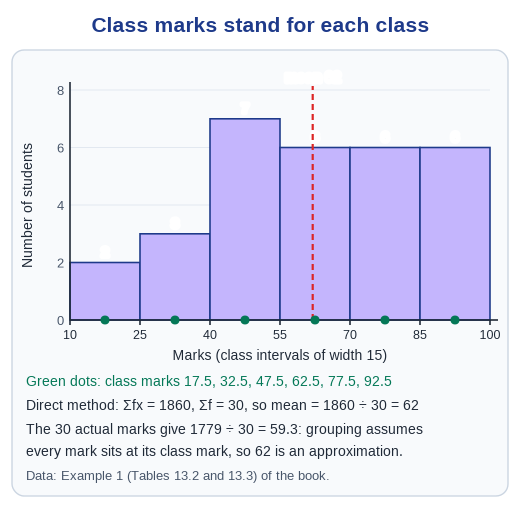
The direct method
Multiply each class mark by its frequency, add the products, and divide by the total frequency:
x̄ = Σfᵢxᵢ ÷ Σfᵢ
For the marks of 30 students (Table 13.3 of the book):
| Class | fᵢ | xᵢ | fᵢxᵢ |
|---|---|---|---|
| 10-25 | 2 | 17.5 | 35 |
| 25-40 | 3 | 32.5 | 97.5 |
| 40-55 | 7 | 47.5 | 332.5 |
| 55-70 | 6 | 62.5 | 375 |
| 70-85 | 6 | 77.5 | 465 |
| 85-100 | 6 | 92.5 | 555 |
| Total | 30 | 1860 |
x̄ = 1860 ÷ 30 = 62. The same 30 students’ actual marks have mean 1779 ÷ 30 = 59.3. The difference is the price of grouping: 62 is an approximation.
The assumed mean method
When the xᵢ are large, the products fᵢxᵢ become tedious. Choose one class mark as the assumed mean a, usually one near the centre, and work with the deviations dᵢ = xᵢ − a. Then
x̄ = a + Σfᵢdᵢ ÷ Σfᵢ
With a = 47.5 the deviations are −30, −15, 0, 15, 30, 45, and Σfᵢdᵢ = −60 − 45 + 0 + 90 + 180 + 270 = 435. So x̄ = 47.5 + 435 ÷ 30 = 47.5 + 14.5 = 62.
Why does this work? Subtracting a from every value lowers their mean by exactly a, so the mean of the dᵢ is x̄ − a. Adding a back gives x̄.
The step-deviation method
All the deviations above are multiples of 15, the class size. Dividing by h gives even smaller numbers, the step deviations uᵢ = (xᵢ − a) ÷ h. Then
x̄ = a + (Σfᵢuᵢ ÷ Σfᵢ) × h
Here u = −2, −1, 0, 1, 2, 3 and Σfᵢuᵢ = −4 − 3 + 0 + 6 + 12 + 18 = 29, so x̄ = 47.5 + (29 ÷ 30) × 15 = 47.5 + 14.5 = 62.
Which method to choose
The book’s guidance is simple:
- Small xᵢ and fᵢ: the direct method is fine.
- Large xᵢ and fᵢ: use the assumed mean or step-deviation method.
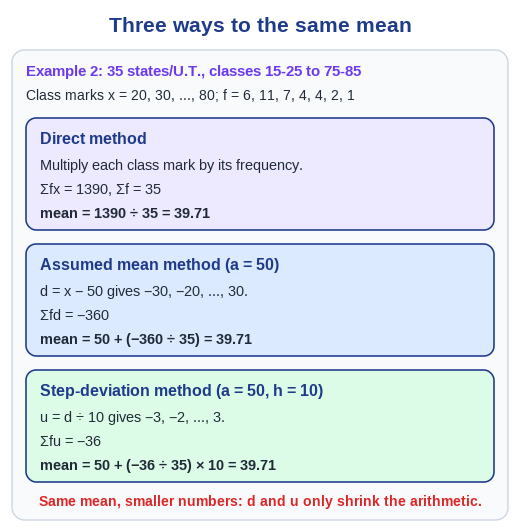
- Unequal class sizes: step-deviation still works if h is a common factor of all the dᵢ. In Example 3 (wickets taken by 45 bowlers, classes of widths 40, 50 and 100), a = 200 and h = 20 give Σfᵢuᵢ = −106 and x̄ = 200 + (−106 ÷ 45) × 20 = 152.89.
Whatever you choose, the answer is the same. A useful check is to work a question two ways.
A step-by-step method
- Write the classes and frequencies in columns, and add the class mark column xᵢ.
- Choose the method: add fᵢxᵢ (direct), or dᵢ and fᵢdᵢ, or dᵢ, uᵢ and fᵢuᵢ.
- Total the frequency column and the last column. Check that Σfᵢ matches the total in the question.
- Put the totals in the formula, and do not forget to add a back (and multiply by h).
- State the answer with its unit, and say what it means in words.
Read next: mode and median of grouped data. All of Exercise 13.1 is solved in the NCERT solutions, and the chapter notes give the full picture.
Practice
-
The class marks of the classes 0-10, 10-20 and 20-30 have frequencies 2, 5 and 3. The mean is:
Show answer
Answer: (c) 16
-
With a = 50 and h = 10, a class mark of 30 has step deviation u equal to:
Show answer
Answer: (b) −2
-
In the assumed mean method, Σfᵢ = 40, Σfᵢdᵢ = −80 and a = 25. The mean is:
Show answer
Answer: (a) 23
-
Why is the mean from a grouped table often slightly different from the mean of the original data?
Show answer
Answer: Grouping throws away the exact values. Every observation in a class is treated as if it were at the class mark, so the grouped mean is an approximation. In the book's Example 1 the raw marks give 59.3 and the grouped table gives 62.
-
Find the mean of: classes 0-20, 20-40, 40-60, 60-80 with frequencies 5, 8, 4, 3, using the step-deviation method.
Show answer
Answer: Class marks 10, 30, 50, 70. Take a = 30, h = 20: u = −1, 0, 1, 2. Σfu = −5 + 0 + 4 + 6 = 5, Σf = 20. Mean = 30 + (5 ÷ 20) × 20 = 35.
Questions students ask
Which value should I take as the assumed mean a?
Any value works, because the mean does not depend on a. A class mark near the middle of the table, often the one with a large frequency, keeps the numbers smallest. The book's Activity 1 asks you to try every class mark as a and see that the mean stays 62.
When should I use the step-deviation method?
When all the dᵢ have a common factor, usually the class size h. It also works for unequal classes if you choose h as a common factor of every dᵢ, as in the book's Example 3 with h = 20.
Why do the three methods give the same mean?
Because the shortcut formulas are just the direct formula rewritten. Subtracting a from every class mark lowers the mean by exactly a, and dividing by h divides it by exactly h; adding a back and multiplying by h undoes both changes.
Where are the exercise questions on the mean?
Exercise 13.1 has 9 questions on the mean of grouped data. All of them, and Examples 1 to 3, are solved with full tables on the NCERT solutions page.
Stuck on a question?
Take a photo and Lagnever AI explains it step by step. Try it for 7 days for ₹2.
Get it on Google Play Open in browser
For parents: after the trial, the plan renews monthly by UPI or card autopay. You can cancel anytime in the app.