
What are the soils of India, and how can we save them?
Answer in short
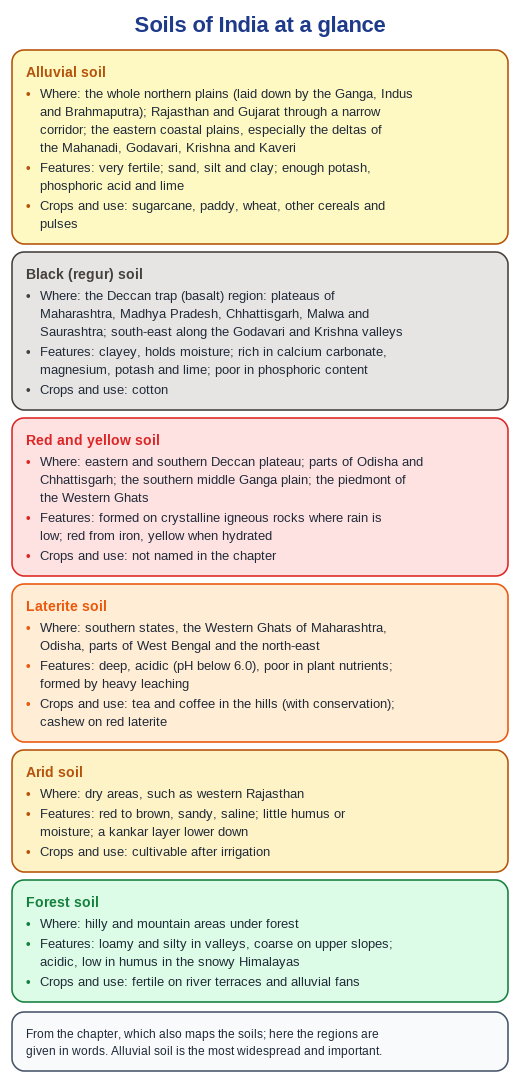
Soil forms over millions of years from parent rock under the influence of relief, climate, vegetation and time. India has six main soils: alluvial, black, red and yellow, laterite, arid and forest soils. Gullies, sheet wash, wind and wrong ploughing erode soil; contour ploughing, terraces, strip cropping and shelter belts protect it.
Stuck on a question? Take a photo and Lagnever AI explains it step by step. Try it for 7 days for ₹2. Get it on Google Play
Why is soil so precious?
Soil is the most important natural resource. Plants grow in it, and it supports many kinds of living things. It is itself a living system, and it forms very slowly: it takes millions of years to build up just a few centimetres. Soil has organic matter (humus) and inorganic matter. Relief, parent rock (bedrock), climate, vegetation and other life, and time decide how it forms. Changes in temperature, running water, wind, glaciers and decomposers break rock down, and chemical and organic changes go on inside the soil.
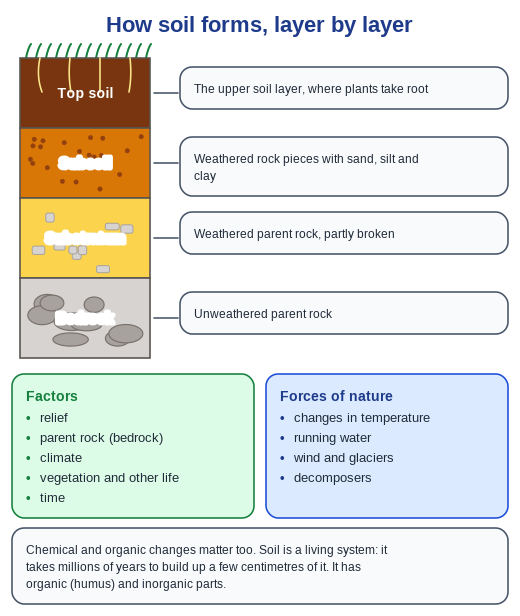
Soils are classified by the factors that formed them and by colour, thickness, texture, age, and chemical and physical properties. India’s varied relief, landforms, climates and vegetation have produced many types. The map in the book shows where they are; here they are described in words.
Alluvial soil
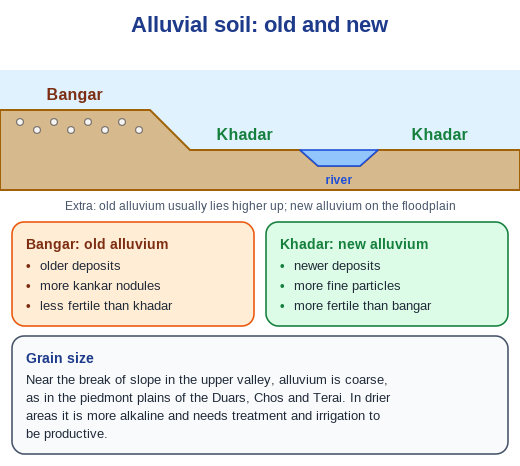
The most widespread and important soil. The whole northern plains are made of it, laid down by three Himalayan river systems: the Ganga, the Indus and the Brahmaputra. It reaches Rajasthan and Gujarat through a narrow corridor, and is found in the eastern coastal plains, especially the deltas of the Mahanadi, Godavari, Krishna and Kaveri. It mixes sand, silt and clay. Near the break of slope in the upper valleys it is coarse, as in the piedmont plains of the Duars, Chos and Terai. By age it is bangar (old, with more kankar nodules) or khadar (new, with more fine particles and more fertile). It holds enough potash, phosphoric acid and lime for sugarcane, paddy, wheat and other cereals and pulses, so these regions are farmed intensively and crowded with people. In drier areas it is more alkaline and needs treatment and irrigation.
Black soil
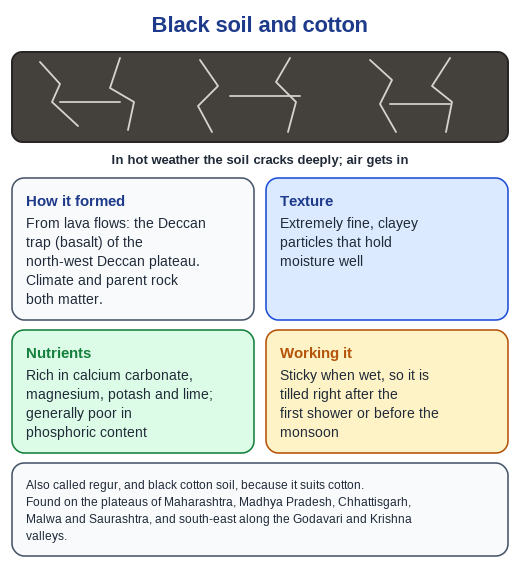
Also called regur, and black cotton soil because cotton grows so well in it. Climate and parent rock together formed it from the lava flows of the Deccan trap (basalt) in the north-west Deccan plateau. It covers the plateaus of Maharashtra, Madhya Pradesh, Chhattisgarh, Malwa and Saurashtra, and stretches south-east along the Godavari and Krishna valleys. Its very fine clay holds moisture well. It is rich in calcium carbonate, magnesium, potash and lime but poor in phosphoric content. In hot weather it cracks deeply, which lets air in; when wet it turns sticky, so farmers till it right after the first shower or before the monsoon.
Red and yellow, laterite, arid and forest soils
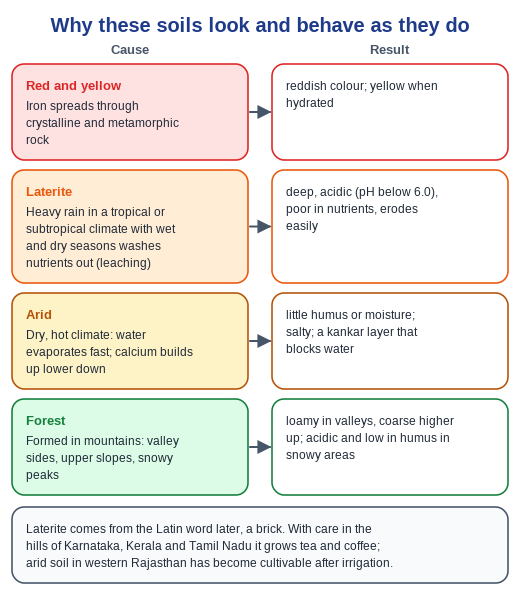
- Red and yellow: forms on crystalline igneous rocks where rain is low, in the east and south of the Deccan plateau, and in parts of Odisha and Chhattisgarh, the southern middle Ganga plain and the foothills of the Western Ghats. Iron makes it red; hydrated, it looks yellow.
- Laterite: from the Latin later, a brick. Heavy rain in a tropical or subtropical climate with wet and dry seasons leaches it. It is deep, acidic (pH below 6.0) and poor in nutrients, rich in humus under forest but poor under sparse cover, and erodes easily. It is found in the southern states, the Western Ghats of Maharashtra, Odisha, parts of West Bengal and the north-east. With conservation, the hills of Karnataka, Kerala and Tamil Nadu grow tea and coffee on it; red laterite in Tamil Nadu, Andhra Pradesh and Kerala suits cashew.
- Arid: red to brown, sandy and saline; in places salt is made from it. It lacks humus and moisture, and a kankar layer lower down stops water soaking in. With irrigation it becomes cultivable, as in western Rajasthan.
- Forest: in hills and mountains under forest. It is loamy and silty on valley sides and coarse on upper slopes; acidic and low in humus in the snowy Himalayas; fertile on river terraces and alluvial fans.
How does soil erosion happen?
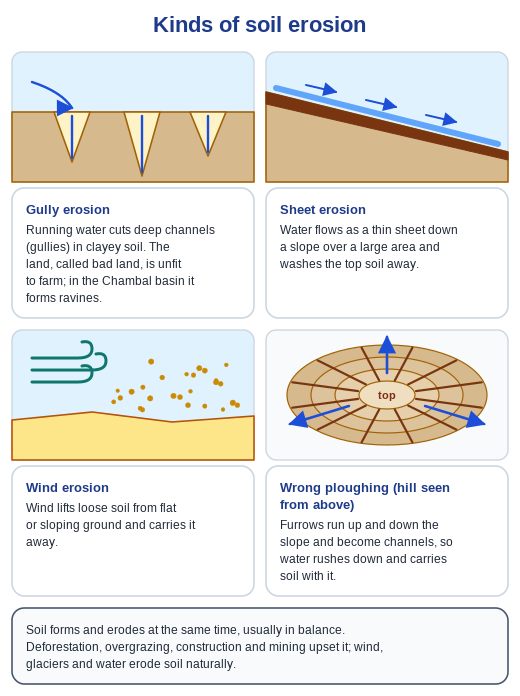
Soil erosion is the stripping of the soil cover and its washing away. Soil forms and erodes at the same time, usually in balance, but deforestation, overgrazing, construction and mining upset it, while wind, glaciers and water erode it naturally. Running water cuts gullies in clayey soil, and the land becomes bad land, called ravines in the Chambal basin. In sheet erosion water flows as a sheet down a slope and removes the top soil. In wind erosion, wind blows loose soil away. Ploughing up and down a slope makes channels down which water rushes.
How can soil be conserved?
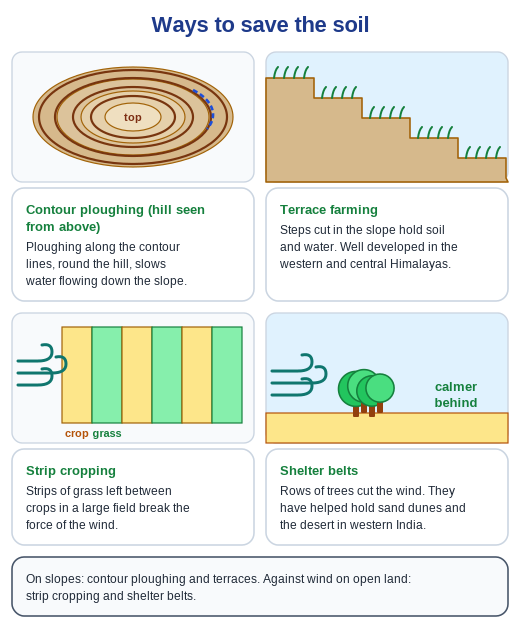
Contour ploughing, along the contour lines, slows water down a slope. Terraces, steps cut into the slope, restrict erosion; terrace farming is well developed in the western and central Himalayas. In strip cropping, strips of grass between crops break the wind. Shelter belts, rows of trees, work the same way and have helped stabilise sand dunes and the desert in western India.
Go back to how India uses its land, or see the NCERT solutions and the chapter notes.
Practice
-
Which soil develops deep cracks in hot weather, which help to aerate it?
Show answer
Answer: (b) black
-
Laterite soil is formed mainly by:
Show answer
Answer: (b) intense leaching in heavy rain
-
Rows of trees planted to break the wind are called:
Show answer
Answer: (c) shelter belts
-
Why does red soil look red, and when does it look yellow?
Show answer
Answer: It turns reddish because iron spreads through the crystalline and metamorphic rocks it forms from. When the soil is in a hydrated form, it looks yellow.
-
Why does arid soil hold so little water?
Show answer
Answer: In a dry, hot climate water evaporates fast, so the soil lacks humus and moisture. Lower down, a kankar layer forms as calcium increases with depth, and it blocks water from soaking in.
Questions students ask
Which soil is most common in India?
Alluvial soil. It makes up the whole northern plains, laid down by the Indus, the Ganga and the Brahmaputra, and is found in the deltas of the Mahanadi, Godavari, Krishna and Kaveri on the east coast.
Why is black soil good for cotton?
It is made of very fine clay that holds moisture well, and it is rich in calcium carbonate, potash, lime and magnesium. That is why it is also called black cotton soil.
What is the difference between contour ploughing and terrace farming?
Contour ploughing follows the contour lines of a slope, so water flows down more slowly. Terrace farming cuts steps into the slope so that each step holds soil and water; it is well developed in the western and central Himalayas.
Stuck on a question?
Take a photo and Lagnever AI explains it step by step. Try it for 7 days for ₹2.
Get it on Google Play Open in browser
For parents: after the trial, the plan renews monthly by UPI or card autopay. You can cancel anytime in the app.