
NCERT Solutions Class 12 Biology Chapter 13: Biodiversity and Conservation
Answers to all 10 end-of-chapter exercises of Chapter 13, Biodiversity and Conservation, of Biology, the Class 12 NCERT textbook. Page numbers follow the 2026-27 reprint (pages 216–227). The exercises are quoted from the book as printed; the answers are our own, built from the chapter, and every fact or argument from outside the chapter is marked Extra. Every number on this page was computed by script. The questions the chapter text asks along the way are answered in short at the end. The book prints no answer key for this chapter. Short notes: Chapter 13 notes.
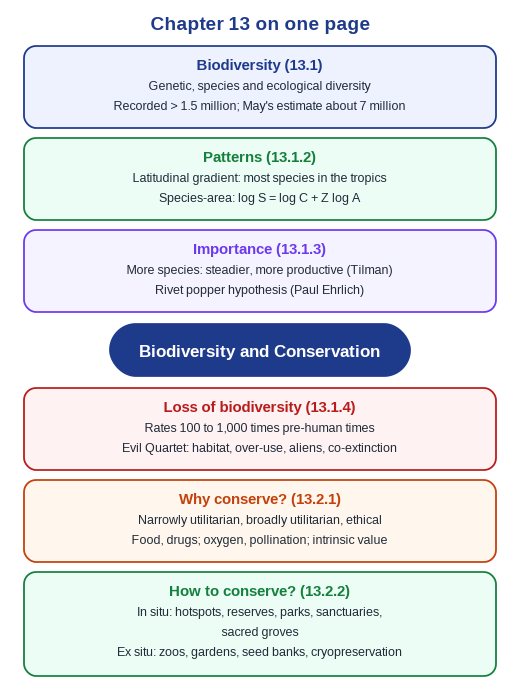
Exercises 1 to 4: what biodiversity is and how it is patterned
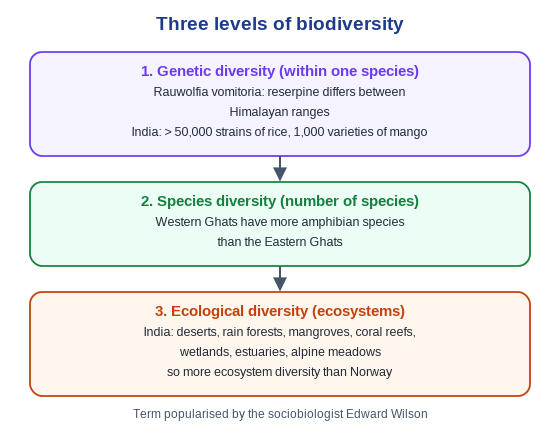
1. “Name the three important components of biodiversity.”
- Genetic diversity: variation within a single species over its range. Example: Rauwolfia vomitoria from different Himalayan ranges differs in the potency and concentration of reserpine; India has more than 50,000 genetically different strains of rice and 1,000 varieties of mango.
- Species diversity: variety at the species level. Example: the Western Ghats hold more kinds of amphibians than the Eastern Ghats.
- Ecological (ecosystem) diversity: variety of ecosystems. Example: India, with deserts, rain forests, mangroves, coral reefs, wetlands, estuaries and alpine meadows, has more ecosystem diversity than Norway.
2. “How do ecologists estimate the total number of species present in the world?”
We know how many species have been described (slightly more than 1.5 million, IUCN 2004), but not how many exist. Ecologists estimate the total like this:
- Species inventories are much more complete for temperate countries than for tropical ones, and most species still waiting to be found are in the tropics.
- They take a group of insects that has been studied exhaustively and compare its species richness in the tropics with that in temperate regions, getting a tropical-to-temperate ratio.
- They extrapolate, applying the same ratio to the other animal and plant groups, which gives a rough total for all species on Earth.
Results vary: extreme estimates range from 20 to 50 million, while the more conservative, scientifically sound estimate by Robert May is about 7 million. On May’s figure, only about 22 per cent of species are recorded so far (our check: 1.5 ÷ 7 ≈ 0.21). Prokaryotes are not included, because their species are hard to identify by normal methods and many cannot be cultured.
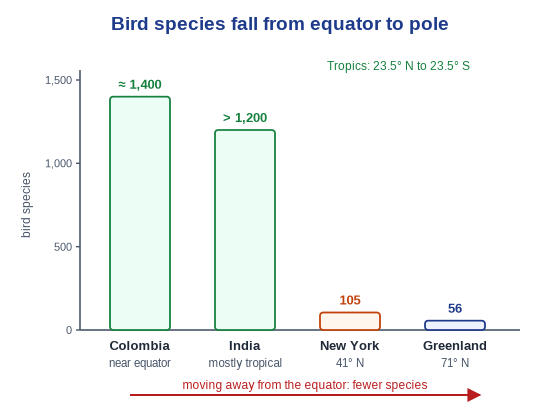
3. “Give three hypotheses for explaining why tropics show greatest levels of species richness.”
- More evolutionary time: speciation is generally a function of time. Temperate regions went through frequent glaciations in the past, but the tropics stayed relatively undisturbed for millions of years, so species had a long time to diversify.
- A more constant environment: tropical environments are less seasonal, more constant and predictable. Such constancy promotes niche specialisation, which leads to greater species diversity.
- More solar energy: the tropics get more solar energy, which raises productivity; higher productivity may in turn support greater diversity indirectly.
4. “What is the significance of the slope of regression in a species – area relationship?”
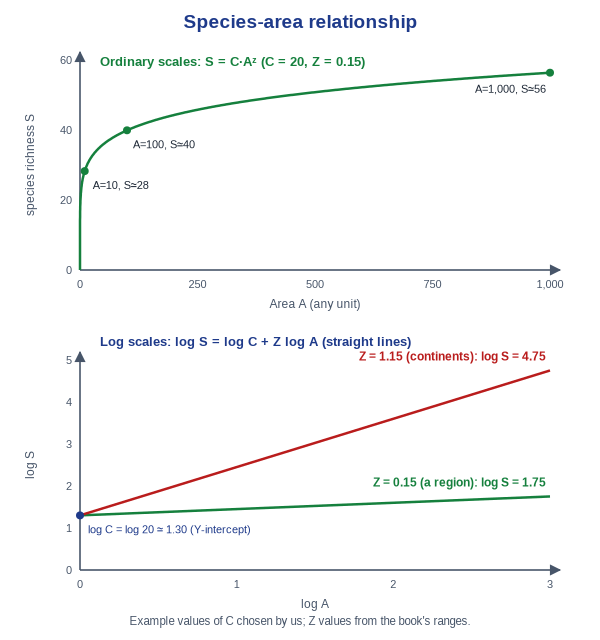
The species-area relationship on log scales is a straight line, log S = log C + Z log A, where S is species richness, A is area, C is the Y-intercept and Z is the slope of the line (the regression coefficient). In power form, S = C·A^Z.
Significance of Z:
- Z tells us how fast species richness rises with area. A larger Z means a steeper line: each increase (or decrease) in area brings a bigger change in the number of species.
- Within a region, Z lies between 0.1 and 0.2, remarkably similar for very different groups and places (plants in Britain, birds in California, molluscs in New York state).
- Across very large areas such as continents, Z is 0.6 to 1.2; for frugivorous birds and mammals of tropical forests on different continents it is 1.15. A steep slope means species richness here depends very strongly on area.
Worked example (our numbers, checked by script): doubling the area multiplies S by 2^Z.
| Z | Doubling the area | Cutting the area to one-tenth |
|---|---|---|
| 0.15 (a region) | × 2^0.15 ≈ 1.11 (about 11 per cent more species) | × 10^−0.15 ≈ 0.71 (about 29 per cent fewer) |
| 1.15 (continents) | × 2^1.15 ≈ 2.22 | × 10^−1.15 ≈ 0.07 (about 93 per cent fewer) |
Extra: because of this, the value of Z helps ecologists predict how many species may be lost when a habitat shrinks.
Exercises 5 and 6: loss of species and why diversity matters
5. “What are the major causes of species losses in a geographical region?”
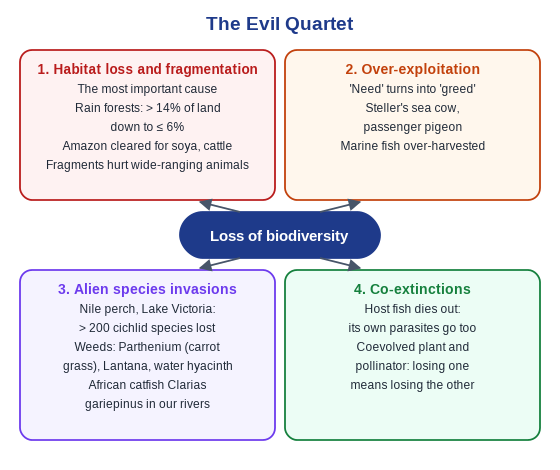
The four major causes, all largely due to human activities, are nicknamed ‘The Evil Quartet’:
- Habitat loss and fragmentation, the most important cause. Tropical rain forests once covered more than 14 per cent of Earth’s land; today the figure is 6 per cent at most; the Amazon is being cleared for soya beans and for grassland to raise beef cattle. Pollution degrades other habitats. When a large habitat is broken into small fragments, mammals and birds that need large territories and animals with migratory habits decline.
- Over-exploitation: when need turns to greed, natural resources are over-used. Steller’s sea cow and the passenger pigeon became extinct through over-exploitation; many marine fish populations are over-harvested today.
- Alien species invasions: some introduced species become invasive and cause the decline or extinction of native species. The Nile perch introduced into Lake Victoria led to the extinction of more than 200 species of cichlid fish; carrot grass (Parthenium), Lantana and water hyacinth (Eicchornia) harm Indian native species; the illegally introduced African catfish Clarias gariepinus threatens native catfishes in our rivers.
- Co-extinctions: when a species dies out, species linked to it in an obligatory way die too, for example the unique parasites of a host fish, or one partner of a coevolved plant-pollinator mutualism when the other is lost.
6. “How is biodiversity important for ecosystem functioning?”
- Stability: ecologists have long held that communities with more species are more stable. A stable community does not vary too much in productivity from year to year, is resistant or resilient to occasional disturbances, and resists invasion by alien species.
- Evidence from Tilman: in David Tilman’s long-term outdoor plot experiments, plots with more species had total biomass that swung less from one year to the next, and greater diversity gave higher productivity.
- Effects of losing it: a region that loses biodiversity may show a decline in plant production, lower resistance to disturbances such as drought, and more variability in plant productivity, water use, and the ups and downs of pests and diseases.
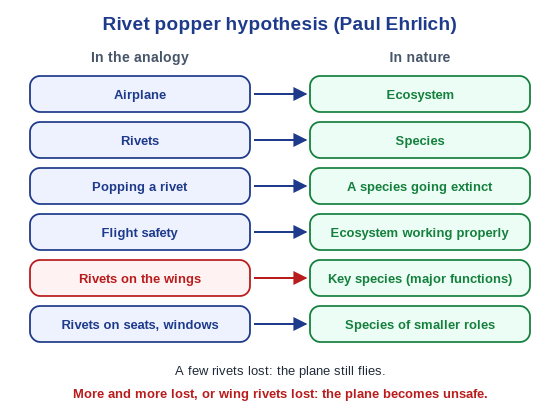
- Rivet popper hypothesis (Paul Ehrlich): an ecosystem is like an airplane held by thousands of rivets (species). Losing a few may not matter at first, but as more are lost the plane becomes dangerously weak; and losing key species (rivets on the wings) that drive major functions is far more serious than losing minor ones.
- Services: biodiversity provides ecosystem services such as oxygen production (the Amazon, about 20 per cent of atmospheric oxygen), pollination, pest control, climate moderation and flood control.
Exercises 7 and 8: sacred groves and ecosystem services
7. “What are sacred groves? What is their role in conservation?”
Sacred groves are tracts of forest set aside by communities for religious and cultural reasons, in which all the trees and wildlife are revered and given total protection. In India they are found in the Khasi and Jaintia Hills (Meghalaya), the Aravalli Hills (Rajasthan), the Western Ghat regions of Karnataka and Maharashtra, and the Sarguja, Chanda and Bastar areas of Madhya Pradesh.
Role in conservation:
- They are a form of in situ conservation: species are protected in their natural habitat along with the whole ecosystem.
- Because nothing may be cut or hunted in them, they keep patches of undisturbed forest amid farms and settlements.
- In Meghalaya, sacred groves are the final shelter left for many rare and threatened plants.
- They show how community tradition can support conservation (Extra: without any special cost to the state).
8. “Among the ecosystem services are control of floods and soil erosion. How is this achieved by the biotic components of the ecosystem?”
The chapter lists flood control among ecosystem services but does not explain the mechanism; the points below are Extra, standard ecology.
- Roots bind the soil: plant roots hold soil particles together, so rain and running water cannot easily wash the topsoil away.
- Canopy breaks the rain: leaves and branches of trees and shrubs intercept falling rain, so drops reach the ground with less force and loosen less soil.
- Ground cover slows runoff: grasses, herbs and fallen leaves slow water flowing over the surface, giving it time to soak in.
- Litter and humus soak up water: decomposers turn litter into humus, which holds water like a sponge; burrowing animals such as earthworms make channels that let water sink into the soil, recharging groundwater instead of rushing into rivers.
- Result: less surface runoff and slower release of water reduce floods downstream, and less soil is carried away, so soil erosion is controlled. When forests are cleared, both floods and erosion usually increase.
Exercises 9 and 10: thinking questions
9. “The species diversity of plants (22 per cent) is much less than that of animals (72 per cent). What could be the explanations to how animals achieved greater diversification?”
The chapter only asks the question (it notes that insects alone make up more than 70 per cent of animal species); the explanations below are Extra reasoning.
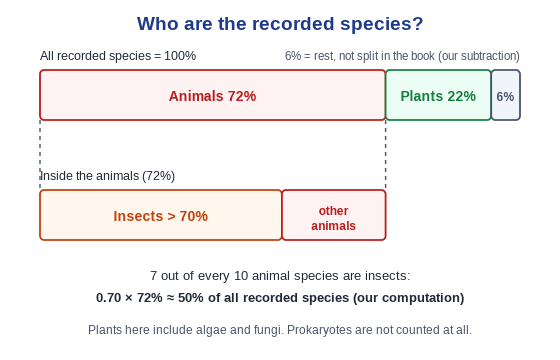
- Insects: most of the animal lead comes from insects. Their small size lets very many species live in a small space, each using a different tiny niche.
- Movement: animals can move, and many can fly, so they reach and settle new habitats and spread into new ways of life.
- Many ways of feeding: animals eat plants, other animals, dead matter or live as parasites; each plant species may support several animal species that feed on its different parts.
- Nervous system and behaviour: complex senses and behaviour, such as courtship, let populations separate and become new species more easily.
- Short life cycles: many small animals breed fast and in large numbers, so variation builds up quickly over generations.
- Coevolution: animals have evolved together with plants as pollinators, seed dispersers and herbivores, producing many specialised species.
Note that the book’s text says “more than 70 per cent” for animals; the exercise uses 72 per cent. Remember also that the book’s “plants” include algae and fungi.
10. “Can you think of a situation where we deliberately want to make a species extinct? How would you justify it?”
This is an open question; the example and arguments are Extra.
Situation: a species that causes serious disease in humans, such as a disease-causing virus. Extra: the smallpox virus is a well-known case of a pathogen that has been eradicated from the wild by vaccination; efforts to eliminate the polio virus are a similar case.
Justification:
- Such a pathogen causes great suffering and death, and it has no known useful role in an ecosystem that another species cannot fill.
- Its removal hurts no other species, because nothing depends on it in an obligatory way, so it causes no co-extinction.
Caution: the chapter’s ethical argument says every species has intrinsic value, and the rivet popper hypothesis warns that removing species can weaken ecosystems in ways we may not foresee. So any deliberate extinction should be limited to clear cases like dangerous pathogens, and even then samples may be kept under strict control for research. Eliminating harmful invasive species from a region (for example Parthenium or water hyacinth in India) is not extinction, since the species survives in its native home.
Questions asked in the chapter text
These are not quoted; each is restated briefly with its page.
Page 216: why are there so many species, and how does this help us? The rest of the chapter answers this: diversity built up over long evolutionary time; it supports stable, productive ecosystems; and it gives us food, medicines, oxygen, pollination and beauty.
Page 218: how can we explain the huge diversification of insects? See the Extra reasoning in Exercise 9: small size and many tiny niches, flight, varied feeding habits, fast breeding and coevolution with flowering plants.
Page 219: will we ever finish listing India’s biological wealth? Probably not soon. It would need very many trained taxonomists and a long time, and many species may become extinct before they are discovered. The book compares this to a library burning before its books are catalogued.
Page 220: what do steeper slopes mean here? A larger Z means species richness changes faster with area. Across continents (Z 0.6 to 1.2) a loss of area removes a much larger share of species than within a region (Z 0.1 to 0.2); see the table in Exercise 4.
Page 220: does the number of species matter to how an ecosystem works? Ecologists have no final answer, but Tilman’s experiments suggest that more species give steadier biomass and higher productivity.
Page 221: would it matter if one tree frog of the Western Ghats were lost, or if there were 15,000 instead of 20,000 ant species? The rivet popper hypothesis gives the answer: one loss may not show at once, but each loss weakens the ecosystem a little, and if the lost species is a key one, the effect can be serious.
Page 222: how is the ‘Sixth Extinction’ different from the earlier five? In its rate and cause: species are going 100 to 1,000 times faster than in pre-human times, and human activities are responsible.
Page 224: can we put a price on oxygen from the Amazon, natural pollination or the beauty of nature? Only roughly. Comparing with the price of an oxygen cylinder, or the cost of pollinating crops by hand, shows these services are worth a great deal; Extra: intangible pleasures such as birdsong cannot really be priced at all.
Practice
-
In log S = log C + Z log A, if Z = 0.1, halving the area multiplies the number of species by about:
Show answer
Answer: (b) 0.93
-
Sacred groves of the Khasi and Jaintia Hills are found in:
Show answer
Answer: (b) Meghalaya
-
The Nile perch in Lake Victoria is an example of:
Show answer
Answer: (c) alien species invasion
-
If about 22 per cent of species are recorded, and India has recorded about 45,000 plant species, roughly how many plant species may India have in all?
Show answer
Answer: 45,000 ÷ 0.22 ≈ 2,04,500, so about 1,59,500 are still unrecorded, which agrees with the book's 'more than 1,00,000' (our arithmetic).
-
Give one example each of a narrowly utilitarian and a broadly utilitarian benefit of biodiversity.
Show answer
Answer: Narrowly utilitarian: plant-derived medicines (more than 25 per cent of drugs sold worldwide). Broadly utilitarian: pollination of crops by bees, birds and bats, or the oxygen produced by the Amazon forest.
Stuck on a question?
Take a photo and Lagnever AI explains it step by step. Try it for 7 days for ₹2.
Get it on Google Play Open in browser
For parents: after the trial, the plan renews monthly by UPI or card autopay. You can cancel anytime in the app.