
NCERT Solutions Class 12 Maths Chapter 12: Linear Programming
Answers to all 10 questions of Exercise 12.1 and to the 5 worked examples of Chapter 12, Linear Programming, of Mathematics Part II, the Class 12 NCERT textbook, plus the dealer’s problem that the chapter solves in Section 12.2. Page numbers follow the 2026-27 reprint (pages 394–405). The exercise questions are quoted from the book; the examples are restated in short and labelled by number and page. Every problem has its own graph of the feasible region, drawn from the computed corner points. Every corner point and every value of Z below was checked by a script that solves each pair of boundary lines, keeps the feasible points, evaluates Z exactly, and runs the half-plane test on unbounded regions; all the answers agree with the book’s answer key. Short notes: Chapter 12 notes.
How the maths is typed here. ≤ means “less than or equal to” and ≥ “greater than or equal to”. Fractions are written with a slash, so 20/19 is twenty nineteenths. A corner point is written (x, y). Z values of money are in rupees. The quoted questions use the same layout.
Words used below. Z is the objective function: the quantity to make as large (maximise) or as small (minimise) as possible. Each inequality is a constraint, a condition x and y must obey. The feasible region is the set of points that obey every constraint at once. A corner point is a corner of that region. The region is bounded if a circle can enclose it, and unbounded if it stretches away without end. A half-plane is all the points on one side of a straight line.
The method used in every answer (the corner point method):
- Draw each constraint line and shade the side that satisfies it. The common part, in the first quadrant, is the feasible region.
- Find every corner point exactly, by solving the two boundary lines that meet there.
- Work out Z at each corner. Call the largest value M and the smallest m.
- If the region is bounded: M is the maximum and m is the minimum. Done.
- If the region is unbounded, one more check is needed (Z = ax + by):
- M is the maximum only if no feasible point has ax + by > M (the open half-plane ax + by > M misses the region).
- m is the minimum only if no feasible point has ax + by < m.
The dealer’s problem (Section 12.2, pages 395–399)
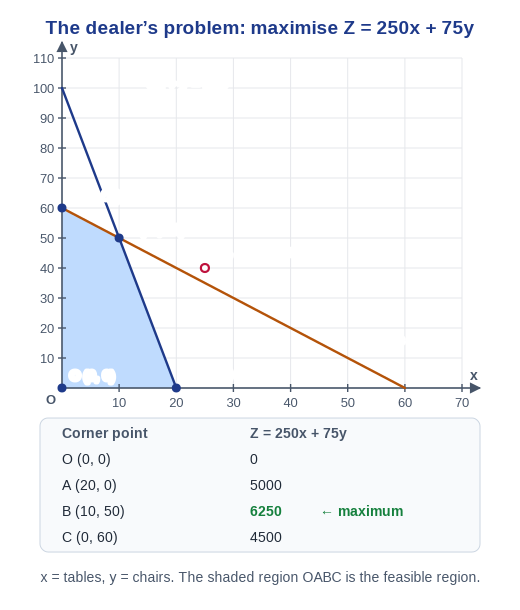
The problem. A dealer buys tables (₹2500 each, profit ₹250) and chairs (₹500 each, profit ₹75) with ₹50,000, and can store at most 60 pieces. How many of each give the largest profit?
Formulation. With x tables and y chairs: maximise Z = 250x + 75y subject to 5x + y ≤ 100 (money, after dividing by 500), x + y ≤ 60 (storage), x ≥ 0, y ≥ 0.
Corners. O(0, 0), A(20, 0) where 5x + y = 100 meets the x-axis, C(0, 60) where x + y = 60 meets the y-axis, and B, where the two lines meet: subtracting x + y = 60 from 5x + y = 100 gives 4x = 40, so B = (10, 50).
| Corner point | Z = 250x + 75y |
|---|---|
| O(0, 0) | 0 |
| A(20, 0) | 5000 |
| B(10, 50) | 6250 |
| C(0, 60) | 4500 |
The region is bounded, so the maximum profit is ₹6250, from 10 tables and 50 chairs. The book also names (10, 50), (0, 60) and (20, 0) as feasible solutions and (25, 40) as infeasible: 25 + 40 = 65 breaks the storage limit (and 5 × 25 + 40 = 165 breaks the money limit too).
Examples 1 to 5 (pages 399–403)
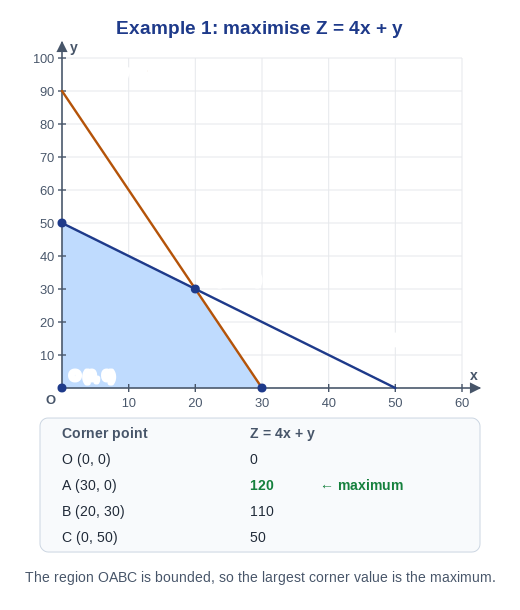
Example 1 (page 399): maximise Z = 4x + y subject to x + y ≤ 50, 3x + y ≤ 90, x ≥ 0, y ≥ 0.
The lines meet where (3x + y) − (x + y) = 90 − 50, so 2x = 40, x = 20 and y = 30. The other corners are O(0, 0), A(30, 0) (from 3x + y = 90) and C(0, 50) (from x + y = 50). The region OABC is bounded.
| Corner point | Z = 4x + y |
|---|---|
| (0, 0) | 0 |
| (30, 0) | 120 |
| (20, 30) | 110 |
| (0, 50) | 50 |
Maximum Z = 120 at (30, 0).
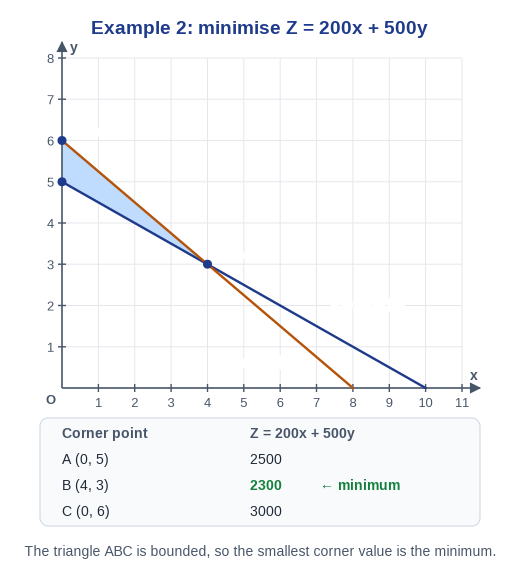
Example 2 (page 400): minimise Z = 200x + 500y subject to x + 2y ≥ 10, 3x + 4y ≤ 24, x ≥ 0, y ≥ 0.
The region lies above x + 2y = 10 and below 3x + 4y = 24. The lines meet where 3x + 4y = 24 and 2x + 4y = 20 (twice the first line); subtracting gives x = 4, then y = 3. The region is the bounded triangle with corners A(0, 5), B(4, 3) and C(0, 6).
| Corner point | Z = 200x + 500y |
|---|---|
| (0, 5) | 2500 |
| (4, 3) | 2300 |
| (0, 6) | 3000 |
Minimum Z = 2300 at (4, 3).
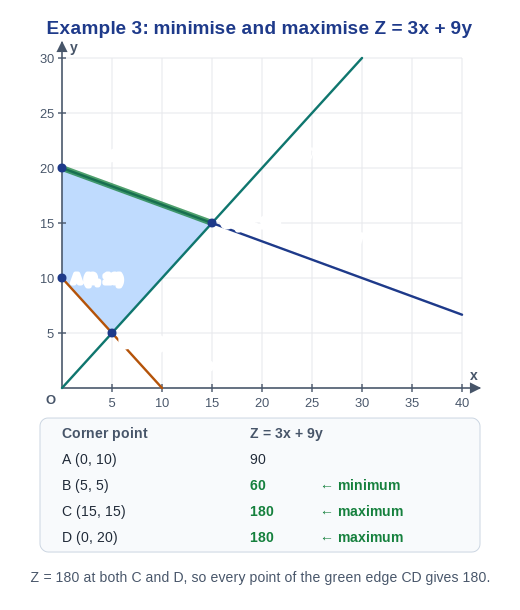
Example 3 (page 401): find the minimum and the maximum of Z = 3x + 9y subject to x + 3y ≤ 60, x + y ≥ 10, x ≤ y, x ≥ 0, y ≥ 0.
Corners: A(0, 10) and D(0, 20) on the y-axis; B, where x + y = 10 meets x = y, so B = (5, 5); and C, where x + 3y = 60 meets x = y, so 4x = 60 and C = (15, 15). The region ABCD is bounded.
| Corner point | Z = 3x + 9y |
|---|---|
| A(0, 10) | 90 |
| B(5, 5) | 60 |
| C(15, 15) | 180 |
| D(0, 20) | 180 |
Minimum Z = 60 at (5, 5). Maximum Z = 180 at both (15, 15) and (0, 20). Because two corners tie, every point of the segment CD gives 180 too: CD lies on the line x + 3y = 60, and on that line Z = 3(x + 3y) = 180. For example, the midpoint (7.5, 17.5) gives 22.5 + 157.5 = 180.
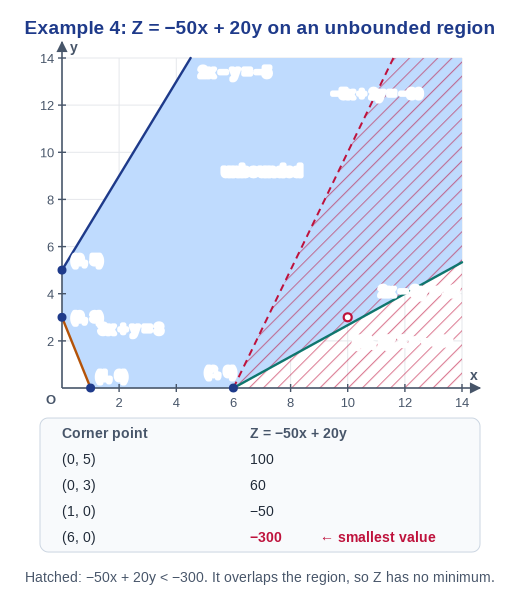
Example 4 (page 402): the minimum of Z = −50x + 20y subject to 2x − y ≥ −5, 3x + y ≥ 3, 2x − 3y ≤ 12, x ≥ 0, y ≥ 0.
The region is unbounded. Its corners are (0, 5) (2x − y = −5 on the y-axis), (0, 3) (3x + y = 3 on the y-axis), (1, 0) (3x + y = 3 on the x-axis) and (6, 0) (2x − 3y = 12 on the x-axis).
| Corner point | Z = −50x + 20y |
|---|---|
| (0, 5) | 100 |
| (0, 3) | 60 |
| (1, 0) | −50 |
| (6, 0) | −300 |
The smallest corner value is −300, but the region is unbounded, so test the open half-plane −50x + 20y < −300, that is −5x + 2y < −30. It does meet the region: (10, 3) satisfies every constraint (2(10) − 3 = 17 ≥ −5, 33 ≥ 3, 20 − 9 = 11 ≤ 12) and gives Z = −500 + 60 = −440. So Z has no minimum value.
The book then asks whether Z has the maximum 100 at (0, 5), and why. Test the half-plane −50x + 20y > 100, that is y > 2.5x + 5. Every feasible point has y ≤ 2x + 5 (from 2x − y ≥ −5), and for x ≥ 0, 2x + 5 ≤ 2.5x + 5. So no feasible point lies in that half-plane, and the maximum of Z is 100, at (0, 5).
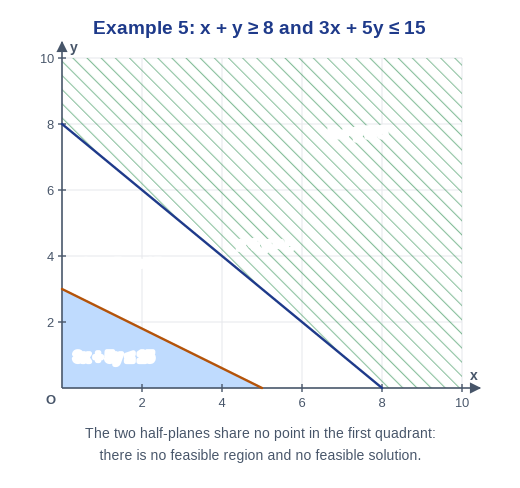
Example 5 (page 403): minimise Z = 3x + 2y subject to x + y ≥ 8, 3x + 5y ≤ 15, x ≥ 0, y ≥ 0.
The book asks whether there is any feasible region, and why. In the first quadrant, 3x + 5y ≤ 15 keeps only the triangle with corners (0, 0), (5, 0) and (0, 3), where x + y is at most 5. But the first constraint needs x + y ≥ 8. No point satisfies both, so there is no feasible region and no feasible solution, and Z has no minimum.
Exercise 12.1 (pages 403–404)
The book’s instruction for all ten questions: “Solve the following Linear Programming Problems graphically:”
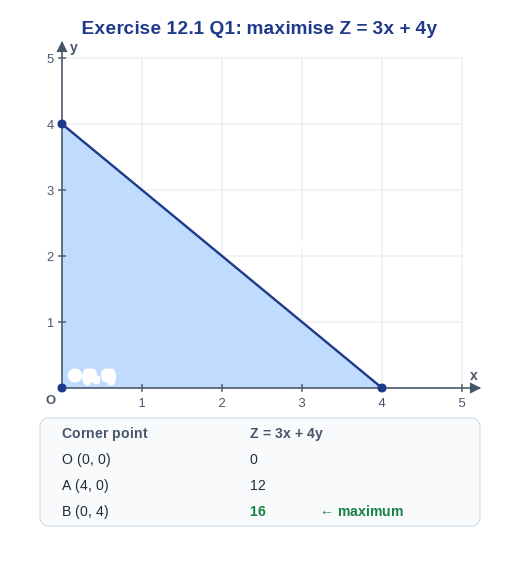
1. “Maximise Z = 3x + 4y subject to the constraints : x + y ≤ 4, x ≥ 0, y ≥ 0.”
The feasible region is the triangle below x + y = 4 in the first quadrant, with corners O(0, 0), A(4, 0) and B(0, 4). It is bounded.
| Corner point | Z = 3x + 4y |
|---|---|
| (0, 0) | 0 |
| (4, 0) | 12 |
| (0, 4) | 16 |
Maximum Z = 16 at (0, 4).
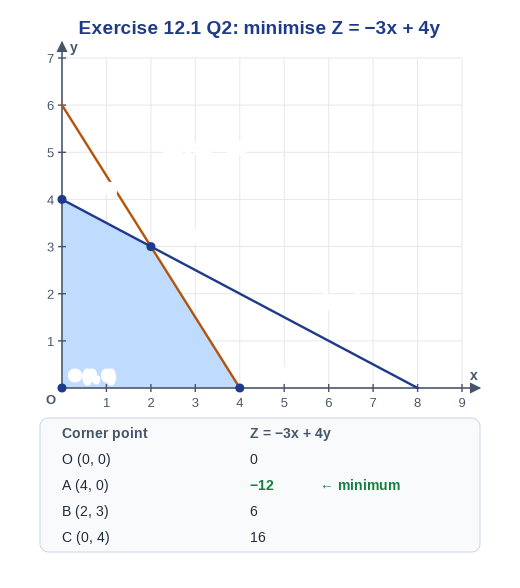
2. “Minimise Z = – 3x + 4y subject to x + 2y ≤ 8, 3x + 2y ≤ 12, x ≥ 0, y ≥ 0.”
The lines meet where (3x + 2y) − (x + 2y) = 12 − 8, so 2x = 4, x = 2 and y = 3. The bounded region has corners O(0, 0), A(4, 0) (from 3x + 2y = 12), B(2, 3) and C(0, 4) (from x + 2y = 8).
| Corner point | Z = −3x + 4y |
|---|---|
| (0, 0) | 0 |
| (4, 0) | −12 |
| (2, 3) | 6 |
| (0, 4) | 16 |
Minimum Z = −12 at (4, 0).
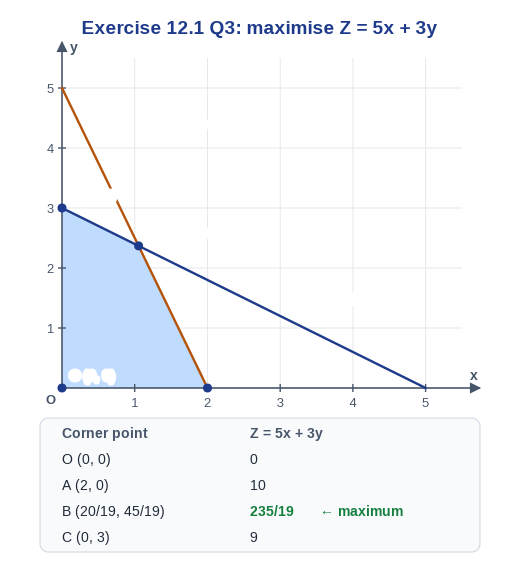
3. “Maximise Z = 5x + 3y subject to 3x + 5y ≤ 15, 5x + 2y ≤ 10, x ≥ 0, y ≥ 0.”
Solve 3x + 5y = 15 and 5x + 2y = 10. Multiply the first by 2 and the second by 5: 6x + 10y = 30 and 25x + 10y = 50. Subtracting, 19x = 20, so x = 20/19, and then 5y = 15 − 60/19 = 225/19, so y = 45/19. The bounded region has corners O(0, 0), A(2, 0) (from 5x + 2y = 10), B(20/19, 45/19) and C(0, 3) (from 3x + 5y = 15).
| Corner point | Z = 5x + 3y |
|---|---|
| (0, 0) | 0 |
| (2, 0) | 10 |
| (20/19, 45/19) | 100/19 + 135/19 = 235/19 |
| (0, 3) | 9 |
235/19 ≈ 12.37 is the largest, so maximum Z = 235/19 at (20/19, 45/19).
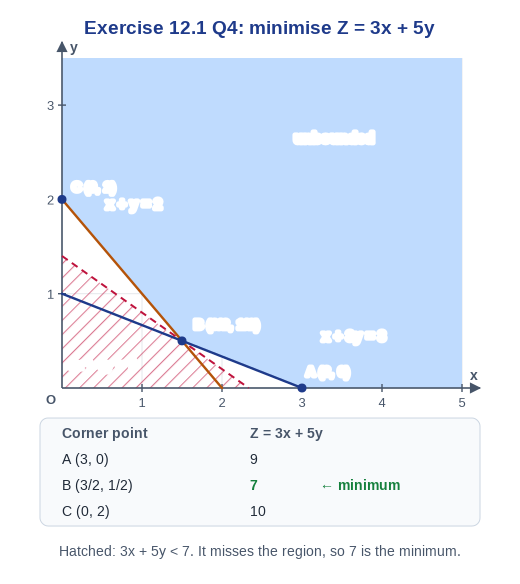
4. “Minimise Z = 3x + 5y such that x + 3y ≥ 3, x + y ≥ 2, x, y ≥ 0.”
Both constraints are “at least”, so the region lies above both lines and is unbounded. The lines meet where (x + 3y) − (x + y) = 3 − 2, so 2y = 1, y = 1/2 and x = 3/2. The other corners are (3, 0) (x + 3y = 3 on the x-axis) and (0, 2) (x + y = 2 on the y-axis).
| Corner point | Z = 3x + 5y |
|---|---|
| (3, 0) | 9 |
| (3/2, 1/2) | 9/2 + 5/2 = 7 |
| (0, 2) | 10 |
The smallest corner value is 7. Since the region is unbounded, check the open half-plane 3x + 5y < 7. In the region, 3x + 5y = 2(x + y) + (x + 3y) ≥ 2 × 2 + 3 = 7, so no feasible point has 3x + 5y < 7. Hence minimum Z = 7 at (3/2, 1/2).
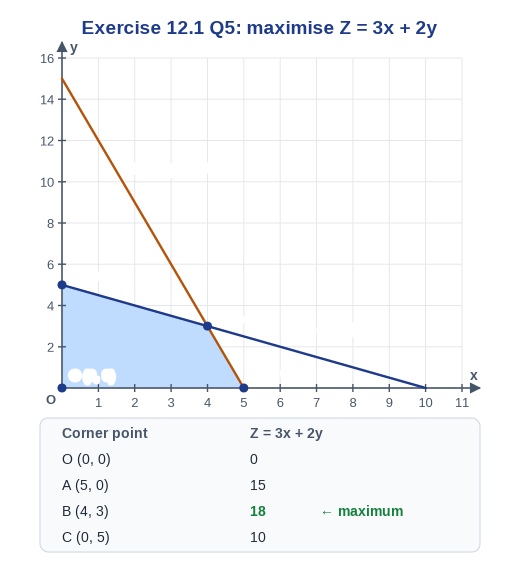
5. “Maximise Z = 3x + 2y subject to x + 2y ≤ 10, 3x + y ≤ 15, x, y ≥ 0.”
Solve x + 2y = 10 and 3x + y = 15: from the second, y = 15 − 3x, so x + 30 − 6x = 10, x = 4 and y = 3. The bounded region has corners O(0, 0), A(5, 0) (from 3x + y = 15), B(4, 3) and C(0, 5) (from x + 2y = 10).
| Corner point | Z = 3x + 2y |
|---|---|
| (0, 0) | 0 |
| (5, 0) | 15 |
| (4, 3) | 18 |
| (0, 5) | 10 |
Maximum Z = 18 at (4, 3).
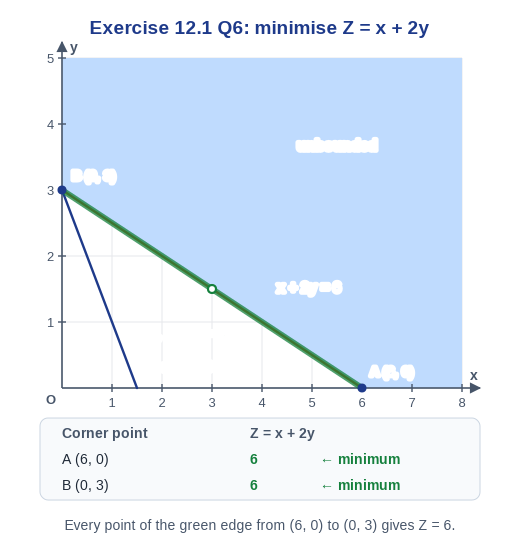
6. “Minimise Z = x + 2y subject to 2x + y ≥ 3, x + 2y ≥ 6, x, y ≥ 0. Show that the minimum of Z occurs at more than two points.”
The line x + 2y = 6 meets the axes at (6, 0) and (0, 3). The line 2x + y = 3 also passes through (0, 3), since 2(0) + 3 = 3. Every other point on or above x + 2y = 6 (in the first quadrant) already has 2x + y ≥ 3, so this constraint cuts nothing away. The feasible region is the unbounded part of the first quadrant on or above x + 2y = 6, with corners (6, 0) and (0, 3).
| Corner point | Z = x + 2y |
|---|---|
| (6, 0) | 6 |
| (0, 3) | 6 |
Both corners give 6, the smallest value. The region is unbounded, so check x + 2y < 6: every feasible point has x + 2y ≥ 6 (it is one of the constraints), so there is no common point. Hence minimum Z = 6.
Since the two corners tie, Z = 6 at every point of the segment joining (6, 0) and (0, 3), because that whole segment lies on x + 2y = 6. For example, (3, 3/2) is feasible and gives 3 + 3 = 6, and (2, 2) gives 2 + 4 = 6. The segment has infinitely many points, so the minimum occurs at more than two points.
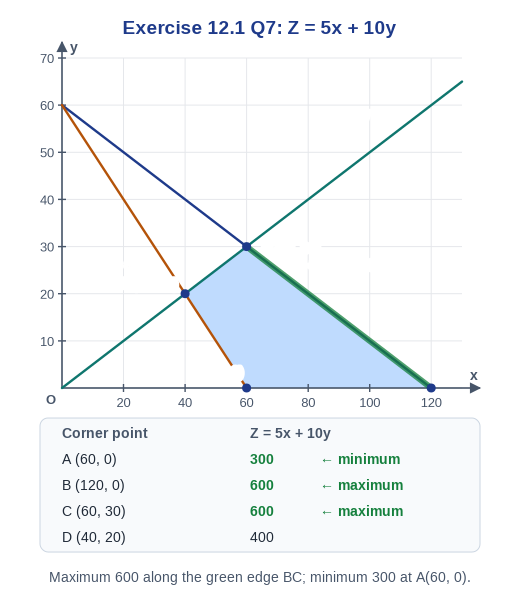
7. “Minimise and Maximise Z = 5x + 10 y subject to x + 2y ≤ 120, x + y ≥ 60, x – 2y ≥ 0, x, y ≥ 0.”
Here x − 2y ≥ 0 means y ≤ x/2. The corners are:
- A(60, 0): x + y = 60 meets the x-axis;
- B(120, 0): x + 2y = 120 meets the x-axis;
- C: x + 2y = 120 meets x = 2y, so 4y = 120, y = 30 and C = (60, 30);
- D: x + y = 60 meets x = 2y, so 3y = 60, y = 20 and D = (40, 20).
The region ABCD is bounded.
| Corner point | Z = 5x + 10y |
|---|---|
| (60, 0) | 300 |
| (120, 0) | 600 |
| (60, 30) | 600 |
| (40, 20) | 400 |
Minimum Z = 300 at (60, 0). Maximum Z = 600 at every point of the segment joining (120, 0) and (60, 30), because both ends give 600 and that edge lies on x + 2y = 120, where Z = 5(x + 2y) = 600.
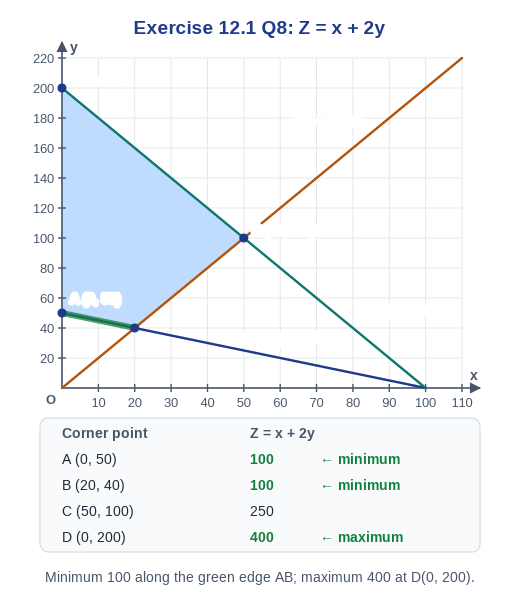
8. “Minimise and Maximise Z = x + 2y subject to x + 2y ≥ 100, 2x – y ≤ 0, 2x + y ≤ 200; x, y ≥ 0.”
Here 2x − y ≤ 0 means y ≥ 2x. The corners are:
- A(0, 50): x + 2y = 100 meets the y-axis;
- B: x + 2y = 100 meets y = 2x, so 5x = 100, x = 20 and B = (20, 40);
- C: 2x + y = 200 meets y = 2x, so 4x = 200, x = 50 and C = (50, 100);
- D(0, 200): 2x + y = 200 meets the y-axis.
The region ABCD is bounded.
| Corner point | Z = x + 2y |
|---|---|
| (0, 50) | 100 |
| (20, 40) | 100 |
| (50, 100) | 250 |
| (0, 200) | 400 |
Minimum Z = 100 at every point of the segment joining (0, 50) and (20, 40) (that edge lies on x + 2y = 100). Maximum Z = 400 at (0, 200).
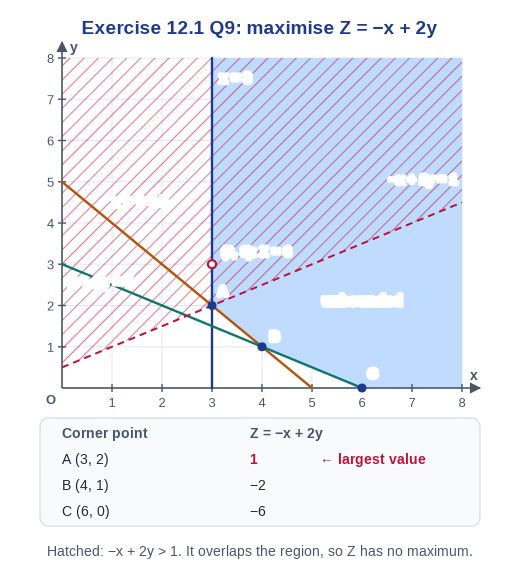
9. “Maximise Z = – x + 2y, subject to the constraints: x ≥ 3, x + y ≥ 5, x + 2y ≥ 6, y ≥ 0.”
All the constraints are “at least”, so the region is unbounded. Corners:
- A: x = 3 meets x + y = 5, so A = (3, 2);
- B: x + y = 5 meets x + 2y = 6, so y = 1 and B = (4, 1);
- C: x + 2y = 6 meets the x-axis at (6, 0).
| Corner point | Z = −x + 2y |
|---|---|
| (3, 2) | 1 |
| (4, 1) | −2 |
| (6, 0) | −6 |
The largest corner value is 1, but the region is unbounded, so test the open half-plane −x + 2y > 1. It does share points with the region: (3, 3) satisfies x ≥ 3, x + y = 6 ≥ 5 and x + 2y = 9 ≥ 6, and gives Z = −3 + 6 = 3 > 1. In fact, on the feasible line x = 3, Z = 2y − 3 grows without end. So Z has no maximum value.
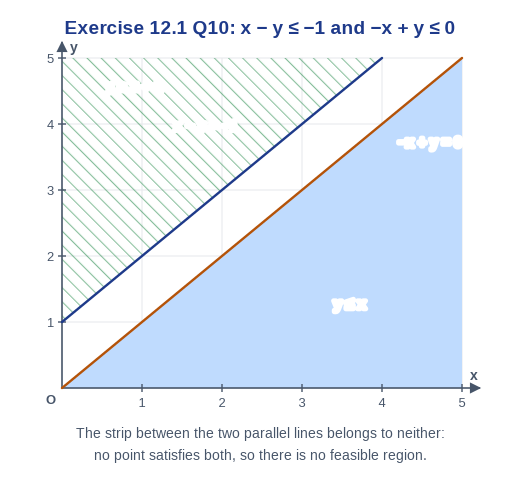
10. “Maximise Z = x + y, subject to x – y ≤ –1, –x + y ≤ 0, x, y ≥ 0.”
The first constraint says y ≥ x + 1 and the second says y ≤ x. A number y cannot be both at least x + 1 and at most x, so no point satisfies both. The lines y = x + 1 and y = x are parallel, and the half-planes lie on opposite sides of the strip between them. There is no feasible region, so Z has no maximum value.
Notes on the book
- All answers match the key. Exercise 12.1: 16 at (0, 4); −12 at (4, 0); 235/19 at (20/19, 45/19); 7 at (3/2, 1/2); 18 at (4, 3); 6 along the segment from (6, 0) to (0, 3); minimum 300 at (60, 0) and maximum 600 along the segment from (120, 0) to (60, 30); minimum 100 along the segment from (0, 50) to (20, 40) and maximum 400 at (0, 200); no maximum; no feasible region.
- Question 6: the constraint 2x + y ≥ 3 adds nothing to the region, because x + 2y ≥ 6 with x, y ≥ 0 already forces it; its line only touches the region at the corner (0, 3).
- Steps of the corner point method (page 399): the book numbers the check for unbounded regions as step 4, while Example 4 refers to it as step 3(ii). It is the same rule.
- Historical note (pages 404–405): the name Kantorovich is spelt “Katorovich” once, a printing slip.
Practice
-
Maximise Z = 2x + y subject to x + y ≤ 5, x ≥ 0, y ≥ 0. The maximum is:
Show answer
Answer: (b) 10
-
The constraints x + y ≤ 2 and x + y ≥ 5, with x, y ≥ 0, give:
Show answer
Answer: (c) no feasible region
-
Minimise Z = x + y subject to x + 2y ≥ 4, 2x + y ≥ 4, x ≥ 0, y ≥ 0. The minimum is:
Show answer
Answer: (b) 8/3
-
Maximise Z = x + 2y subject to x + y ≤ 6, x ≤ 4, x ≥ 0, y ≥ 0.
Show answer
Answer: The region is bounded, with corners (0, 0), (4, 0), (4, 2) and (0, 6); (4, 2) comes from x = 4 and x + y = 6. Z = 0, 4, 8 and 12 there, so the maximum is 12 at (0, 6).
-
Show that Z = x + y has no maximum subject to x + y ≥ 1, x ≥ 0, y ≥ 0.
Show answer
Answer: The region is unbounded with corners (1, 0) and (0, 1), where Z = 1. The open half-plane x + y > 1 contains feasible points, for example (2, 2) with Z = 4, so 1 is not a maximum and Z has no maximum value.
Stuck on a question?
Take a photo and Lagnever AI explains it step by step. Try it for 7 days for ₹2.
Get it on Google Play Open in browser
For parents: after the trial, the plan renews monthly by UPI or card autopay. You can cancel anytime in the app.