
NCERT Solutions Class 12 Maths Chapter 13: Probability
Answers to every question of Exercises 13.1, 13.2 and 13.3 and the Miscellaneous Exercise (62 questions in all) and to the 24 worked examples of Chapter 13, Probability, of Mathematics Part II, the Class 12 NCERT textbook. Page numbers follow the 2026-27 reprint (pages 406–438). The exercise questions are quoted from the book; the examples are restated in short and labelled by number and page. Every answer below was checked by a script that lists the sample spaces where possible and works with exact fractions; all of them agree with the book’s answer key. Short notes: Chapter 13 notes.
How the maths is typed here. P(E|F) is “the probability of E given F”. E′ is “not E”, ∩ is “and”, ∪ is “or”, and φ is the empty set. Fractions are written with a slash, so 3/7 is three sevenths. In two-dice questions an outcome (a, b) means a on the first die and b on the second.
The tools used throughout:
- Conditional probability: P(E|F) = P(E ∩ F)/P(F), P(F) ≠ 0; with equally likely outcomes, n(E ∩ F)/n(F).
- Multiplication rule: P(E ∩ F) = P(E) P(F|E) = P(F) P(E|F).
- Independence: P(E ∩ F) = P(E) P(F).
- Total probability and Bayes: for a partition E₁, …, Eₙ, P(A) = Σ P(Eⱼ) P(A|Eⱼ) and P(Eᵢ|A) = P(Eᵢ) P(A|Eᵢ)/P(A).
In-text questions of Section 13.2 (pages 406–411)
Three coins (pages 406–407). E = at least two heads = {HHH, HHT, HTH, THH}, F = first coin tail = {THH, THT, TTH, TTT}. Why is P(E) = 1/2? E has 4 of the 8 equally likely outcomes, each of probability 1/8, and 4 × 1/8 = 1/2. Given F, only THH of F’s 4 outcomes is in E, so P(E|F) = 1/4.
Why must P(F) ≠ 0 in P(E|F) = P(E ∩ F)/P(F) (page 408)? P(F) is the denominator, and division by 0 is not defined. Also, P(F) = 0 means F is impossible (F = φ for equally likely outcomes), so there is nothing to condition on.
Why is P(E ∩ F) = 0.043 in Example 4 (page 411)? E ∩ F is “a girl in Class XII”. 10% of the 430 girls is 43 students out of 1000, so P(E ∩ F) = 43/1000 = 0.043.
Examples 1 to 24 (pages 409–435)
Example 1 (page 409): P(A) = 7/13, P(B) = 9/13, P(A ∩ B) = 4/13; find P(A|B). P(A|B) = (4/13)/(9/13) = 4/9.
Example 2 (pages 409–410): two children, at least one a boy; probability both are boys. S = {bb, gb, bg, gg}. F = at least one boy = {bb, gb, bg}, E ∩ F = {bb}. P(E|F) = (1/4)/(3/4) = 1/3.
Example 3 (page 410): cards 1 to 10, the number drawn is more than 3; probability it is even. B = {4, …, 10} has 7 cards; the even ones in B are 4, 6, 8, 10. P(A|B) = (4/10)/(7/10) = 4/7.
Example 4 (pages 410–411): 1000 students, 430 girls, 10% of the girls in Class XII; probability that a randomly chosen girl is in Class XII. P(girl) = 0.43 and P(girl in XII) = 43/1000 = 0.043. P(XII | girl) = 0.043/0.43 = 0.1.
Example 5 (page 411): a die thrown three times; P(4 on the third throw | 6 then 5 on the first two). n(S) = 216. B = {(6, 5, k)}: 6 outcomes. A ∩ B = {(6, 5, 4)}. P(A|B) = (1/216)/(6/216) = 1/6.
Example 6 (pages 411–412): two dice, sum 6; probability that a 4 appears at least once. F = {(1, 5), (2, 4), (3, 3), (4, 2), (5, 1)}, and E (a 4 at least once) has 11 outcomes. E ∩ F = {(2, 4), (4, 2)}. P(E|F) = (2/36)/(5/36) = 2/5.
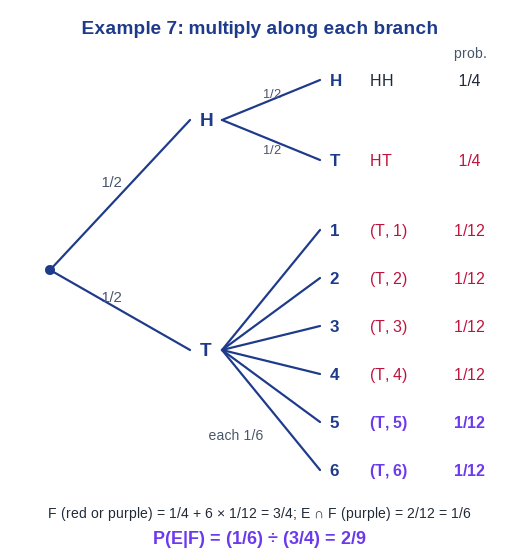
Example 7 (pages 412–413): toss a coin; a head means toss again, a tail means throw a die. P(die shows more than 4 | at least one tail). HH and HT each have probability 1/4; each (T, k) has 1/2 × 1/6 = 1/12. F = at least one tail: P(F) = 1/4 + 6 × 1/12 = 3/4. E ∩ F = {(T, 5), (T, 6)}: probability 1/6. P(E|F) = (1/6)/(3/4) = 2/9.
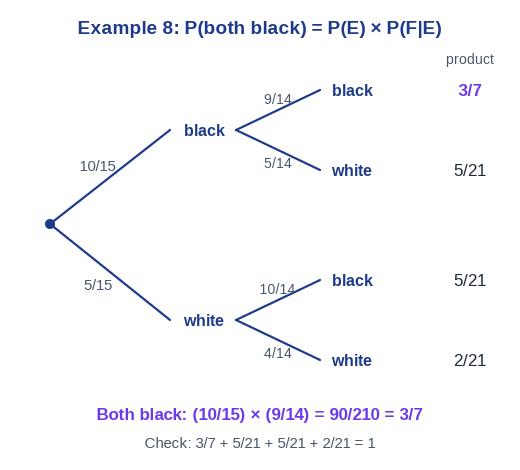
Example 8 (pages 415–416): urn with 10 black and 5 white balls, two drawn without replacement; probability both are black. P(first black) = 10/15; then 9 black remain among 14, so P(second black | first black) = 9/14. P = 10/15 × 9/14 = 3/7.
Example 9 (pages 416–417): three cards without replacement; probability of king, king, then ace. P(K) = 4/52, P(K|K) = 3/51, P(A|KK) = 4/50. P(KKA) = 4/52 × 3/51 × 4/50 = 2/5525.
Example 10 (page 419): one die; E = multiple of 3, F = even. Independent? E = {3, 6}, F = {2, 4, 6}, E ∩ F = {6}. P(E) P(F) = 1/3 × 1/2 = 1/6 = P(E ∩ F), so E and F are independent.
Example 11 (page 419): a die thrown twice; A = odd on the first throw, B = odd on the second. Independent? P(A) = P(B) = 18/36 = 1/2 and P(A ∩ B) = 9/36 = 1/4 = 1/2 × 1/2. Independent.
Example 12 (pages 419–420): three coins; E = all three coins alike (HHH or TTT), F = at least two heads, G = at most two heads. Which pairs are independent? P(E) = 2/8 = 1/4, P(F) = 4/8 = 1/2, P(G) = 7/8. E ∩ F = {HHH}, E ∩ G = {TTT}, F ∩ G = {HHT, HTH, THH}.
- P(E ∩ F) = 1/8 = 1/4 × 1/2: E, F independent.
- P(E ∩ G) = 1/8 but P(E) P(G) = 7/32: E, G dependent.
- P(F ∩ G) = 3/8 but P(F) P(G) = 7/16: F, G dependent.
Example 13 (page 420): if E and F are independent, prove that E and F′ are independent. E is the union of the disjoint events E ∩ F and E ∩ F′, so P(E ∩ F′) = P(E) − P(E ∩ F) = P(E) − P(E) P(F) = P(E)[1 − P(F)] = P(E) P(F′). Hence E and F′ are independent. The same steps show E′, F and E′, F′ are independent.
Example 14 (page 421): for independent A and B, show P(at least one) = 1 − P(A′) P(B′). P(A ∪ B) = P(A) + P(B) − P(A) P(B) = P(A) + P(B)[1 − P(A)] = 1 − P(A′) + P(B) P(A′) = 1 − P(A′)[1 − P(B)] = 1 − P(A′) P(B′).
Example 15 (page 425): P(strike) = 0.65; job on time with probability 0.32 if a strike, 0.80 if not. Probability the job is on time. By total probability: 0.65 × 0.32 + 0.35 × 0.80 = 0.208 + 0.28 = 0.488.
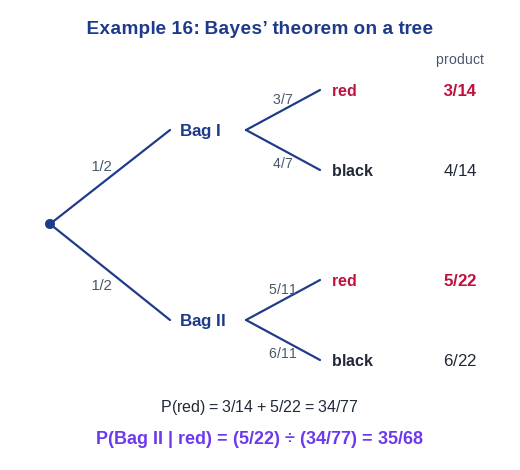
Example 16 (page 426): Bag I has 3 red and 4 black, Bag II has 5 red and 6 black; a bag is chosen at random and a red ball drawn. P(Bag II | red). P(E₂|A) = (½ × 5/11)/(½ × 3/7 + ½ × 5/11) = (5/22)/(34/77) = 35/68.
Example 17 (pages 426–427): boxes with two gold coins, two silver coins, and one of each; a box is chosen and a gold coin drawn. Probability the other coin is gold. The other coin is gold only for box I. P(E₁|A) = (⅓ × 1)/(⅓ × 1 + ⅓ × 0 + ⅓ × ½) = (1/3)/(1/2) = 2/3.
Example 18 (pages 427–428): a test detects 90% of people with HIV and wrongly shows positive for 1% of people without it; 0.1% of the population has HIV. A person tests positive; probability the person has HIV. P(E|A) = (0.001 × 0.9)/(0.001 × 0.9 + 0.999 × 0.01) = 0.0009/0.01089 = 90/1089 ≈ 0.083.
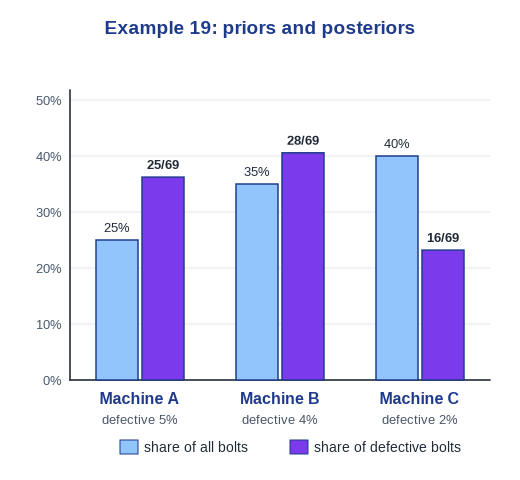
Example 19 (pages 428–429): machines A, B, C make 25%, 35%, 40% of the bolts, with 5%, 4%, 2% defective. A defective bolt is found; probability it came from B. P(defective) = 0.25 × 0.05 + 0.35 × 0.04 + 0.40 × 0.02 = 0.0125 + 0.014 + 0.008 = 0.0345. P(B₂|E) = 0.014/0.0345 = 28/69. (For A and C the same method gives 25/69 and 16/69.)
Example 20 (page 429): a doctor comes by train, bus, scooter or other means with probabilities 3/10, 1/5, 1/10, 2/5, and is late with probabilities 1/4, 1/3, 1/12, 0. He is late; probability he came by train. Products: 3/40, 1/15, 1/120, 0, which add to 18/120 = 3/20. P(T₁|E) = (3/40)/(3/20) = 1/2.
Example 21 (page 430): a man tells the truth 3 times out of 4, throws a die and reports a six. Probability it is a six. P(S₁|E) = (1/6 × 3/4)/(1/6 × 3/4 + 5/6 × 1/4) = (3/24)/(8/24) = 3/8.
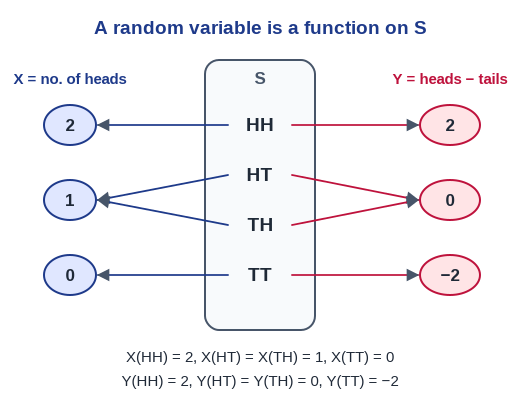
Remark (pages 430–431): random variables. For two tosses, X = number of heads gives X(HH) = 2, X(HT) = X(TH) = 1, X(TT) = 0, and Y = heads minus tails gives Y(HH) = 2, Y(HT) = Y(TH) = 0, Y(TT) = −2: two random variables on one sample space.
Example 22 (pages 433–434): four boxes of coloured balls (the book’s table); a box is chosen at random and a black ball drawn. Probability it came from box III. From the table, P(black) in boxes I to IV is 3/18, 2/8, 1/7 and 4/13, each box with prior 1/4. P(E₃|A) = (1/7)/(3/18 + 2/8 + 1/7 + 4/13) = 156/947 ≈ 0.165.
Example 23 (page 434): A and B throw a die in turns, A first, until someone gets a 6. Probability that each one gets the first 6. This is a turn-taking problem with a geometric series. A gets the first 6 on throw 1, 3, 5, …: P = 1/6 + (5/6)² (1/6) + (5/6)⁴ (1/6) + … = (1/6)/(1 − 25/36) = 6/11. So B gets it first with probability 1 − 6/11 = 5/11.
Example 24 (page 435): a correct set-up (probability 0.8) gives 90% acceptable items, a wrong one 40%. After 2 acceptable items, probability the set-up is correct. P(B₁|A) = (0.8 × 0.9 × 0.9)/(0.8 × 0.81 + 0.2 × 0.4 × 0.4) = 0.648/0.68 = 648/680 ≈ 0.95.
Exercise 13.1 (pages 413–415)
1. “Given that E and F are events such that P(E) = 0.6, P(F) = 0.3 and P(E ∩ F) = 0.2, find P(E|F) and P(F|E)”
P(E|F) = 0.2/0.3 = 2/3; P(F|E) = 0.2/0.6 = 1/3.
2. “Compute P(A|B), if P(B) = 0.5 and P(A ∩ B) = 0.32”
P(A|B) = 0.32/0.5 = 0.64 = 16/25.
3. “If P(A) = 0.8, P(B) = 0.5 and P(B|A) = 0.4, find (i) P(A ∩ B) (ii) P(A|B) (iii) P(A ∪ B)”
(i) P(A ∩ B) = P(A) P(B|A) = 0.8 × 0.4 = 0.32. (ii) P(A|B) = 0.32/0.5 = 0.64. (iii) P(A ∪ B) = 0.8 + 0.5 − 0.32 = 0.98.
4. “Evaluate P(A ∪ B), if 2P(A) = P(B) = 5/13 and P(A|B) = 2/5”
P(B) = 5/13 and P(A) = 5/26. P(A ∩ B) = P(B) P(A|B) = 5/13 × 2/5 = 2/13 = 4/26. P(A ∪ B) = 5/26 + 10/26 − 4/26 = 11/26.
5. “If P(A) = 6/11, P(B) = 5/11 and P(A ∪ B) = 7/11, find (i) P(A∩B) (ii) P(A|B) (iii) P(B|A)”
(i) P(A ∩ B) = 6/11 + 5/11 − 7/11 = 4/11. (ii) P(A|B) = (4/11)/(5/11) = 4/5. (iii) P(B|A) = (4/11)/(6/11) = 2/3.
Book’s instruction for Questions 6 to 9: “Determine P(E|F) in Exercises 6 to 9.”
6. “A coin is tossed three times, where (i) E : head on third toss , F : heads on first two tosses (ii) E : at least two heads , F : at most two heads (iii) E : at most two tails , F : at least one tail”
S has 8 equally likely outcomes. (i) F = {HHH, HHT}; E ∩ F = {HHH}. P(E|F) = 1/2. (ii) F (at most two heads) = all but HHH: 7 outcomes. E ∩ F = {HHT, HTH, THH}. P(E|F) = 3/7. (iii) F (at least one tail) = all but HHH: 7 outcomes. E (at most two tails) = all but TTT, so E ∩ F has 6 outcomes. P(E|F) = 6/7.
7. “Two coins are tossed once, where (i) E : tail appears on one coin, F : one coin shows head (ii) E : no tail appears, F : no head appears”
S = {HH, HT, TH, TT}. (i) E = F = {HT, TH} (exactly one tail is the same as exactly one head). P(E|F) = 1. (ii) F = {TT}, E = {HH}, E ∩ F = φ. P(E|F) = 0.
8. “A die is thrown three times, E : 4 appears on the third toss, F : 6 and 5 appears respectively on first two tosses”
F = {(6, 5, k): k = 1, …, 6} has 6 outcomes and E ∩ F = {(6, 5, 4)}. P(E|F) = 1/6.
9. “Mother, father and son line up at random for a family picture E : son on one end, F : father in middle”
There are 3! = 6 orders. F = {MFS, SFM}. In both, the son stands at an end, so E ∩ F = F. P(E|F) = 1.
10. “A black and a red dice are rolled. (a) Find the conditional probability of obtaining a sum greater than 9, given that the black die resulted in a 5. (b) Find the conditional probability of obtaining the sum 8, given that the red die resulted in a number less than 4.”
(a) Black die 5: 6 outcomes. Sum more than 9 needs the red die to show 5 or 6: 2 outcomes. P = 1/3. (b) Red die 1, 2 or 3: 18 outcomes. Sum 8 with red 2 or 3 needs black 6 or 5: (6, 2) and (5, 3), 2 outcomes (red 1 would need black 7). P = 2/18 = 1/9.
11. “A fair die is rolled. Consider events E = {1,3,5}, F = {2,3} and G = {2,3,4,5} Find (i) P(E|F) and P(F|E) (ii) P(E|G) and P(G|E) (iii) P((E ∪ F)|G) and P((E ∩ F)|G)”
E ∩ F = {3}, E ∩ G = {3, 5}, E ∪ F = {1, 2, 3, 5}. (i) P(E|F) = 1/2; P(F|E) = 1/3. So 1/2, 1/3. (ii) P(E|G) = 2/4 = 1/2; P(G|E) = 2/3. So 1/2, 2/3. (iii) (E ∪ F) ∩ G = {2, 3, 5}: P((E ∪ F)|G) = 3/4. (E ∩ F) ∩ G = {3}: P((E ∩ F)|G) = 1/4.
12. “Assume that each born child is equally likely to be a boy or a girl. If a family has two children, what is the conditional probability that both are girls given that (i) the youngest is a girl, (ii) at least one is a girl?”
Write (elder, younger): S = {bb, bg, gb, gg}. (i) Youngest a girl: {bg, gg}. P(gg | this) = 1/2. (ii) At least one girl: {bg, gb, gg}. P(gg | this) = 1/3.
13. “An instructor has a question bank consisting of 300 easy True / False questions, 200 difficult True / False questions, 500 easy multiple choice questions and 400 difficult multiple choice questions. If a question is selected at random from the question bank, what is the probability that it will be an easy question given that it is a multiple choice question?”
Multiple choice questions: 500 + 400 = 900, of which 500 are easy. P(easy | multiple choice) = 500/900 = 5/9.
14. “Given that the two numbers appearing on throwing two dice are different. Find the probability of the event ‘the sum of numbers on the dice is 4’.”
Different numbers: 36 − 6 = 30 outcomes. Sum 4 with different numbers: (1, 3) and (3, 1); (2, 2) is excluded. P = 2/30 = 1/15.
15. “Consider the experiment of throwing a die, if a multiple of 3 comes up, throw the die again and if any other number comes, toss a coin. Find the conditional probability of the event ‘the coin shows a tail’, given that ‘at least one die shows a 3’.”
If any die shows a 3, the first throw was 3 or 6, so the die was thrown again and no coin was tossed. The event “coin shows a tail” cannot happen together with “at least one die shows a 3”, so P(E ∩ F) = 0 while P(F) = 7/36 ≠ 0. P(E|F) = 0.
Book’s instruction: “In each of the Exercises 16 and 17 choose the correct answer:”
16. “If P(A) = 1/2, P(B) = 0, then P(A|B) is (A) 0 (B) 1/2 (C) not defined (D) 1”
P(A|B) = P(A ∩ B)/P(B) needs P(B) ≠ 0. Here P(B) = 0, so it is not defined: (C).
17. “If A and B are events such that P(A|B) = P(B|A), then (A) A ⊂ B but A ≠ B (B) A = B (C) A ∩ B = φ (D) P(A) = P(B)”
P(A ∩ B)/P(B) = P(A ∩ B)/P(A). With P(A ∩ B) ≠ 0, this gives P(A) = P(B). (D).
Exercise 13.2 (pages 421–423)
1. “If P(A) = 3/5 and P(B) = 1/5, find P(A ∩ B) if A and B are independent events.”
P(A ∩ B) = 3/5 × 1/5 = 3/25.
2. “Two cards are drawn at random and without replacement from a pack of 52 playing cards. Find the probability that both the cards are black.”
P = 26/52 × 25/51 = 25/102.
3. “A box of oranges is inspected by examining three randomly selected oranges drawn without replacement. If all the three oranges are good, the box is approved for sale, otherwise, it is rejected. Find the probability that a box containing 15 oranges out of which 12 are good and 3 are bad ones will be approved for sale.”
P(all three good) = 12/15 × 11/14 × 10/13 = 1320/2730 = 44/91.
4. “A fair coin and an unbiased die are tossed. Let A be the event ‘head appears on the coin’ and B be the event ‘3 on the die’. Check whether A and B are independent events or not.”
S has 12 outcomes. P(A) = 1/2, P(B) = 1/6 and P(A ∩ B) = P({(H, 3)}) = 1/12 = 1/2 × 1/6. A and B are independent.
5. “A die marked 1, 2, 3 in red and 4, 5, 6 in green is tossed. Let A be the event, ‘the number is even,’ and B be the event, ‘the number is red’. Are A and B independent?”
A = {2, 4, 6}, B = {1, 2, 3}, A ∩ B = {2}. P(A ∩ B) = 1/6, but P(A) P(B) = 1/2 × 1/2 = 1/4. Not independent.
6. “Let E and F be events with P(E) = 3/5, P(F) = 3/10 and P(E ∩ F) = 1/5. Are E and F independent?”
P(E) P(F) = 9/50, but P(E ∩ F) = 1/5 = 10/50. Not independent.
7. “Given that the events A and B are such that P(A) = 1/2, P(A ∪ B) = 3/5 and P(B) = p. Find p if they are (i) mutually exclusive (ii) independent.”
(i) P(A ∪ B) = P(A) + P(B): 3/5 = 1/2 + p, so p = 1/10. (ii) P(A ∪ B) = P(A) + P(B) − P(A) P(B): 3/5 = 1/2 + p − p/2 = 1/2 + p/2, so p/2 = 1/10 and p = 1/5.
8. “Let A and B be independent events with P(A) = 0.3 and P(B) = 0.4. Find (i) P(A ∩ B) (ii) P(A ∪ B) (iii) P(A|B) (iv) P(B|A)”
(i) 0.3 × 0.4 = 0.12. (ii) 0.3 + 0.4 − 0.12 = 0.58. (iii) P(A|B) = P(A) = 0.3. (iv) P(B|A) = P(B) = 0.4.
9. “If A and B are two events such that P(A) = 1/4, P(B) = 1/2 and P(A ∩ B) = 1/8, find P (not A and not B).”
P(A ∪ B) = 1/4 + 1/2 − 1/8 = 5/8. P(A′ ∩ B′) = 1 − P(A ∪ B) = 3/8.
10. “Events A and B are such that P (A) = 1/2, P(B) = 7/12 and P(not A or not B) = 1/4. State whether A and B are independent ?”
P(A′ ∪ B′) = 1 − P(A ∩ B), so P(A ∩ B) = 3/4. But P(A) P(B) = 7/24 ≠ 3/4. A and B are not independent. (See the note at the end: these numbers cannot all hold together.)
11. “Given two independent events A and B such that P(A) = 0.3, P(B) = 0.6. Find (i) P(A and B) (ii) P(A and not B) (iii) P(A or B) (iv) P(neither A nor B)”
(i) 0.3 × 0.6 = 0.18. (ii) A and B′ are independent: 0.3 × 0.4 = 0.12. (iii) 0.3 + 0.6 − 0.18 = 0.72. (iv) 1 − 0.72 = 0.28 (or 0.7 × 0.4).
12. “A die is tossed thrice. Find the probability of getting an odd number at least once.”
P(no odd number in three throws) = (1/2)³ = 1/8, the throws being independent. P(at least one odd) = 1 − 1/8 = 7/8.
13. “Two balls are drawn at random with replacement from a box containing 10 black and 8 red balls. Find the probability that (i) both balls are red. (ii) first ball is black and second is red. (iii) one of them is black and other is red.”
With replacement the draws are independent: P(red) = 8/18 = 4/9, P(black) = 10/18 = 5/9. (i) 4/9 × 4/9 = 16/81. (ii) 5/9 × 4/9 = 20/81. (iii) black-red or red-black: 2 × 20/81 = 40/81.
14. “Probability of solving specific problem independently by A and B are 1/2 and 1/3 respectively. If both try to solve the problem independently, find the probability that (i) the problem is solved (ii) exactly one of them solves the problem.”
(i) 1 − P(neither) = 1 − 1/2 × 2/3 = 2/3. (ii) P(A only) + P(B only) = 1/2 × 2/3 + 1/2 × 1/3 = 1/3 + 1/6 = 1/2.
15. “One card is drawn at random from a well shuffled deck of 52 cards. In which of the following cases are the events E and F independent ? (i) E : ‘the card drawn is a spade’ F : ‘the card drawn is an ace’ (ii) E : ‘the card drawn is black’ F : ‘the card drawn is a king’ (iii) E : ‘the card drawn is a king or queen’ F : ‘the card drawn is a queen or jack’.”
(i) P(E ∩ F) = 1/52 = 1/4 × 1/13: independent. (ii) P(E ∩ F) = 2/52 = 1/26 = 1/2 × 1/13: independent. (iii) P(E) = P(F) = 8/52 = 2/13, and E ∩ F = the 4 queens, P = 1/13. But 2/13 × 2/13 = 4/169 ≠ 1/13: not independent. E and F are independent in (i) and (ii).
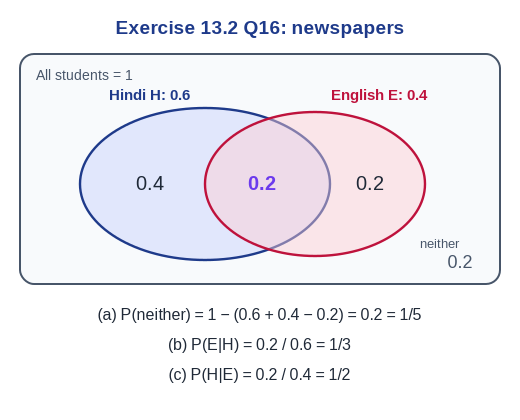
16. “In a hostel, 60% of the students read Hindi newspaper, 40% read English newspaper and 20% read both Hindi and English newspapers. A student is selected at random. (a) Find the probability that she reads neither Hindi nor English newspapers. (b) If she reads Hindi newspaper, find the probability that she reads English newspaper. (c) If she reads English newspaper, find the probability that she reads Hindi newspaper.”
P(H) = 0.6, P(E) = 0.4, P(H ∩ E) = 0.2. (a) P(neither) = 1 − (0.6 + 0.4 − 0.2) = 0.2 = 1/5. (b) P(E|H) = 0.2/0.6 = 1/3. (c) P(H|E) = 0.2/0.4 = 1/2.
Book’s instruction: “Choose the correct answer in Exercises 17 and 18.”
17. “The probability of obtaining an even prime number on each die, when a pair of dice is rolled is (A) 0 (B) 1/3 (C) 1/12 (D) 1/36”
The only even prime on a die is 2. P(2 on both) = 1/6 × 1/6 = 1/36. (D).
18. “Two events A and B will be independent, if (A) A and B are mutually exclusive (B) P(A′B′) = [1 – P(A)] [1 – P(B)] (C) P(A) = P(B) (D) P(A) + P(B) = 1”
Check option (B). P(A′B′) means P(not A and not B).
- “Not A and not B” is the same as “not (A or B)”, so P(A′B′) = 1 − P(A ∪ B) = 1 − P(A) − P(B) + P(A ∩ B).
- The right side is [1 − P(A)][1 − P(B)] = 1 − P(A) − P(B) + P(A) P(B).
- The two sides are equal exactly when P(A ∩ B) = P(A) P(B), which is the test for independence.
The other options do not force independence: mutually exclusive events with non-zero probabilities are never independent, and (C) and (D) say nothing about P(A ∩ B). Answer (B).
Exercise 13.3 (pages 431–433)
1. “An urn contains 5 red and 5 black balls. A ball is drawn at random, its colour is noted and is returned to the urn. Moreover, 2 additional balls of the colour drawn are put in the urn and then a ball is drawn at random. What is the probability that the second ball is red?”
If the first is red (1/2), the urn has 7 red, 5 black; if black (1/2), 5 red, 7 black. By total probability, P(second red) = 1/2 × 7/12 + 1/2 × 5/12 = 1/2.
2. “A bag contains 4 red and 4 black balls, another bag contains 2 red and 6 black balls. One of the two bags is selected at random and a ball is drawn from the bag which is found to be red. Find the probability that the ball is drawn from the first bag.”
P(red) = 1/2 × 4/8 + 1/2 × 2/8 = 1/4 + 1/8 = 3/8. P(first bag | red) = (1/4)/(3/8) = 2/3.
3. “Of the students in a college, it is known that 60% reside in hostel and 40% are day scholars (not residing in hostel). Previous year results report that 30% of all students who reside in hostel attain A grade and 20% of day scholars attain A grade in their annual examination. At the end of the year, one student is chosen at random from the college and he has an A grade, what is the probability that the student is a hostlier?”
P(A grade) = 0.6 × 0.3 + 0.4 × 0.2 = 0.18 + 0.08 = 0.26. P(hosteller | A grade) = 0.18/0.26 = 9/13.
4. “In answering a question on a multiple choice test, a student either knows the answer or guesses. Let 3/4 be the probability that he knows the answer and 1/4 be the probability that he guesses. Assuming that a student who guesses at the answer will be correct with probability 1/4. What is the probability that the student knows the answer given that he answered it correctly?”
P(correct) = 3/4 × 1 + 1/4 × 1/4 = 13/16. P(knows | correct) = (3/4)/(13/16) = 12/13.
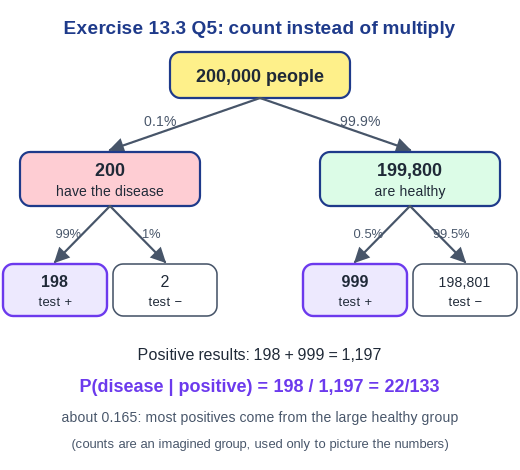
5. “A laboratory blood test is 99% effective in detecting a certain disease when it is in fact, present. However, the test also yields a false positive result for 0.5% of the healthy person tested (i.e. if a healthy person is tested, then, with probability 0.005, the test will imply he has the disease). If 0.1 percent of the population actually has the disease, what is the probability that a person has the disease given that his test result is positive ?”
P(disease) = 0.001, P(+ | disease) = 0.99, P(+ | healthy) = 0.005. P(+) = 0.001 × 0.99 + 0.999 × 0.005 = 0.00099 + 0.004995 = 0.005985. P(disease | +) = 0.00099/0.005985 = 22/133 (about 0.165).
6. “There are three coins. One is a two headed coin (having head on both faces), another is a biased coin that comes up heads 75% of the time and third is an unbiased coin. One of the three coins is chosen at random and tossed, it shows heads, what is the probability that it was the two headed coin ?”
P(head) = 1/3 × 1 + 1/3 × 3/4 + 1/3 × 1/2 = 1/3 × 9/4 = 3/4. P(two-headed | head) = (1/3)/(3/4) = 4/9.
7. “An insurance company insured 2000 scooter drivers, 4000 car drivers and 6000 truck drivers. The probability of an accidents are 0.01, 0.03 and 0.15 respectively. One of the insured persons meets with an accident. What is the probability that he is a scooter driver?”
Priors: 2000/12000 = 1/6, 4000/12000 = 1/3, 6000/12000 = 1/2. Products: 1/6 × 0.01 = 1/600, 1/3 × 0.03 = 6/600, 1/2 × 0.15 = 45/600; total 52/600. P(scooter | accident) = 1/52. 1/52.
8. “A factory has two machines A and B. Past record shows that machine A produced 60% of the items of output and machine B produced 40% of the items. Further, 2% of the items produced by machine A and 1% produced by machine B were defective. All the items are put into one stockpile and then one item is chosen at random from this and is found to be defective. What is the probability that it was produced by machine B?”
P(defective) = 0.6 × 0.02 + 0.4 × 0.01 = 0.012 + 0.004 = 0.016. P(B | defective) = 0.004/0.016 = 1/4.
9. “Two groups are competing for the position on the Board of directors of a corporation. The probabilities that the first and the second groups will win are 0.6 and 0.4 respectively. Further, if the first group wins, the probability of introducing a new product is 0.7 and the corresponding probability is 0.3 if the second group wins. Find the probability that the new product introduced was by the second group.”
P(new product) = 0.6 × 0.7 + 0.4 × 0.3 = 0.42 + 0.12 = 0.54. P(second group | new product) = 0.12/0.54 = 2/9.
10. “Suppose a girl throws a die. If she gets a 5 or 6, she tosses a coin three times and notes the number of heads. If she gets 1, 2, 3 or 4, she tosses a coin once and notes whether a head or tail is obtained. If she obtained exactly one head, what is the probability that she threw 1, 2, 3 or 4 with the die?”
P(5 or 6) = 1/3, and then P(exactly one head in three tosses) = 3/8. P(1 to 4) = 2/3, and then P(one head in one toss) = 1/2. P(exactly one head) = 1/3 × 3/8 + 2/3 × 1/2 = 1/8 + 1/3 = 11/24. P(1 to 4 | one head) = (1/3)/(11/24) = 8/11.
11. “A manufacturer has three machine operators A, B and C. The first operator A produces 1% defective items, where as the other two operators B and C produce 5% and 7% defective items respectively. A is on the job for 50% of the time, B is on the job for 30% of the time and C is on the job for 20% of the time. A defective item is produced, what is the probability that it was produced by A?”
P(defective) = 0.5 × 0.01 + 0.3 × 0.05 + 0.2 × 0.07 = 0.005 + 0.015 + 0.014 = 0.034. P(A | defective) = 0.005/0.034 = 5/34.
12. “A card from a pack of 52 cards is lost. From the remaining cards of the pack, two cards are drawn and are found to be both diamonds. Find the probability of the lost card being a diamond.”
Lost card a diamond (1/4): 12 diamonds remain among 51, P(two diamonds) = ¹²C₂/⁵¹C₂ = 66/1275. Lost card not a diamond (3/4): 13 diamonds remain, P = ¹³C₂/⁵¹C₂ = 78/1275. P(lost diamond | two diamonds) = (1/4 × 66)/(1/4 × 66 + 3/4 × 78) = 66/(66 + 234) = 66/300 = 11/50.
13. “Probability that A speaks truth is 4/5. A coin is tossed. A reports that a head appears. The probability that actually there was head is (A) 4/5 (B) 1/2 (C) 1/5 (D) 2/5”
P(head | reports head) = (1/2 × 4/5)/(1/2 × 4/5 + 1/2 × 1/5) = (4/10)/(5/10) = 4/5. (A).
14. “If A and B are two events such that A ⊂ B and P(B) ≠ 0, then which of the following is correct? (A) P(A | B) = P(B)/P(A) (B) P(A|B) < P(A) (C) P(A|B) ≥ P(A) (D) None of these”
A ⊂ B gives A ∩ B = A, so P(A|B) = P(A)/P(B). Since 0 < P(B) ≤ 1, P(A)/P(B) ≥ P(A). (C).
Miscellaneous Exercise on Chapter 13 (pages 435–437)
1. “A and B are two events such that P (A) ≠ 0. Find P(B|A), if (i) A is a subset of B (ii) A ∩ B = φ”
(i) A ∩ B = A, so P(B|A) = P(A)/P(A) = 1. (ii) P(A ∩ B) = 0, so P(B|A) = 0.
2. “A couple has two children, (i) Find the probability that both children are males, if it is known that at least one of the children is male. (ii) Find the probability that both children are females, if it is known that the elder child is a female.”
(i) At least one male: {MM, MF, FM}; both male in 1 of 3: 1/3. (ii) Elder female: {FM, FF}; both female in 1 of 2: 1/2.
3. “Suppose that 5% of men and 0.25% of women have grey hair. A grey haired person is selected at random. What is the probability of this person being male? Assume that there are equal number of males and females.”
P(grey) = 1/2 × 0.05 + 1/2 × 0.0025 = 0.02625. P(male | grey) = 0.025/0.02625 = 20/21.
4. “Suppose that 90% of people are right-handed. What is the probability that at most 6 of a random sample of 10 people are right-handed?”
Take the 10 people as independent, each right-handed with probability 0.9. A particular set of r right-handed people (and 10 − r others) has probability (0.9)ʳ(0.1)¹⁰⁻ʳ, and there are ¹⁰Cᵣ such sets. So
P(at most 6) = 1 − P(7, 8, 9 or 10) = 1 − Σ (r = 7 to 10) ¹⁰Cᵣ (0.9)ʳ (0.1)¹⁰⁻ʳ.
The four terms are about 0.0574, 0.1937, 0.3874 and 0.3487, so the answer is about 0.0128. (This counting method is the binomial distribution, which is not a section of the 2026-27 chapter; the steps above use only independence and combinations from Class 11.)
5. “If a leap year is selected at random, what is the chance that it will contain 53 tuesdays?”
366 days = 52 weeks + 2 days, giving 52 Tuesdays plus two extra consecutive days. The extra pair is one of (Sun, Mon), (Mon, Tue), (Tue, Wed), (Wed, Thu), (Thu, Fri), (Fri, Sat), (Sat, Sun), all equally likely. Two of them contain a Tuesday, so P = 2/7.
6. “Suppose we have four boxes A,B,C and D containing coloured marbles as given below: [table: A has 1 red, 6 white, 3 black; B has 6 red, 2 white, 2 black; C has 8 red, 1 white, 1 black; D has 0 red, 6 white, 4 black] One of the boxes has been selected at random and a single marble is drawn from it. If the marble is red, what is the probability that it was drawn from box A?, box B?, box C?”
Each box has 10 marbles and prior 1/4. P(red) = 1/4 × (1/10 + 6/10 + 8/10 + 0) = 15/40. Then P(A | red) = 1/15, P(B | red) = 6/15 = 2/5, P(C | red) = 8/15. 1/15, 2/5, 8/15.
7. “Assume that the chances of a patient having a heart attack is 40%. It is also assumed that a meditation and yoga course reduce the risk of heart attack by 30% and prescription of certain drug reduces its chances by 25%. At a time a patient can choose any one of the two options with equal probabilities. It is given that after going through one of the two options the patient selected at random suffers a heart attack. Find the probability that the patient followed a course of meditation and yoga?”
With yoga the risk is 0.4 × 0.7 = 0.28; with the drug, 0.4 × 0.75 = 0.30. P(attack) = 1/2 × 0.28 + 1/2 × 0.30 = 0.29. P(yoga | attack) = 0.14/0.29 = 14/29.
8. “If each element of a second order determinant is either zero or one, what is the probability that the value of the determinant is positive? (Assume that the individual entries of the determinant are chosen independently, each value being assumed with probability 1/2 ).”
For the determinant with rows (a, b) and (c, d), the value is ad − bc, and there are 2⁴ = 16 equally likely choices. It is positive only when ad = 1 and bc = 0: a = d = 1 and (b, c) is (0, 0), (0, 1) or (1, 0). That is 3 cases, so P = 3/16.
9. “An electronic assembly consists of two subsystems, say, A and B. From previous testing procedures, the following probabilities are assumed to be known: P(A fails) = 0.2 P(B fails alone) = 0.15 P(A and B fail) = 0.15 Evaluate the following probabilities (i) P(A fails|B has failed) (ii) P(A fails alone)”
P(B fails) = P(B alone) + P(both) = 0.15 + 0.15 = 0.3. (i) P(A fails | B failed) = 0.15/0.3 = 0.5. (ii) P(A alone) = P(A fails) − P(both) = 0.2 − 0.15 = 0.05.
10. “Bag I contains 3 red and 4 black balls and Bag II contains 4 red and 5 black balls. One ball is transferred from Bag I to Bag II and then a ball is drawn from Bag II. The ball so drawn is found to be red in colour. Find the probability that the transferred ball is black.”
Red transferred (3/7): Bag II has 5 red, 5 black, P(red) = 5/10. Black transferred (4/7): Bag II has 4 red, 6 black, P(red) = 4/10. P(black transferred | red) = (4/7 × 4/10)/(3/7 × 5/10 + 4/7 × 4/10) = 16/(15 + 16) = 16/31.
Book’s instruction: “Choose the correct answer in each of the following:”
11. “If A and B are two events such that P(A) ≠ 0 and P(B | A) = 1, then (A) A ⊂ B (B) B ⊂ A (C) B = φ (D) A = φ”
P(B|A) = P(A ∩ B)/P(A) = 1 gives P(A ∩ B) = P(A). So the part of A that lies in B carries all of A’s probability: whenever A happens, B happens too. That is what A ⊂ B (A is a subset of B) expresses. Answer (A).
12. “If P(A|B) > P(A), then which of the following is correct : (A) P(B|A) < P(B) (B) P(A ∩ B) < P(A) . P(B) (C) P(B|A) > P(B) (D) P(B|A) = P(B)”
P(A ∩ B)/P(B) > P(A) gives P(A ∩ B) > P(A) P(B); dividing by P(A) gives P(B|A) > P(B). (C).
13. “If A and B are any two events such that P(A) + P(B) – P(A and B) = P(A), then (A) P(B|A) = 1 (B) P(A|B) = 1 (C) P(B|A) = 0 (D) P(A|B) = 0”
The condition gives P(B) = P(A ∩ B), so P(A|B) = P(A ∩ B)/P(B) = 1. (B).
Notes on the book
- All answers match the key. Exercise 13.1: 2/3, 1/3; 16/25; 0.32, 0.64, 0.98; 11/26; 4/11, 4/5, 2/3; 1/2, 3/7, 6/7; 1, 0; 1/6; 1; 1/3, 1/9; 1/2, 1/3, 1/2, 2/3, 3/4, 1/4; 1/2, 1/3; 5/9; 1/15; 0; C; D. Exercise 13.2: 3/25; 25/102; 44/91; independent; not; not; 1/10, 1/5; 0.12, 0.58, 0.3, 0.4; 3/8; not; 0.18, 0.12, 0.72, 0.28; 7/8; 16/81, 20/81, 40/81; 2/3, 1/2; (i) and (ii); 1/5, 1/3, 1/2; D; B. Exercise 13.3: 1/2; 2/3; 9/13; 12/13; 22/133; 4/9; 1/52; 1/4; 2/9; 8/11; 5/34; 11/50; A; C. Miscellaneous: 1, 0; 1/3, 1/2; 20/21; the sum in Q4; 2/7; 1/15, 2/5, 8/15; 14/29; 3/16; 0.5, 0.05; 16/31; A; C; B.
- Exercise 13.2 Q10: the data do not fit together. P(not A or not B) = 1/4 forces P(A ∩ B) = 3/4, which is larger than P(A) = 1/2, and that is impossible. The book’s expected answer, “not independent”, comes from comparing 3/4 with P(A) P(B) = 7/24.
- Miscellaneous Q4 needs the binomial method, which the rationalised chapter no longer teaches; the key gives the answer as a sum, and we worked it from independence and combinations.
- Leftover references: the introduction (page 406) and the historical note (page 438) still speak of the binomial distribution, and the introduction of probability distributions, mean and variance; these sections are not in the 2026-27 chapter.
- Section 13.5 (page 423) names the author of the theorem as “John Bayes”. Extra (not from the book): he is usually known as Thomas Bayes.
- Example 22 gives 0.165 as a rounded value; the exact answer is 156/947.
Practice
-
If P(E) = 0.6, P(F) = 0.3 and P(E ∩ F) = 0.2, then P(E|F) is:
Show answer
Answer: (b) 2/3
-
A and B are independent with P(A) = 0.3 and P(B) = 0.6. P(neither A nor B) is:
Show answer
Answer: (c) 0.28
-
If A ⊂ B and P(B) ≠ 0, which is always true?
Show answer
Answer: (b) P(A|B) ≥ P(A)
-
A die is thrown twice. Find the probability of an odd number on both throws, and say whether the two events are independent.
Show answer
Answer: P(odd first) = P(odd second) = 1/2 and P(odd on both) = 9/36 = 1/4 = 1/2 × 1/2. So the events are independent and the probability is 1/4.
-
Bag I has 1 red and 3 black balls, Bag II has 3 red and 1 black. A bag is chosen at random and a red ball is drawn. Find P(Bag I | red).
Show answer
Answer: P(red) = 1/2 × 1/4 + 1/2 × 3/4 = 1/2. P(Bag I | red) = (1/2 × 1/4)/(1/2) = 1/4.
Stuck on a question?
Take a photo and Lagnever AI explains it step by step. Try it for 7 days for ₹2.
Get it on Google Play Open in browser
For parents: after the trial, the plan renews monthly by UPI or card autopay. You can cancel anytime in the app.