
What are intrinsic and extrinsic semiconductors?
Answer in short
An intrinsic semiconductor is pure Si or Ge, whose carriers come only from heat, so n_e = n_h = n_i. An extrinsic semiconductor is doped: a pentavalent donor makes n-type material with electrons in the majority; a trivalent acceptor makes p-type with holes in the majority. Always n_e n_h = n_i².
Stuck on a question? Take a photo and Lagnever AI explains it step by step. Try it for 7 days for ₹2. Get it on Google Play
Bands decide the class of a solid
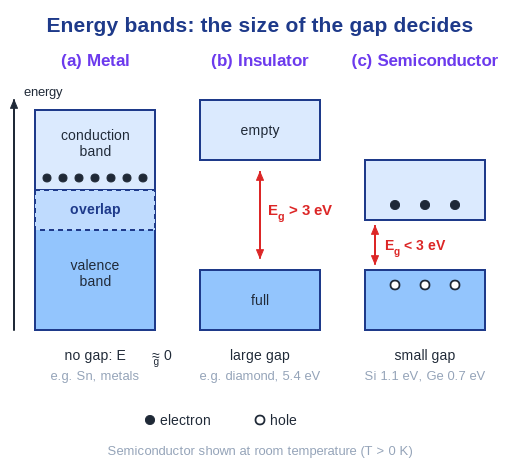
When atoms come together in a crystal, the sharp energy levels of single atoms spread into bands. Two matter here: the valence band, holding the valence electrons, and the conduction band above it, where electrons can move through the crystal. The band gap E_g separates them.
- Metal: the bands overlap, E_g ≈ 0, and many electrons can move.
- Insulator: E_g > 3 eV; heat cannot lift electrons across.
- Semiconductor: E_g < 3 eV; at room temperature a few electrons cross.
The book’s values are 5.4 eV for diamond, 1.1 eV for silicon and 0.7 eV for germanium. That is why carbon in the diamond lattice insulates while Si and Ge, with the same lattice, are semiconductors.
Intrinsic: pure silicon or germanium
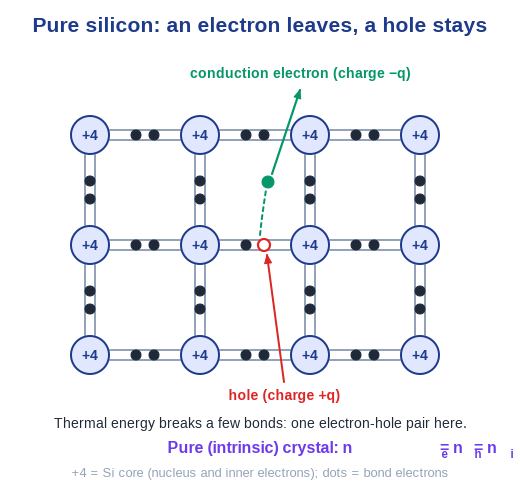
Each Si or Ge atom shares its four valence electrons with four neighbours in covalent bonds. At very low temperature all bonds are intact and nothing conducts. At room temperature heat breaks a few bonds. Each break gives:
- a conduction electron, charge −q, that moves through the crystal, and
- a hole, the vacancy left in the bond, with effective charge +q.
Because the two always come in pairs,
n_e = n_h = n_i
where n_i is the intrinsic carrier concentration. A hole moves when an electron in a neighbouring bond jumps into it; the vacancy then appears at that electron’s old site. Under an electric field holes drift towards the negative side, so the total current is I = I_e + I_h. Electrons and holes also recombine, and at equilibrium generation and recombination go on at equal rates.
Extrinsic: doping changes everything
A few parts per million of a suitable impurity raise the conductivity many times. The added atoms take ordinary lattice sites.
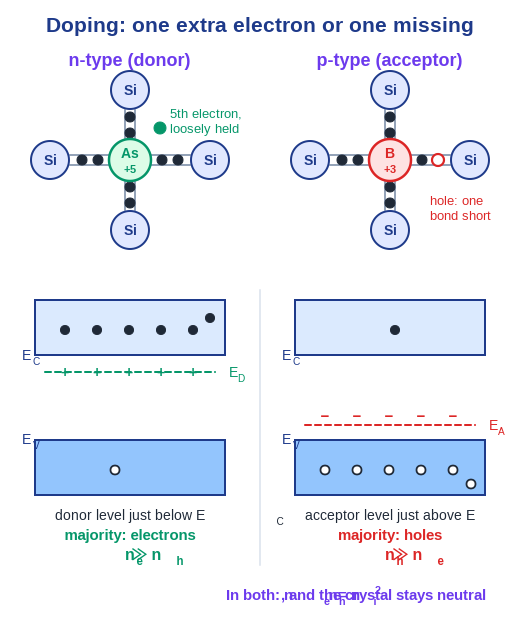
n-type (donor). A pentavalent atom such as As, Sb or P uses four electrons for bonds. The fifth is held so weakly, about 0.01 eV in Ge and 0.05 eV in Si, that at room temperature it is already loose. In band language, the donor level E_D lies just below E_C. Electrons are the majority carriers: n_e ≫ n_h.
p-type (acceptor). A trivalent atom such as B, Al or In has only three electrons for four bonds, so one bond keeps a hole. An electron from a nearby bond fills it, and the hole moves on. The acceptor level E_A lies just above E_V. Holes are the majority carriers: n_h ≫ n_e.
In both cases the crystal stays neutral. Each extra electron in n-type material is balanced by a positive donor core; each hole in p-type material by a negative acceptor core.
The mass-action law: n_e n_h = n_i²
Doping does not only add majority carriers. With so many of them around, the thermally made minority carriers recombine faster, so their number falls. In thermal equilibrium the product stays fixed:
n_e n_h = n_i²
Worked example (Example 14.2, page 332). Silicon has 5 × 10²⁸ atoms m⁻³ and is doped with 1 ppm of arsenic.
- Donors: N_D = 5 × 10²⁸ × 10⁻⁶ = 5 × 10²² m⁻³.
- Thermal electrons, about 10¹⁶ m⁻³, are negligible beside this, so n_e ≈ N_D = 5 × 10²² m⁻³.
- Holes: n_h = n_i²/n_e = (1.5 × 10¹⁶)²/(5 × 10²²) = (2.25 × 10³²)/(5 × 10²²) = 4.5 × 10⁹ m⁻³.
So doping one atom in a million raises the electron count from 1.5 × 10¹⁶ to 5 × 10²² m⁻³, more than three million times, while the holes fall to 4.5 × 10⁹ m⁻³.
Quick comparison
| Intrinsic | n-type | p-type | |
|---|---|---|---|
| Dopant | none | pentavalent (As, Sb, P) | trivalent (B, Al, In) |
| Majority carrier | none (equal) | electrons | holes |
| Extra level | none | E_D just below E_C | E_A just above E_V |
| Carriers | n_e = n_h = n_i | n_e ≫ n_h | n_h ≫ n_e |
Next, put a p region and an n region side by side in one crystal: that is the p-n junction diode. Back to the Chapter 14 notes.
Practice
-
Which of these is a donor impurity for silicon?
Show answer
Answer: (d) Phosphorus
-
In p-type silicon, the minority carriers are:
Show answer
Answer: (b) electrons
-
In equilibrium, a semiconductor with n_i = 1.5 × 10¹⁶ m⁻³ has n_e = 1.5 × 10²¹ m⁻³. Its hole concentration is:
Show answer
Answer: (a) 1.5 × 10¹¹ m⁻³
-
Germanium with 4 × 10²⁸ atoms m⁻³ is doped with 1 ppm of indium. Take n_i = 2.5 × 10¹⁹ m⁻³. Find n_h and n_e and say which type it is.
Show answer
Answer: N_A = 4 × 10²⁸ × 10⁻⁶ = 4 × 10²² m⁻³, far more than n_i, so n_h ≈ 4 × 10²² m⁻³. n_e = n_i²/n_h = (2.5 × 10¹⁹)²/(4 × 10²²) = 6.25 × 10³⁸/4 × 10²² ≈ 1.6 × 10¹⁶ m⁻³. Indium is trivalent, so the material is p-type.
Questions students ask
Why is the conductivity of a pure semiconductor so low at room temperature?
Only a tiny fraction of bonds are broken by heat at room temperature, so there are very few electrons and holes. For silicon the book gives n_i = 1.5 × 10¹⁶ m⁻³ against 5 × 10²⁸ atoms m⁻³: about one carrier pair for every three trillion atoms.
Why must the dopant atom be about the size of a silicon atom?
It has to sit in a lattice site of the crystal without distorting it. Elements from groups III and V next to silicon in the periodic table, such as boron, aluminium, phosphorus and arsenic, meet this condition.
Does heating increase the carriers from the dopant?
Hardly. At room temperature almost every donor or acceptor is already ionised, so the dopant's contribution depends on the doping level, not on temperature. What heat changes is the small number of thermally made electron-hole pairs.
Stuck on a question?
Take a photo and Lagnever AI explains it step by step. Try it for 7 days for ₹2.
Get it on Google Play Open in browser
For parents: after the trial, the plan renews monthly by UPI or card autopay. You can cancel anytime in the app.