
How do a resistor, an inductor and a capacitor respond to ac?
Answer in short
With v = v_m sin ωt, a resistor carries i = (v_m/R) sin ωt, in phase. In an inductor the current lags by π/2, limited by X_L = ωL. In a capacitor it leads by π/2, limited by X_C = 1/ωC. Only the resistor uses power.
Stuck on a question? Take a photo and Lagnever AI explains it step by step. Try it for 7 days for ₹2. Get it on Google Play
What happens in a resistor?
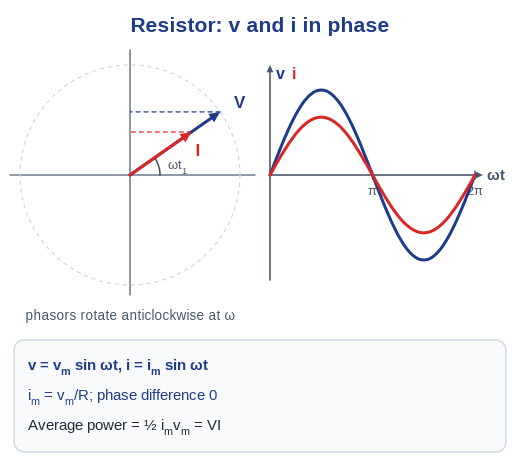
Connect a resistor R to an ac source whose voltage is v = vm sin ωt. Here vm is the peak value (amplitude) and ω = 2πν is the angular frequency. At every instant the loop rule gives v = iR, so
i = im sin ωt, with im = vm/R
Ohm’s law holds for ac too. Voltage and current rise, fall and cross zero together: they are in phase.
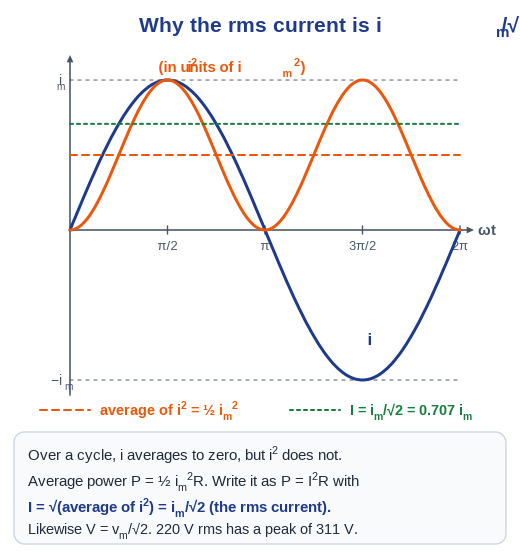
Over a whole cycle the current averages to zero. The heating does not, because the instantaneous power p = i²R = im²R sin² ωt is never negative. Since sin² ωt = ½(1 − cos 2ωt) and cos 2ωt averages to zero, the average of sin² ωt is ½ and
P = ½ im²R
What are rms values?
Writing this as P = I²R defines the rms (root mean square) or effective current I = im/√2 = 0.707 im. Likewise the rms voltage is V = vm/√2. With these, V = IR and P = VI = I²R = V²/R, in the same form as for dc. The rms current is the dc current that would heat the same resistor at the same average rate, and this is also how the ampere is understood for ac.
Values quoted for ac are rms values unless stated otherwise. The household 220 V has a peak of √2 × 220 ≈ 311 V. A bulb rated 100 W, 220 V has R = V²/P = 484 Ω, a peak supply voltage of 311 V and an rms current of P/V ≈ 0.45 A.
How do phasors show phase?
A phasor is an arrow that rotates anticlockwise about the origin with angular speed ω. Its length is a peak value, vm or im, and its projection on the vertical axis is the instantaneous value. Drawn at one moment t1, a phasor diagram shows how far apart in phase two quantities are: the angle between their arrows. For a resistor, V and I always point the same way. Phasors are only a drawing aid: voltage and current are scalars, but sine quantities of one frequency add just as the projections of rotating arrows do.
What happens in an inductor?
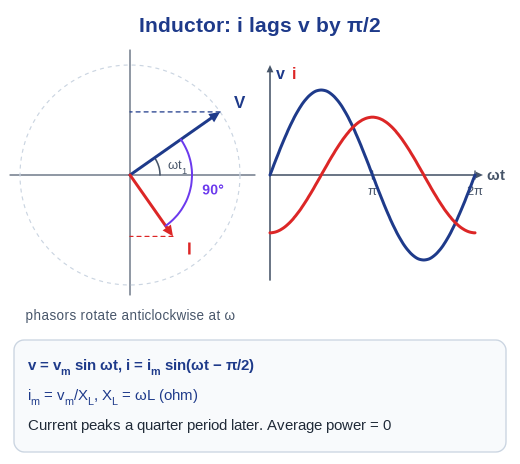
Take a pure inductor L (negligible resistance). Its self-induced emf, −L di/dt, opposes changes in current. The loop rule gives v = L di/dt, so di/dt = (vm/L) sin ωt. Integrating,
i = −(vm/ωL) cos ωt = im sin(ωt − π/2)
The constant of integration is zero because the current swings evenly about zero. The amplitude is im = vm/XL, where the inductive reactance is
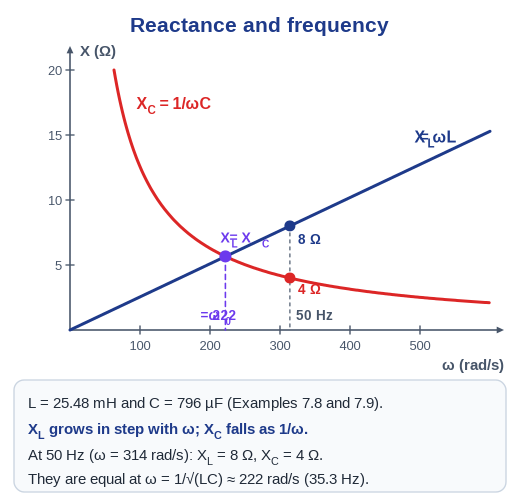
XL = ωL (unit: ohm)
The current lags the voltage by π/2, a quarter period. XL grows with both L and the frequency, so an inductor holds back high-frequency current more. The instantaneous power is p = −½ imvm sin 2ωt, which averages to zero. Energy flows into the magnetic field for a quarter cycle and back out in the next.
For 25.0 mH at 50 Hz: XL = 2π × 50 × 25.0 × 10⁻³ = 7.85 Ω, and on 220 V the rms current is 220/7.85 = 28 A. Putting an iron rod inside a coil raises L and so XL; a bulb in series with the coil then glows less (Example 7.5).
What happens in a capacitor?
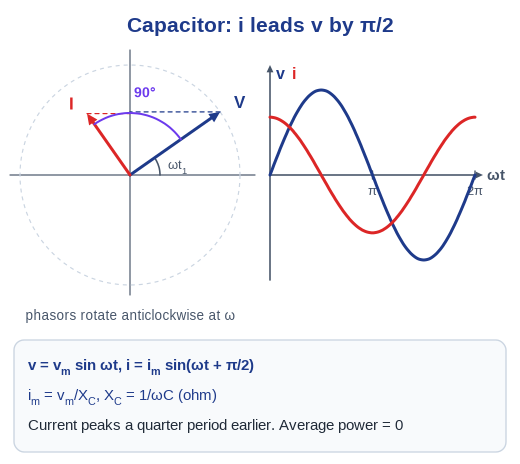
On a dc source a capacitor charges once and then the current stops. On ac it is charged, discharged and charged the other way every cycle, so the current never stops. With q = Cv = Cvm sin ωt,
i = dq/dt = ωCvm cos ωt = im sin(ωt + π/2)
so im = vm/XC, with the capacitive reactance
XC = 1/ωC (unit: ohm)
The current leads the voltage by π/2. XC falls as the frequency or the capacitance rises. The instantaneous power is ½ imvm sin 2ωt, again zero on average: energy goes into the electric field and comes back.
For 15.0 µF at 50 Hz: XC = 1/(2π × 50 × 15.0 × 10⁻⁶) = 212 Ω. On 220 V the rms current is 1.04 A, the peak 1.47 A. Doubling the frequency halves XC and doubles the current. A lamp in series with a capacitor stays dark on dc but glows on ac, and glows less if C is made smaller (Example 7.3).
Safety: the 220 V figures are only data for calculation. Never experiment with the mains. A bulb-and-coil or lamp-and-capacitor demonstration uses a low-voltage ac source from the school laboratory, only with a teacher.
Next topic: the series LCR circuit and resonance. See also the chapter notes and the NCERT solutions.
Practice
-
An ac current has a peak value of 2.0 A. Its rms value is about:
Show answer
Answer: (b) 1.4 A
-
The frequency of the source across a pure inductor is doubled at the same voltage. The current becomes:
Show answer
Answer: (b) half
-
The phase difference between the voltage across a capacitor and the current through it is:
Show answer
Answer: (c) π/2
-
Find the reactance of a 0.10 H inductor and of a 10 µF capacitor at 50 Hz.
Show answer
Answer: X_L = 2πνL = 2π × 50 × 0.10 = 31.4 Ω. X_C = 1/(2πνC) = 1/(2π × 50 × 10 × 10⁻⁶) = 318 Ω.
-
An ac source has a peak voltage of 12 V. What is its rms voltage, and what dc voltage would heat a resistor at the same average rate?
Show answer
Answer: V = 12/√2 = 8.5 V. A steady 8.5 V dc gives the same average heating, because that is what the rms value means.
Questions students ask
Why is the average current zero but the average power not zero?
The current is positive for half the cycle and negative for the other half, so its average is zero. Heating depends on i², which is positive in both halves, so the average power is ½ i_m²R.
What is the rms value of an alternating current?
It is the square root of the average of i² over a cycle. For a sine wave it is i_m/√2 = 0.707 i_m. It equals the steady dc current that would give the same average heating in a resistor.
Why does an inductor make the current lag?
An inductor opposes any change of current with a self-induced emf. The current can only build up gradually, so it reaches its peak a quarter period after the voltage does.
Why is the reactance of a capacitor smaller at higher frequency?
At a higher frequency the capacitor charges and discharges more often each second, so more charge flows per second for the same voltage. A larger current for the same voltage means a smaller reactance, X_C = 1/ωC.
Stuck on a question?
Take a photo and Lagnever AI explains it step by step. Try it for 7 days for ₹2.
Get it on Google Play Open in browser
For parents: after the trial, the plan renews monthly by UPI or card autopay. You can cancel anytime in the app.