
How does a transformer work?
Answer in short
A transformer has a primary of N_p turns and a secondary of N_s turns on a soft-iron core. Alternating flux from the primary links both coils, so V_s/V_p = N_s/N_p, and with no losses I_s/I_p = N_p/N_s. More secondary turns step the voltage up.
Stuck on a question? Take a photo and Lagnever AI explains it step by step. Try it for 7 days for ₹2. Get it on Google Play
What is a transformer made of?
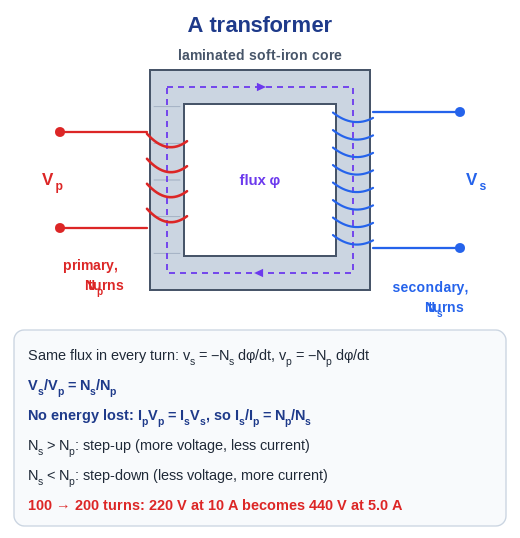
A transformer changes an alternating voltage into a larger or a smaller one. It has two coils of insulated wire wound on a core of soft iron. The primary coil, with Np turns, usually takes the input; the secondary coil, with Ns turns, gives the output. The coils may be wound one on top of the other, or on two separate limbs of the core. There is no electrical connection between them: energy passes from one to the other through the magnetic flux in the core. This is mutual induction, the subject of Chapter 6 (Electromagnetic Induction).
How does it change the voltage?
Apply an ac voltage vp to the primary. The current it drives produces an alternating flux in the core. Take an ideal transformer: the resistance of the primary is negligible, and no flux escapes from the core, so the same flux passes through every turn of both coils. If φ is the flux through one turn at time t, Faraday’s law gives the emf in the secondary,
εs = −Ns dφ/dt
The same flux also induces a back emf in the primary, εp = −Np dφ/dt. Because the primary has no resistance, this back emf must equal the applied voltage; otherwise the primary current would be unlimited. If the secondary is open or carries only a small current, its terminal voltage equals its emf. Dividing the two equations, the dφ/dt cancels:
vs/vp = Ns/Np
The voltage per turn is the same in both coils. The book lists the assumptions: small primary resistance and current, the same flux through both coils, and a small secondary current.
What happens to the current?
If no energy is lost, the power drawn by the primary equals the power given by the secondary, ipvp = isvs. Combining with the turns rule,
is/ip = Np/Ns
Both voltage and current oscillate at the source frequency, so these ratios hold for peak values and for rms values alike. In rms form, Vs = (Ns/Np)Vp and Is = (Np/Ns)Ip.
- Step-up transformer: Ns > Np. The voltage goes up and the current comes down. With 100 primary turns and 200 secondary turns, 220 V at 10 A becomes 440 V at 5.0 A.
- Step-down transformer: Ns < Np. The voltage goes down and the current goes up.
Raising the voltage does not create energy, because the current falls in the same proportion. The assumption of no loss is a fair one: the book notes that a well-designed transformer can be more than 95 per cent efficient.
Where does energy go in a real transformer?
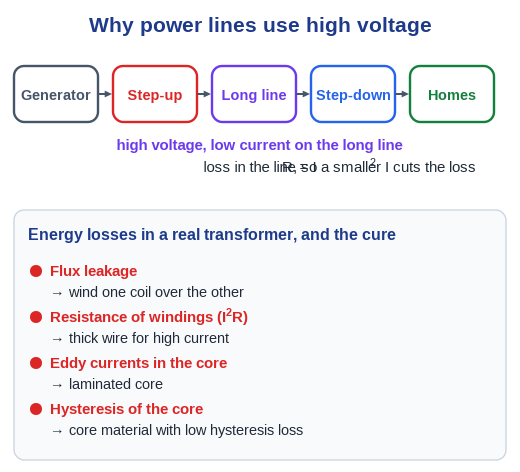
Four effects waste a little energy, each with a cure:
- Flux leakage. Some primary flux does not pass through the secondary, because of poor core design or air gaps. Winding one coil over the other reduces it.
- Resistance of the windings. Current heats the wire (I²R). In windings that carry a large current at low voltage, thick wire keeps this small.
- Eddy currents. The changing flux also induces circulating currents in the iron core itself, which heat it. A laminated core, made of thin insulated sheets, cuts these currents down.
- Hysteresis. The core is magnetised one way and then the other, again and again, and each reversal costs some energy, which appears as heat. A core material with low hysteresis loss is used.
Why are transformers needed to send power far?
Power stations are often far from the towns that use the power. For a given power P = VI, the current in a line is smaller when the voltage is higher, and the energy wasted as heat in the line is I²R. So the generator’s output is stepped up to a high voltage before it is sent over long distances. At a sub-station near the users it is stepped down, and again at distribution sub-stations and on utility poles, before it reaches homes at a low voltage. This easy change of voltage is the main reason ac is used for supplying power.
Safety: transformers and lines on poles carry dangerous voltages. Never touch or go near them, and never open a transformer or an adapter. Classroom work with transformers uses low-voltage kits, only with a teacher.
A note on roles: in a motor electrical energy is the input and mechanical energy the output; in a generator it is the other way round. A transformer changes neither: electrical energy goes in and electrical energy comes out, at a different voltage.
Before this: the series LCR circuit and resonance. See also the chapter notes and the NCERT solutions.
Practice
-
A transformer steps 220 V down to 22 V. If the primary has 1000 turns, the secondary has:
Show answer
Answer: (b) 100 turns
-
The core of a transformer is laminated to reduce:
Show answer
Answer: (b) eddy currents
-
In an ideal step-up transformer, compared with the primary, the secondary has:
Show answer
Answer: (b) higher voltage and lower current
-
An ideal transformer has 100 turns in the primary and 1000 in the secondary. The secondary current is 2 A. Find the primary current.
Show answer
Answer: I_p/I_s = N_s/N_p, so I_p = 2 × 1000/100 = 20 A. The voltage rises ten times and the current falls ten times.
-
Why is electricity sent over long distances at a high voltage?
Show answer
Answer: For the same power P = VI, a higher voltage means a smaller current. The heat lost in the line is I²R, so a smaller current wastes much less energy.
Questions students ask
On what principle does a transformer work?
Mutual induction. The changing current in the primary coil sets up a changing magnetic flux in the iron core. This flux passes through the secondary coil and induces an emf in it.
Does a step-up transformer break the law of conservation of energy?
No. It raises the voltage but lowers the current in the same ratio, so the power out is at most equal to the power in. In a real transformer it is a little less, because of losses.
What are the energy losses in a transformer?
Flux leakage (not all the flux passes through the secondary), heating in the resistance of the windings, eddy currents in the iron core, and hysteresis as the core is magnetised back and forth. They are reduced by winding the coils one over the other, using thick wire, laminating the core and choosing a core material with low hysteresis loss.
What assumptions give V_s/V_p = N_s/N_p?
The book lists three: the primary resistance and current are small, the same flux links both coils because very little escapes from the core, and the secondary current is small.
Stuck on a question?
Take a photo and Lagnever AI explains it step by step. Try it for 7 days for ₹2.
Get it on Google Play Open in browser
For parents: after the trial, the plan renews monthly by UPI or card autopay. You can cancel anytime in the app.