
Class 12 Biology Chapter 13: Biodiversity and Conservation Notes Hinglish mein
Ye chapter 5 lines mein
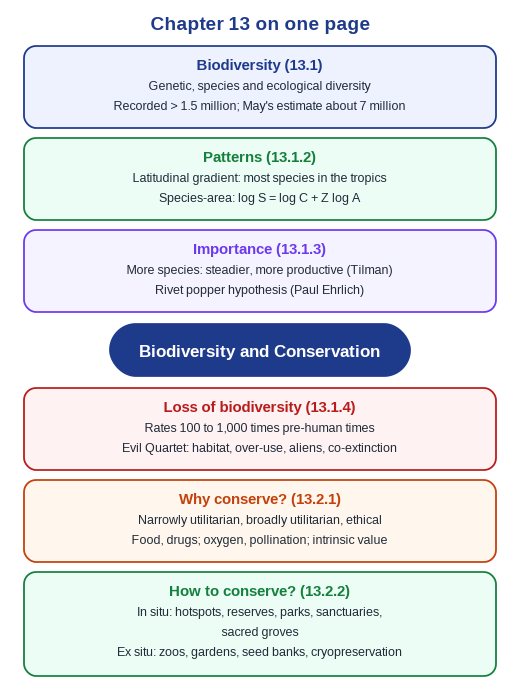
Biodiversity biological organisation ke har level par life ki milee-juli variety hai, khaaskar genetic, species aur ecological diversity. Yeh tropics mein sabse zyada hoti hai aur area ke saath badhti hai (log S = log C + Z log A). Insaani activities Evil Quartet ke zariye species khatam kar rahi hain: habitat loss aur fragmentation, over-exploitation, alien species invasions aur co-extinctions. Hum ise utilitarian aur ethical kaarano se bachaate hain, in situ (hotspots, protected areas, sacred groves) aur ex situ (zoos, gardens, seed banks, cryopreservation) tareeqon se.
Yeh chapter kis baare mein hai?
Yeh Unit X, Ecology, ka aur poori Class 12 Biology book ka aakhri chapter hai. Organisms and Populations aur Ecosystem ke baad yeh poochhta hai ki life ki kitni variety hai, wo kahan zyada hai, hum use kyon kho rahe hain aur use kaise bachaa sakte hain. Rationalised chapter mein do sections hain: 13.1 Biodiversity (ginti, patterns, importance aur loss ke chaar sub-sections ke saath) aur 13.2 Biodiversity Conservation (kyon aur kaise).
Do topic pages gehraai mein jaate hain: biodiversity ke patterns aur nuksaan aur biodiversity ko kaise bachaayein. Saari 10 exercises NCERT solutions mein hal hain.
Biodiversity kya hai?
Earth par life har biological level par alag-alag hai, cells ke andar ke bade molecules se lekar biomes tak. Is milee-juli variety ke liye shabd hai biodiversity, jise sociobiologist Edward Wilson ne popular kiya. Chapter teen levels ko sabse zaroori maanta hai.
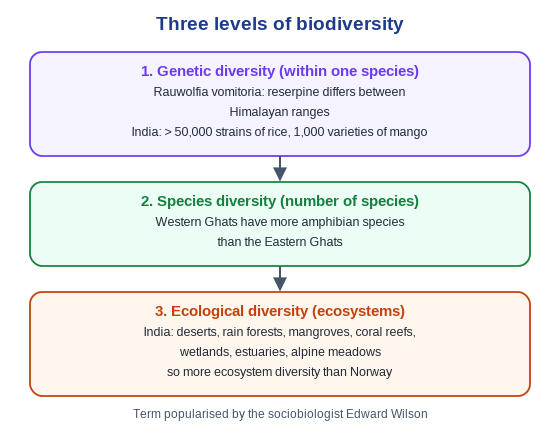
- Genetic diversity: ek species apne failaav ke area mein genetically kaafi alag ho sakti hai. Alag-alag Himalayan ranges ka medicinal plant Rauwolfia vomitoria apne active chemical reserpine ki taakat aur matra mein alag hota hai. India mein rice ke 50,000 se zyada genetically alag strains aur mango ki 1,000 varieties hain.
- Species diversity: species ki ginti aur variety. Western Ghats mein Eastern Ghats se zyada amphibian species hain.
- Ecological diversity: ecosystems ki variety. Deserts, rain forests, mangroves, coral reefs, wetlands, estuaries aur alpine meadows ke saath India mein Norway jaise Scandinavian desh se kahin zyada ecosystem diversity hai.
Evolution ko yeh variety jodne mein laakhon saal lage; aaj ki species loss ki rate se iska bada hissa do sadiyon se kam mein khatam ho sakta hai. Isiliye biodiversity ab har desh ki chinta wala environmental issue hai.
Kitni species hain?
Har naam di gayi species publish hoti hai, isliye hum jaante hain ki kitni record hui hain. Kitni maujood hain, yeh batana kahin mushkil hai.
- IUCN (2004): ab tak 1.5 million se thodi zyada plant aur animal species describe hui hain.
- Temperate deshon ki species lists tropical deshon se zyada poori hain, aur zyaadatar anjaan species tropics mein hain. Isliye biologists ek bahut achhe se padhe gaye insect group ka tropical aur temperate species richness ka ratio nikaalte hain, aur use doosre groups par extrapolate karke mota total nikaalte hain.
- Extreme estimates 20 se 50 million tak jaate hain; Robert May ka zyada saavdhaan, scientific estimate lagbhag 7 million hai. Is hisaab se sirf lagbhag 22 per cent species record hui hain (hamara check: 1.5 ÷ 7 ≈ 0.21).
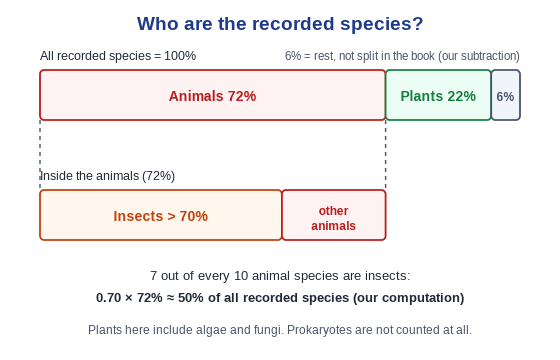
Recorded species mein:
- 70 per cent se zyada animals hain; plants, algae, fungi, bryophytes, gymnosperms aur angiosperms ko milaakar, 22 per cent se zyada nahi.
- Insects saare animals ka 70 per cent se zyada hain: har 10 animal species mein 7 insects.
- Fungi ki species fishes, amphibians, reptiles aur mammals ko milaakar bhi zyada hain.
- Prokaryotes gine hi nahi gaye. Normal taxonomic tareeqe microbes ke liye theek nahi, aur kai lab mein ugaaye nahi ja sakte; biochemical ya molecular criteria se unki species millions mein ho sakti hain.
India ka hissa
India ke paas duniya ki zameen ka sirf 2.4 per cent hai par species ka 8.1 per cent, isliye yeh 12 mega diversity countries mein se ek hai. Yahan lagbhag 45,000 plant species aur usse dugni animal species record hui hain. Agar sirf 22 per cent species jaani gayi hain, to India mein abhi bhi 1,00,000 se zyada plant aur 3,00,000 se zyada animal species describe hona baaki ho sakti hain. Yeh list poori karne ke liye bahut saare trained taxonomists aur kai saal chahiye, aur kai species naam milne se pehle hi khatam ho sakti hain.
Biodiversity ke patterns
Latitudinal gradient
Species duniya mein barabar nahi faili hain. Sabse jaana-maana pattern: equator se poles ki taraf jaate hue diversity aam taur par ghatti hai. Bahut kam exceptions ke saath, tropics (23.5° N se 23.5° S) mein temperate ya polar areas se zyada species hain.
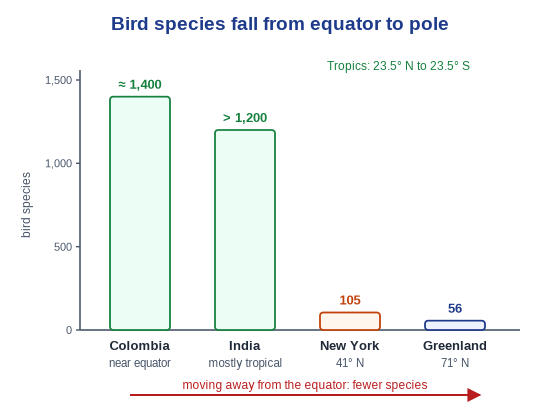
- Birds: Colombia (equator ke paas) lagbhag 1,400 species; New York (41° N) 105; Greenland (71° N) sirf 56; zyaadatar tropical India mein 1,200 se zyada.
- Ecuador jaise tropical forest mein, US ke Midwest ke utne hi bade temperate forest se 10 guna tak zyada vascular plant species ho sakti hain.
- Amazonian rain forest Earth ki sabse ameer jagah hai: 40,000 se zyada plant species, 3,000 fishes, 1,300 birds, 427 mammals, 427 amphibians, 378 reptiles aur 1,25,000 se zyada invertebrates, aur shaayad kam se kam do million insect species abhi bhi bina naam ki.
Tropics itne ameer kyon? Teen main hypotheses:
- Samay: speciation samay par depend karta hai. Temperate regions mein baar-baar glaciations hue, jabki tropics laakhon saal tak lagbhag shaant rahe, to species ko diversify hone ka lamba samay mila.
- Sthir mahaul: tropical mausam kam seasonal aur zyada predictable hai, jo niche specialisation ko badhaata hai aur isse zyada species banti hain.
- Zyada solar energy: zyada sunlight matlab zyada productivity, jo indirectly zyada species ko sahaara de sakti hai.
Species-area relationship
South American jungles explore karte hue Alexander von Humboldt ne dekha ki ek region ke andar explore kiya area badhne par species ki ginti badhti hai, par sirf ek limit tak. Kai groups (angiosperms, birds, bats, freshwater fishes) mein species richness aur area ka graph rectangular hyperbola hota hai. Logarithmic axes par yeh seedhi line ban jaata hai:
log S = log C + Z log A, jo S = C·A^Z ke barabar hai
jahan S = species richness, A = area, Z = line ka slope (regression coefficient) aur C = Y-intercept.
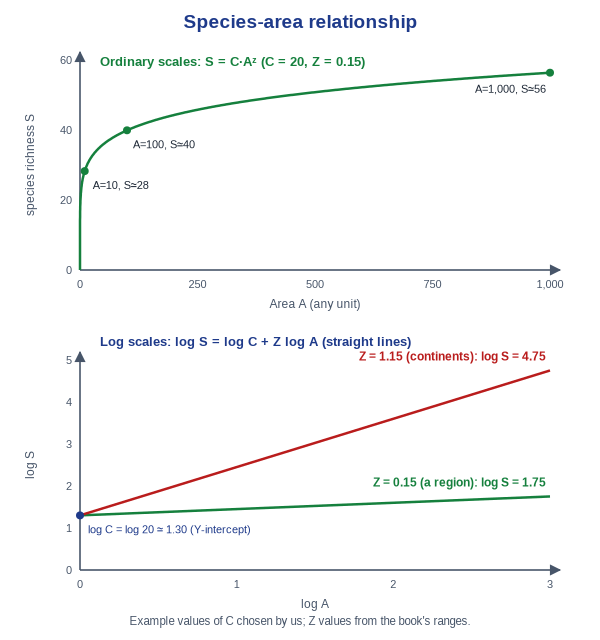
- Region ke andar Z 0.1 se 0.2 hota hai, group ya jagah koi bhi ho (Britain ke plants, California ke birds, New York state ke molluscs, sabke slopes milte-julte).
- Poore continents jaise bahut bade areas ke liye slope kaafi tez, Z = 0.6 se 1.2; alag-alag continents ke tropical forests ke fruit khaane wale (frugivorous) birds aur mammals ke liye Z = 1.15.
- Worked example (hamare numbers, C = 20): Z = 0.15 par area dugna karne se species 2^0.15 ≈ 1.11 guna hoti hain; Z = 1.15 par 2^1.15 ≈ 2.22 guna. Tez slope ka matlab hai species richness area par bahut zyada depend karti hai, to area khone par kahin zyada species khoti hain.
Species diversity kyon zaroori hai?
Ecologists ke paas abhi pakka jawab nahi hai ki species ki ginti ecosystem ke kaam ko kitna tay karti hai. Bahut samay tak maana gaya ki zyada species wale communities zyada stable hote hain. Stable community ki productivity saal-dar-saal zyada nahi badalti, kabhi-kabhaar ke disturbances jhel leti hai ya unse ubhar aati hai, aur alien species ke hamle ko rokti hai.
- David Tilman ke outdoor plots ke lambe experiments: zyada species wale plots mein total biomass saal-dar-saal kam badla, aur zyada diversity se productivity bhi zyada rahi.
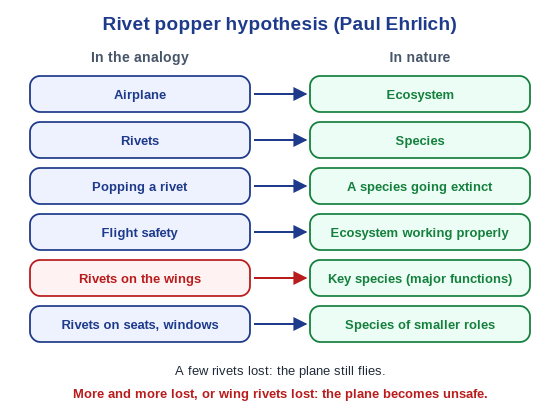
- Rivet popper hypothesis (Paul Ehrlich): ek airplane (ecosystem) socho jo hazaaron rivets (species) se juda hai. Agar har yaatri ek rivet nikaal le (ek species extinct ho), to pehle plane theek udta hai, par jaise-jaise rivets nikalte hain wo kamzor hota jaata hai. Aur kaun sa rivet nikla, yeh bhi maayne rakhta hai: wings ke rivets (bade kaam chalaane wali key species) seats ya khidkiyon ke kuch rivets se kahin zyada zaroori hain.
Biodiversity ka nuksaan
Speciation se nayi species mushkil se jud rahi hain, par nuksaan lagaataar ho raha hai, aur iske peeche saaf taur par insaani activities hain.
- Tropical Pacific islands par insaanon ke basne se 2,000 se zyada native bird species khatam hone ki baat kahi jaati hai.
- IUCN Red List (2004): pichhle 500 saal mein 784 extinctions (338 vertebrates, 359 invertebrates, 87 plants; hamara check: 338 + 359 + 87 = 784). Haal ke examples: dodo (Mauritius), quagga (Africa), thylacine (Australia), Steller’s sea cow (Russia) aur tiger ki teen subspecies (Bali, Javan, Caspian). Sirf pichhle bees saal mein 27 species gaayab huin.
- Extinctions random nahi hain: amphibians zyada kamzor lagte hain. 15,500 se zyada species par extinction ka khatra hai, jinmein birds ki 12 per cent, mammals ki 23 per cent, amphibians ki 32 per cent aur gymnosperms ki 31 per cent species hain.
- Fossils dikhaate hain ki life ke 3 billion saal se zyada mein paanch mass extinctions hue. Aaj ka ‘Sixth Extinction’ apni rate mein alag hai: pre-human samay se 100 se 1,000 guna tez, aur hamari wajah se. Agar yahi chalta raha to agle 100 saal mein lagbhag aadhi species khatam ho sakti hain.
Jab kisi region mein biodiversity ghatti hai to (a) plant production ghat sakta hai, (b) drought jaise disturbances ke saamne resistance kam ho sakti hai, aur (c) plant productivity, water use, aur pest aur disease cycles jaise processes mein utaar-chadhaav zyada ho sakta hai.
Kaaran: Evil Quartet
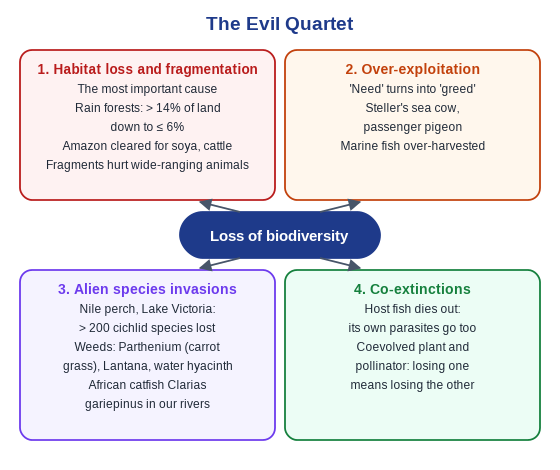
- Habitat loss aur fragmentation (sabse zaroori kaaran). Tropical rain forests kabhi zameen ke 14 per cent se zyada hisse par the, ab 6 per cent se zyada par nahi. Amazon, jise ‘lungs of the planet’ kehte hain, soya beans aur cattle ke grasslands ke liye kaata ja raha hai. Pollution kai aur habitats bigaadta hai. Jab bada habitat chhote tukdon mein bant jaata hai, to bade territory wale mammals aur birds aur migratory animals sabse zyada nuksaan uthaate hain.
- Over-exploitation. Jab ‘need’ ‘greed’ ban jaati hai, natural resources ka zyada istemaal hota hai. Steller’s sea cow aur passenger pigeon pichhle 500 saal mein isi se khatam hue; aaj kai samudri machhliyan zaroorat se zyada pakdi ja rahi hain.
- Alien species invasions. Kuch baahar se laayi gayi species invasive ban kar native species ko hata deti hain. Lake Victoria (east Africa) mein daale gaye Nile perch se 200 se zyada cichlid fish species khatam ho gayin. India mein carrot grass (Parthenium), Lantana aur water hyacinth (Eicchornia) native species ko nuksaan pahunchaate hain, aur gair-qanooni taur par laayi gayi African catfish Clarias gariepinus hamari native catfishes ke liye khatra hai.
- Co-extinctions. Jab ek species khatam hoti hai, to usse obligatory taur par judi species bhi saath khatam hoti hain: host fish ke parasites, ya coevolved plant-pollinator jodi mein ek ke jaane par doosra.
Biodiversity conservation
Kyon bachaayein?
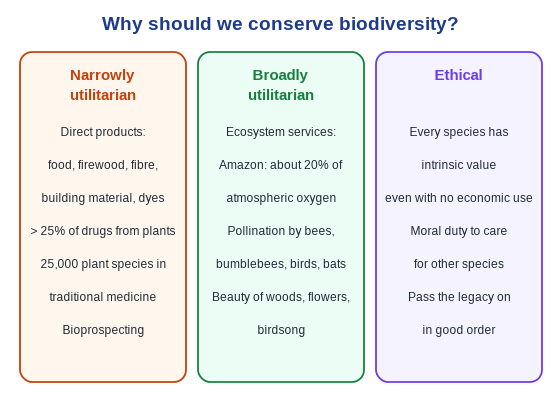
- Narrowly utilitarian: seedhe economic faayde: khaana (anaaj, daalein, phal), lakdi, fibre, building material, industrial products (tannins, lubricants, dyes, resins, perfumes) aur dawaiyan. Duniya mein biki dawaiyon ka 25 per cent se zyada plants se aata hai, aur 25,000 plant species traditional medicine mein use hoti hain. Bioprospecting, yaani molecular, genetic aur species diversity mein kaam ke products dhoondhna, biodiversity se bhare deshon ko bade faayde de sakta hai.
- Broadly utilitarian: ecosystem services. Amazon forest photosynthesis se atmosphere ki lagbhag 20 per cent oxygen banaata hai, aisa estimate hai. Bees, bumblebees, birds aur bats ka pollination hamein phal aur beej deta hai. Ghane jungle mein ghoomna, basant ke phool aur chidiyon ki awaaz aisi khushiyan hain jinki keemat nahi lagaayi ja sakti.
- Ethical: har species ki apni intrinsic value hai, chahe wo hamare kaam ki ho ya nahi. Jin laakhon species ke saath hum yeh planet baantte hain unki dekhbhaal karna aur yeh jeevit virasat achhi haalat mein aane wali peedhiyon ko dena hamara naitik farz hai.
Kaise bachaayein?
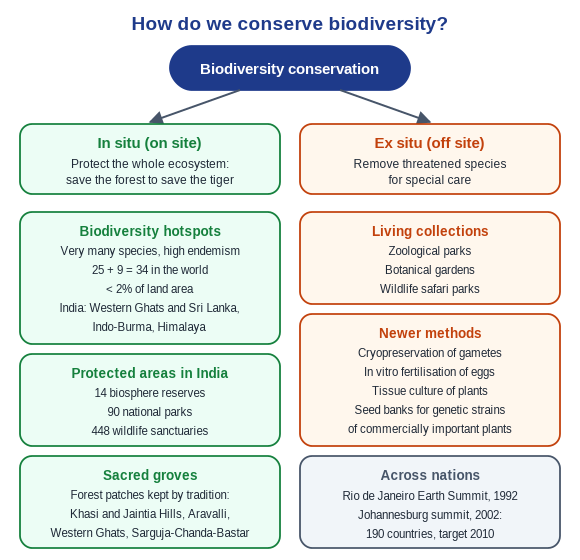
In situ (apni jagah par): poora ecosystem bachaao to uski har level ki biodiversity bach jaati hai: tiger bachaane ke liye poora jungle bachaao.
- Biodiversity hotspots: conservation ke liye paisa seemit hai, isliye conservationists ne bahut zyada species richness aur high endemism wale regions ko sabse zyada protection ke liye chuna. Pehle 25, phir 9 aur: kul 34. Yahan habitat bhi tezi se khatam ho raha hai. Teen hotspots India ke sabse ameer regions ko cover karte hain: Western Ghats aur Sri Lanka, Indo-Burma aur Himalaya. Saare hotspots milkar zameen ka 2 per cent se kam hain, phir bhi unki sakht suraksha se chal rahe mass extinctions lagbhag 30 per cent kam ho sakte hain.
- India ke protected areas: 14 biosphere reserves, 90 national parks aur 448 wildlife sanctuaries.
- Sacred groves: dharmik aur saanskritik parampara se alag rakhe gaye jungle ke tukde, jahan har ped aur jaanwar poori tarah surakshit hai. Yeh Khasi aur Jaintia Hills (Meghalaya), Aravalli Hills (Rajasthan), Karnataka aur Maharashtra ke Western Ghat regions, aur Madhya Pradesh ke Sarguja, Chanda aur Bastar areas mein milte hain. Meghalaya mein yeh kai rare aur threatened plants ki aakhri sharan hain.
Ex situ (apni jagah se bahar): jab koi species endangered ya threatened ho (jungle mein jald extinction ka bahut zyada khatra) aur use turant madad chahiye.
- Threatened plants aur animals zoological parks, botanical gardens aur wildlife safari parks mein rakhe aur sambhaale jaate hain; kuch animals jo jungle mein khatam ho chuke hain, sirf zoos mein bache hain.
- Naye tareeqe: gametes ka lambe samay tak zinda aur fertile haalat mein cryopreservation, in vitro fertilisation, plants ka tissue culture se propagation, aur commercially zaroori plants ke genetic strains ke liye seed banks.
International koshish: biodiversity seemaayein nahi maanti. Convention on Biological Diversity (‘The Earth Summit’, Rio de Janeiro, 1992) ne saare deshon se biodiversity bachaane aur uske faayde sustainably use karne ko kaha. World Summit on Sustainable Development (Johannesburg, 2002) mein 190 deshon ne 2010 tak biodiversity loss ki rate kaafi kam karne ka vaada kiya.
Book khatam karne se pehle
Teen levels ek-ek example ke saath, ginti ka tareeqa aur main figures, tropics ki teen hypotheses, species-area equation aur Z ka matlab, Tilman aur rivet popper hypothesis, loss ke chaar kaaran ek-ek example ke saath, bachaane ke teen kaaran, aur Indian examples ke saath in situ aur ex situ yaad rakho. Dhyaan do ki chapter ka summary kuch figures ko text se alag round karta hai: haal mein lagbhag 700 extinctions (text: 500 saal mein 784) aur 450 se zyada sanctuaries (text: 448). Saari 10 exercises Chapter 13 ke NCERT solutions mein hal hain.
Key terms (zaroori shabd)
| Term | Matlab |
|---|---|
| Biodiversity | Biological organisation ke saare levels par life ki kul variety, cells ke molecules se lekar biomes tak. Yeh shabd sociobiologist Edward Wilson ne popular kiya. |
| Genetic diversity | Ek hi species ke andar uske failaav ke area mein variation, jaise alag-alag Himalayan ranges mein Rauwolfia vomitoria ke reserpine ki matra. |
| Species diversity | Species ke level par variety, jaise Western Ghats mein Eastern Ghats se zyada amphibian species. |
| Ecological diversity | Kisi region mein ecosystems ki variety, jaise India ke deserts, rain forests, mangroves, coral reefs, wetlands, estuaries aur alpine meadows. |
| Latitudinal gradient | Equator se poles ki taraf jaate hue species diversity ka aam taur par ghatna. |
| Species-area relationship | Ek region mein explore kiye gaye area ke saath species richness badhti hai, par ek limit tak. Normal scales par curve rectangular hyperbola hai; log scales par seedhi line log S = log C + Z log A. |
| Z (regression coefficient) | Log-log species-area line ka slope: region ke andar 0.1 se 0.2, poore continents ke liye kaafi tez (0.6 se 1.2). |
| Rivet popper hypothesis | Paul Ehrlich ki misaal: species ek airplane (ecosystem) ke rivets jaisi hain. Kuch rivets nikalne se turant fark nahi padta, par bahut saare ya zaroori rivets nikalne se poora system khatre mein aa jaata hai. |
| The Evil Quartet | Biodiversity loss ke chaar main kaarano ka nickname: habitat loss aur fragmentation, over-exploitation, alien species invasions aur co-extinctions. |
| Co-extinction | Jab koi species khatam hoti hai to usse obligatory taur par judi species bhi khatam ho jaati hain, jaise host fish ke parasites. |
| Biodiversity hotspot | Bahut zyada species richness aur high endemism wala region, jise sabse zyada protection ke liye chuna gaya. Duniya mein 34 hain. |
| Endemism | Species ka sirf ek region tak seemit hona, kahin aur na milna. |
| In situ conservation | On-site conservation: poore ecosystem ko bachaana taaki uski har level ki biodiversity bache, jaise national parks, sanctuaries, biosphere reserves aur sacred groves. |
| Ex situ conservation | Off-site conservation: threatened species ko unke habitat se nikaal kar khaas jagah rakhna, jaise zoos, botanical gardens, seed banks aur cryopreservation. |
Is chapter ke topics
Practice karo
-
Alag-alag Himalayan ranges mein ugne wale Rauwolfia vomitoria ke reserpine content mein fark kis cheez ka example hai?
Jawab dekho
Jawab: (b) genetic diversity
-
Equation log S = log C + Z log A mein Z kya hai?
Jawab dekho
Jawab: (c) line ka slope (regression coefficient)
-
Ek region ke andar Z aam taur par kitna hota hai?
Jawab dekho
Jawab: (b) 0.1 se 0.2
-
Chapter ke hisaab se species extinction ka sabse zaroori kaaran kaun sa hai?
Jawab dekho
Jawab: (c) Habitat loss aur fragmentation
-
Lake Victoria ki cichlid fishes kis cheez ko daalne ke baad khatam huin?
Jawab dekho
Jawab: (b) Nile perch
-
Inmein se ex situ conservation ka tareeqa kaun sa hai?
Jawab dekho
Jawab: (c) Seed bank
Students ke sawal
Class 12 Biology Chapter 13 ke main topics kya hain?
Biodiversity ke levels, Earth aur India mein kitni species hain, biodiversity ke patterns (latitudinal gradient aur species-area relationship), ecosystem ke liye species diversity kyon zaroori hai, biodiversity loss aur uske chaar kaaran, aur conservation ke kaaran aur tareeqe, in situ aur ex situ.
Kya Biodiversity and Conservation 2026-27 ki NCERT Class 12 Biology book mein hai?
Haan. Yeh Reprint 2026-27 wali Class 12 Biology textbook ka Chapter 13, yaani aakhri chapter hai, pages 216 se 227 par, Unit X, Ecology mein. Ismein 10 end-of-chapter exercises hain.
In situ aur ex situ conservation mein kya fark hai?
In situ conservation species ko unki apni jagah par poore ecosystem ke saath bachaata hai, jaise national parks aur sacred groves. Ex situ conservation threatened species ko jungle se nikaal kar khaas dekhbhaal mein rakhta hai, jaise zoos, botanical gardens aur seed banks.
Is chapter ke kaun se diagrams practise karne chahiye?
Normal aur log scales par species-area curve equation ke saath, latitudinal gradient, recorded species ka share, Evil Quartet ka flow chart, aur in situ aur ex situ ka chart.
Koi sawal atak gaya?
Photo lo, Lagnever AI step-by-step samjhayega. 7 din ka trial sirf ₹2.
Google Play se app lo Browser mein kholo
Parents ke liye: trial ke baad plan har mahine UPI ya card autopay se renew hota hai. App mein kabhi bhi cancel kar sakte hain.