
NCERT Solutions Class 10 Maths Chapter 1: Real Numbers
Answers to the questions inside Chapter 1, Real Numbers, all seven worked examples, the proofs of Theorems 1.2 and 1.3, and every question of Exercises 1.1 and 1.2, from Mathematics, the Class 10 NCERT textbook. Page numbers follow the 2026-27 reprint (pages 1–9). The exercise questions are quoted from the book; the examples and in-chapter questions are restated in short and labelled by number. Every number below was checked by computing it again, and every factorisation by multiplying the primes back. Short notes: Chapter 1 notes.
Questions inside the chapter (pages 2–3)
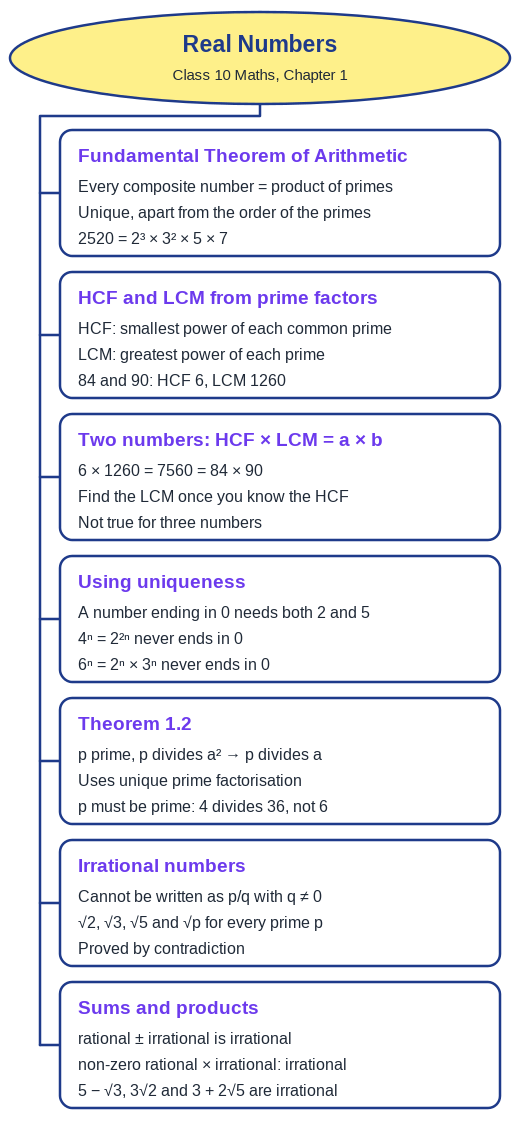
Page 2: is the collection of all primes finite or infinite? Infinite: there are infinitely many primes, as the book says. A short reason (Extra, Euclid’s argument): if you had a finite list of all primes, multiply them and add 1. That number leaves remainder 1 when divided by every prime on the list, so its prime factors are missing from the list, which is impossible.
Page 2: can every composite number be made by multiplying primes, or is there one that is not a product of powers of primes? Every composite number is a product of primes; there is no exception. This is exactly the Fundamental Theorem of Arithmetic (Theorem 1.1, page 3), which also says the product is unique apart from the order. The products listed on page 2 are right: 7 × 11 × 23 = 1771, 3 × 7 × 11 × 23 = 5313, 2 × 3 × 7 × 11 × 23 = 10626, 2³ × 3 × 7³ = 8232 and 2² × 3 × 7 × 11 × 23 = 21252.
Page 3: check that 3803 and 3607 are primes. It is enough to test the primes up to the square root, because a composite number always has a prime factor no bigger than its square root. √3803 is about 61.7, and none of the 18 primes from 2 to 61 divides 3803 (for example, 3803 = 7 × 543 + 2). √3607 is about 60.1, and none of the 17 primes from 2 to 59 divides 3607 (3607 = 7 × 515 + 2). So both are prime, and 3² × 3803 × 3607 = 9 × 3803 × 3607 = 123456789.
Page 3: try it with other natural numbers. Our own examples: 1001 = 7 × 11 × 13; 2026 = 2 × 10¹³, where 1013 is prime; 9999 = 3² × 11 × 101; and 2027 is itself prime.
Examples 1 to 4 (pages 4–5)
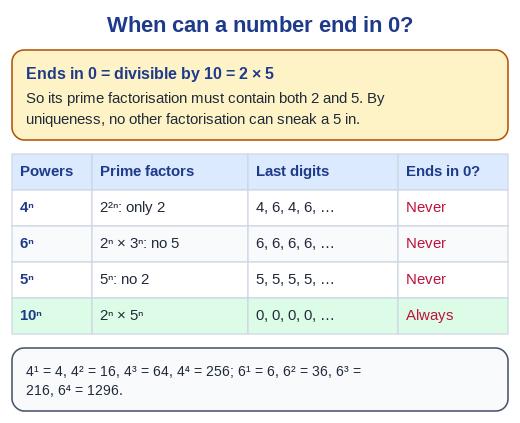
Example 1 (page 4): can 4ⁿ end with the digit 0 for some natural number n? A number ending in 0 is divisible by 10, so it is divisible by 5, and 5 would appear in its prime factorisation. But 4ⁿ = (2²)ⁿ = 2²ⁿ, so its only prime factor is 2. By the uniqueness in the Fundamental Theorem of Arithmetic, 4ⁿ has no other factorisation that could contain 5. So no natural number n makes 4ⁿ end in 0.
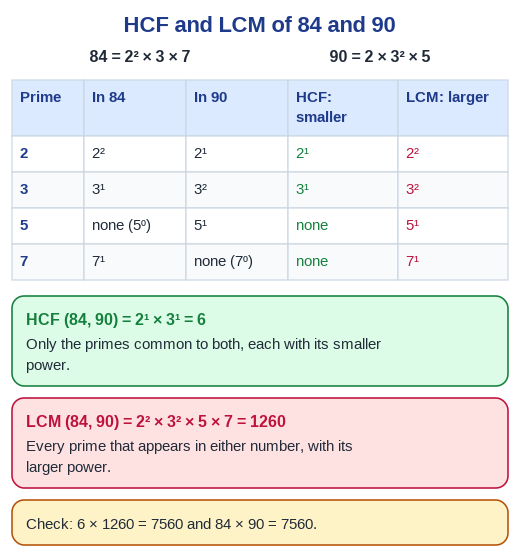
Example 2 (page 4): 6 and 20, HCF and LCM from their prime factors.
6 = 2¹ × 3¹ and 20 = 2² × 5¹
HCF = the common prime 2 with its lowest power = 2¹ = 2
LCM = every prime with its highest power = 2² × 3¹ × 5¹ = 60
Check: HCF × LCM = 2 × 60 = 120 = 6 × 20.
Example 3 (page 4): HCF of 96 and 404 by prime factorisation, then their LCM.
96 = 2⁵ × 3 and 404 = 2² × 101
HCF = 2² = 4
LCM = 96 × 404 ÷ HCF = 38784 ÷ 4 = 9696
Check directly: LCM = 2⁵ × 3 × 101 = 32 × 303 = 9696.
Example 4 (page 5): three numbers, 6, 72 and 120, their HCF and LCM.
6 = 2 × 3, 72 = 2³ × 3², 120 = 2³ × 3 × 5
HCF = 2¹ × 3¹ = 6 (smallest powers of the common primes 2 and 3)
LCM = 2³ × 3² × 5¹ = 360 (greatest powers of 2, 3 and 5)
Remark (page 5). For three numbers, HCF × LCM = 6 × 360 = 2160, but 6 × 72 × 120 = 51840, which is 24 times as large. So HCF × LCM = product holds for two numbers only.
Exercise 1.1 (pages 5–6)
1. “Express each number as a product of its prime factors: (i) 140 (ii) 156 (iii) 3825 (iv) 5005 (v) 7429”
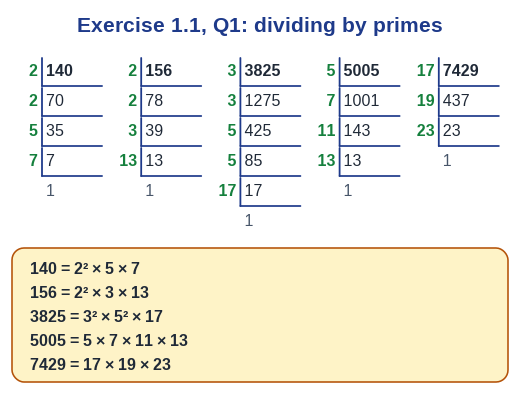
Divide by primes, smallest first, until 1 is left.
(i) 140 = 2 × 70 = 2 × 2 × 35 = 2 × 2 × 5 × 7, so 140 = 2² × 5 × 7.
(ii) 156 = 2 × 78 = 2 × 2 × 39 = 2 × 2 × 3 × 13, so 156 = 2² × 3 × 13.
(iii) 3825 = 3 × 1275 = 3 × 3 × 425 = 3 × 3 × 5 × 85 = 3 × 3 × 5 × 5 × 17, so 3825 = 3² × 5² × 17.
(iv) 5005 = 5 × 1001 = 5 × 7 × 143 = 5 × 7 × 11 × 13, so 5005 = 5 × 7 × 11 × 13.
(v) 7429 is not divisible by 2, 3, 5, 7, 11 or 13; 7429 = 17 × 437 = 17 × 19 × 23, so 7429 = 17 × 19 × 23.
Answer: (i) 2² × 5 × 7 (ii) 2² × 3 × 13 (iii) 3² × 5² × 17 (iv) 5 × 7 × 11 × 13 (v) 17 × 19 × 23
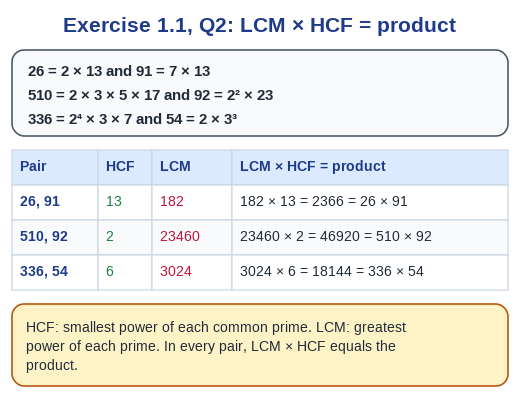
2. “Find the LCM and HCF of the following pairs of integers and verify that LCM × HCF = product of the two numbers. (i) 26 and 91 (ii) 510 and 92 (iii) 336 and 54”
(i) 26 = 2 × 13 and 91 = 7 × 13. HCF = 13; LCM = 2 × 7 × 13 = 182. LCM × HCF = 182 × 13 = 2366, and 26 × 91 = 2366. Verified.
(ii) 510 = 2 × 3 × 5 × 17 and 92 = 2² × 23. HCF = 2; LCM = 2² × 3 × 5 × 17 × 23 = 23460. LCM × HCF = 23460 × 2 = 46920, and 510 × 92 = 46920. Verified.
(iii) 336 = 2⁴ × 3 × 7 and 54 = 2 × 3³. HCF = 2 × 3 = 6; LCM = 2⁴ × 3³ × 7 = 3024. LCM × HCF = 3024 × 6 = 18144, and 336 × 54 = 18144. Verified.
Answer: (i) HCF 13, LCM 182 (ii) HCF 2, LCM 23460 (iii) HCF 6, LCM 3024. In each case LCM × HCF = product.
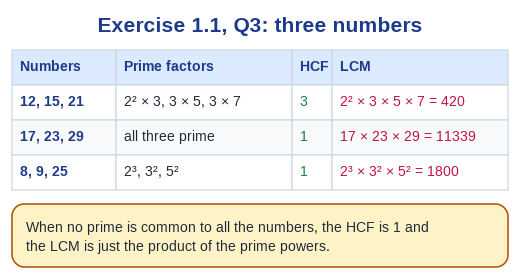
3. “Find the LCM and HCF of the following integers by applying the prime factorisation method. (i) 12, 15 and 21 (ii) 17, 23 and 29 (iii) 8, 9 and 25”
(i) 12 = 2² × 3, 15 = 3 × 5, 21 = 3 × 7. HCF = 3 (the only prime common to all three); LCM = 2² × 3 × 5 × 7 = 420.
(ii) 17, 23 and 29 are all primes, with no common prime factor. HCF = 1; LCM = 17 × 23 × 29 = 11339.
(iii) 8 = 2³, 9 = 3², 25 = 5²; no prime is common. HCF = 1; LCM = 2³ × 3² × 5² = 1800.
Answer: (i) HCF 3, LCM 420 (ii) HCF 1, LCM 11339 (iii) HCF 1, LCM 1800
4. “Given that HCF (306, 657) = 9, find LCM (306, 657).”
Given: HCF (306, 657) = 9.
To find: LCM (306, 657).
- For any two positive integers, HCF × LCM = product of the two numbers.
- So LCM = (306 × 657) ÷ HCF.
- 306 × 657 = 201042.
- LCM = 201042 ÷ 9 = 22338.
Check: 306 = 2 × 3² × 17 and 657 = 3² × 73, so HCF = 3² = 9 and LCM = 2 × 3² × 17 × 73 = 22338.
Answer: LCM (306, 657) = 22338.
5. “Check whether 6ⁿ can end with the digit 0 for any natural number n.”
- A number ends in 0 only if it is divisible by 10 = 2 × 5. So 5 must be one of its prime factors.
- 6ⁿ = (2 × 3)ⁿ = 2ⁿ × 3ⁿ. Its only prime factors are 2 and 3.
- By the Fundamental Theorem of Arithmetic, this factorisation is unique (there is no other one). So 6ⁿ can never have 5 as a prime factor.
- (In fact 6, 36, 216, 1296, … always end in 6.)
Answer: No. 6ⁿ cannot end with the digit 0 for any natural number n.
6. “Explain why 7 × 11 × 13 + 13 and 7 × 6 × 5 × 4 × 3 × 2 × 1 + 5 are composite numbers.”
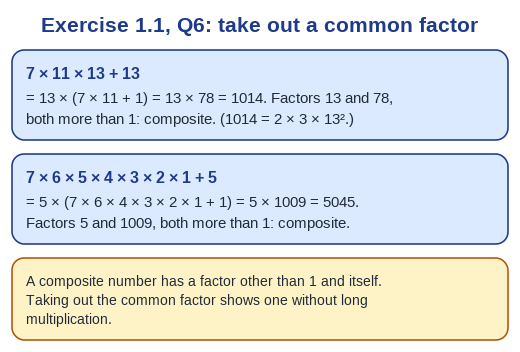
A composite number has a factor other than 1 and itself. Take out the common factor:
7 × 11 × 13 + 13 = 13 × (7 × 11 + 1) = 13 × 78 = 1014
7 × 6 × 5 × 4 × 3 × 2 × 1 + 5 = 5 × (7 × 6 × 4 × 3 × 2 × 1 + 1) = 5 × 1009 = 5045
The first number has the factors 13 and 78, and the second the factors 5 and 1009, all greater than 1. (Fully: 1014 = 2 × 3 × 13² and 5045 = 5 × 1009, where 1009 is prime.)
Answer: Each number has a factor other than 1 and itself (13 and 5), so both are composite.
7. “There is a circular path around a sports field. Sonia takes 18 minutes to drive one round of the field, while Ravi takes 12 minutes for the same. Suppose they both start at the same point and at the same time, and go in the same direction. After how many minutes will they meet again at the starting point?”
Given: Sonia takes 18 minutes for one round. Ravi takes 12 minutes. They start together from the same point.
To find: After how many minutes they are together at the starting point again.
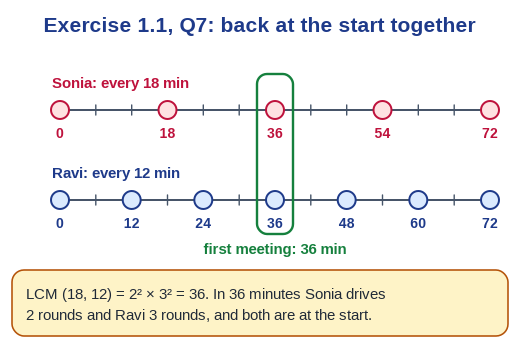
- Sonia is at the start after 18, 36, 54, … minutes (multiples of 18).
- Ravi is at the start after 12, 24, 36, … minutes (multiples of 12).
- They are there together at the smallest common multiple, that is, the LCM of 18 and 12.
- 18 = 2 × 3² and 12 = 2² × 3.
- LCM = 2² × 3² = 36. By then Sonia has done 2 rounds and Ravi 3.
Answer: They meet again at the starting point after 36 minutes.
Theorems 1.2 and 1.3 (pages 6–7)
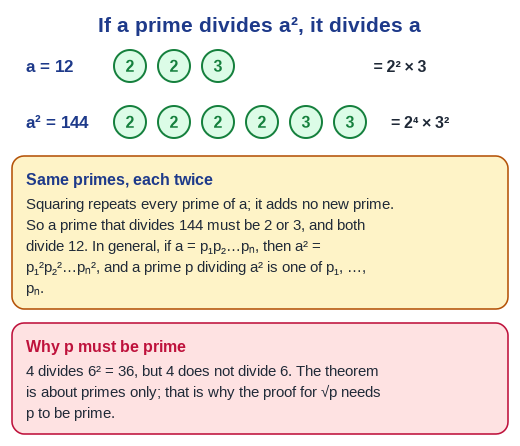
Theorem 1.2: if a prime p divides a², then p divides a (a a positive integer). Let a = p₁p₂…pₙ be the prime factorisation of a. Then a² = p₁²p₂²…pₙ². If p divides a², then p is a prime factor of a², and by uniqueness the only prime factors of a² are p₁, p₂, …, pₙ. So p is one of them, and so p divides a. (The book marks this proof “not from the examination point of view”.)
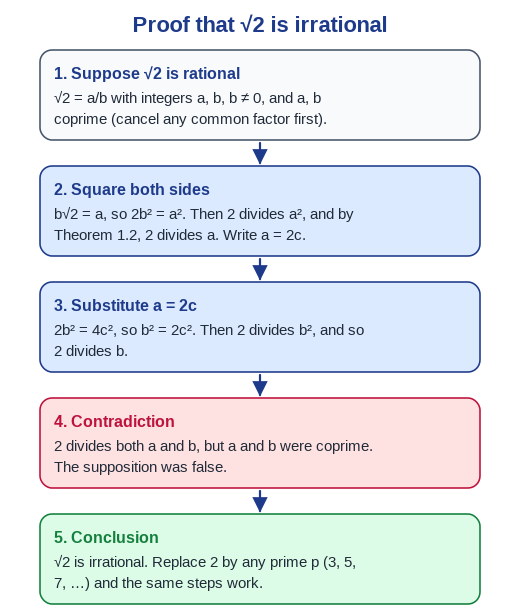
Theorem 1.3: √2 is irrational. Assume, to the contrary, that √2 is rational. Then √2 = a/b for integers a, b with b ≠ 0, and after cancelling common factors we may take a and b coprime. Multiplying by b, b√2 = a, and squaring, 2b² = a². Hence 2 divides a², and by Theorem 1.2, 2 divides a. Write a = 2c; then 2b² = 4c², so b² = 2c². Hence 2 divides b², and so 2 divides b. Now 2 divides both a and b, which contradicts their being coprime. The assumption was false, so √2 is irrational.
Examples 5 to 7 (pages 7–9)
Example 5 (page 7): prove that √3 is irrational. Assume, to the contrary, that √3 = a/b with integers a, b, b ≠ 0, and a, b coprime. Then b√3 = a, so 3b² = a². So 3 divides a², and since 3 is prime, 3 divides a (Theorem 1.2). Put a = 3c: 3b² = 9c², so b² = 3c². So 3 divides b², and hence 3 divides b. Then 3 is a common factor of a and b, contradicting coprimality. So √3 is irrational.
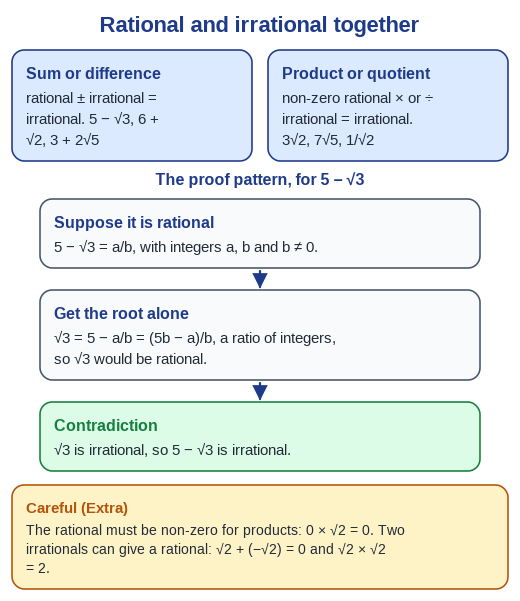
Example 6 (page 8): show that 5 − √3 is irrational. Assume 5 − √3 = a/b with coprime integers a, b and b ≠ 0. Then
√3 = 5 − a/b = (5b − a)/b
Since a and b are integers and b ≠ 0, (5b − a)/b is rational, so √3 would be rational. This contradicts Example 5. So 5 − √3 is irrational.
Example 7 (page 8): show that 3√2 is irrational. Assume 3√2 = a/b with coprime integers a, b and b ≠ 0. Then √2 = a/(3b). Since 3, a and b are integers and 3b ≠ 0, a/(3b) is rational, so √2 would be rational. This contradicts Theorem 1.3. So 3√2 is irrational.
Exercise 1.2 (page 9)
1. “Prove that √5 is irrational.”
To prove: √5 is irrational.
Proof:
- Assume the opposite: √5 is rational. Then √5 = a/b for some integers a and b, with b ≠ 0.
- Cancel any common factor, so a and b are coprime (their only common factor is 1).
- Then b√5 = a. Squaring both sides, 5b² = a².
- So 5 divides a². Since 5 is prime, 5 divides a (Theorem 1.2). Write a = 5c for some integer c.
- Put a = 5c in step 3: 5b² = 25c², so b² = 5c².
- So 5 divides b², and by Theorem 1.2, 5 divides b.
- Now 5 divides both a and b. This contradicts step 2 (a and b are coprime).
- So our assumption was wrong.
Hence proved: √5 is irrational.
2. “Prove that 3 + 2√5 is irrational.”
Given: √5 is irrational (Question 1).
To prove: 3 + 2√5 is irrational.
Proof:
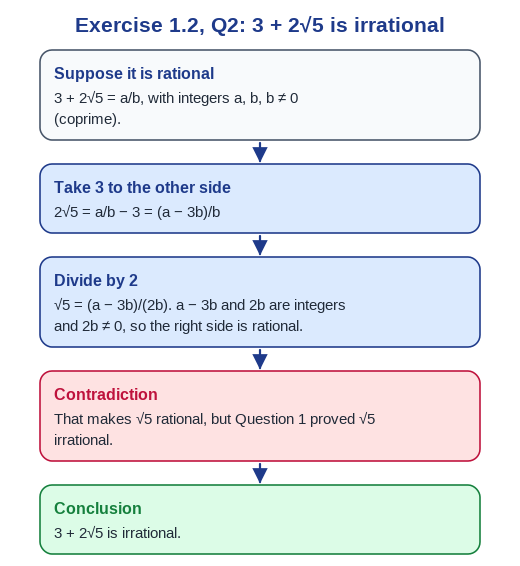
- Assume the opposite: 3 + 2√5 is rational. Then 3 + 2√5 = a/b for some integers a and b, with b ≠ 0.
- Move 3 to the other side: 2√5 = a/b − 3 = (a − 3b)/b.
- Divide by 2: √5 = (a − 3b)/(2b).
- a − 3b and 2b are integers, and 2b ≠ 0. So (a − 3b)/(2b) is rational.
- Then √5 would be rational. But √5 is irrational (Question 1). This is a contradiction.
- So our assumption was wrong.
Hence proved: 3 + 2√5 is irrational.
3. “Prove that the following are irrationals : (i) 1/√2 (ii) 7√5 (iii) 6 + √2”
Given: √2 is irrational (Theorem 1.3) and √5 is irrational (Question 1).
To prove: 1/√2, 7√5 and 6 + √2 are irrational.
Proof (each part by contradiction):
(i) Assume 1/√2 is rational: 1/√2 = a/b with integers a, b and b ≠ 0. Since 1/√2 is not 0, a ≠ 0 too. Taking reciprocals, √2 = b/a, a ratio of integers with a ≠ 0, so √2 would be rational. This contradicts Theorem 1.3. So 1/√2 is irrational.
(ii) Assume 7√5 is rational: 7√5 = a/b with integers a, b and b ≠ 0. Then √5 = a/(7b). Since a and 7b are integers and 7b ≠ 0, √5 would be rational, which contradicts Question 1. So 7√5 is irrational.
(iii) Assume 6 + √2 is rational: 6 + √2 = a/b with integers a, b and b ≠ 0. Then √2 = a/b − 6 = (a − 6b)/b. Since a − 6b and b are integers and b ≠ 0, √2 would be rational, which contradicts Theorem 1.3. So 6 + √2 is irrational.
Hence proved: 1/√2, 7√5 and 6 + √2 are all irrational.
The note to the reader (page 9)
The box at the end of the chapter gives two results that do hold for three positive integers p, q and r:
LCM (p, q, r) = p × q × r × HCF (p, q, r) ÷ [HCF (p, q) × HCF (q, r) × HCF (p, r)]
HCF (p, q, r) = p × q × r × LCM (p, q, r) ÷ [LCM (p, q) × LCM (q, r) × LCM (p, r)]
Check with Example 4 (6, 72 and 120): the pairwise HCFs are 6, 24 and 6, so LCM = 51840 × 6 ÷ (6 × 24 × 6) = 311040 ÷ 864 = 360. The pairwise LCMs are 72, 360 and 120, so HCF = 51840 × 360 ÷ (72 × 360 × 120) = 6. Both match. The box says “see Example 8”; in this edition the example with 6, 72 and 120 is Example 4.
Practice
-
The LCM of 2² × 3 × 5 and 2 × 3² × 7 is:
Show answer
Answer: (a) 2² × 3² × 5 × 7
-
HCF(a, b) = 16 and a × b = 3072. Then LCM(a, b) is:
Show answer
Answer: (a) 192
-
Which of these numbers is composite?
Show answer
Answer: (a) 5 × 7 × 11 + 7
-
Prove that 2 + √3 is irrational.
Show answer
Answer: Suppose 2 + √3 = a/b with integers a, b and b ≠ 0. Then √3 = a/b − 2 = (a − 2b)/b, a ratio of integers, so √3 would be rational. But √3 is irrational, so this is impossible, and 2 + √3 is irrational.
-
Two school bells ring every 20 minutes and every 30 minutes. They ring together at 9:00 am. When do they next ring together?
Show answer
Answer: 20 = 2² × 5 and 30 = 2 × 3 × 5, so LCM = 2² × 3 × 5 = 60 minutes. They ring together again at 10:00 am.
Stuck on a question?
Take a photo and Lagnever AI explains it step by step. Try it for 7 days for ₹2.
Get it on Google Play Open in browser
For parents: after the trial, the plan renews monthly by UPI or card autopay. You can cancel anytime in the app.