
Class 10 Maths Chapter 1: Real Numbers Notes
This chapter in five lines
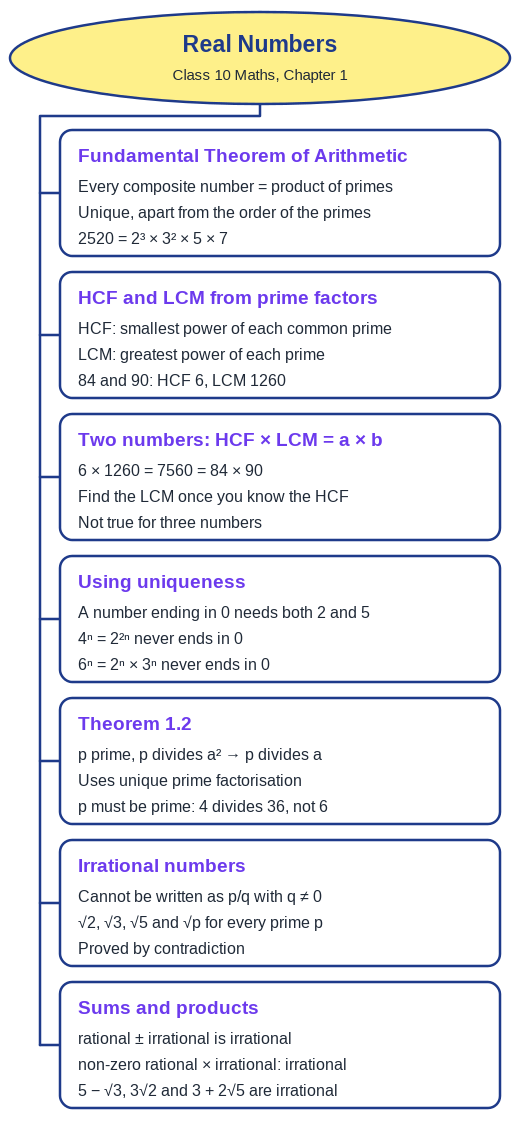
Every composite number is a product of primes in exactly one way, apart from the order: this is the Fundamental Theorem of Arithmetic. It gives the HCF (smallest powers of the common primes) and the LCM (greatest powers of all the primes), and for two numbers HCF × LCM = a × b. With it the chapter proves, by contradiction, that √2, √3, √5 and numbers such as 5 − √3 are irrational.
What is this chapter about?
In Class 9 you met irrational numbers such as √2 and √3 and placed them on the number line, but you did not prove that they are irrational. This short chapter, nine pages long, does that. Its tool is one fact about whole numbers, the Fundamental Theorem of Arithmetic. The same fact also gives a clean way to find the HCF and LCM of numbers, which you did in Classes 6 and 7.
What does the Fundamental Theorem of Arithmetic say?
Multiply primes together and you get bigger numbers: 7 × 11 × 13 = 1001. The theorem looks the other way. It says that every composite number is a product of primes, and apart from the order of the primes there is only one such product. To find the primes, split the number with a factor tree until every branch ends in a prime. The book factorises 32760 = 2³ × 3² × 5 × 7 × 13 and 123456789 = 3² × 3803 × 3607.
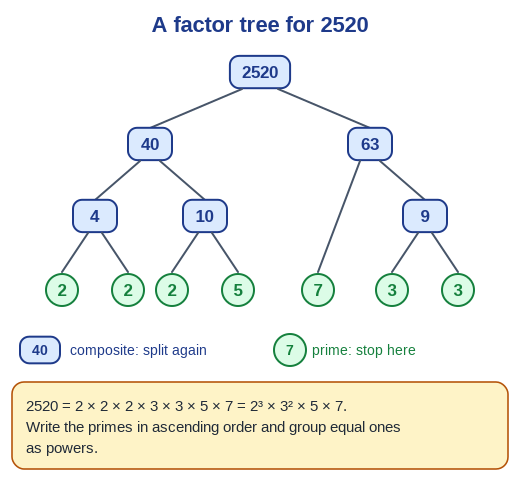
“Unique” means that however you split the number, the same primes come out, each the same number of times. We write them in ascending order and group equal primes as powers: 2520 = 2³ × 3² × 5 × 7. The book notes that a version of the theorem was probably first recorded in Euclid’s Elements (Book IX, Proposition 14), and that Carl Friedrich Gauss (1777–1855) gave the first correct proof. Read more on the Fundamental Theorem of Arithmetic.
How does uniqueness help?
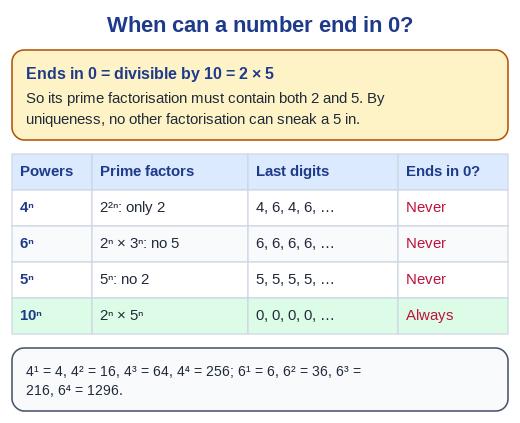
A number ends in the digit 0 only if it is divisible by 10 = 2 × 5, so its prime factorisation must contain both 2 and 5. Now 4ⁿ = 2²ⁿ: its only prime is 2. Uniqueness says no other factorisation of 4ⁿ can contain a 5, so 4ⁿ never ends in 0, for any natural number n. The same reasoning answers questions about 6ⁿ, 12ⁿ and so on.
How do we find the HCF and LCM by prime factorisation?
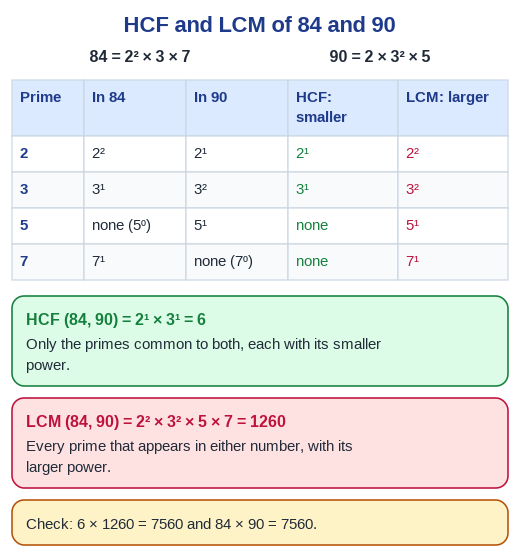
Factorise each number. For the HCF, multiply the primes common to all the numbers, each with its lowest power. For the LCM, multiply every prime that appears in any of them, each with its highest power. For 84 = 2² × 3 × 7 and 90 = 2 × 3² × 5, the HCF is 2 × 3 = 6 and the LCM is 2² × 3² × 5 × 7 = 1260.
Why is HCF × LCM = a × b only for two numbers?
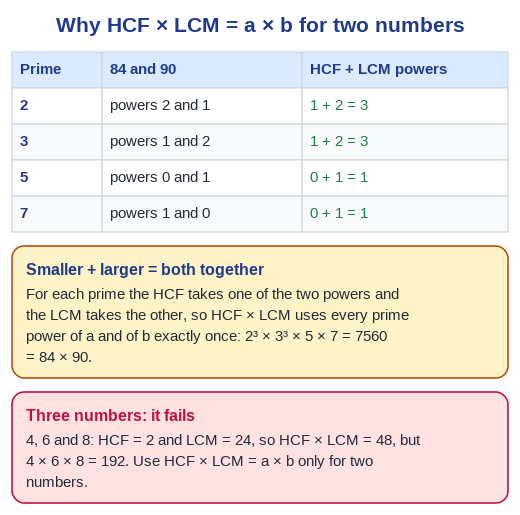
Check the example: 6 × 1260 = 7560 = 84 × 90. If a and b are two positive integers, then HCF(a, b) × LCM(a, b) = a × b. For each prime, the HCF takes the smaller of the two powers and the LCM the larger, so together they use both powers once. This lets you find the LCM quickly once you know the HCF. With three numbers it breaks down: for 6, 72 and 120 the HCF is 6 and the LCM 360, and 6 × 360 = 2160 is far from 6 × 72 × 120 = 51840.
What is an irrational number?
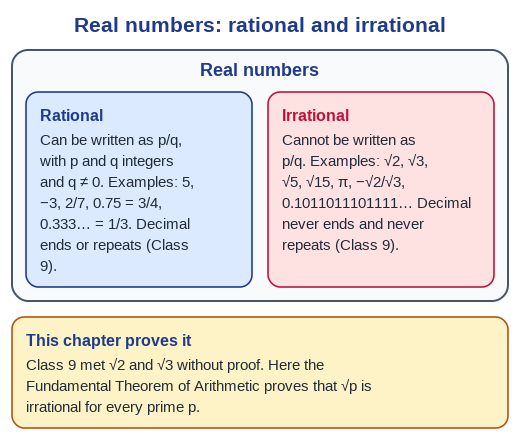
A number is rational if it can be written as p/q, with p and q integers and q ≠ 0. A number that cannot be written so is irrational: √2, √3, √15, π and 0.10110111011110… are examples. Rational and irrational numbers together make up the real numbers.
How do we prove that √2 is irrational?
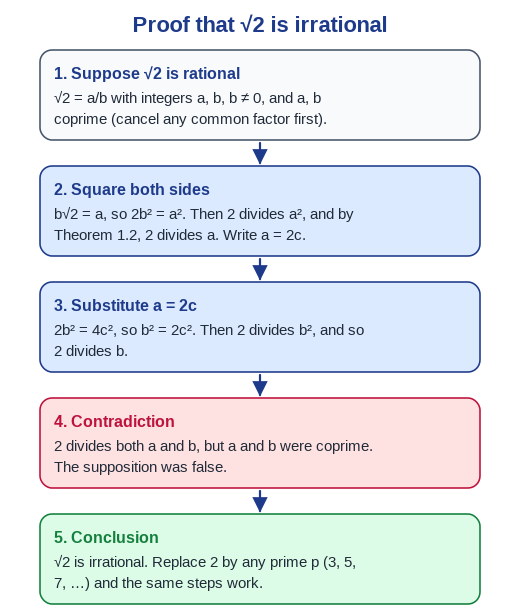
First a tool, Theorem 1.2: if a prime p divides a², then p divides a. The reason is that a² has exactly the same primes as a, each twice, so a prime dividing a² must already be one of the primes of a. (The book marks this proof “not from the examination point of view”; the theorem itself is used in every proof below.)
The proof is by contradiction. Suppose √2 = a/b, with a and b coprime integers and b ≠ 0. Squaring gives 2b² = a², so 2 divides a², and so 2 divides a. Write a = 2c; then b² = 2c², so 2 divides b too. Now 2 divides both a and b, which contradicts their being coprime. So √2 is irrational. The same steps, with 3 or 5 in place of 2, prove √3 and √5 irrational. Read how to prove numbers irrational.
What about 5 − √3 or 3√2?
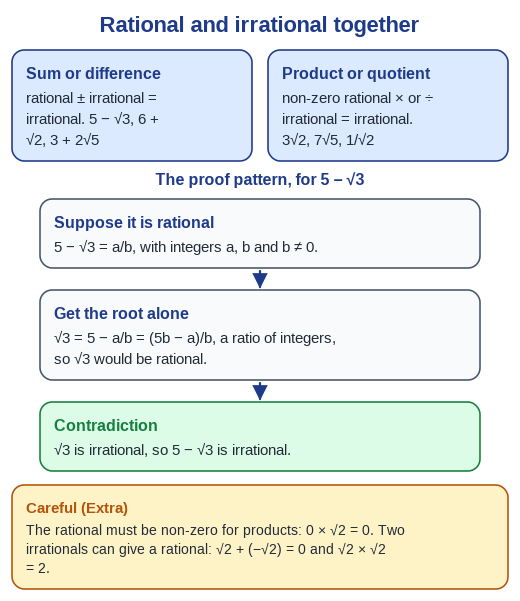
Class 9 stated two rules: a rational number plus or minus an irrational number is irrational, and a non-zero rational number times or divided by an irrational number is irrational. The chapter proves cases of them. Suppose 5 − √3 = a/b. Then √3 = (5b − a)/b, a ratio of integers, so √3 would be rational, which is false. In the same way, 3√2 = a/b would give √2 = a/(3b).
Before we move on
This chapter builds on prime factorisation from Class 6, the HCF from Class 7 and the square root of 2 from Class 8. Older guides may still show Euclid’s division lemma or decimal expansions here; the current book has neither. Answers to every example and both exercises are in the NCERT solutions for Chapter 1.
Key terms
| Term | Meaning |
|---|---|
| Prime number | A natural number greater than 1 whose only factors are 1 and itself: 2, 3, 5, 7, 11, 13, … |
| Composite number | A natural number greater than 1 with a factor other than 1 and itself, such as 4, 15 or 2520. |
| Prime factorisation | Writing a number as a product of primes, in ascending order with powers: 2520 = 2³ × 3² × 5 × 7. |
| Fundamental Theorem of Arithmetic (Theorem 1.1) | Every composite number is a product of primes, and there is only one such product if we ignore the order of the primes. |
| Factor tree | A diagram that splits a number into two factors again and again until only primes are left. |
| HCF | Highest common factor. By prime factorisation: multiply the primes common to all the numbers, each with its lowest power. |
| LCM | Lowest common multiple. By prime factorisation: multiply every prime that appears in any of the numbers, each with its highest power. |
| HCF × LCM = a × b | True whenever a and b are two positive integers, so LCM = a × b ÷ HCF. It is not true for three numbers. |
| Coprime numbers | Integers with no common factor other than 1, such as 8 and 15. |
| Rational number | A number that can be written as p/q, where p and q are integers and q ≠ 0. |
| Irrational number | A number that cannot be written as p/q with integers p, q and q ≠ 0, such as √2, √3 or π. |
| Theorem 1.2 | For a positive integer a and a prime p: if p divides a², then p also divides a. |
| Proof by contradiction | Assume the opposite of what you want to prove, reason correctly until you reach something impossible, and conclude that the assumption was false. |
Topics in this chapter
Practice
-
The prime factorisation of 252 is:
Show answer
Answer: (a) 2² × 3² × 7
-
HCF(a, b) = 6 and a × b = 1800. Then LCM(a, b) is:
Show answer
Answer: (a) 300
-
Which of these ends with the digit 0 for every natural number n?
Show answer
Answer: (d) 30ⁿ
-
Which of these numbers is irrational?
Show answer
Answer: (c) √7
-
In the proof that √2 is irrational, we start by writing √2 = a/b, where a and b are:
Show answer
Answer: (b) coprime integers with b ≠ 0
Questions students ask
What are the main topics of Class 10 Maths Chapter 1?
The Fundamental Theorem of Arithmetic, the HCF and LCM by prime factorisation, the result HCF × LCM = a × b for two numbers, and proofs by contradiction that √2, √3, √5 and numbers built from them, such as 5 − √3 or 3√2, are irrational.
Is Euclid's division lemma in the 2026-27 Class 10 Maths book?
No. In the rationalised book (revised October 2022, marked Reprint 2026-27) the chapter has only the Fundamental Theorem of Arithmetic, irrational numbers and a summary after the introduction. The introduction still mentions Euclid's division algorithm and decimal expansions, but those sections are no longer there.
Is HCF × LCM equal to the product for three numbers?
No, it holds for two positive integers only. For 6, 72 and 120 the HCF is 6 and the LCM is 360, so HCF × LCM = 2160, while 6 × 72 × 120 = 51840.
Which proofs should I practise for the board exam?
Practise the proof that √2 is irrational until you can write every step, then the same proof for √3 and √5, and the short proofs for numbers such as 5 − √3, 3√2, 3 + 2√5, 1/√2 and 6 + √2. Each time, say what you assume, where Theorem 1.2 is used and what the contradiction is.
Stuck on a question?
Take a photo and Lagnever AI explains it step by step. Try it for 7 days for ₹2.
Get it on Google Play Open in browser
For parents: after the trial, the plan renews monthly by UPI or card autopay. You can cancel anytime in the app.