
What is the Fundamental Theorem of Arithmetic?
Answer in short
The Fundamental Theorem of Arithmetic says that every composite number is a product of primes, and that there is only one such product if we ignore the order of the primes. However you split 2520, you get 2³ × 3² × 5 × 7. The theorem gives the HCF and LCM and shows why 4ⁿ never ends in 0.
Stuck on a question? Take a photo and Lagnever AI explains it step by step. Try it for 7 days for ₹2. Get it on Google Play
What does the theorem say?
Take a few primes, say 2, 3, 5 and 7, and multiply them, repeating any you like: 2 × 2 × 3 × 7 = 84, 2 × 3 × 3 × 5 = 90. Since there are infinitely many primes, this makes infinitely many numbers. The theorem goes the other way:
Every composite number is a product of primes, and, apart from the order of the primes, it has only one such product.
A prime has exactly two factors, 1 and itself (2, 3, 5, 7, 11, …). A composite number has more, so it can be split into smaller factors. The theorem is called fundamental because so much about whole numbers rests on it.
How do you find a prime factorisation?
Use a factor tree. Split the number into any two factors, then split each factor that is not prime, and stop when every branch ends in a prime. For 2520, one way is 2520 = 40 × 63, then 40 = 4 × 10 and 63 = 7 × 9, and finally 4 = 2 × 2, 10 = 2 × 5 and 9 = 3 × 3.
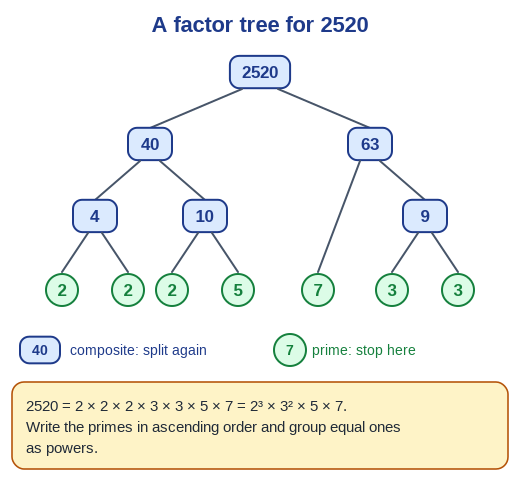
Collect the primes in ascending order and group equal ones as powers: 2520 = 2 × 2 × 2 × 3 × 3 × 5 × 7 = 2³ × 3² × 5 × 7. You can also divide by primes again and again, starting with 2, as in the ladders on the solutions page. The book factorises bigger numbers too: 32760 = 2³ × 3² × 5 × 7 × 13 and 123456789 = 3² × 3803 × 3607.
What does “unique” mean?
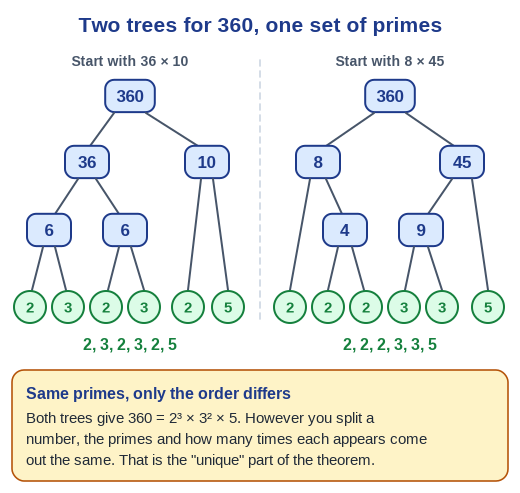
It means that the primes you end with, and how many times each appears, do not depend on how you split the number. Start 360 as 36 × 10 or as 8 × 45: both trees end with three 2s, two 3s and one 5, so 360 = 2³ × 3² × 5 either way. Only the order of the primes can change, and once we agree to write them in ascending order, the factorisation is exactly one.
The book adds a little history: a version of the theorem was probably first recorded in Euclid’s Elements (Book IX, Proposition 14), and Carl Friedrich Gauss gave the first proof that was fully correct.
How does uniqueness answer questions?
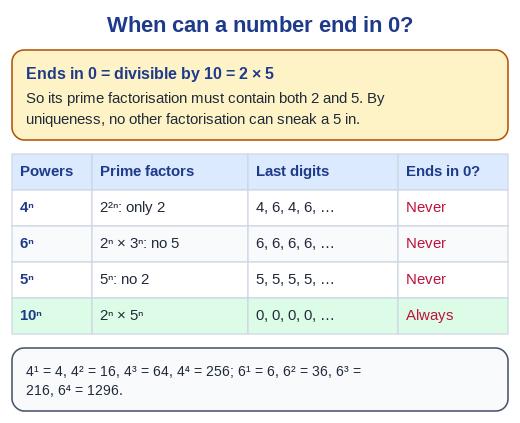
Can 4ⁿ end with the digit 0 for some natural number n? A number ending in 0 is divisible by 10 = 2 × 5, so 5 would have to be one of its prime factors. But 4ⁿ = (2²)ⁿ = 2²ⁿ, whose only prime is 2. Because the factorisation is unique, there is no second factorisation that contains a 5. So 4ⁿ never ends in 0. Its last digits simply alternate: 4, 16, 64, 256, …
How do you find the HCF and LCM by prime factorisation?
Write each number as a product of prime powers. Then:
- HCF: multiply the primes common to all the numbers, each with its lowest power.
- LCM: multiply every prime that appears in any of the numbers, each with its highest power.
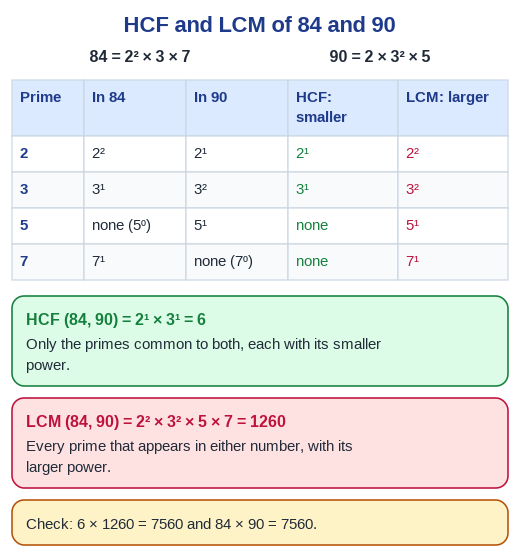
For 84 = 2² × 3 × 7 and 90 = 2 × 3² × 5, the common primes are 2 and 3, so HCF = 2 × 3 = 6. Every prime counts for the LCM, so LCM = 2² × 3² × 5 × 7 = 1260. The method works for three numbers as well: 12 = 2² × 3, 18 = 2 × 3² and 30 = 2 × 3 × 5 give HCF = 2 × 3 = 6 and LCM = 2² × 3² × 5 = 180.
Why is HCF × LCM = a × b?
If a and b are two positive integers, then HCF(a, b) × LCM(a, b) = a × b. Look at one prime at a time. In 84 the power of 2 is 2, in 90 it is 1; the HCF takes the smaller (1) and the LCM the larger (2), and 1 + 2 = 3 = 2 + 1. This happens for every prime, so HCF × LCM uses each prime power of a and b exactly once: 6 × 1260 = 7560 = 84 × 90.
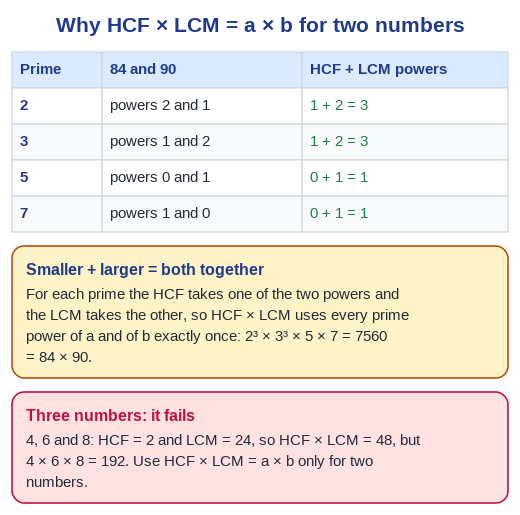
This saves work. HCF(24, 36) = 12, so LCM(24, 36) = 24 × 36 ÷ 12 = 72. But with three numbers the min and max no longer cover every power, and the rule fails: 4, 6 and 8 have HCF 2 and LCM 24, product 48, while 4 × 6 × 8 = 192.
Where does the LCM turn up?
Whenever repeating events must line up. Two lights that blink every 8 seconds and every 12 seconds blink together again after LCM(8, 12) = 2³ × 3 = 24 seconds. Exercise 1.1 has the same idea with two people going round a field.
Read next: proving numbers irrational, the chapter notes and the NCERT solutions. For the basics, see prime factorisation from Class 6.
Practice
-
The prime factorisation of 360 is:
Show answer
Answer: (a) 2³ × 3² × 5
-
The HCF of 2³ × 3² × 5 and 2² × 3³ × 7 is:
Show answer
Answer: (a) 2² × 3²
-
Two numbers have HCF 9 and LCM 360. One of them is 45. The other is:
Show answer
Answer: (a) 72
-
Is there a natural number n for which 12ⁿ ends in 0? Explain.
Show answer
Answer: No. 12ⁿ = 2²ⁿ × 3ⁿ has no prime factor 5, but a number ending in 0 is divisible by 10 = 2 × 5. By uniqueness, 12ⁿ has no other prime factorisation, so it never ends in 0.
-
Find the HCF and LCM of 48 and 180 by prime factorisation, and check HCF × LCM = 48 × 180.
Show answer
Answer: 48 = 2⁴ × 3 and 180 = 2² × 3² × 5. HCF = 2² × 3 = 12; LCM = 2⁴ × 3² × 5 = 720. Check: 12 × 720 = 8640 = 48 × 180.
Questions students ask
Why is 1 not a prime number?
A prime has exactly two factors, 1 and itself, and 1 has only one. If 1 counted as a prime, factorisations would stop being unique, since 6 = 2 × 3 = 1 × 2 × 3. (This reason is Extra; the chapter does not discuss it.)
What does “unique” mean in the Fundamental Theorem of Arithmetic?
It means that a composite number has only one prime factorisation if we ignore the order of the primes. 2 × 3 × 5 × 7 and 3 × 5 × 7 × 2 count as the same. Written in ascending order with powers, the factorisation is exactly one.
How do you find the LCM using the HCF?
For two positive integers, LCM = a × b ÷ HCF. For 96 and 404 the HCF is 4, so the LCM is 96 × 404 ÷ 4 = 9696.
Does HCF × LCM = a × b work for three numbers?
No. For 6, 72 and 120 the HCF is 6 and the LCM is 360, so HCF × LCM = 2160, while the product of the three numbers is 51840.
Stuck on a question?
Take a photo and Lagnever AI explains it step by step. Try it for 7 days for ₹2.
Get it on Google Play Open in browser
For parents: after the trial, the plan renews monthly by UPI or card autopay. You can cancel anytime in the app.