
How do you prove that √2 is irrational?
Answer in short
Suppose √2 = a/b, with a and b coprime integers and b ≠ 0. Squaring gives 2b² = a², so 2 divides a. Writing a = 2c gives b² = 2c², so 2 divides b. Then 2 divides both a and b, contradicting their being coprime. So √2 is irrational; the same proof works for √p when p is prime.
Stuck on a question? Take a photo and Lagnever AI explains it step by step. Try it for 7 days for ₹2. Get it on Google Play
What is an irrational number?
A number is rational if it can be written as p/q, where p and q are integers and q ≠ 0: 5, −3, 2/7 and 0.75 = 3/4 are rational. A number that cannot be written in this form is irrational. Examples are √2, √3, √15, π, −√2/√3 and 0.10110111011110…, where each block has one more 1 than the last. Together, the rational and irrational numbers make up the real numbers.
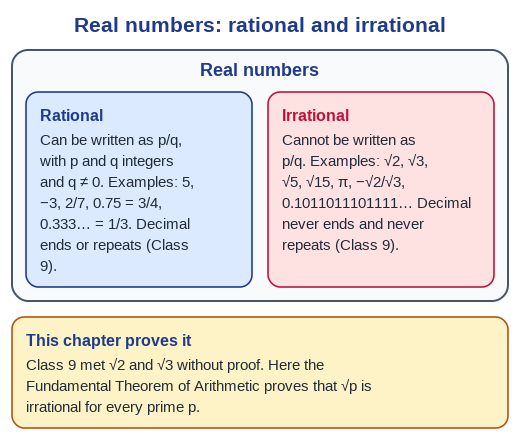
In Class 9 you placed √2 on the number line, but you did not prove that it cannot be a fraction. Checking fractions one by one could never settle it, because there are infinitely many. We need a proof.
What is proof by contradiction?
To prove a statement, assume its opposite and follow the logic. If correct steps lead to something impossible, the assumption was wrong, so the statement is true. Think of a detective: “if the suspect was in Pune at 9 pm, he could not have been seen in Delhi at 9 pm; he was seen in Delhi, so he was not in Pune.” To prove √2 irrational, we assume it is rational and reach an impossibility.
Why does a prime that divides a² also divide a?
This is Theorem 1.2: if a prime p divides a², then p divides a. Write a as a product of primes, a = p₁p₂…pₙ. Then a² = p₁²p₂²…pₙ²: the same primes, each twice, and no new ones. By the uniqueness in the Fundamental Theorem of Arithmetic, the only primes dividing a² are p₁, …, pₙ. So if p divides a², p is one of them, and therefore p divides a. The book marks this proof “not from the examination point of view”, but the theorem itself is used in every proof below.
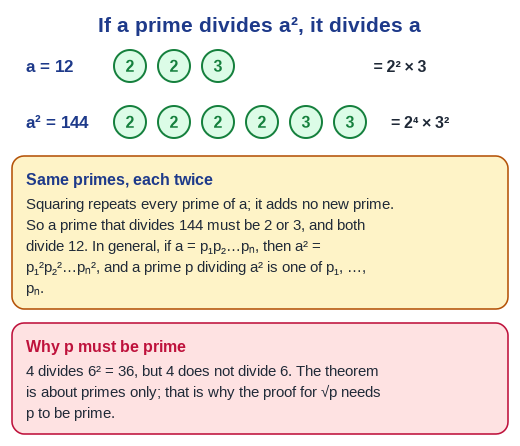
The word prime matters: 4 divides 6² = 36, but 4 does not divide 6.
The proof that √2 is irrational
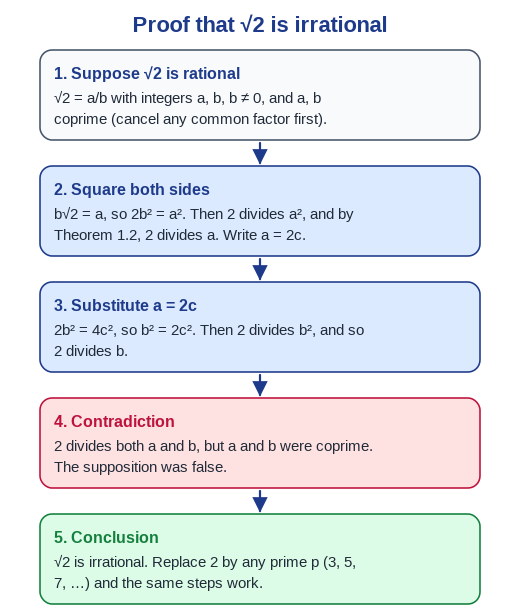
- Assume, to the contrary, that √2 is rational. Then √2 = a/b for integers a and b with b ≠ 0, and after cancelling any common factor we may take a and b coprime.
- Then b√2 = a. Squaring, 2b² = a². So 2 divides a², and by Theorem 1.2, 2 divides a.
- Write a = 2c for some integer c. Then 2b² = 4c², that is, b² = 2c². So 2 divides b², and so 2 divides b.
- Now 2 is a common factor of a and b. But we chose a and b coprime, so this cannot happen.
- The contradiction came from assuming √2 is rational. So √2 is irrational.
Does the same proof work for √3, √5 and √p?
Yes. Put 3 in place of 2: 3b² = a² shows that 3 divides a; then a = 3c gives b² = 3c², so 3 divides b as well. Every step used only that 2 is a prime, so the proof works for √p whenever p is prime: √3, √5, √7, √11 and so on. It does not work for √4, because 4 is not prime, and indeed √4 = 2.
How do you prove that 5 − √3 or 3√2 is irrational?
Class 9 told you that a rational number plus or minus an irrational number is irrational, and that a non-zero rational times or divided by an irrational number is irrational. To prove such a case, assume the number is rational and make the root the subject.
- 5 − √3. Suppose 5 − √3 = a/b. Then √3 = 5 − a/b = (5b − a)/b, a ratio of integers, so √3 would be rational. Contradiction.
- 3√2. Suppose 3√2 = a/b. Then √2 = a/(3b), again rational. Contradiction.
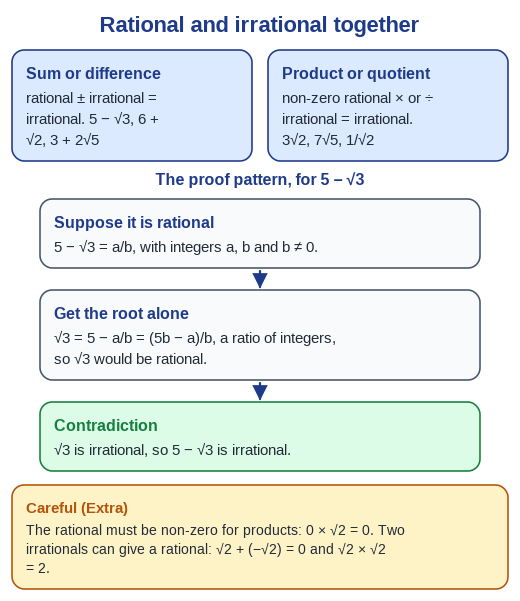
Our own example: is 7 − 2√3 irrational? Suppose 7 − 2√3 = a/b. Then 2√3 = (7b − a)/b and √3 = (7b − a)/(2b), which would be rational because a and b are integers and 2b ≠ 0. That is impossible, so 7 − 2√3 is irrational.
A tip for writing these proofs
Begin with “Let us assume, to the contrary, that … is rational.” Say that a and b are integers with b ≠ 0 (and coprime, for the √p proof). Name Theorem 1.2 when you use it. End by saying what contradicts what, and state the conclusion in a full sentence.
Read next: the Fundamental Theorem of Arithmetic, the chapter notes and the NCERT solutions. In Class 8 you saw another argument in the square root of 2.
Practice
-
Which of these is rational?
Show answer
Answer: (b) √2 × √8
-
In the proof that √3 is irrational, after putting a = 3c into 3b² = a², we get:
Show answer
Answer: (a) b² = 3c²
-
To prove 2 − √5 irrational, we assume 2 − √5 = a/b. This gives:
Show answer
Answer: (a) √5 = (2b − a)/b
-
Prove that √7 is irrational.
Show answer
Answer: Suppose √7 = a/b, a and b coprime, b ≠ 0. Then 7b² = a², so 7 divides a² and, 7 being prime, 7 divides a. Put a = 7c: 7b² = 49c², so b² = 7c², and 7 divides b. So 7 divides both a and b, a contradiction. Hence √7 is irrational.
-
Prove that 4√3 is irrational.
Show answer
Answer: Suppose 4√3 = a/b with integers a, b and b ≠ 0. Then √3 = a/(4b), a ratio of integers with 4b ≠ 0, so √3 would be rational. That contradicts √3 being irrational, so 4√3 is irrational.
Questions students ask
What is proof by contradiction?
You assume the opposite of what you want to prove, then reason step by step until you reach something impossible. Since correct steps cannot lead from a true statement to an impossible one, the assumption must be false, and the statement you wanted is true.
Why do we take a and b coprime in the proof?
Any fraction can be cancelled down until the numerator and denominator have no common factor other than 1. The proof then shows that 2 divides both a and b, which is impossible for coprime numbers. That impossibility is the contradiction.
Why does the same proof not show that √4 is irrational?
The step “4 divides a², so 4 divides a” is false, because 4 is not prime: 4 divides 36 but not 6. Indeed √4 = 2 is rational. Theorem 1.2 needs a prime, so the proof works for √2, √3, √5, √7 and every √p with p prime.
Is the sum of two irrational numbers always irrational?
No. √2 and −√2 are both irrational, but their sum is 0, and √2 × √2 = 2. The rule is only about a rational and an irrational number together. (These examples are Extra.)
Stuck on a question?
Take a photo and Lagnever AI explains it step by step. Try it for 7 days for ₹2.
Get it on Google Play Open in browser
For parents: after the trial, the plan renews monthly by UPI or card autopay. You can cancel anytime in the app.