
The square root of 2
Answer in short
√2 is the number whose square is 2. It is the length of the hypotenuse of a right triangle with two sides of 1, and of the diagonal of a unit square. Squaring decimals shows 1.414 < √2 < 1.415; its decimal, 1.41421356…, never ends, and it cannot be written as a fraction m/n.
Stuck on a question? Take a photo and Lagnever AI explains it step by step. Try it for 7 days for ₹2. Get it on Google Play
Doubling a square
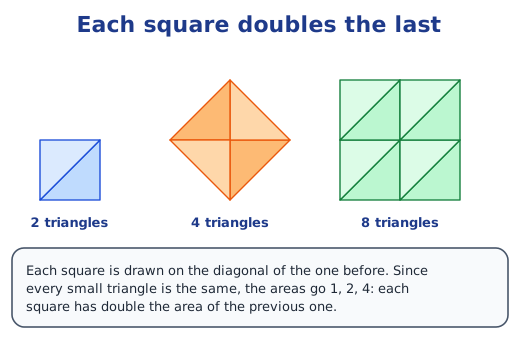
Around 800 BCE, Baudhayana asked how to build a square twice as big as a given square. Doubling the side fails, because it gives four times the area. His answer (Shulbasutra, verse 1.9) is to build the new square on the diagonal of the old one. Lines drawn east-west and north-south show why: the old square is made of 2 identical right triangles and the new one of 4. Repeating the step gives squares made of 2, 4 and 8 triangles, each doubling the last.
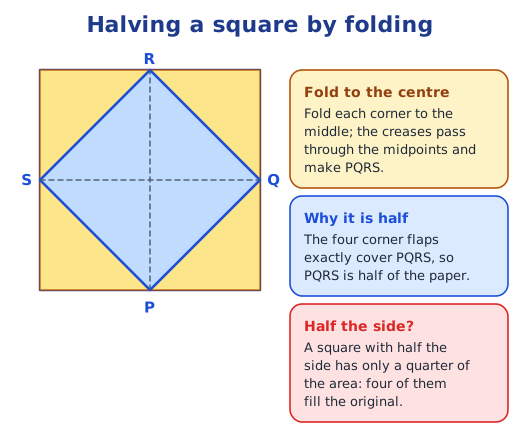
Halving works the same way in reverse. Fold the four corners of a square sheet to its centre: the creases join the midpoints of the sides and form a tilted square whose area is exactly half the sheet, because the four folded flaps cover it completely. A square with half the side would have only a quarter of the area.
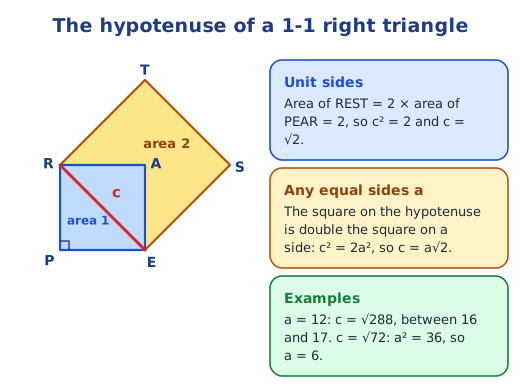
The hypotenuse of a 1-1 right triangle
Cut a unit square PEAR along its diagonal ER and you get a right triangle whose two shorter sides are 1. The square REST on its hypotenuse is the doubled square, so its area is 2 × 1 = 2. If the hypotenuse has length c, then c² = 2, and c = √2, the number whose square is 2. For equal sides of any length a, the same argument gives c² = 2a², so c = a√2. Equal sides of 12 give c = √288, between 16 and 17; a hypotenuse of √72 gives sides of 6.
How big is √2?
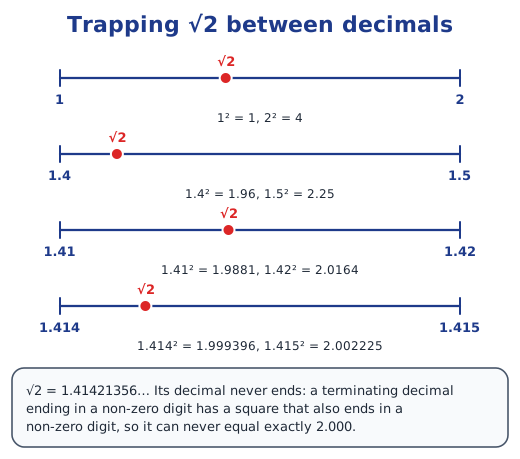
Squares can trap √2 between two numbers. Since 1² = 1 and 2² = 4, √2 lies between 1 and 2; these are called a lower and an upper bound. Next, 1.4² = 1.96 and 1.5² = 2.25, so 1.4 < √2 < 1.5. Then 1.41² = 1.9881 and 1.42² = 2.0164, so 1.41 < √2 < 1.42. Then 1.414² = 1.999396 and 1.415² = 2.002225, so 1.414 < √2 < 1.415. Each step adds one more correct digit, and the process can go on as long as we like.
A decimal that never ends
Will the digits ever stop? Suppose √2 were a terminating decimal. Its last digit would be non-zero, and the square of such a number also ends in a non-zero digit after the decimal point, so it could never equal 2 or 2.000 exactly. The decimal of √2 must therefore go on for ever: √2 = 1.41421356…
Not a fraction either
Could √2 be a fraction m/n of counting numbers? Then 2 = m²/n², so 2n² = m². In the prime factorisation of a square, each prime appears an even number of times. So m² would contain the prime 2 an even number of times, while 2n² contains it an odd number of times, which is impossible. This proof was given by Euclid in his Elements, around 300 BCE. Numbers like √2 are studied more in higher classes. Continue with the theorem and Pythagorean triples, or see the Chapter 2 notes and NCERT solutions.

Practice
-
The hypotenuse of a right triangle with two sides of 1 unit is:
Show answer
Answer: (b) √2 units
-
Between which two numbers does √2 lie?
Show answer
Answer: (c) 1.4 and 1.5
-
An isosceles right triangle has equal sides of 12 units. Its hypotenuse is:
Show answer
Answer: (b) √288, between 16 and 17
-
An isosceles right triangle has a hypotenuse of 10. How long are its equal sides?
Show answer
Answer: c² = 2a², so 100 = 2a² and a² = 50. Each side is √50, about 7.07, since 7.0² = 49 and 7.1² = 50.41.
-
Why can √2 not be a terminating decimal?
Show answer
Answer: A terminating decimal like 1.414…4 ends in a non-zero digit, and its square then also ends in a non-zero digit after the decimal point. So the square can never be exactly 2 or 2.000…; the decimal of √2 must go on for ever.
Questions students ask
What is the value of √2?
√2 = 1.41421356…, and its digits never end or repeat in a pattern. For everyday work, 1.414 or 1.41 is used. Squaring shows 1.414² = 1.999396 and 1.415² = 2.002225, so √2 lies between them.
Why is the diagonal of a square of side 1 equal to √2?
The square drawn on the diagonal is twice as big as the original square, as Baudhayana showed. The unit square has area 1, so the square on the diagonal has area 2, and its side, the diagonal, is the number whose square is 2: √2.
How do we know √2 is not a fraction?
If √2 were m/n, then 2n² = m². In any square number each prime appears an even number of times, so 2 appears an even number of times in m² but an odd number of times in 2n². Both cannot be true, so √2 is not a fraction. Euclid gave this proof around 300 BCE.
Stuck on a question?
Take a photo and Lagnever AI explains it step by step. Try it for 7 days for ₹2.
Get it on Google Play Open in browser
For parents: after the trial, the plan renews monthly by UPI or card autopay. You can cancel anytime in the app.