
Pythagorean triples: Baudhayana triples
Answer in short
A Baudhayana or Pythagorean triple is three counting numbers (a, b, c) with a² + b² = c², so they can be the sides of a right triangle, like (3, 4, 5) or (5, 12, 13). Multiplying a triple by any counting number gives another, so there are infinitely many; a triple with no common factor is called primitive.
Stuck on a question? Take a photo and Lagnever AI explains it step by step. Try it for 7 days for ₹2. Get it on Google Play
Right triangles with whole-number sides
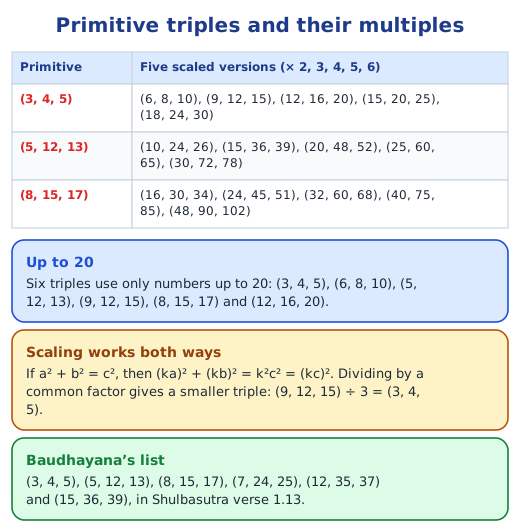
Most right triangles have at least one side that is not a whole number: sides 1 and 1 give a hypotenuse of √2. But some have three whole-number sides. In his Shulbasutra (verse 1.13), Baudhayana listed six: (3, 4, 5), (5, 12, 13), (7, 24, 25), (8, 15, 17), (15, 36, 39) and (12, 35, 37). Three counting numbers with a² + b² = c² are called Baudhayana triples, and also Baudhayana-Pythagoras triples or Pythagorean triples. Check one: 5² + 12² = 25 + 144 = 169 = 13².
Scaling a triple
Is (30, 40, 50) a triple? Yes: 900 + 1600 = 2500. So is (300, 400, 500). In general (3k, 4k, 5k) works for every counting number k, since 9k² + 16k² = 25k². The same argument works for any triple: if a² + b² = c², then (ka)² + (kb)² = k²(a² + b²) = k²c² = (kc)². A triple multiplied like this is a scaled version, so there are infinitely many triples. The triples using numbers up to 20 are (3, 4, 5), (6, 8, 10), (5, 12, 13), (9, 12, 15), (8, 15, 17) and (12, 16, 20).
Primitive triples
A triple whose numbers have no common factor greater than 1 is primitive. (3, 4, 5), (5, 12, 13) and (8, 15, 17) are primitive; (9, 12, 15) is not, because 3 divides all three numbers. Dividing a non-primitive triple by its common factor f gives another triple, since a² + b² = c² still holds after dividing everything by f²: (9, 12, 15) becomes (3, 4, 5). So every triple is either primitive or a scaled version of a primitive one, and finding all primitive triples means finding them all.
Making triples from odd squares
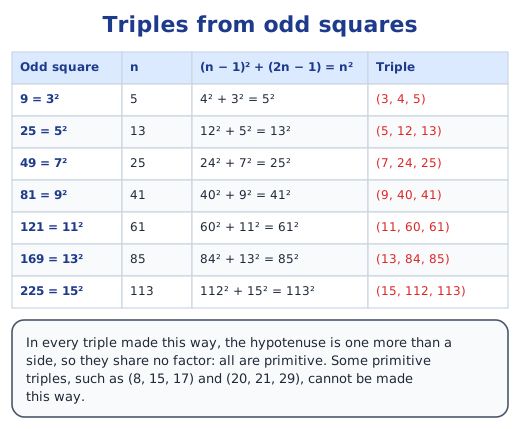
Add odd numbers in turn: 1 + 3 = 4 = 2², 1 + 3 + 5 = 9 = 3², 1 + 3 + 5 + 7 = 16 = 4². The first n odd numbers always add up to n², and the odd number in position n is 2n − 1. So the first n − 1 odd numbers make (n − 1)², and (n − 1)² + (2n − 1) = n². Now pick n so that 2n − 1 is itself a square. For 9 = 3², the 5th odd number, n = 5 and 4² + 3² = 5². For 25 = 5², the 13th, n = 13 and 12² + 5² = 13². The odd squares 49, 81 and 121 give (7, 24, 25), (9, 40, 41) and (11, 60, 61).
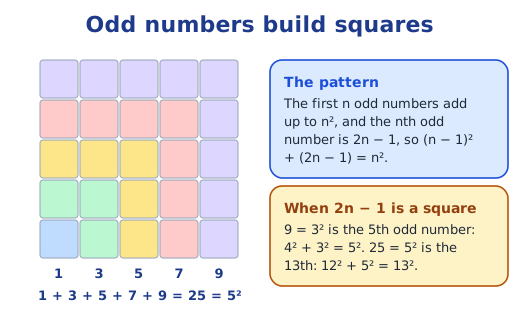
These triples are all primitive, because the hypotenuse n and the side n − 1 are consecutive numbers, which share no factor. But the method misses some primitive triples, such as (8, 15, 17) and (20, 21, 29), where no side is one less than the hypotenuse.
What about cubes?
Squares can be sums of two squares in infinitely many ways. In the 17th century the French mathematician Fermat claimed that no cube is a sum of two cubes, nor any higher power the sum of two such powers: xⁿ + yⁿ = zⁿ has no solution in counting numbers when n is more than 2. His proof was never found. After more than 300 years of attempts, Andrew Wiles, who had read about the problem at the age of 10, proved this Fermat’s Last Theorem in 1994. See the theorem, the square root of 2, the Chapter 2 notes and the NCERT solutions.
Practice
-
Which of these is a Baudhayana triple?
Show answer
Answer: (b) (7, 24, 25)
-
Which triple is NOT primitive?
Show answer
Answer: (c) (12, 16, 20)
-
Using the odd square 49, the triple formed is:
Show answer
Answer: (a) (7, 24, 25)
-
List all Baudhayana triples using numbers up to 20.
Show answer
Answer: (3, 4, 5), (6, 8, 10), (5, 12, 13), (9, 12, 15), (8, 15, 17) and (12, 16, 20). Of these, (3, 4, 5), (5, 12, 13) and (8, 15, 17) are primitive.
-
Give a primitive triple that the odd-square method cannot make.
Show answer
Answer: (8, 15, 17). The method always gives a side one less than the hypotenuse, but here the sides are 8 and 15 and the hypotenuse 17. (20, 21, 29) is another.
Questions students ask
What is a Pythagorean triple?
It is a set of three counting numbers a, b and c with a² + b² = c². Because of the Baudhayana-Pythagoras theorem, such numbers can be the sides of a right triangle. Baudhayana listed several in his Shulbasutra, so they are also called Baudhayana triples.
What is a primitive triple?
A Baudhayana triple whose three numbers have no common factor greater than 1, such as (3, 4, 5) or (5, 12, 13). Every other triple is a scaled version of a primitive one: (6, 8, 10) is 2 × (3, 4, 5).
Are there infinitely many Pythagorean triples?
Yes. If (a, b, c) is a triple, so is (ka, kb, kc) for every counting number k, because (ka)² + (kb)² = k²(a² + b²) = (kc)². There are even infinitely many primitive ones, such as those made from odd squares: (3, 4, 5), (5, 12, 13), (7, 24, 25), (9, 40, 41) and so on.
Stuck on a question?
Take a photo and Lagnever AI explains it step by step. Try it for 7 days for ₹2.
Get it on Google Play Open in browser
For parents: after the trial, the plan renews monthly by UPI or card autopay. You can cancel anytime in the app.