
Class 8 Maths Part 2 Chapter 2: The Baudhayana-Pythagoras Theorem Notes
This chapter in five lines
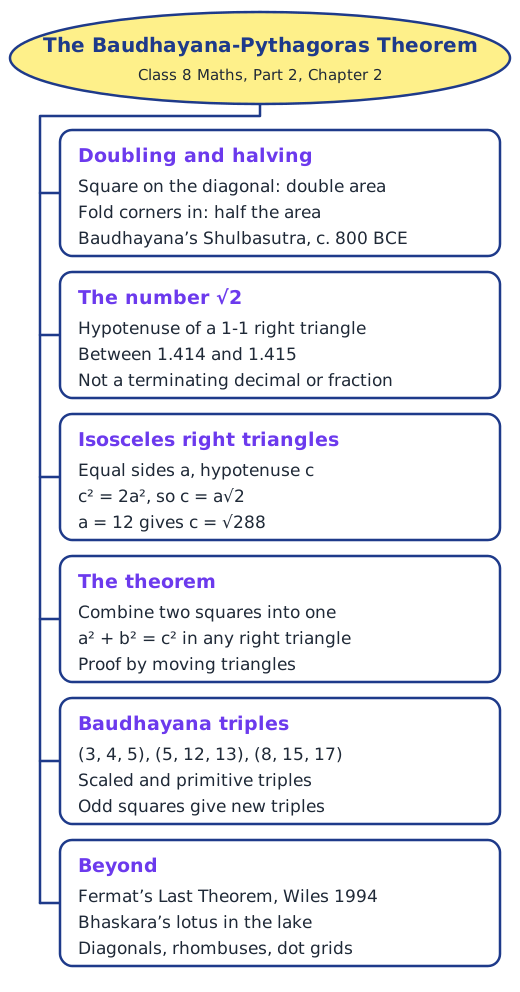
The Baudhayana-Pythagoras Theorem says that in a right-angled triangle with shorter sides a and b and hypotenuse c, a² + b² = c². The chapter builds it from Baudhayana’s Shulbasutra: doubling and halving squares, finding the hypotenuse √2 of a right triangle with two sides of 1, combining two squares into one, listing integer triples such as (3, 4, 5), and solving problems with the theorem.
What is this chapter about?
Around 800 BCE, Baudhayana wrote a Shulbasutra, a manual for building fire altars of exact shapes and sizes. Builders needed to make one square twice as big as another, or one square equal to two others put together. Following his questions, the chapter discovers one of the most important results in geometry: the theorem that links the three sides of every right-angled triangle.
Doubling and halving a square
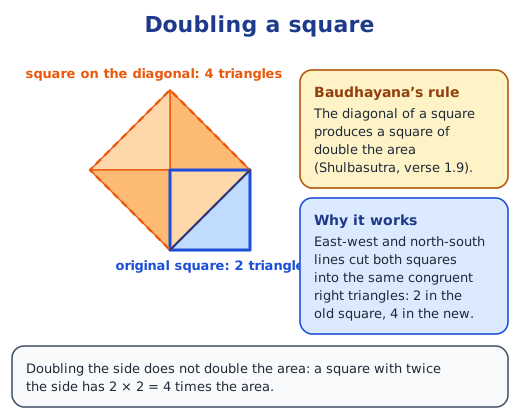
Doubling the side of a square does not double its area; it makes it four times as big. Baudhayana’s answer is to draw a square on the diagonal. North-south and east-west lines cut the original square into 2 identical right triangles and the new square into 4, so the new one has double the area. Running the idea backwards halves a square: fold the corners of a square paper to its centre, and the creases through the midpoints form a square with half the area.
The number √2
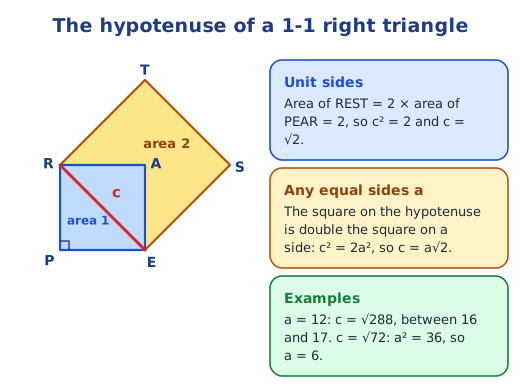
A right triangle whose two shorter sides are 1 unit is half of a unit square, and the square on its hypotenuse is the doubled square, with area 2. So the hypotenuse c satisfies c² = 2, and c = √2. More generally, equal sides a give c² = 2a², or c = a√2. Squaring decimals traps √2 ever more tightly: 1.4 < √2 < 1.5, then 1.41 < √2 < 1.42, then 1.414 < √2 < 1.415. Its decimal never ends, and, as Euclid proved around 300 BCE, it cannot be written as a fraction. Read the square root of 2.
Combining two squares: the theorem
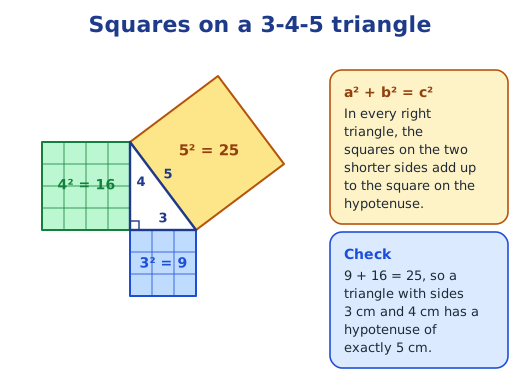
What if two different squares must be combined into one? Baudhayana’s rule: make a right triangle whose shorter sides are the sides of the two squares; the square on its hypotenuse has exactly their total area. Putting the two squares side by side and moving two triangles proves it, which gives Baudhayana’s theorem: in any right triangle with shorter sides a and b and hypotenuse c, a² + b² = c². So a right triangle with sides 3 cm and 4 cm has a hypotenuse of exactly 5 cm, because 9 + 16 = 25. The theorem is also called the Pythagorean theorem, after Pythagoras, who studied it about three centuries after Baudhayana. Read the Baudhayana-Pythagoras theorem.
Baudhayana triples
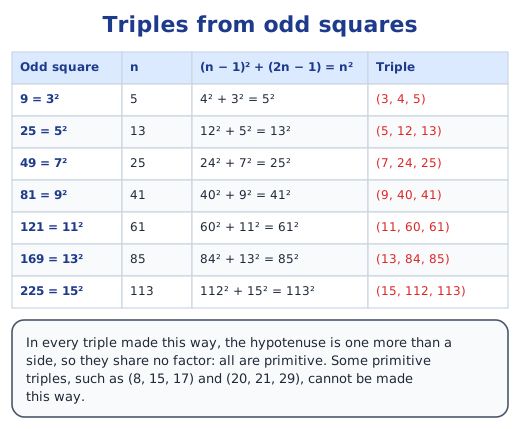
Counting numbers (a, b, c) with a² + b² = c² are called Baudhayana triples or Pythagorean triples. Baudhayana himself listed six of them, including (3, 4, 5), (5, 12, 13), (7, 24, 25) and (8, 15, 17). Multiplying a triple by any counting number gives another, such as (6, 8, 10), so there are infinitely many. Triples with no common factor, like (3, 4, 5), are primitive. A neat trick finds more: the first n odd numbers add up to n², so (n − 1)² + (2n − 1) = n², and whenever 2n − 1 is itself a square, a new triple appears. Read Pythagorean triples.
A problem that took over 300 years
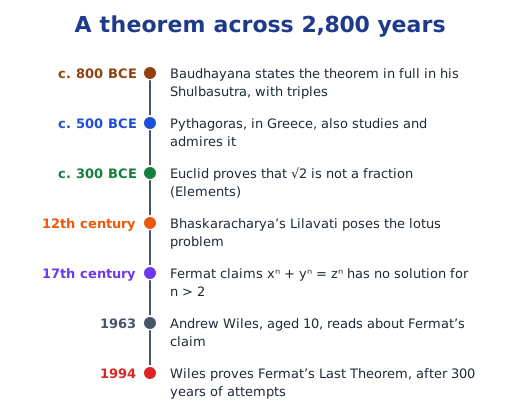
Since many squares are sums of two squares, the French mathematician Fermat asked in the 17th century whether a cube can be the sum of two cubes, or a fourth power the sum of two fourth powers. He wrote in a margin that xⁿ + yⁿ = zⁿ has no solution for n greater than 2, and that he had a proof the margin was too small to hold. Nobody found it for over 300 years. In 1963 a 10-year-old, Andrew Wiles, read about the problem and decided to solve it; he proved Fermat’s Last Theorem in 1994.
Using the theorem
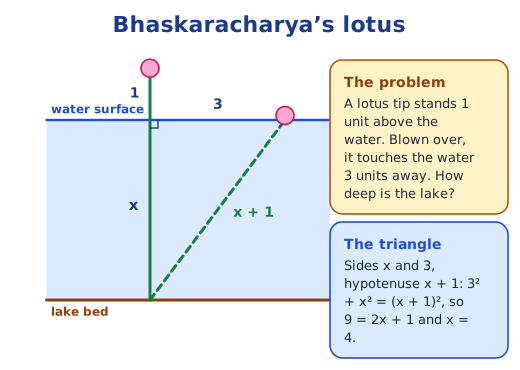
The theorem finds lengths that cannot be measured directly. In Bhaskaracharya’s Lilavati, a lotus stands 1 unit above a lake and, blown by the breeze, touches the water 3 units away. If the depth is x, the stem is x + 1, and 3² + x² = (x + 1)², which gives x = 4. The same idea gives the diagonal of a square, the side of a rhombus from its diagonals, and the height of an equilateral triangle.
In a nutshell
For any right triangle, the square on the hypotenuse equals the sum of the squares on the other two sides. Use a² + b² = c² to find a missing side, check whether three lengths make a right triangle, and build triples. The chapter ends with a puzzle about three wrongly labelled boxes. Answers to every question are in the NCERT solutions for Part 2 Chapter 2.
Key terms
| Term | Meaning |
|---|---|
| Hypotenuse | The side opposite the right angle in a right-angled triangle; it is always the longest side. |
| Isosceles right triangle | A right triangle whose two shorter sides are equal; with equal sides a, its hypotenuse is a√2. |
| Square on a side | The square drawn with a side of the triangle as one of its sides; its area is that side squared. |
| √2 (square root of 2) | The number whose square is 2, the hypotenuse of a right triangle with two sides of 1; √2 = 1.41421356… |
| Lower and upper bound | Numbers just below and just above an unknown value, such as 1.414 and 1.415 for √2. |
| Non-terminating decimal | A decimal whose digits go on for ever, like that of √2. |
| Baudhayana’s theorem | In a right triangle with sides a, b and hypotenuse c, a² + b² = c²; also called the Pythagorean theorem. |
| Baudhayana triple | Three counting numbers (a, b, c) with a² + b² = c², such as (3, 4, 5); also called a Pythagorean triple. |
| Primitive triple | A Baudhayana triple whose numbers have no common factor greater than 1, such as (5, 12, 13). |
| Scaled triple | A triple made by multiplying every number of another triple by the same counting number, such as (6, 8, 10). |
| Fermat’s Last Theorem | The statement that xⁿ + yⁿ = zⁿ has no solution in counting numbers when n is greater than 2; proved by Andrew Wiles in 1994. |
| Shulbasutra | Ancient Indian texts on building fire altars; Baudhayana’s, from about 800 BCE, states the theorem in full. |
Topics in this chapter
Practice
-
A right triangle has shorter sides 6 cm and 8 cm. Its hypotenuse is:
Show answer
Answer: (a) 10 cm
-
√2 lies between:
Show answer
Answer: (b) 1.41 and 1.42
-
Which of these is a Baudhayana triple?
Show answer
Answer: (b) (5, 12, 13)
-
Doubling the side of a square multiplies its area by:
Show answer
Answer: (c) 4
-
Which triple is primitive?
Show answer
Answer: (c) (8, 15, 17)
-
The diagonal of a square of side 5 cm is:
Show answer
Answer: (c) 5√2 cm, about 7.07 cm
Questions students ask
What are the main topics of Class 8 Maths Part 2 Chapter 2?
Doubling and halving a square; the hypotenuse of an isosceles right triangle and the number √2; why √2 is neither a terminating decimal nor a fraction; combining two squares and the theorem a² + b² = c²; Baudhayana triples, scaled and primitive; Fermat’s Last Theorem; and applications such as Bhaskaracharya’s lotus problem.
Is The Baudhayana-Pythagoras Theorem in the new NCERT Class 8 Maths book?
Yes. It is Chapter 2 of Ganita Prakash, the Class 8 Maths textbook Part 2 (first edition December 2025, used in 2026-27), on pages 33 to 54. It comes after Fractions in Disguise.
Why is it called the Baudhayana-Pythagoras theorem?
Baudhayana stated the theorem in full, general form in his Shulbasutra around 800 BCE, about three centuries before the Greek mathematician Pythagoras, after whom it is often named. Using both names makes clear which theorem is meant.
What is the formula of the Baudhayana-Pythagoras theorem?
For a right-angled triangle whose shorter sides are a and b and whose hypotenuse is c, a² + b² = c². So c = √(a² + b²), and a missing shorter side is √(c² − b²). For sides 5 and 12, c² = 25 + 144 = 169, so c = 13.
Stuck on a question?
Take a photo and Lagnever AI explains it step by step. Try it for 7 days for ₹2.
Get it on Google Play Open in browser
For parents: after the trial, the plan renews monthly by UPI or card autopay. You can cancel anytime in the app.