
The Baudhayana-Pythagoras theorem: a² + b² = c²
Answer in short
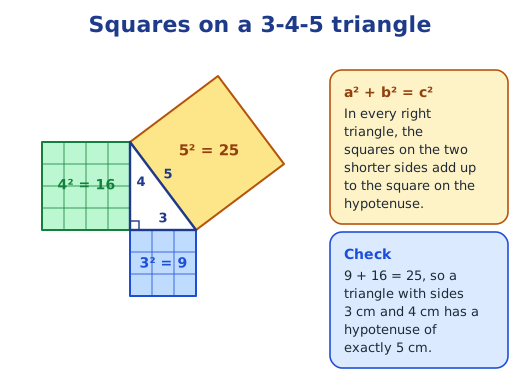
The Baudhayana-Pythagoras theorem says that in a right-angled triangle with shorter sides a and b and hypotenuse c, a² + b² = c²: the square on the hypotenuse has the same area as the two other squares together. For sides 3 cm and 4 cm, c² = 9 + 16 = 25, so the hypotenuse is exactly 5 cm.
Stuck on a question? Take a photo and Lagnever AI explains it step by step. Try it for 7 days for ₹2. Get it on Google Play
Combining two different squares
Doubling a square is easy: draw a square on its diagonal. But what if two different squares, of sides a and b, have to be combined into one square with their total area? In his Shulbasutra (verse 1.12), Baudhayana gave the answer: make a right-angled triangle whose shorter sides are a and b. The square drawn on its hypotenuse has exactly the area of the two squares put together. When a and b are equal, this is the same as the doubling rule, since the hypotenuse is then the diagonal of the square.
The theorem
Written in symbols, Baudhayana’s rule is the theorem: for a right-angled triangle whose shorter sides are a and b and whose hypotenuse is c, a² + b² = c². Baudhayana was the first to state it in this general form, around 800 BCE. The Greek philosopher-mathematician Pythagoras, who lived about three centuries later, also studied it, so it is widely known as the Pythagorean theorem. Calling it the Baudhayana-Pythagoras theorem makes clear which theorem is meant.
Why it is true
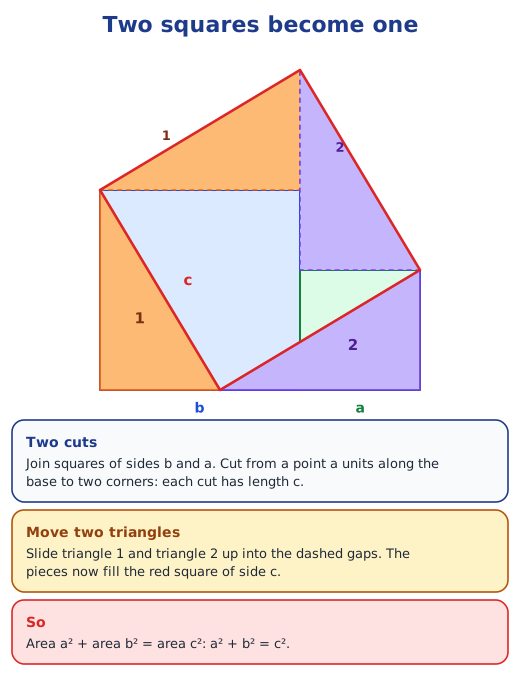
Baudhayana’s verse 2.1 points to a proof. Put a square of side b and a square of side a side by side, bottoms in line. Mark a point a units from the left end of the base, and cut from it to the top-left corner of the large square and to the top-right corner of the small one. Each cut is the hypotenuse c of a right triangle with sides a and b. Now slide the two cut-off triangles up into the gaps above. The three pieces fit together into a square of side c. All four of its angles are right angles, because at each corner the two acute angles of a right triangle, x and 90° − x, add up to 90°. Since nothing was added or lost, a² + b² = c².
Finding a missing side
The theorem turns into two quick rules. To find the hypotenuse, add the squares and take the square root: c = √(a² + b²). Draw a right triangle with sides 3 cm and 4 cm and the hypotenuse measures about 5 cm; the theorem says it is exactly 5 cm, since 9 + 16 = 25. To find a shorter side, subtract: if one side is 8 cm and the hypotenuse 17 cm, the third side is √(289 − 64) = √225 = 15 cm. Answers need not be whole numbers: sides 5 and 7 give c = √74, about 8.60.
Squares with three or five times the area
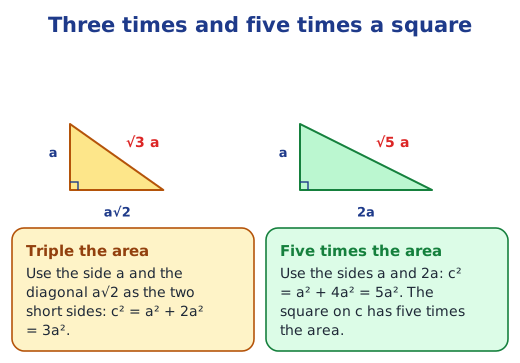
Baudhayana also showed how to make a square three times as big as a given one (verse 1.10). Take a right triangle whose shorter sides are the side a of the square and its diagonal a√2. Then c² = a² + 2a² = 3a², so the square on c has triple the area. With shorter sides a and 2a, c² = a² + 4a² = 5a², five times the area.
Where it is used
The theorem gives the diagonal of a square of side 5 cm as 5√2, about 7.07 cm; the side of a rhombus with diagonals 24 and 70 as √(12² + 35²) = 37; and the depth of the lake in Bhaskaracharya’s lotus problem as 4 units. Learn about whole-number answers in Pythagorean triples and about √2 in the square root of 2. The whole chapter is in the Chapter 2 notes, with every exercise in the NCERT solutions.
Practice
-
A right triangle has shorter sides 5 cm and 12 cm. Its hypotenuse is:
Show answer
Answer: (a) 13 cm
-
A right triangle has a side of 8 cm and a hypotenuse of 17 cm. The third side is:
Show answer
Answer: (b) 15 cm
-
The diagonal of a rectangle 9 cm by 12 cm is:
Show answer
Answer: (a) 15 cm
-
Find the missing side when a = 7 and b = 12.
Show answer
Answer: c² = 7² + 12² = 49 + 144 = 193, so c = √193, about 13.89.
-
Is the hypotenuse always the longest side of a right triangle?
Show answer
Answer: Yes. c² = a² + b² is more than a² and more than b², because each square is positive, so c is longer than a and longer than b.
Questions students ask
What does the Baudhayana-Pythagoras theorem say?
In every right-angled triangle, the square drawn on the hypotenuse is exactly as big as the squares drawn on the other two sides put together. In symbols, a² + b² = c², where c is the hypotenuse, the side opposite the right angle.
How did Baudhayana state the theorem?
In his Shulbasutra (verse 1.12) he wrote, in effect, that the square made on the diagonal of a rectangle has the area of the squares made on its two sides together. This is the general theorem, stated about three centuries before Pythagoras.
How do you prove a² + b² = c²?
Place squares of sides b and a side by side. Make two cuts from a point a units along the base to two corners; each cut is the hypotenuse c of an a-b right triangle. Moving the two cut-off triangles fills a square of side c exactly, so a² + b² = c².
Stuck on a question?
Take a photo and Lagnever AI explains it step by step. Try it for 7 days for ₹2.
Get it on Google Play Open in browser
For parents: after the trial, the plan renews monthly by UPI or card autopay. You can cancel anytime in the app.