
NCERT Solutions Class 8 Maths Part 2 Chapter 2: The Baudhayana-Pythagoras Theorem
Answers to every question in Part 2 Chapter 2, The Baudhayana-Pythagoras Theorem, of Ganita Prakash Grade 8 (first edition, December 2025, used in 2026-27): the questions in the text, every Figure it Out, Math Talk and Try This, and the Find the Colours puzzle. Page numbers follow the book (pages 33–54). Square roots that are not whole numbers are given to two decimal places. Short notes: Part 2 Chapter 2 notes.
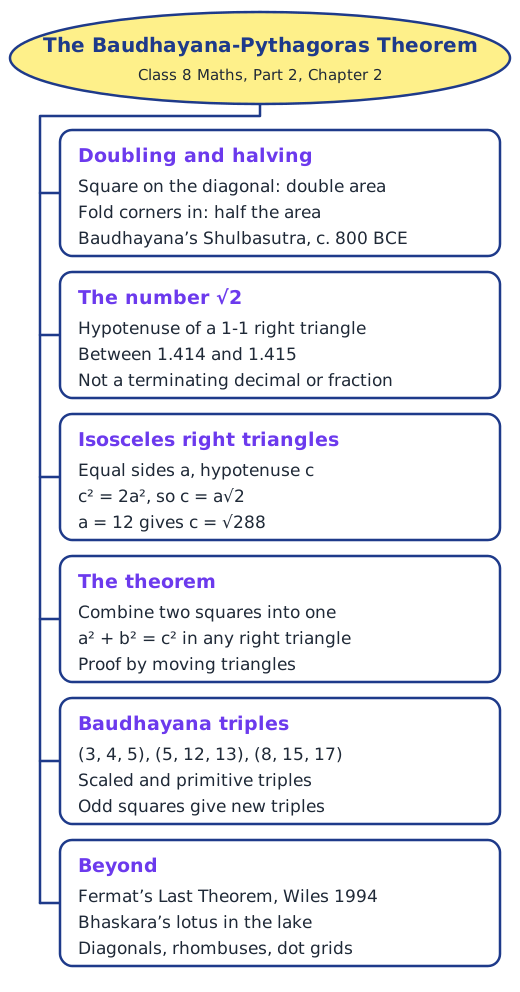
Doubling and halving a square (pages 33–37)
Will doubling the side double the area? No: the new square has 2 × 2 = 4 times the area.
Why does the square on the diagonal have double the area? East-west and north-south lines through the corners cut the original square into 2 small right triangles and the square on the diagonal into 4, all congruent, so its area is double.
Why do the extended sides pass through the corners of the dotted square? A diagonal of a square bisects its corner angle. The sides of the original square meet the diagonal at 45°, so they bisect the 90° corners of the dotted square, and the bisector of a corner of a square passes through the opposite corner.
Why are the small triangles congruent? Each is half of an identical small square, cut along a diagonal: all have two equal sides (half the diagonal) meeting at a right angle, so they are congruent by SAS.
Paper activity. Pieces 5, 6, 7 and 8, each a quarter of Square 2 cut along both diagonals, fit along the four sides of Square 1 to make a square with double the area.
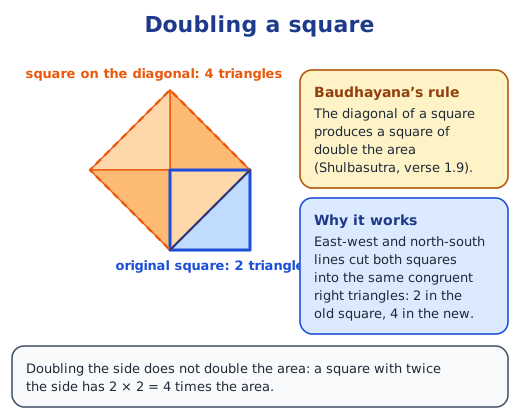
Why is the inside square half the larger one? The lines through the midpoints cut the large square into 8 congruent triangles; the tilted square contains 4 of them.
Will a square with half the side have half the area? No, only a quarter: 4 such squares fill the original.
Why is PQRS a square with half the area? The four corner triangles are congruent (SAS: two halves of sides meeting at a right angle), so PQ = QR = RS = SP. Each corner triangle is isosceles and right-angled, so its other angles are 45°, and each angle of PQRS is 180° − 45° − 45° = 90°. Joining PR and QS cuts PQRS into four triangles congruent to the corner flaps, so the flaps exactly cover PQRS: it is half the paper.
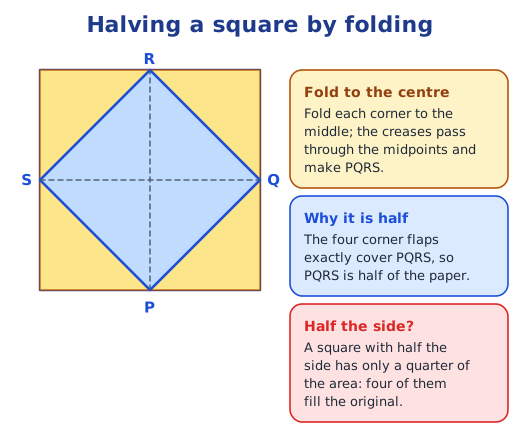
The hypotenuse and √2 (pages 37–41)
Hypotenuse of the 1-1 right triangle: √2, since the square on it has area 2. Bounds: 1 < √2 < 2; 1.4 < √2 < 1.5; 1.41 < √2 < 1.42; 1.414 < √2 < 1.415. A terminating decimal? No: its square would end in a non-zero digit. A fraction? No: 2n² = m² is impossible.
Figure it Out (pages 39–40)
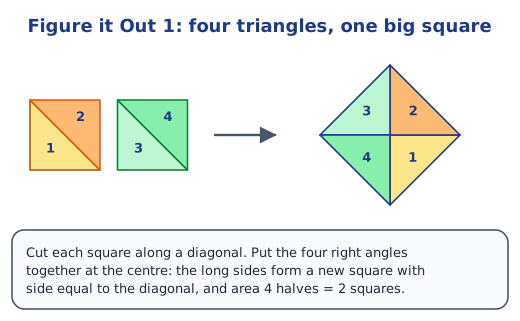
1. Cut each square along one diagonal to get four right triangles. Put their right angles together at a centre point with the long sides outward: they form a square whose side is the diagonal, with double the area of either square.
2. c² = 2a². (i) a = 3: c = √18 ≈ 4.24, so 4.2 < c < 4.3 (4.2² = 17.64, 4.3² = 18.49). (ii) a = 4: c = √32 ≈ 5.66, so 5.6 < c < 5.7. (iii) a = 6: c = √72 ≈ 8.49, so 8.4 < c < 8.5. (iv) a = 8: c = √128 ≈ 11.31, so 11.3 < c < 11.4. (v) a = 9: c = √162 ≈ 12.73, so 12.7 < c < 12.8.
3. The square on the hypotenuse has area 10² = 100, which is double the square on a side, so a² = 50 and each side is √50 ≈ 7.07 (between 7.0 and 7.1).
Combining two squares (pages 41–47)
Does the method agree for two equal squares? Yes: with equal shorter sides, the hypotenuse is the diagonal of the square, which is exactly the earlier doubling rule.
Why is the 4-sided figure a square? Its four sides are hypotenuses of congruent triangles, so they are equal. At each corner, the angles x and 90° − x of two of the triangles sit on a straight line (180°), leaving 180° − 90° = 90°. Four equal sides and four right angles make a square.
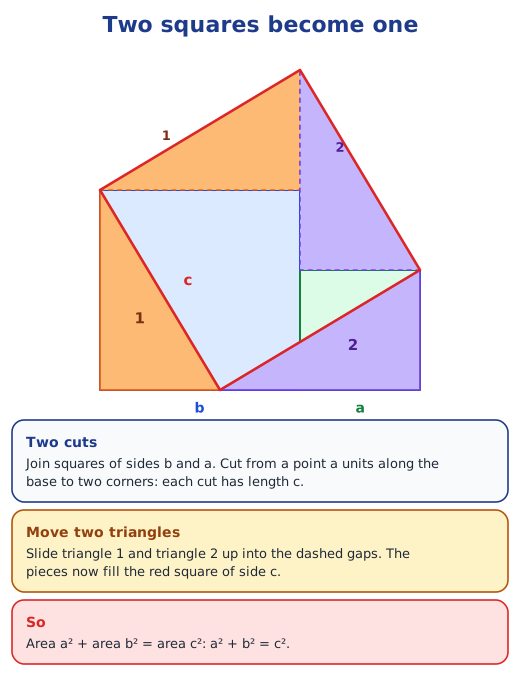
Figure it Out (page 47)
1. 5² + 12² = 169, so the hypotenuse is 13 cm.
2. 17² − 8² = 289 − 64 = 225, so the third side is 15 cm.
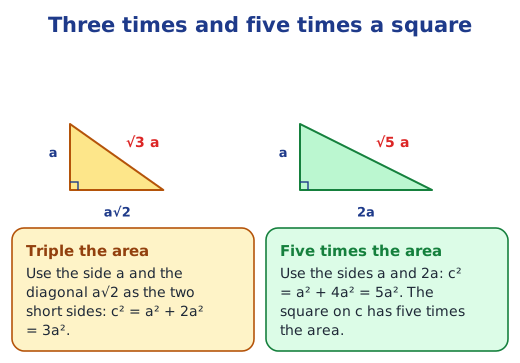
3. Triple: make a right triangle with shorter sides equal to the side a of the square and its diagonal a√2; the square on its hypotenuse has area a² + 2a² = 3a². Five times: use shorter sides a and 2a; the square on the hypotenuse has area a² + 4a² = 5a².
4. (i) c = √74 ≈ 8.60. (ii) c = √208 ≈ 14.42. (iii) b = √(225 − 81) = √144 = 12. (iv) c = √193 ≈ 13.89. (v) c = √(2.25 + 12.25) = √14.5 ≈ 3.81.
Baudhayana triples (pages 48–50)
Triples up to 20: (3, 4, 5), (6, 8, 10), (5, 12, 13), (9, 12, 15), (8, 15, 17) and (12, 16, 20). (30, 40, 50) and (300, 400, 500) are triples: 900 + 1600 = 2500 and 90,000 + 1,60,000 = 2,50,000. Pattern: (6, 8, 10), (9, 12, 15) and (12, 16, 20) are (3, 4, 5) times 2, 3 and 4. (5, 12, 13) is primitive; the other primitive triples up to 20 are (3, 4, 5) and (8, 15, 17). Their scaled versions are below; none is primitive, since k divides all three numbers.
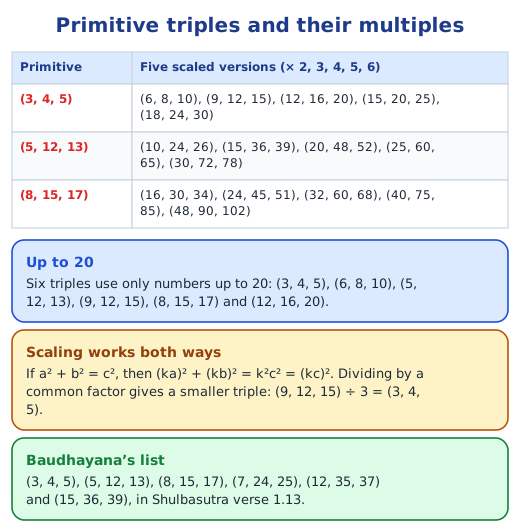
Is (a/f, b/f, c/f) a triple? Yes: dividing a² + b² = c² by f² gives (a/f)² + (b/f)² = (c/f)². For (9, 12, 15) with f = 3: (3, 4, 5), and 9 + 16 = 25. The nth odd number is 2n − 1, and the first n − 1 odd numbers add up to (n − 1)².
Figure it Out (page 50)
1. From the odd squares 49, 81, 121, 169 and 225: (7, 24, 25), (9, 40, 41), (11, 60, 61), (13, 84, 85) and (15, 112, 113).
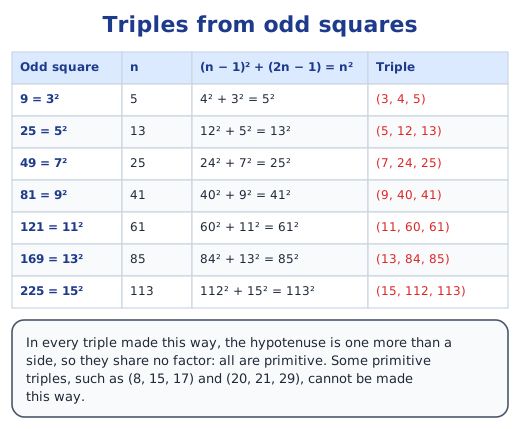
2. No. One shorter side, n − 1, is one less than the hypotenuse n, and consecutive numbers have no common factor greater than 1, so every triple it makes is primitive.
3. Yes, for example (8, 15, 17), (20, 21, 29), (12, 35, 37) and (28, 45, 53): in these, no side is one less than the hypotenuse.
Applications (pages 52–54)
Lilavati’s lotus: 3² + x² = (x + 1)² gives x = 4, so the lake is 4 units deep.
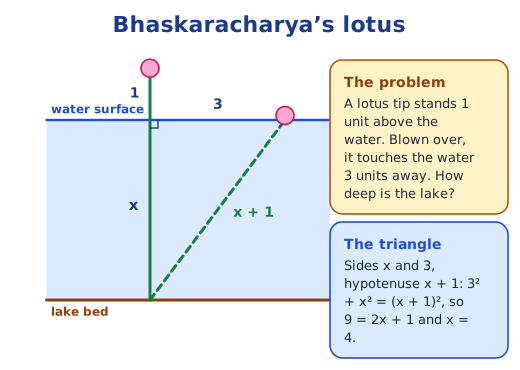
Figure it Out (pages 52–54)
1. 5√2 = √50 ≈ 7.07 cm.
2. Sides 7 and 9 round the right angle: hypotenuse √130 ≈ 11.40. Sides 4 and 10: hypotenuse √116 ≈ 10.77. Side 40, hypotenuse 41: third side √(1681 − 1600) = 9. Side 10, hypotenuse √200: third side √(200 − 100) = 10. Sides 10 and √150: hypotenuse √250 ≈ 15.81. Side 27, hypotenuse 45: third side √(2025 − 729) = 36.
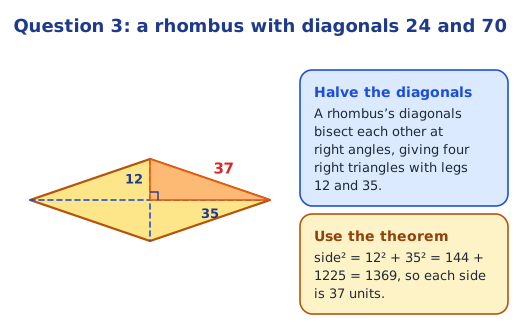
3. The diagonals bisect each other at right angles, giving right triangles with sides 12 and 35: side = √(144 + 1225) = √1369 = 37 units.
4. Yes. c² = a² + b² is greater than a² and greater than b², so c is greater than both a and b.
5. True: divide any non-primitive triple by the greatest common factor of its numbers to get a primitive triple, of which it is a scaled version.
6. For example 3 × 4 (diagonal 5), 6 × 8 (10), 5 × 12 (13), 8 × 15 (17) and 7 × 24 (25).
7. The area needed is 7² − 5² = 49 − 25 = 24. Draw a right triangle with hypotenuse 7 and one side 5: draw a 5-unit segment, a perpendicular at one end, and an arc of radius 7 from the other end to cut it. The perpendicular side is √24, and the square on it has area 24.
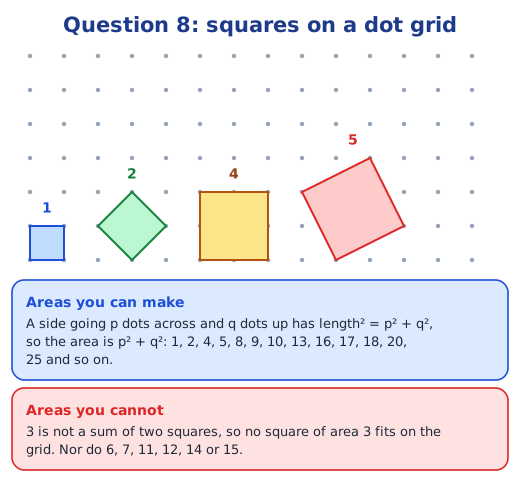
8. (i) (a) Yes: a tilted square whose side joins dots 1 across and 1 up (side² = 1 + 1 = 2). (b) No: 3 is not a sum of two squares. (c) Yes: a 2 × 2 square. (d) Yes: a tilted square with sides going 1 across and 2 up (side² = 1 + 4 = 5). (ii) Exactly the numbers that are sums of two squares p² + q²: 1, 2, 4, 5, 8, 9, 10, 13, 16, 17, 18, 20, 25, and so on.
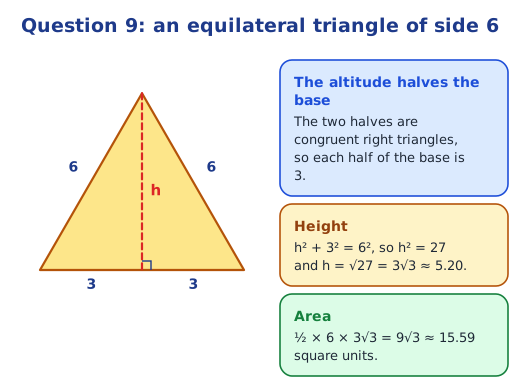
9. The altitude splits the triangle into two congruent right triangles (RHS: the hypotenuses are equal sides of 6 and the altitude is shared), so it bisects the base into 3 and 3. Then h² = 6² − 3² = 27, h = 3√3 ≈ 5.20, and the area is ½ × 6 × 3√3 = 9√3 ≈ 15.59 square units.
Find the Colours (page 54)
Open the box labelled RED. Its label is wrong, so it holds blue or green balls. If it holds blue, then the box labelled BLUE cannot hold blue (wrong label, and blue is taken), so it holds green, and the box labelled GREEN holds red. If it holds green, then the box labelled GREEN cannot hold green, so it holds blue, and the box labelled BLUE holds red. One box is enough.
Short notes and more practice are on the topic pages: the theorem, Pythagorean triples and the square root of 2.
Practice
-
The sides of a right triangle round the right angle are 1.5 and 3.5. The hypotenuse is about:
Show answer
Answer: (a) 3.81
-
A rhombus has diagonals 24 and 70. Its side is:
Show answer
Answer: (b) 37
-
Which area is impossible for a square drawn with its corners on a dot grid?
Show answer
Answer: (b) 3
-
What is the area of an equilateral triangle whose sides are 6 units?
Show answer
Answer: The altitude halves the base, so h² + 3² = 6², h² = 27 and h = 3√3 ≈ 5.20. Area = ½ × 6 × 3√3 = 9√3 ≈ 15.59 square units.
-
True or false: every Baudhayana triple is primitive or is a multiple of a primitive one.
Show answer
Answer: True. If the three numbers share a greatest common factor f greater than 1, dividing by f gives a primitive triple, and the original is f times it. If they share no factor, the triple is primitive itself.
Stuck on a question?
Take a photo and Lagnever AI explains it step by step. Try it for 7 days for ₹2.
Get it on Google Play Open in browser
For parents: after the trial, the plan renews monthly by UPI or card autopay. You can cancel anytime in the app.