
Prime factorisation
Answer in short
Prime factorisation means writing a number as a product of prime numbers, such as 56 = 2 × 2 × 2 × 7. Keep breaking composite factors until only primes are left. Every number greater than 1 has exactly one prime factorisation, apart from the order of the factors, and it helps to check co-primes and divisibility.
Stuck on a question? Take a photo and Lagnever AI explains it step by step. Try it for 7 days for ₹2. Get it on Google Play
Breaking a number into primes
Take 56. It is composite: 56 = 4 × 14. Now 14 is also composite, 14 = 2 × 7, so 56 = 4 × 2 × 7. And 4 = 2 × 2, so 56 = 2 × 2 × 2 × 7. Now every factor is prime and cannot be broken further. Writing a number as a product of primes is its prime factorisation, and the primes in it, here 2 and 7, are its prime factors.
- Every number greater than 1 has a prime factorisation.
- The number 1 has none, because no prime divides it.
- A prime is its own prime factorisation: 7 = 7.
Factor trees
A factor tree keeps splitting each composite number into two factors until only primes are left.
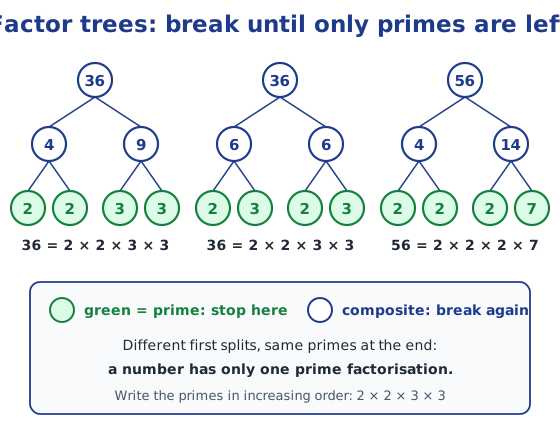
Whether you start 36 as 2 × 18, 3 × 12, 4 × 9 or 6 × 6, you always end with two 2s and two 3s. It is a remarkable fact that every number has only one prime factorisation, apart from the order of the factors.
Does the order matter?
No. Think of 30 cubes stacked as a box 2 cubes high, 3 cubes wide and 5 cubes long: counting them layer by layer in any direction gives 30, so 2 × 3 × 5 = 3 × 5 × 2 = 5 × 2 × 3. We can multiply numbers in any order and get the same result, which you will later study as commutativity and associativity. By habit we write the primes in increasing order: 225 = 3 × 3 × 5 × 5.
Factorising a product
To factorise a product, factorise each part and put them together. Since 72 = 12 × 6, 12 = 2 × 2 × 3 and 6 = 2 × 3, we get 72 = 2 × 2 × 3 × 2 × 3 = 2 × 2 × 2 × 3 × 3. Each prime appears in 72 as many times as in 12 and 6 together. In the same way, 108 × 75 = (2 × 2 × 3 × 3 × 3) × (3 × 5 × 5) = 2 × 2 × 3 × 3 × 3 × 3 × 5 × 5.
Worked examples
| Number | Prime factorisation |
|---|---|
| 64 | 2 × 2 × 2 × 2 × 2 × 2 |
| 104 | 2 × 2 × 2 × 13 |
| 105 | 3 × 5 × 7 |
| 243 | 3 × 3 × 3 × 3 × 3 |
| 1331 | 11 × 11 × 11 |
| 1000 | 2 × 2 × 2 × 5 × 5 × 5 |
The smallest number with three different prime factors is 2 × 3 × 5 = 30, and with four it is 2 × 3 × 5 × 7 = 210.
Using prime factorisation
To check co-primes: two numbers are co-prime if no prime appears in both factorisations. 80 = 2 × 2 × 2 × 2 × 5 and 63 = 3 × 3 × 7 share none, so they are co-prime.
To check divisibility: one number divides another if its prime factorisation is included in the other’s.
- Is 168 divisible by 12? 168 = 2 × 2 × 2 × 3 × 7 contains 12 = 2 × 2 × 3, so yes: 168 = 12 × 14.
- Is 75 divisible by 21? 21 = 3 × 7, but 7 is not a prime factor of 75 = 3 × 5 × 5, so no.
- Is 42 divisible by 12? 12 needs two 2s, but 42 = 2 × 3 × 7 has only one, so no.
For checking whether two numbers share a factor, read co-prime numbers; for quick tests, read divisibility rules. For the textbook’s questions, see the Chapter 5 NCERT solutions; for the whole chapter, see the Chapter 5 notes.
Practice
-
The prime factorisation of 1000 is:
Show answer
Answer: (b) 2 × 2 × 2 × 5 × 5 × 5
-
A number has one 2, two 3s and one 11 as prime factors. The number is:
Show answer
Answer: (c) 198
-
Three primes less than 30 multiply to 1955. They are:
Show answer
Answer: (b) 5, 17 and 23
-
Find the prime factorisation of 56 × 25 without multiplying first.
Show answer
Answer: 56 = 2 × 2 × 2 × 7 and 25 = 5 × 5, so 56 × 25 = 2 × 2 × 2 × 5 × 5 × 7.
-
Is 168 divisible by 12? Use prime factorisation.
Show answer
Answer: Yes. 168 = 2 × 2 × 2 × 3 × 7 and 12 = 2 × 2 × 3; all of 12's primes appear in 168, so 168 = 12 × 14.
Questions students ask
What is prime factorisation?
Writing a number as a product of prime numbers. For example, the prime factorisation of 84 is 2 × 2 × 3 × 7.
Can a number have two different prime factorisations?
No. Every number greater than 1 has only one prime factorisation, apart from the order in which the primes are written.
How does prime factorisation help?
It shows whether two numbers are co-prime (no prime in common) and whether one number divides another (its prime factorisation is included in the other's).
Stuck on a question?
Take a photo and Lagnever AI explains it step by step. Try it for 7 days for ₹2.
Get it on Google Play Open in browser
For parents: after the trial, the plan renews monthly by UPI or card autopay. You can cancel anytime in the app.