
NCERT Solutions Class 6 Maths Chapter 5: Prime Time
Answers to every “Figure it Out”, Math Talk and Try This question in Chapter 5, Prime Time, of Ganita Prakash (Reprint 2026-27), with the factor trees, the sieve and the prime puzzles drawn. The page numbers match the book, and the answers are checked against NCERT’s own solutions printed with the chapter; where we differ, we explain why. Questions about your own life, such as the year you were born, have sample answers. Short notes: Chapter 5 notes.
The idli-vada game (page 107)
Numbers that are multiples of both 3 and 5 are 15, 30, 45, 60, … They are called common multiples of 3 and 5.
Figure it Out: idli-vada (page 108)
1. ‘Idli-vada’ is said at the common multiples of 3 and 5, which are the multiples of 15. The 10th time is at 15 × 10 = 150.
2. From 1 to 90: a. ‘idli’ (multiples of 3, including ‘idli-vada’): 90 ÷ 3 = 30 times. b. ‘vada’ (multiples of 5): 90 ÷ 5 = 18 times. c. ‘idli-vada’ (multiples of 15): 90 ÷ 15 = 6 times.
3. Till 900, every answer becomes 10 times bigger: 300, 180 and 60.
4. Yes. The figure is the game played till 30: the left circle holds the ‘idli’ numbers (multiples of 3), the right circle the ‘vada’ numbers (multiples of 5), and the overlap the ‘idli-vada’ numbers, 15 and 30. (The book’s figure leaves out 6, which belongs with the multiples of 3.) Played till 60:
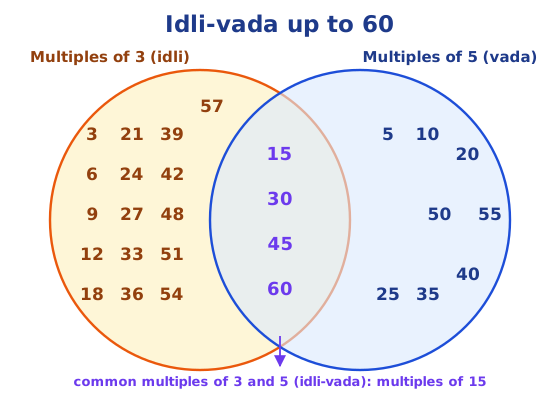
Other pairs, up to 60 (‘idli-vada’ numbers shown):
- a. 2 and 5: 10, 20, 30, 40, 50, 60 (multiples of 10).
- b. 3 and 7: 21 and 42.
- c. 4 and 6: 12, 24, 36, 48 and 60 (multiples of 12).
Nobody said just ‘vada’ (page 109): every multiple of the larger number was also a multiple of the smaller one, so the larger number is a multiple of the smaller. With 4 as one number, the other could be 2 (every multiple of 4 is a multiple of 2) or 8 (every multiple of 8 is a multiple of 4). With 3, 5 or 10, a plain ‘vada’ would come up, such as 4 with 3, or 5 with 4. (NCERT’s key gives only 8, but 2 also fits the rule, since ‘vada’ goes with the larger number and every multiple of 4 is a multiple of 2.)
Jump Jackpot (pages 109–110)
Jump sizes that reach both 15 and 30: the common factors of 15 and 30, which are 1, 3, 5 and 15.
The table of 31 to 70: 1. The shaded numbers are all multiples of 3. 2. The circled numbers are all multiples of 4. 3. 36, 48 and 60 are both shaded and circled; they are common multiples of 3 and 4.
Figure it Out: multiples and factors (pages 110–111)
1. Multiples of 40 between 310 and 410: 320, 360 and 400.
2. a. Multiples of 7 below 40 are 7, 14, 21, 28 and 35; only 35 has digits adding to 8: 35. b. Numbers below 100 with factors 3 and 5 are the multiples of 15: 15, 30, 45, 60, 75, 90; only in 45 is one digit 1 more than the other: 45.
3. 6 is a perfect number: its factors 1, 2, 3 and 6 add up to 12, which is twice 6.
4. a. 20 and 28: 1, 2, 4. b. 35 and 50: 1, 5. c. 4, 8 and 12: 1, 2, 4. d. 5, 15 and 25: 1, 5.
5. Odd multiples of 25 work: 25, 75 and 125 (also 175, 225, …).
6. The first common multiple of the two numbers must be more than 50. For numbers below 10, this happens only for 7 and 8 (first ‘idli-vada’ at 56), 7 and 9 (63) and 8 and 9 (72).
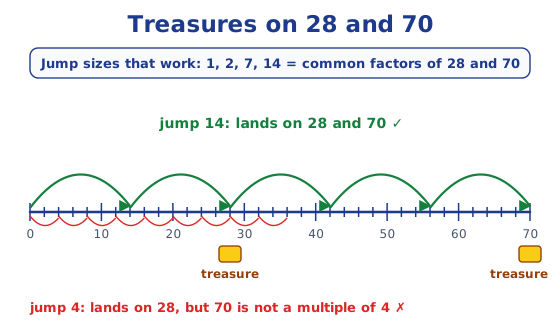
7. The common factors of 28 and 70: jump sizes 1, 2, 7 and 14.
8. The common multiples 24, 48 and 72 are the multiples of 24, so the two numbers have 24 as their first common multiple. One answer is 6 and 8. Up to 72, the multiples of 6 only are 6, 12, 18, 30, 36, 42, 54, 60 and 66; the multiples of 8 only are 8, 16, 32, 40, 56 and 64; the common multiples are 24, 48 and 72. Other possible pairs are 3 and 8, and 8 and 12. (NCERT’s key suggests 3 and 4, but then 12, 36 and 60 would also be common multiples, and the diagram shows only 24, 48 and 72.)
9. The number must contain the primes of 1 to 10 except 7: three 2s (for 8), two 3s (for 9) and a 5, so 2 × 2 × 2 × 3 × 3 × 5 = 360.
10. Include 7 as well: 360 × 7 = 2520.
Prime numbers (pages 112–113)
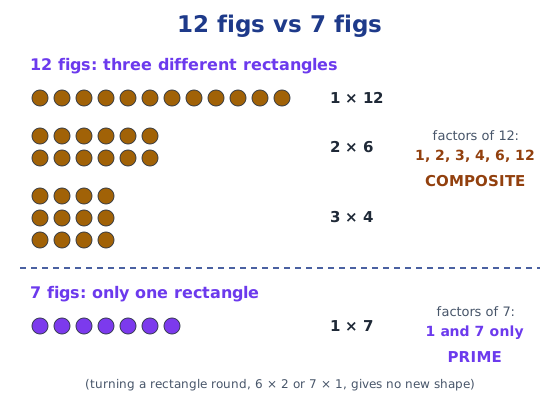
Arranging figs: 12 figs can be arranged as 1 × 12, 2 × 6, 3 × 4, 4 × 3, 6 × 2 and 12 × 1; 7 figs only as 1 × 7 or 7 × 1. The numbers of rows and columns are always factors of the number of figs.
From 21 to 30: 2 primes (23 and 29) and 8 composite numbers (21, 22, 24, 25, 26, 27, 28 and 30).
Primes from 1 to 100 by the sieve: 2, 3, 5, 7, 11, 13, 17, 19, 23, 29, 31, 37, 41, 43, 47, 53, 59, 61, 67, 71, 73, 79, 83, 89 and 97, which is 25 primes.
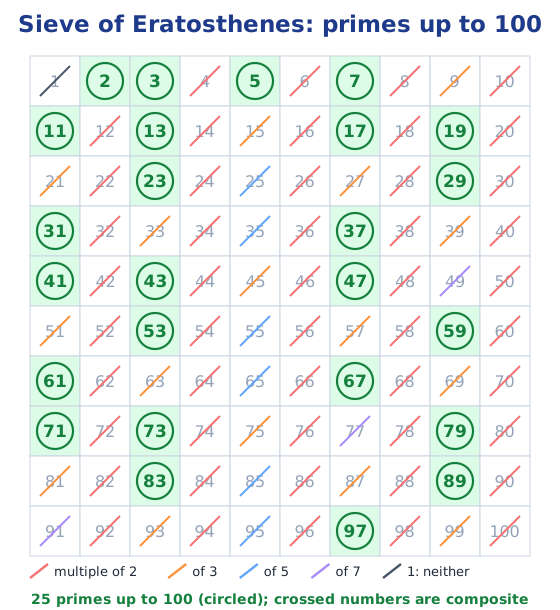
How the sieve works: each crossed-out number is a multiple of a smaller prime, so it has a factor other than 1 and itself and is composite. A number never crossed out is not a multiple of any smaller prime, so its only factors are 1 and itself: it is prime.
Figure it Out: primes (pages 114–115)
1. No. Every even number greater than 2 has 2 as a factor, so it has more than two factors.
2. Smallest difference: 1 (2 and 3). Largest difference up to 100: 8 (89 and 97).
3. No. Primes in each row: 1–10: 4; 11–20: 4; 21–30: 2; 31–40: 2; 41–50: 3; 51–60: 2; 61–70: 2; 71–80: 3; 81–90: 2; 91–100: 1. The fewest are in 91–100 (only 97); the most in 1–10 and 11–20 (4 each).
4. 23 and 37 are prime; 51 = 3 × 17 and 26 = 2 × 13 are not.
5. For example 2 + 3 = 5, 3 + 7 = 10 and 11 + 19 = 30 (also 2 + 13, 3 + 17, 7 + 13, 13 + 17).
6. 13 and 31, 17 and 71, 37 and 73, 79 and 97.
7. 90, 91, 92, 93, 94, 95, 96, between the primes 89 and 97.
8. Besides 3 and 5, and 17 and 19: 5 and 7, 11 and 13, 29 and 31, 41 and 43, 59 and 61, 71 and 73.
9. a. True: a number ending in 4 is even and greater than 2. b. False: a product of two or more primes has those primes as factors, so it has more than two factors. c. False: a prime has exactly two factors, 1 and itself. d. False: 2 is even and prime. e. True: every prime after 2 is odd, so the next number is even and greater than 2, hence composite.
10. 105 = 3 × 5 × 7. (45 = 3 × 3 × 5 and 91 = 7 × 13 use two primes; 60 = 2 × 2 × 3 × 5 repeats 2; 330 = 2 × 3 × 5 × 11 has four.)
11. None. The numbers 245, 254, 425, 452, 524 and 542 end in 2, 4 or 5, so each is divisible by 2 or by 5.
12. Yes: 2 → 5, 5 → 11, 11 → 23, 23 → 47, 29 → 59 (also 41 → 83 and 53 → 107).
Co-prime numbers (pages 115–117)
Safe pairs: a. 15 and 39: not safe (jump 3). b. 4 and 15: safe. c. 18 and 29: safe. d. 20 and 55: not safe (jump 5).
Co-prime pairs: a. 18 and 35: co-prime. b. 15 and 37: co-prime. c. 30 and 415: not (both divisible by 5). d. 17 and 69: co-prime (69 = 3 × 23). e. 81 and 18: not (both divisible by 9).
Anshu’s observation: 1. When the numbers are co-prime, the first common multiple is their product: 3 and 5 meet first at 15, and 4 and 9 at 36. 2. When they share a factor, it is less than the product: 4 and 6 meet first at 12 (product 24), and 6 and 8 at 24 (product 48).
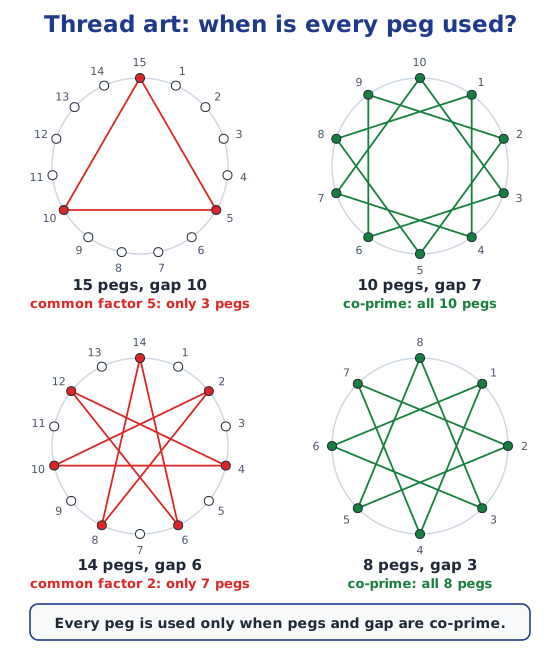
Co-prime thread art: the thread reaches every peg only when the number of pegs and the thread-gap are co-prime; otherwise it closes early. a. 15 pegs, gap 10 (common factor 5): only 3 pegs, a triangle. b. 10 pegs, gap 7: co-prime, all 10 pegs. c. 14 pegs, gap 6 (common factor 2): only 7 pegs. d. 8 pegs, gap 3: co-prime, all 8 pegs.
Prime factorisation (pages 117–120)
Anshu’s mistake: one factor pair does not show all the factors; 56 = 7 × 8 and 63 = 9 × 7 reveal the common factor 7.
72 = 12 × 6: 72 = 2 × 2 × 3 × 2 × 3 = 2 × 2 × 2 × 3 × 3. The 2 appears three times (twice in 12, once in 6) and the 3 twice (once in each), exactly as in 12 and 6 put together.
Why 30 = 2 × 3 × 5 in any order: the 30 cubes form a box 2 high, 3 wide and 5 long. Counting them as 2 layers of 15, 3 slices of 10 or 5 slices of 6 always gives 30, so the order of multiplying does not matter.
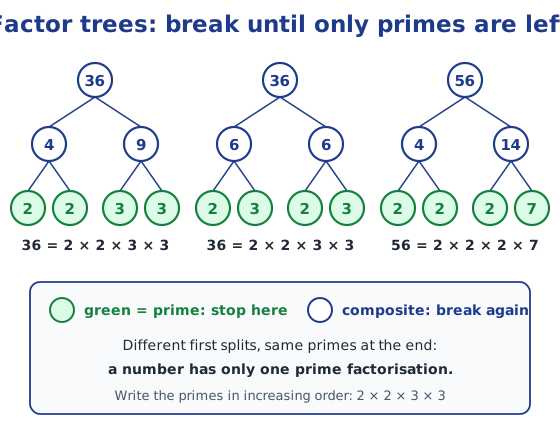
Figure it Out (page 120)
1.
| Number | Prime factorisation |
|---|---|
| 64 | 2 × 2 × 2 × 2 × 2 × 2 |
| 104 | 2 × 2 × 2 × 13 |
| 105 | 3 × 5 × 7 |
| 243 | 3 × 3 × 3 × 3 × 3 |
| 320 | 2 × 2 × 2 × 2 × 2 × 2 × 5 |
| 141 | 3 × 47 |
| 1728 | 2 × 2 × 2 × 2 × 2 × 2 × 3 × 3 × 3 |
| 729 | 3 × 3 × 3 × 3 × 3 × 3 |
| 1024 | ten 2s: 2 × 2 × … × 2 |
| 1331 | 11 × 11 × 11 |
| 1000 | 2 × 2 × 2 × 5 × 5 × 5 |
2. 2 × 3 × 3 × 11 = 198.
3. 1955 = 5 × 391 = 5 × 17 × 23.
4. a. 56 × 25 = (2 × 2 × 2 × 7) × (5 × 5) = 2 × 2 × 2 × 5 × 5 × 7. b. 108 × 75 = (2 × 2 × 3 × 3 × 3) × (3 × 5 × 5) = 2 × 2 × 3 × 3 × 3 × 3 × 5 × 5. c. 1000 × 81 = (2 × 2 × 2 × 5 × 5 × 5) × (3 × 3 × 3 × 3) = 2 × 2 × 2 × 3 × 3 × 3 × 3 × 5 × 5 × 5.
5. a. 2 × 3 × 5 = 30. b. 2 × 3 × 5 × 7 = 210.
A composite common factor? If 80 and 63 had a composite common factor, its prime factors would appear in the prime factorisations of both. Since 80 = 2 × 2 × 2 × 2 × 5 and 63 = 3 × 3 × 7 share no prime, they have no common factor other than 1: they are co-prime.
Figure it Out: co-primes and divisibility (page 122)
1. a. 30 = 2 × 3 × 5 and 45 = 3 × 3 × 5: not co-prime (3 and 5 shared). b. 57 = 3 × 19 and 85 = 5 × 17: co-prime. c. 121 = 11 × 11 and 1331 = 11 × 11 × 11: not co-prime. d. 343 = 7 × 7 × 7 and 216 = 2 × 2 × 2 × 3 × 3 × 3: co-prime.
2. a. 225 = 3 × 3 × 5 × 5 and 27 = 3 × 3 × 3: No, 225 has only two 3s. b. 96 = 2 × 2 × 2 × 2 × 2 × 3 and 24 = 2 × 2 × 2 × 3: Yes, 96 = 24 × 4. c. 343 = 7 × 7 × 7 and 17 is prime: No. d. 999 = 3 × 3 × 3 × 37 and 99 = 3 × 3 × 11: No, 11 is not a factor of 999. (The key writes four 3s for 999, but 3 × 3 × 3 × 37 = 999.)
3. The numbers are 42 and 231. They share 3 and 7, so they are not co-prime. Neither divides the other: 42 has a 2 that 231 lacks, and 231 has an 11 that 42 lacks.
4. Yes, for two different primes: each has only 1 and itself as factors, so the only common factor is 1. (A prime and the same prime, such as 5 and 5, share the factor 5.)
Divisibility tests (pages 122–125)
Factors of 8560 from 2 to 10: 2, 4, 5, 8 and 10. It is not divisible by 3, 6, 7 or 9.
By 10: 125 is not a multiple of 10, since multiples of 10 end in 0; 8560 is. The statement is right: numbers divisible by 10 end in 0.
By 5: the last digits of 5, 10, 15, 20, … alternate between 5 and 0. The largest number below 399 divisible by 5 is 395; 8560 is divisible by 5. The statement is right.
By 2: multiples of 2 end in 0, 2, 4, 6 or 8, so 682 and 8560 are divisible by 2. Multiples of 2 between 399 and 411: 400, 402, 404, 406, 408, 410. The statement is right.
By 4: multiples of 4 from 330 to 340: 332, 336; from 1730 to 1740: 1732, 1736; from 2030 to 2040: 2032, 2036. The last two digits repeat, so only they matter. 8536 is divisible by 4 (36 is). All three statements are true, because 100 is a multiple of 4.
By 8: from 120 to 140: 128, 136; from 1120 to 1140: 1128, 1136; from 3120 to 3140: 3128, 3136. The last two digits are not enough (200 is a multiple of 8, but 100 is not), but the last three are, because 1000 is a multiple of 8. Changing the last two digits of 8560 gives other multiples of 8 such as 8568 or 8576; 8560 itself is already one (560 = 8 × 70). All three statements are true.
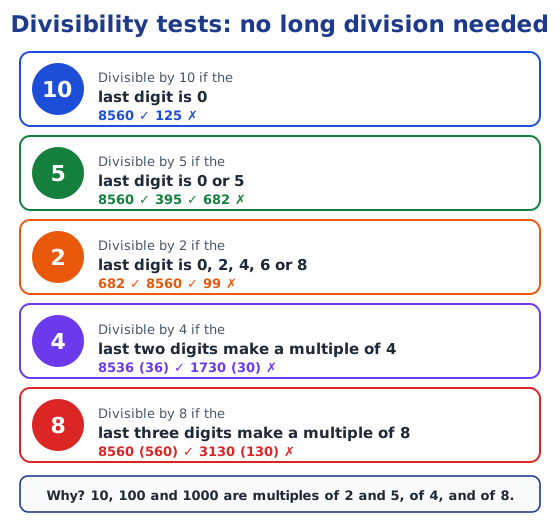
Figure it Out: divisibility (pages 125–126)
1. a. Sample: for someone born in 2014, the leap years so far are 2016, 2020 and 2024. b. From 2024 to 2099: 2024, 2028, …, 2096, which is 19 leap years.
2. Largest: 8888; smallest: 2112. (The first digit equals the last, which must be even, and the last two digits must form a multiple of 4. NCERT’s key gives 9999 and 1001, but both are odd, so neither is divisible by 4.)
3. a. Sometimes true: 2 + 2 = 4 is, 2 + 4 = 6 is not. b. Sometimes true: 1 + 3 = 4 is, 1 + 5 = 6 is not.
4.
| Number | Remainders when divided by 10, 5 and 2 |
|---|---|
| 78 | 8, 3, 0 |
| 99 | 9, 4, 1 |
| 173 | 3, 3, 1 |
| 572 | 2, 2, 0 |
| 980 | 0, 0, 0 |
| 1111 | 1, 1, 1 |
| 2345 | 5, 0, 1 |
5. 8 and 5 (or 8 and 10). Divisible by 8 means divisible by 4 and 2 as well, and divisible by 2 and 5 means divisible by 10.
6. 5600, 6000 and 77622160. (572 and 2352 do not end in 0 or 5.)
7. 16 × 625 = 10000.
Fun with numbers (pages 126–128)
Special numbers (sample reasons):
- 5, 7, 12, 35: 5 is the smallest and the only one leaving remainder 1 when divided by 4; 7 is the only one leaving remainder 1 when divided by 3; 12 is the only even number; 35 is the only product of two others in the box (5 × 7).
- 3, 8, 11, 24: 3 is the only odd single-digit number; 8 is the only cube (2 × 2 × 2); 11 is the only two-digit prime and equals 3 + 8; 24 is the only multiple of both 3 and 8 (3 × 8).
- 27, 3, 123, 31: 3 is the only single-digit number; 27 is the only cube; 123 is the only three-digit number; 31 is the only one that is not a multiple of 3.
- 17, 27, 44, 65: 17 is the only prime; 27 is the only multiple of 3; 44 is the only even number; 65 is the only multiple of 5.
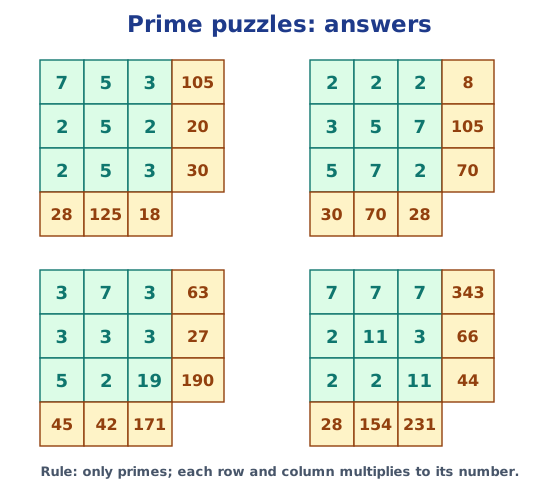
Prime puzzles: each puzzle has exactly one answer.
For more practice, read prime and composite numbers, co-prime numbers, prime factorisation and divisibility rules.
Practice
-
What is the smallest number that is a multiple of all the numbers from 1 to 10?
Show answer
Answer: (c) 2520
-
How many three-digit primes can you make using each of 2, 4 and 5 once?
Show answer
Answer: (a) 0
-
Which number is the product of exactly three distinct primes?
Show answer
Answer: (c) 105
-
Find the common factors of 20 and 28.
Show answer
Answer: Factors of 20: 1, 2, 4, 5, 10, 20. Factors of 28: 1, 2, 4, 7, 14, 28. Common factors: 1, 2 and 4.
-
Write two numbers whose product is 10000, neither ending in 0.
Show answer
Answer: 10000 = 2 × 2 × 2 × 2 × 5 × 5 × 5 × 5, so take all the 2s together and all the 5s together: 16 × 625 = 10000.
Stuck on a question?
Take a photo and Lagnever AI explains it step by step. Try it for 7 days for ₹2.
Get it on Google Play Open in browser
For parents: after the trial, the plan renews monthly by UPI or card autopay. You can cancel anytime in the app.