
Class 6 Maths Chapter 5: Prime Time Notes
This chapter in five lines
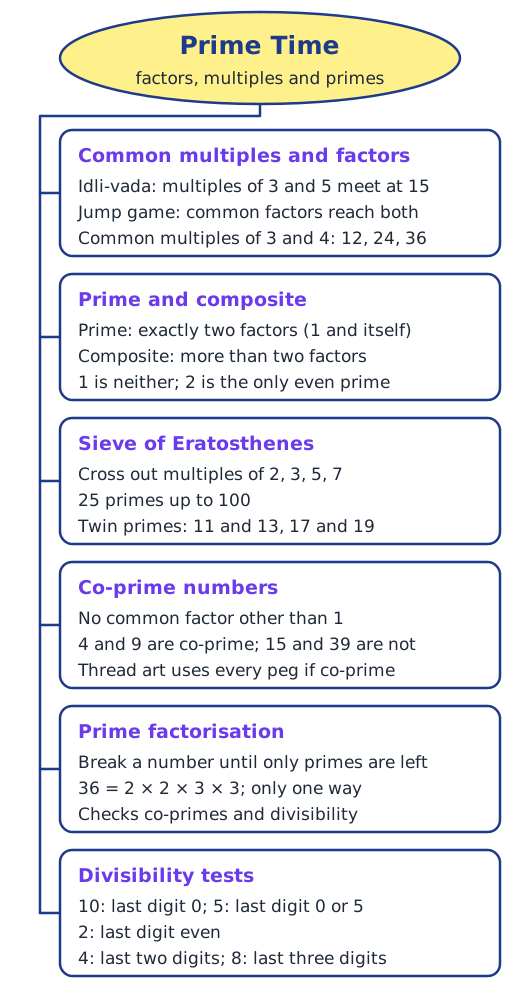
Prime Time is about factors and multiples. Numbers that are multiples of two numbers are their common multiples, and numbers that divide both are their common factors. A prime number has exactly two factors, 1 and itself; a composite number has more; 1 is neither. Two numbers with no common factor other than 1 are co-prime. Every number greater than 1 is a product of primes in only one way, its prime factorisation, and simple tests check divisibility by 2, 4, 5, 8 and 10.
Common multiples and common factors
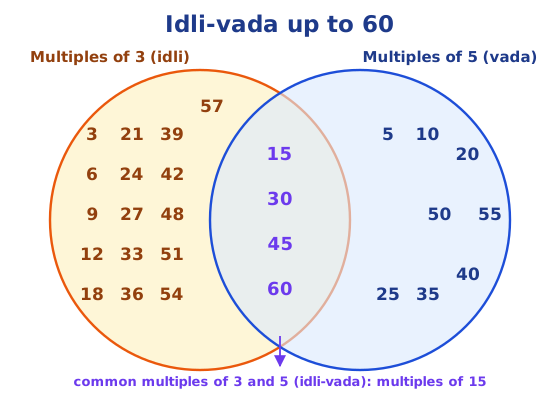
In the idli-vada game, children count in turn but say ‘idli’ for multiples of 3, ‘vada’ for multiples of 5 and ‘idli-vada’ for numbers that are multiples of both. The ‘idli-vada’ numbers, 15, 30, 45, …, are the common multiples of 3 and 5; they are the multiples of 15, so the 10th one is 150.
In the Jump Jackpot game, Jumpy starts at 0 and jumps by a fixed size. He lands on 24 with jump sizes 1, 2, 3, 4, 6, 8, 12 and 24, the factors of 24. To land on two treasures, such as 14 and 36, the jump size must be a common factor of both: 1 or 2.
Prime and composite numbers
Guna can arrange 12 figs in rectangles in several ways (1 × 12, 2 × 6, 3 × 4), but Anshu can arrange 7 figs only as 1 × 7. A number with exactly two factors, 1 and itself, is a prime number; a number with more than two factors is a composite number. The number 1, with only one factor, is neither. The first primes are 2, 3, 5, 7, 11, 13, 17 and 19, and 2 is the only even prime. Read more in prime and composite numbers.
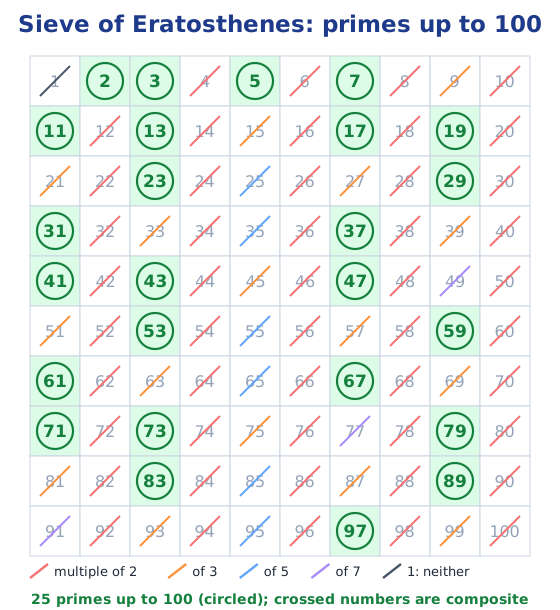
The Sieve of Eratosthenes, named after a Greek mathematician of about 2200 years ago, finds primes: cross out 1, circle 2 and cross out its multiples, circle 3 and cross out its multiples, and so on. The circled numbers are prime; there are 25 up to 100.
Co-prime numbers
In a new treasure game, a jump size of 1 is not allowed. Grumpy’s treasures are safe on 4 and 9, because no jump size other than 1 reaches both. Two numbers with no common factor other than 1 are co-prime: 4 and 9 are co-prime, but 15 and 39 share the factor 3. For co-prime numbers, the first common multiple is their product. In thread art, a thread reaches every peg only when the number of pegs and the thread-gap are co-prime. Read more in co-prime numbers.
Prime factorisation
To check whether 56 and 63 are co-prime, Anshu writes 56 = 14 × 4 and 63 = 21 × 3 and wrongly decides they are, but Guna writes 56 = 7 × 8 and 63 = 9 × 7 and finds the common factor 7. The sure method is to break each number into primes: 56 = 2 × 2 × 2 × 7 and 63 = 3 × 3 × 7. This is the prime factorisation. Every number greater than 1 has exactly one, apart from the order of the factors, which does not matter because we can multiply in any order. Read more in prime factorisation.
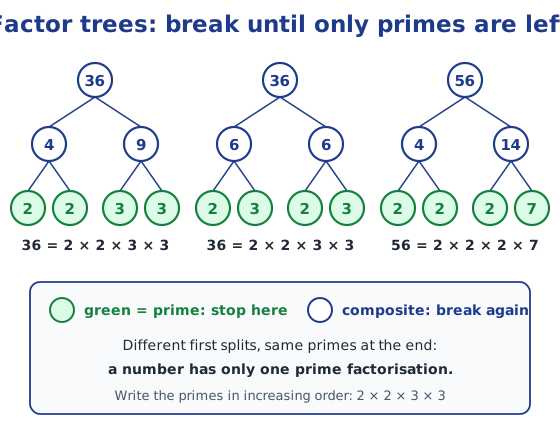
Prime factorisations answer two questions. Two numbers are co-prime if they share no prime factor, like 40 = 2 × 2 × 2 × 5 and 231 = 3 × 7 × 11. One number divides another if its prime factorisation is included in the other’s: 168 = 2 × 2 × 2 × 3 × 7 is divisible by 12 = 2 × 2 × 3, but 42 = 2 × 3 × 7 is not, because it has only one 2.
Divisibility tests
Long division is not always needed. A number is divisible by 10 if its last digit is 0, by 5 if it ends in 0 or 5, and by 2 if it ends in 0, 2, 4, 6 or 8. For 4, look at the last two digits, and for 8, at the last three, because 100 is a multiple of 4 and 1000 a multiple of 8. So 8560 is divisible by 2, 4, 5, 8 and 10. Read more in divisibility rules.
Fun with numbers
In a box of four numbers, each number can be special in its own way: in 9, 16, 25 and 43, for example, 9 is the only single-digit number and 43 the only prime. In the prime puzzle, you fill a grid with primes so that each row and column multiplies to the given number.
Answers to every question are in the NCERT solutions for Chapter 5.
Key terms
| Term | Meaning |
|---|---|
| Factor | A number that divides another number exactly: 4 is a factor of 12 because 12 ÷ 4 = 3. |
| Multiple | A number obtained by multiplying a number by 1, 2, 3, …: 3, 6, 9 and 12 are multiples of 3. |
| Common multiple | A number that is a multiple of two or more numbers: 15, 30 and 45 are common multiples of 3 and 5. |
| Common factor | A number that is a factor of two or more numbers: 1 and 2 are the common factors of 14 and 36. |
| Prime number | A number with exactly two factors, 1 and itself, such as 2, 3, 5, 7, 11 and 13. |
| Composite number | A number with more than two factors, such as 4, 6, 8, 9 and 10; the number 1 is neither prime nor composite. |
| Sieve of Eratosthenes | A method of listing primes by crossing out 1 and the multiples of each prime in turn; the numbers left are prime. |
| Twin primes | Pairs of primes that differ by 2, such as 3 and 5, 11 and 13, or 17 and 19. |
| Co-prime numbers | Two numbers with no common factor other than 1, such as 4 and 9. |
| Prime factorisation | Writing a number as a product of primes, such as 56 = 2 × 2 × 2 × 7; every number greater than 1 has only one, apart from the order. |
| Perfect number | A number whose factors add up to twice the number, such as 6 (1 + 2 + 3 + 6 = 12) and 28. |
| Divisibility test | A quick check, without long division, of whether a number is divisible by another, such as the last digit being 0 for 10. |
Topics in this chapter
Practice
-
Which of these numbers is prime?
Show answer
Answer: (c) 37
-
Which pair is co-prime?
Show answer
Answer: (b) 18 and 35
-
The prime factorisation of 72 is:
Show answer
Answer: (b) 2 × 2 × 2 × 3 × 3
-
8536 is divisible by 4 because:
Show answer
Answer: (b) 36 is a multiple of 4
-
In the idli-vada game with 3 and 5, ‘idli-vada’ is said for the 10th time at:
Show answer
Answer: (c) 150
Questions students ask
What are the main topics of Class 6 Maths Chapter 5?
Common multiples and common factors through the idli-vada and treasure games, prime and composite numbers, the Sieve of Eratosthenes, co-prime numbers, prime factorisation, divisibility tests for 2, 4, 5, 8 and 10, and number puzzles.
Is Prime Time in the new Ganita Prakash book?
Yes. Prime Time is Chapter 5 of Ganita Prakash, the Class 6 Maths textbook (Reprint 2026-27). It comes after Chapter 4, Data Handling and Presentation.
How many questions does Chapter 5 have?
There are five Figure it Out sets, with 10, 12, 5, 4 and 7 questions, plus Math Talk and Try This questions and the prime puzzles. Our NCERT solutions page answers every one.
Stuck on a question?
Take a photo and Lagnever AI explains it step by step. Try it for 7 days for ₹2.
Get it on Google Play Open in browser
For parents: after the trial, the plan renews monthly by UPI or card autopay. You can cancel anytime in the app.