
Co-prime numbers
Answer in short
Two numbers are co-prime if their only common factor is 1. For example, 4 and 9 are co-prime, but 15 and 39 are not, because both are divisible by 3. Co-prime numbers need not be prime themselves. To check, find the prime factorisations: if the two numbers share no prime factor, they are co-prime.
Stuck on a question? Take a photo and Lagnever AI explains it step by step. Try it for 7 days for ₹2. Get it on Google Play
Common factors in the treasure game
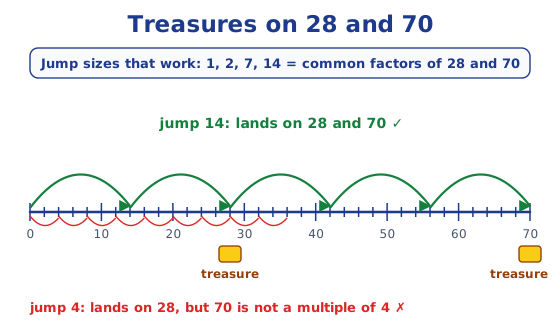
In the Jump Jackpot game, Jumpy starts at 0 and jumps by a fixed size; he wins if he lands on the treasures. To land on two treasures, his jump size must be a factor of both numbers, that is, a common factor. For treasures on 28 and 70, the jump sizes that work are 1, 2, 7 and 14.
Safe pairs and co-prime numbers
Now a new rule: a jump size of 1 is not allowed. Grumpy wants to place two treasures so that Jumpy cannot reach both. Placing them on 12 and 26 fails, because a jump size of 2 reaches both. But 4 and 9 are safe: no jump size other than 1 reaches both.
Safe pairs have no common factor other than 1. Such numbers are called co-prime. Checking the book’s pairs:
| Pair | Co-prime? |
|---|---|
| 15 and 39 | No: common factor 3 |
| 4 and 15 | Yes |
| 18 and 29 | Yes |
| 20 and 55 | No: common factor 5 |
| 18 and 35 | Yes |
| 30 and 415 | No: common factor 5 |
| 17 and 69 | Yes (69 = 3 × 23) |
| 81 and 18 | No: common factor 9 |
Co-prime does not mean prime
Co-prime describes a pair of numbers. The numbers themselves can be composite: 4 = 2 × 2 and 9 = 3 × 3 share no factor except 1, so they are co-prime. Two different primes are always co-prime, because each has only 1 and itself as factors.
Checking with prime factorisation
Finding one factor pair is not enough. Anshu wrote 56 = 14 × 4 and 63 = 21 × 3, saw no common factor and wrongly said they were co-prime; Guna wrote 56 = 7 × 8 and 63 = 9 × 7 and found 7. The reliable way is the full prime factorisation:
- 56 = 2 × 2 × 2 × 7 and 63 = 3 × 3 × 7 share the prime 7, so they are not co-prime.
- 40 = 2 × 2 × 2 × 5 and 231 = 3 × 7 × 11 share no prime, so they are co-prime.
- 242 = 2 × 11 × 11 and 195 = 3 × 5 × 13 share no prime, so they are co-prime.
If two numbers had a composite common factor, its prime factors would appear in both factorisations, so no common prime means no common factor except 1.
The first common multiple
In the idli-vada game, Anshu noticed that the first common multiple of two numbers is sometimes equal to their product and sometimes smaller. For co-prime pairs it equals the product: 4 and 9 first meet at 36 = 4 × 9, and 3 and 5 at 15. When the numbers share a factor, it is smaller: 4 and 6 first meet at 12, not 24, and 6 and 8 at 24, not 48.
Co-prime thread art
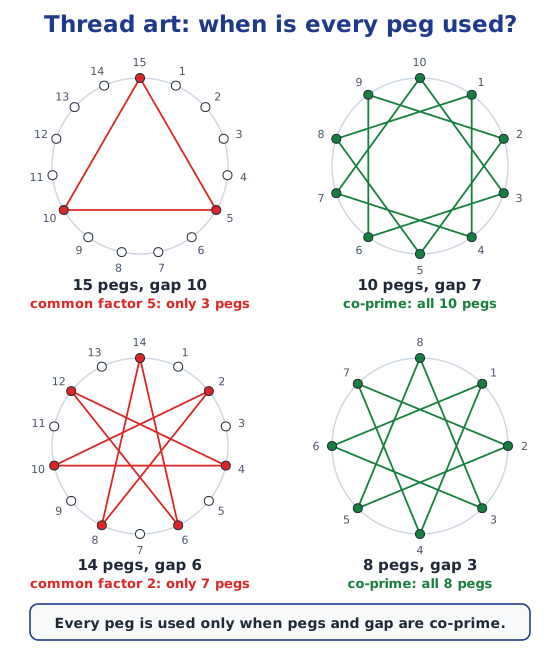
Tie a thread round a circle of pegs, skipping a fixed number each time. The thread reaches every peg only when the number of pegs and the thread-gap are co-prime.
For more on breaking numbers into primes, read prime factorisation. For the textbook’s questions, see the Chapter 5 NCERT solutions; for the whole chapter, see the Chapter 5 notes.
Practice
-
Which pair is co-prime?
Show answer
Answer: (c) 18 and 29
-
Which pair is NOT co-prime?
Show answer
Answer: (d) 121 and 1331
-
For which pair is the first common multiple equal to the product?
Show answer
Answer: (c) 4 and 9
-
Are 80 and 63 co-prime? Use prime factorisation.
Show answer
Answer: Yes. 80 = 2 × 2 × 2 × 2 × 5 and 63 = 3 × 3 × 7 have no prime factor in common, so their only common factor is 1.
-
Are any two prime numbers co-prime?
Show answer
Answer: Yes, if they are different: each has only 1 and itself as factors, so the only factor they share is 1. (A prime is not co-prime with itself: 5 and 5 share the factor 5.)
Questions students ask
What are co-prime numbers?
Two numbers that have no common factor other than 1, such as 4 and 9, 8 and 15, or 18 and 35.
Are co-prime numbers always prime?
No. Co-prime is about a pair of numbers having no common factor except 1. The numbers themselves can be composite, as 4 and 9 are.
How do you check whether two numbers are co-prime?
Write the prime factorisation of each. If no prime appears in both, the numbers are co-prime; if a prime appears in both, it is a common factor and they are not co-prime.
Stuck on a question?
Take a photo and Lagnever AI explains it step by step. Try it for 7 days for ₹2.
Get it on Google Play Open in browser
For parents: after the trial, the plan renews monthly by UPI or card autopay. You can cancel anytime in the app.