
Prime and composite numbers
Answer in short
A prime number has exactly two factors, 1 and itself, such as 2, 3, 5, 7 and 11. A composite number has more than two factors, such as 4 and 9. The number 1 has only one factor, so it is neither prime nor composite. There are 25 primes up to 100, and 2 is the only even prime.
Stuck on a question? Take a photo and Lagnever AI explains it step by step. Try it for 7 days for ₹2. Get it on Google Play
Rectangles of figs
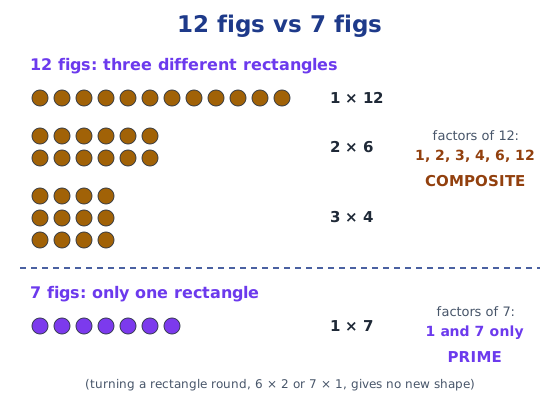
Guna wants to pack 12 figs (anjeer) in a box and Anshu wants to pack 7. Guna can arrange 12 figs in a rectangle in several ways: 1 row of 12, 2 rows of 6, or 3 rows of 4. Each time, rows × columns = 12, so the numbers of rows and columns are factors of 12. Anshu can make only one rectangle, 1 row of 7, because 7 has only two factors, 1 and 7.
Prime, composite and 1
- A prime number has exactly two factors: 1 and the number itself. The first primes are 2, 3, 5, 7, 11, 13, 17 and 19.
- A composite number has more than two factors, that is, at least one factor other than 1 and itself. The first composite numbers are 4, 6, 8, 9, 10, 12, 14, 15, 16, 18 and 20.
- The number 1 has only one factor, so it is neither prime nor composite.
From 21 to 30 there are only two primes, 23 and 29; the other eight numbers are composite.
The Sieve of Eratosthenes
The Greek mathematician Eratosthenes, who lived about 2200 years ago, gave a neat way to list primes:
- Cross out 1, because it is neither prime nor composite.
- Circle 2 and cross out all its multiples after it: 4, 6, 8, …
- The next number not crossed out is 3. Circle it and cross out its multiples: 6, 9, 12, …
- Circle 5 and cross out its multiples, then do the same for 7, and carry on until every number is circled or crossed out.
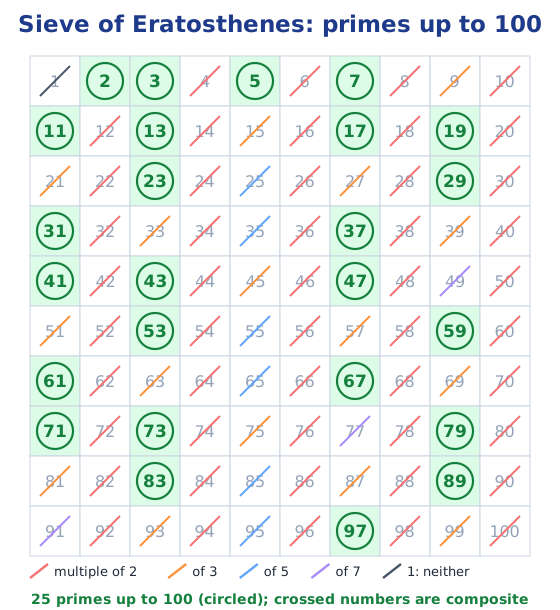
Why it works: every crossed-out number is a multiple of a smaller prime, so it has a factor other than 1 and itself, and is composite. A number that is never crossed out has no smaller prime as a factor, so its only factors are 1 and itself, and it is prime. Up to 100, the 25 primes are 2, 3, 5, 7, 11, 13, 17, 19, 23, 29, 31, 37, 41, 43, 47, 53, 59, 61, 67, 71, 73, 79, 83, 89 and 97.
Patterns among primes
- 2 is the only even prime, because every other even number has 2 as a factor.
- The smallest gap between two successive primes is 1 (between 2 and 3); up to 100, the largest gap is 8 (between 89 and 97).
- The numbers 90 to 96 are seven composite numbers in a row.
- Twin primes differ by 2: 3 and 5, 5 and 7, 11 and 13, 17 and 19, 29 and 31, 41 and 43, 59 and 61, and 71 and 73.
- Some primes come in reversed pairs: 13 and 31, 17 and 71, 37 and 73, 79 and 97.
- No prime has 4 as its units digit, because such a number is even and greater than 2.
- For every prime after 3, the next number is even, so it is composite.
How many primes are there?
Prime numbers are called the building blocks of all whole numbers, and mathematicians have studied them for more than 2000 years. The book’s fun fact: the largest prime anyone has written down would take about 6500 pages, so it exists only on a computer. The book also asks whether the list of primes ever ends. (Extra: it does not: the Greek mathematician Euclid proved that there is no largest prime.)
To see how primes build up other numbers, read prime factorisation. For the textbook’s questions, see the Chapter 5 NCERT solutions; for the whole chapter, see the Chapter 5 notes.
Practice
-
Which of these is a prime number?
Show answer
Answer: (c) 29
-
How many primes are there from 21 to 30?
Show answer
Answer: (b) 2
-
Which number is neither prime nor composite?
Show answer
Answer: (b) 1
-
Find seven consecutive composite numbers below 100.
Show answer
Answer: 90, 91, 92, 93, 94, 95 and 96. They lie between the primes 89 and 97: 91 = 7 × 13, 93 = 3 × 31 and 95 = 5 × 19, and the others are even.
-
Is there any even prime other than 2? Why?
Show answer
Answer: No. Every even number greater than 2 has 2 as a factor besides 1 and itself, so it has more than two factors and is composite.
Questions students ask
What is a prime number?
A number that has exactly two factors, 1 and the number itself. The first primes are 2, 3, 5, 7, 11, 13, 17 and 19.
Why is 1 not a prime number?
A prime must have exactly two factors. The number 1 has only one factor, itself, so it is neither prime nor composite.
What are twin primes?
Pairs of primes with a difference of 2. Up to 100 they are 3 and 5, 5 and 7, 11 and 13, 17 and 19, 29 and 31, 41 and 43, 59 and 61, and 71 and 73.
Stuck on a question?
Take a photo and Lagnever AI explains it step by step. Try it for 7 days for ₹2.
Get it on Google Play Open in browser
For parents: after the trial, the plan renews monthly by UPI or card autopay. You can cancel anytime in the app.