
NCERT Solutions Class 10 Maths Chapter 10: Circles
Answers to the questions inside Chapter 10, Circles, the three worked examples, and every question of Exercises 10.1 and 10.2, from Mathematics, the Class 10 NCERT textbook. Page numbers follow the 2026-27 reprint (pages 144–153). The exercise questions are quoted from the book; the examples and in-chapter questions are restated in short and labelled by number and page. The book’s figures are not copied: every figure here is our own drawing, computed from the data in the question, with the tangent points, right angles and equal lengths checked by script. Every length, angle and MCQ was checked by calculation, the proofs were tested on thousands of random figures, and all answers match the answer key at the end of the book. Short notes: Chapter 10 notes.
Questions inside the chapter (pages 145–148)
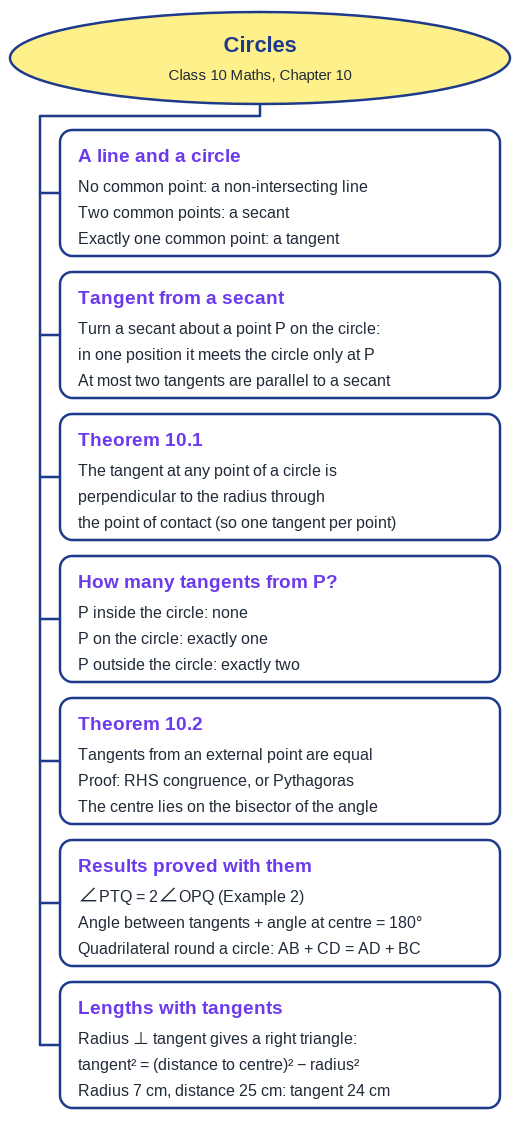
Page 145: can a line and a circle have any other position besides the three shown (no common point, two common points, one common point)? No. A straight line can meet a circle in at most two points, so the number of common points is 0, 1 or 2, and those are exactly the non-intersecting line, the tangent and the secant.
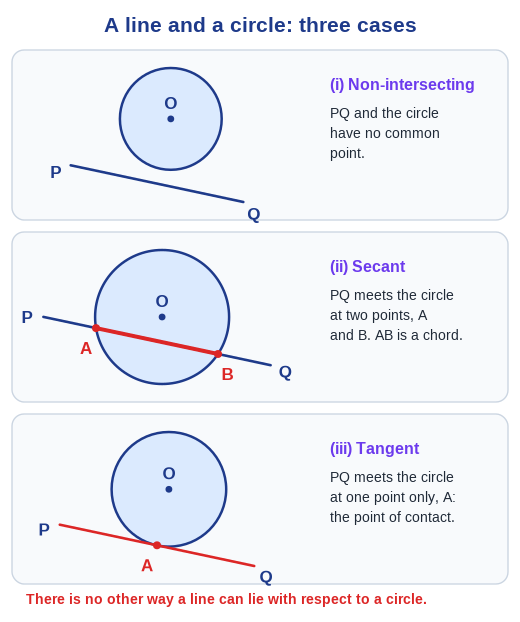
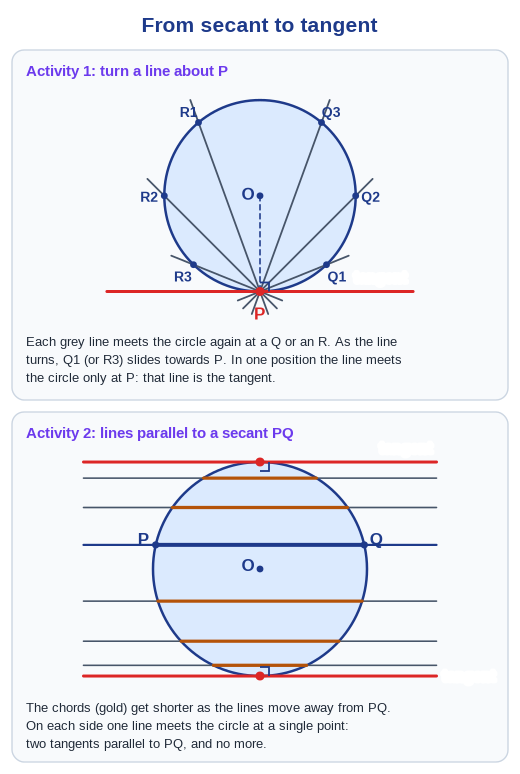
Activities 1 and 2 (pages 145–146): turning a line about a point P of a circle, and drawing lines parallel to a secant. When the line turns about P, its second meeting point with the circle comes closer to P until, in one position, the two meet: that line is the tangent at P, and there is only one such position. Lines parallel to a secant cut shorter and shorter chords; on each side the chord finally shrinks to a point, which gives exactly two tangents parallel to the secant.
Page 146: a wheel moving on the ground; do you see a tangent anywhere? Yes. The ground (the line the wheel moves along) touches the wheel at one point at a time, so it is a tangent to the circle of the wheel. The spoke reaching the point of contact looks perpendicular to the ground, which is what Theorem 10.1 proves.
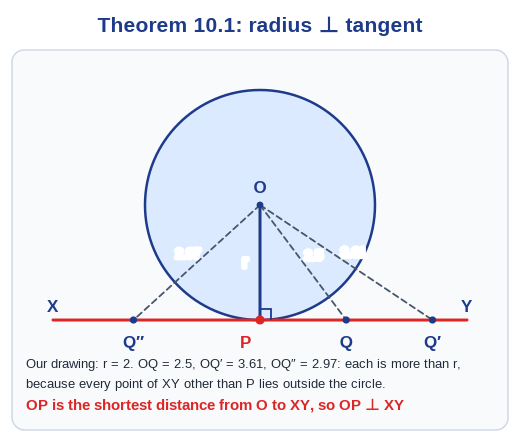
Page 147, in the proof of Theorem 10.1: why must the point Q of the tangent XY lie outside the circle? If Q were inside the circle, the line XY would pass into the circle and come out again, meeting it at two points. Then XY would be a secant, not a tangent. So Q is outside, and OQ > OP. Since this holds for every point of XY other than P, OP is the shortest distance from O to XY, so OP ⊥ XY.
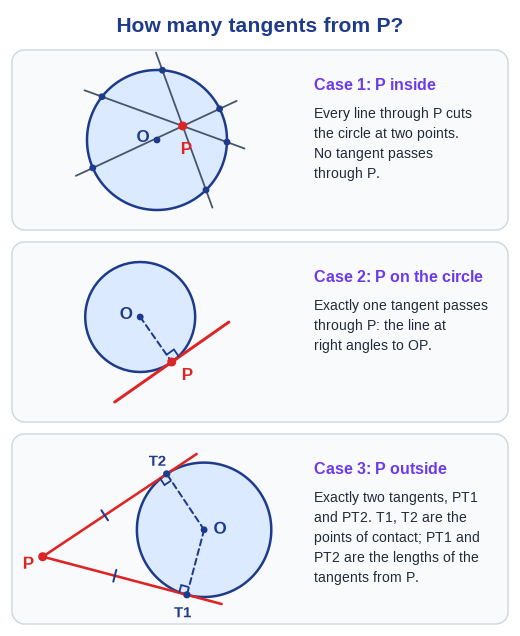
Activity 3 (page 148): try to draw tangents from a point P inside, on and outside a circle. From a point inside: none, because every line through it cuts the circle twice. From a point on the circle: exactly one. From a point outside: exactly two. When you measure the two tangent lengths PT1 and PT2 from an outside point, they are equal; Theorem 10.2 proves it.
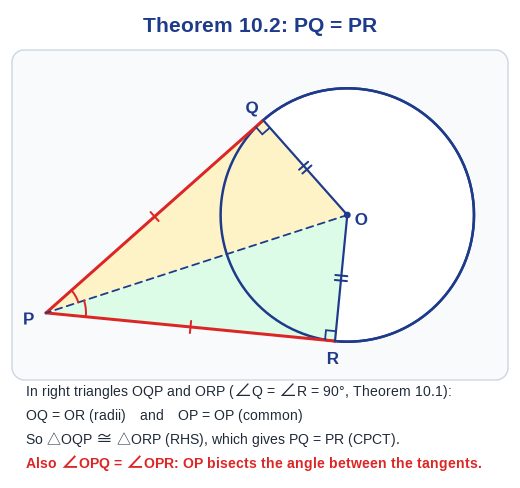
Theorem 10.2 (page 149): the tangents PQ and PR from an external point P are equal. Join OP, OQ, OR. ∠OQP = ∠ORP = 90° (Theorem 10.1), OQ = OR (radii) and OP is common, so △OQP ≅ △ORP (RHS) and PQ = PR (CPCT). The same congruence gives ∠OPQ = ∠OPR, so the centre lies on the bisector of ∠QPR.
Examples 1 to 3 (pages 149–151)
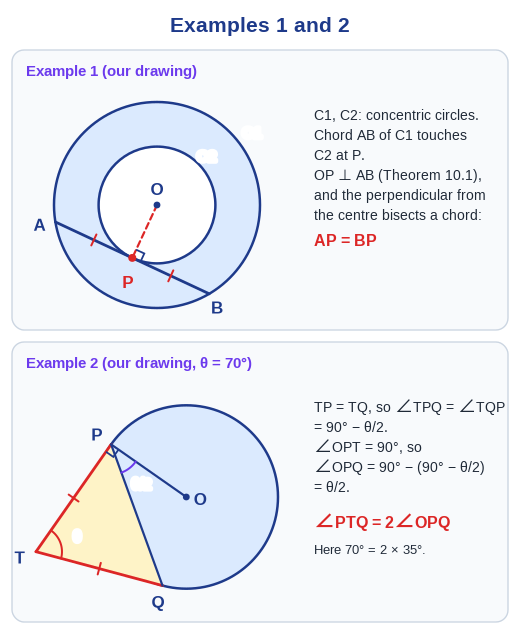
Example 1 (page 149): in two concentric circles, a chord of the larger circle that touches the smaller circle is bisected at the point of contact. Let the chord AB of the larger circle touch the smaller one at P, and join OP. AB is a tangent to the smaller circle and OP is its radius, so OP ⊥ AB (Theorem 10.1). In the larger circle, OP is then the perpendicular from the centre to the chord AB, and that perpendicular bisects the chord. So AP = BP.
Example 2 (page 150): tangents TP and TQ are drawn from T to a circle with centre O; prove ∠PTQ = 2∠OPQ. Let ∠PTQ = θ. TP = TQ (Theorem 10.2), so △TPQ is isosceles and ∠TPQ = ∠TQP = (180° − θ)/2 = 90° − θ/2. By Theorem 10.1, ∠OPT = 90°. So ∠OPQ = ∠OPT − ∠TPQ = 90° − (90° − θ/2) = θ/2 = ½∠PTQ, which gives ∠PTQ = 2∠OPQ.
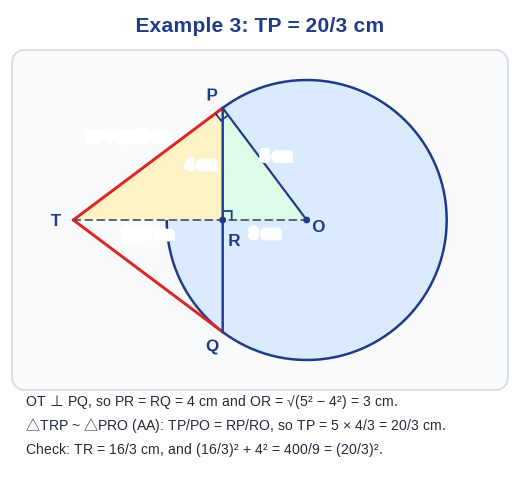
Example 3 (pages 150–151): PQ is a chord of 8 cm in a circle of radius 5 cm, and the tangents at P and Q meet at T; find TP. Join OT, meeting PQ at R. △TPQ is isosceles (TP = TQ) and TO bisects ∠PTQ, so OT ⊥ PQ and OT bisects PQ: PR = RQ = 4 cm. Then OR = √(OP² − PR²) = √(25 − 16) = 3 cm.
The “Why?” on page 151: ∠TPR + ∠RPO = ∠TPO = 90°, because the tangent TP is perpendicular to the radius OP. Also ∠TPR + ∠PTR = 90°, because the angles of △TRP add to 180° and ∠TRP = 90°. Comparing, ∠RPO = ∠PTR.
So the right triangles TRP and PRO are similar (AA), and TP/PO = RP/RO, that is TP/5 = 4/3, so TP = 20/3 cm.
The book’s note finds the same answer with the Pythagoras theorem. Let TP = x and TR = y. In right △PRT, x² = y² + 16 … (1). In right △OPT, x² + 5² = (y + 3)² … (2). Subtracting (1) from (2): 25 = 6y − 7, so y = 32/6 = 16/3. Then x² = (16/3)² + 16 = (16/9)(16 + 9) = 400/9, and x = 20/3.
Exercise 10.1 (page 147)
1. “How many tangents can a circle have?”
There is exactly one tangent at each point of a circle, and a circle has infinitely many points.
Answer: Infinitely many.
2. “Fill in the blanks : (i) A tangent to a circle intersects it in ______ point (s). (ii) A line intersecting a circle in two points is called a ______. (iii) A circle can have ______ parallel tangents at the most. (iv) The common point of a tangent to a circle and the circle is called ______.”
For (iii): tangents parallel to a given direction touch the circle at the two ends of the diameter perpendicular to that direction, so there can be two of them, never more.
Answer: (i) one (ii) secant (iii) two (iv) point of contact
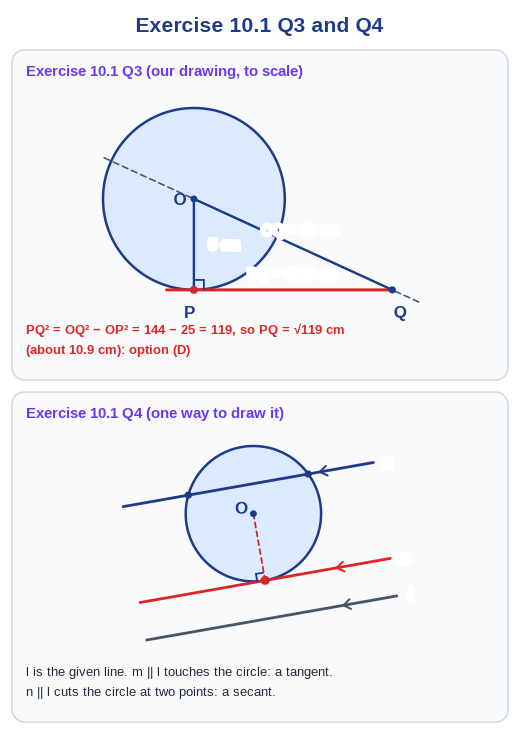
3. “A tangent PQ at a point P of a circle of radius 5 cm meets a line through the centre O at a point Q so that OQ = 12 cm. Length PQ is : (A) 12 cm (B) 13 cm (C) 8.5 cm (D) √119 cm.”
Given: radius OP = 5 cm, OQ = 12 cm, PQ is the tangent at P.
To find: PQ.
- OP is the radius to the point of contact, so ∠OPQ = 90° (Theorem 10.1: the tangent is perpendicular to the radius at the point of contact).
- In right △OPQ, PQ² = OQ² − OP² = 144 − 25 = 119.
- So PQ = √119 cm (about 10.9 cm).
Answer: (D) √119 cm.
4. “Draw a circle and two lines parallel to a given line such that one is a tangent and the other, a secant to the circle.”
One way to do it:
- Draw a circle with centre O and any line l outside it.
- Through O, draw the line perpendicular to l. It meets the circle at two points; call one of them T.
- At T, draw the line m perpendicular to OT. Then m ∥ l (both are perpendicular to the same line), and m touches the circle at T by Theorem 10.1: m is the tangent.
- Through any point between O and T (or through O itself), draw the line n parallel to l. It is nearer to O than the radius, so it cuts the circle at two points: n is the secant.
Exercise 10.2 (pages 151–152)
The book says: “In Q.1 to 3, choose the correct option and give justification.”
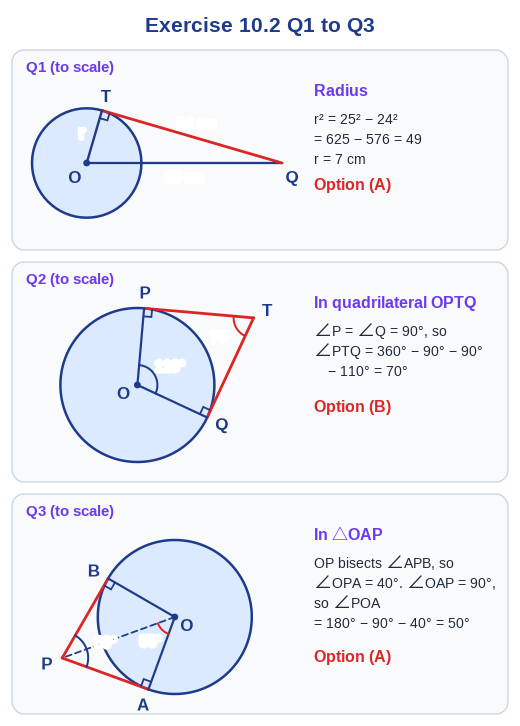
1. “From a point Q, the length of the tangent to a circle is 24 cm and the distance of Q from the centre is 25 cm. The radius of the circle is (A) 7 cm (B) 12 cm (C) 15 cm (D) 24.5 cm”
Given: tangent PQ = 24 cm, OQ = 25 cm.
To find: the radius OP.
- Let the tangent from Q touch the circle at P. Then ∠OPQ = 90° (Theorem 10.1).
- In right △OPQ, OP² = OQ² − PQ² = 625 − 576 = 49.
- So OP = 7 cm.
Answer: (A) 7 cm.
2. “In Fig. 10.11, if TP and TQ are the two tangents to a circle with centre O so that ∠ POQ = 110°, then ∠ PTQ is equal to (A) 60° (B) 70° (C) 80° (D) 90°”
Given: TP and TQ are tangents, ∠POQ = 110°.
To find: ∠PTQ.
- In quadrilateral OPTQ, ∠OPT = ∠OQT = 90° (radius ⊥ tangent).
- The angles of a quadrilateral add to 360°.
- So ∠PTQ = 360° − 90° − 90° − 110° = 70°.
Answer: (B) 70°.
3. “If tangents PA and PB from a point P to a circle with centre O are inclined to each other at angle of 80°, then ∠ POA is equal to (A) 50° (B) 60° (C) 70° (D) 80°”
Given: tangents PA and PB with ∠APB = 80°.
To find: ∠POA.
- OP bisects ∠APB (from the proof of Theorem 10.2), so ∠OPA = 80° ÷ 2 = 40°.
- In △OAP, ∠OAP = 90° (radius ⊥ tangent).
- The angles of a triangle add to 180°, so ∠POA = 180° − 90° − 40° = 50°.
Answer: (A) 50°.
4. “Prove that the tangents drawn at the ends of a diameter of a circle are parallel.”
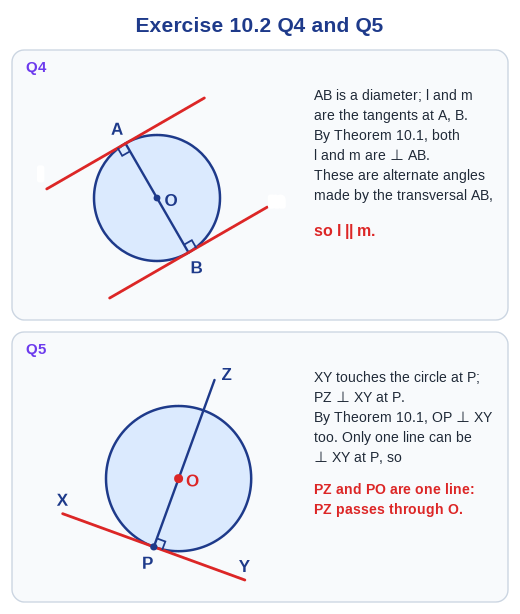
Given: AB is a diameter of a circle with centre O; l and m are the tangents at A and B.
To prove: l ∥ m.
Proof:
- OA is a radius and l is the tangent at A, so l ⊥ AB (Theorem 10.1). In the same way, m ⊥ AB.
- So the transversal AB makes angles of 90° with l and with m. These are a pair of equal alternate angles.
- When alternate angles are equal, the lines are parallel. So l ∥ m. (In short: two lines perpendicular to the same line are parallel.)
Hence proved.
5. “Prove that the perpendicular at the point of contact to the tangent to a circle passes through the centre.”
Given: XY touches a circle with centre O at P; PZ is the line through P perpendicular to XY.
To prove: PZ passes through O.
Proof:
- Join OP. By Theorem 10.1, OP ⊥ XY.
- So both PZ and PO are perpendicular to XY at the same point P.
- Through a point of a line, only one line can be drawn perpendicular to it. (If O were not on PZ, then ∠OPY and ∠ZPY would both be 90°, which is impossible unless the rays PO and PZ are the same.)
- So PZ and PO are the same line, and the perpendicular PZ passes through the centre O.
Hence proved.
6. “The length of a tangent from a point A at distance 5 cm from the centre of the circle is 4 cm. Find the radius of the circle.”
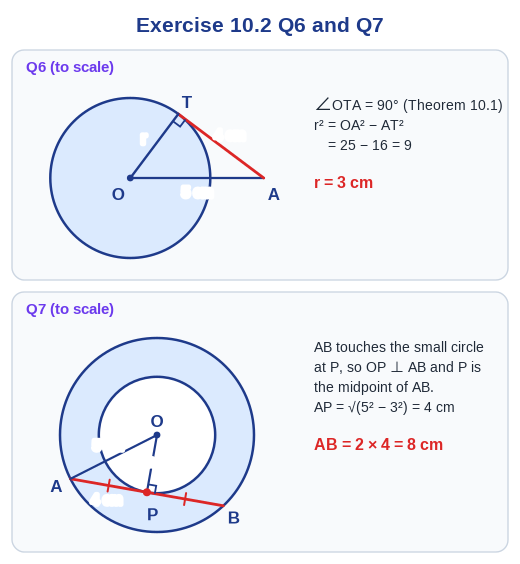
Given: OA = 5 cm, tangent AT = 4 cm.
To find: the radius OT.
- Let the tangent from A touch the circle at T. Then ∠OTA = 90° (Theorem 10.1).
- In right △OTA, OT² = OA² − AT² = 25 − 16 = 9.
- So OT = 3 cm.
Answer: The radius is 3 cm.
7. “Two concentric circles are of radii 5 cm and 3 cm. Find the length of the chord of the larger circle which touches the smaller circle.”
Given: two circles with the same centre O and radii OA = 5 cm and OP = 3 cm; the chord AB of the larger circle touches the smaller circle at P.
To find: AB.
- AB is a tangent to the smaller circle at P, so OP ⊥ AB (Theorem 10.1).
- The perpendicular from the centre to a chord bisects the chord, so P is the mid-point of AB (Example 1).
- In right △OPA, AP = √(OA² − OP²) = √(25 − 9) = √16 = 4 cm.
- AB = 2 × AP = 8 cm.
Answer: The chord is 8 cm long.
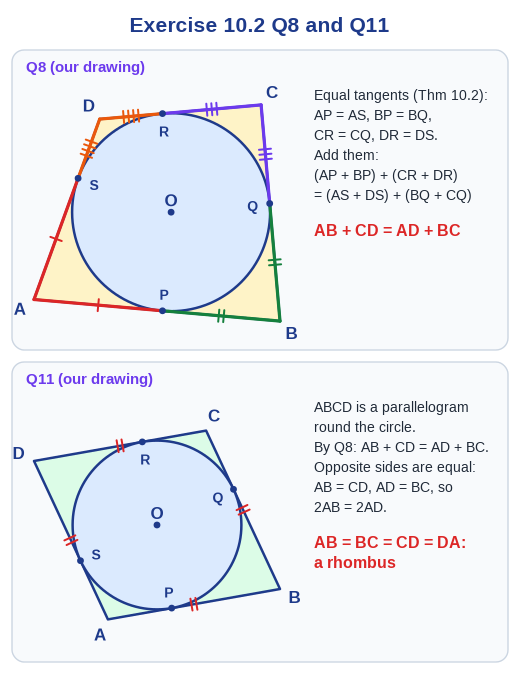
8. “A quadrilateral ABCD is drawn to circumscribe a circle (see Fig. 10.12). Prove that AB + CD = AD + BC”
Given: ABCD circumscribes a circle (all four sides touch the circle), at P, Q, R and S on AB, BC, CD and DA.
To prove: AB + CD = AD + BC.
Proof:
- Tangents from one external point are equal (Theorem 10.2). So AP = AS, BP = BQ, CR = CQ and DR = DS.
- AB + CD = (AP + PB) + (CR + RD).
- Replace each part by its equal tangent: = AS + BQ + CQ + DS.
- Regroup: = (AS + SD) + (BQ + QC) = AD + BC.
So AB + CD = AD + BC.
Hence proved.
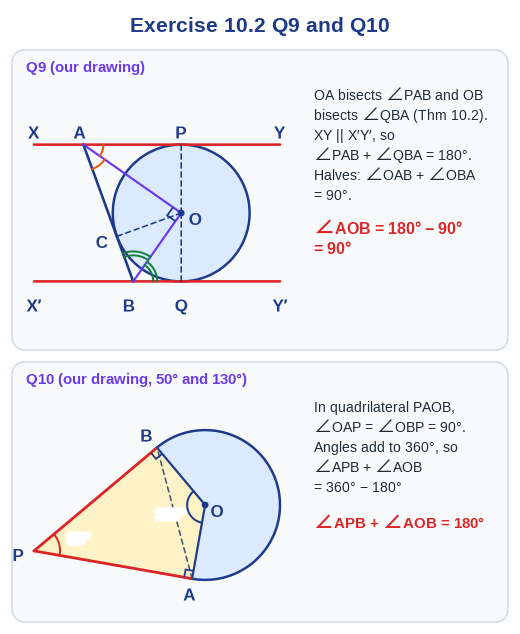
9. “In Fig. 10.13, XY and X′Y′ are two parallel tangents to a circle with centre O and another tangent AB with point of contact C intersecting XY at A and X′Y′ at B. Prove that ∠ AOB = 90°.”
Given: XY ∥ X′Y′ are tangents at P and Q; the tangent AB touches the circle at C and meets XY at A and X′Y′ at B.
To prove: ∠AOB = 90°.
Proof: Join OP, OQ and OC.
- OP ⊥ XY and OQ ⊥ X′Y′ (Theorem 10.1). Since XY ∥ X′Y′, OP and OQ lie on one line: POQ is a diameter.
- In △OPA and △OCA: OP = OC (radii), OA is common, and AP = AC (tangents from A). So △OPA ≅ △OCA (SSS), and ∠POA = ∠COA.
- In the same way, △OQB ≅ △OCB, so ∠QOB = ∠COB.
- POQ is a straight line, so ∠POA + ∠COA + ∠COB + ∠QOB = 180°.
- Using steps 2 and 3: 2∠COA + 2∠COB = 180°, so ∠COA + ∠COB = 90°.
That is, ∠AOB = 90°.
Hence proved. (Another way, used in our figure: OA and OB bisect ∠PAB and ∠QBA; these two angles are co-interior angles between the parallel tangents, so they add to 180°, their halves add to 90°, and the third angle of △AOB is 90°.)
10. “Prove that the angle between the two tangents drawn from an external point to a circle is supplementary to the angle subtended by the line-segment joining the points of contact at the centre.”
Given: PA and PB are tangents from an external point P to a circle with centre O.
To prove: ∠APB + ∠AOB = 180°.
Proof:
- ∠OAP = 90° and ∠OBP = 90° (Theorem 10.1).
- The angles of quadrilateral OAPB add to 360°: ∠APB + ∠OAP + ∠AOB + ∠OBP = 360°.
- So ∠APB + ∠AOB = 360° − 90° − 90° = 180°.
So the two angles are supplementary.
Hence proved.
11. “Prove that the parallelogram circumscribing a circle is a rhombus.”
Given: a parallelogram ABCD circumscribes a circle.
To prove: ABCD is a rhombus.
Proof:
- By Question 8, AB + CD = AD + BC.
- Opposite sides of a parallelogram are equal: AB = CD and AD = BC.
- So 2AB = 2BC, that is, AB = BC.
- Then AB = BC = CD = DA: all four sides are equal.
A parallelogram with all sides equal is a rhombus.
Hence proved.
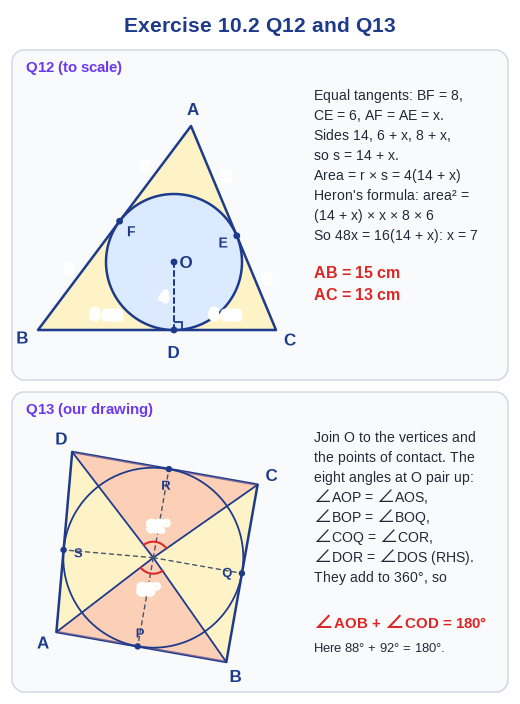
12. “A triangle ABC is drawn to circumscribe a circle of radius 4 cm such that the segments BD and DC into which BC is divided by the point of contact D are of lengths 8 cm and 6 cm respectively (see Fig. 10.14). Find the sides AB and AC.”
Given: inradius 4 cm (the radius of the circle inside the triangle), BD = 8 cm and DC = 6 cm.
To find: AB and AC.
Let the circle (centre O) touch AB at F and AC at E.
-
Equal tangents (Theorem 10.2): BF = BD = 8 cm, CE = CD = 6 cm, and AF = AE = x cm, say.
-
The sides are BC = 14 cm, AB = (x + 8) cm and AC = (x + 6) cm. The semi-perimeter is s = (14 + x + 8 + x + 6)/2 = (14 + x) cm.
-
Area by joining O to the vertices: the radius to each point of contact is the height of a small triangle, so area(ABC) = ½ × 4 × BC + ½ × 4 × CA + ½ × 4 × AB = 2 × (perimeter) = 4(14 + x).
-
Area by Heron’s formula (Class 9): √(s(s − a)(s − b)(s − c)) = √((14 + x) × x × 6 × 8) = √(48x(14 + x)).
-
Equate and square: 48x(14 + x) = 16(14 + x)². Divide by 16(14 + x), which is not 0: 3x = 14 + x, so x = 7.
-
AB = 7 + 8 = 15 cm and AC = 7 + 6 = 13 cm.
Answer: AB = 15 cm and AC = 13 cm.
Check: with sides 13, 14 and 15, s = 21, the area is √(21 × 8 × 7 × 6) = 84 cm², and 84/21 = 4 cm, the given radius. (Our figure puts B on the left and C on the right.)
13. “Prove that opposite sides of a quadrilateral circumscribing a circle subtend supplementary angles at the centre of the circle.”
Given: ABCD circumscribes a circle with centre O, touching AB, BC, CD and DA at P, Q, R and S.
To prove: ∠AOB + ∠COD = 180° and ∠BOC + ∠AOD = 180°.
Proof: Join O to A, B, C, D and to P, Q, R, S.
-
In △OAP and △OAS: OP = OS (radii), OA is common, and AP = AS (Theorem 10.2). So △OAP ≅ △OAS (SSS), and ∠AOP = ∠AOS.
-
In the same way, ∠BOP = ∠BOQ, ∠COQ = ∠COR and ∠DOR = ∠DOS.
-
The eight angles round O add to 360°: ∠AOP + ∠AOS + ∠BOP + ∠BOQ + ∠COQ + ∠COR + ∠DOR + ∠DOS = 360°.
-
Using step 2: 2(∠AOP + ∠BOP + ∠COR + ∠DOR) = 360°, so (∠AOP + ∠BOP) + (∠COR + ∠DOR) = 180°.
-
That is, ∠AOB + ∠COD = 180°.
-
In the same way, ∠BOC + ∠AOD = 180°. So each pair of opposite sides subtends supplementary angles at the centre.
Hence proved.
The summary of the chapter (page 153)
The book ends with a three-point summary: what a tangent to a circle is, that the tangent is perpendicular to the radius through the point of contact, and that the two tangents from an external point are equal in length. Each point is covered above and in the chapter notes.
Practice
-
From a point 17 cm from the centre of a circle, the length of the tangent is 15 cm. The radius is:
Show answer
Answer: (b) 8 cm
-
Tangents TP and TQ to a circle with centre O make ∠PTQ = 50°. Then ∠POQ is:
Show answer
Answer: (c) 130°
-
A quadrilateral ABCD circumscribes a circle with AB = 6 cm, BC = 7 cm and AD = 8 cm. CD is:
Show answer
Answer: (c) 9 cm
-
Two concentric circles have radii 13 cm and 12 cm. Find the length of the chord of the larger circle that touches the smaller one.
Show answer
Answer: The chord touches the smaller circle at its midpoint P, and OP ⊥ chord. Half the chord = √(13² − 12²) = √25 = 5 cm, so the chord is 10 cm.
-
PA and PB are tangents from P to a circle with centre O. Prove that OP is the perpendicular bisector of AB.
Show answer
Answer: PA = PB (Theorem 10.2) and OA = OB (radii). So both P and O are at equal distances from A and B, and each lies on the perpendicular bisector of AB. Two points fix a line, so the line OP is the perpendicular bisector of AB.
Stuck on a question?
Take a photo and Lagnever AI explains it step by step. Try it for 7 days for ₹2.
Get it on Google Play Open in browser
For parents: after the trial, the plan renews monthly by UPI or card autopay. You can cancel anytime in the app.