
Class 10 Maths Chapter 10: Circles Notes
This chapter in five lines
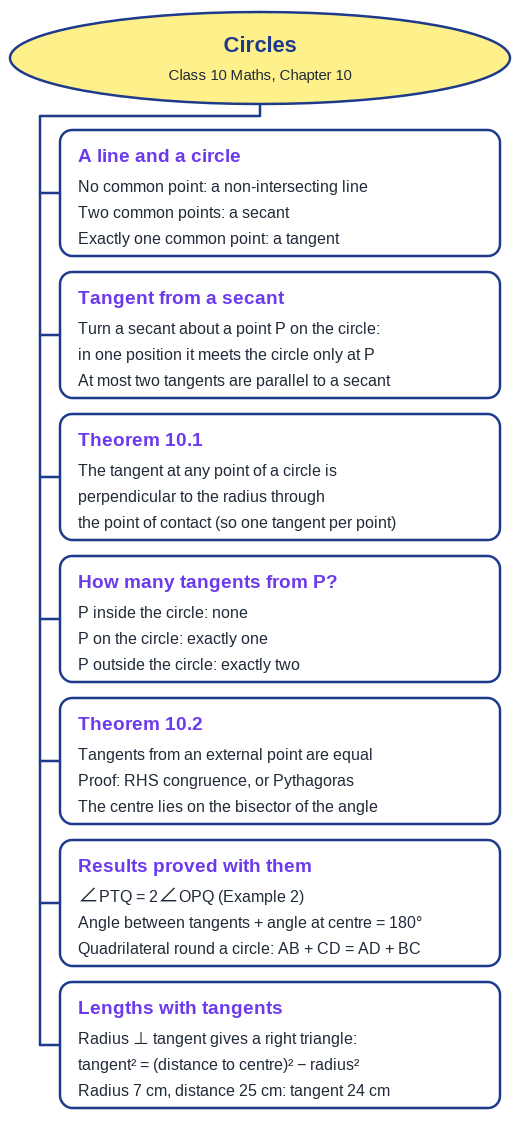
A line can miss a circle, cut it at two points (a secant) or touch it at exactly one point (a tangent). The chapter proves two theorems: the tangent at any point is perpendicular to the radius through the point of contact, and the two tangents drawn from an outside point are equal in length.
What is this chapter about?
A circle is the set of all points of a plane at a fixed distance, the radius, from a fixed point, the centre. You met chords, arcs, sectors and segments in Class 9. This chapter asks a new question: what can happen when a straight line and a circle lie in the same plane? One of the answers, the tangent, is the star of the chapter. Think of the rope running over a pulley at a well, or a cycle wheel on a flat road: the rope and the road behave like tangents to the circles.
The chapter is short, 10 pages, with two theorems, three examples and two exercises.
How can a line and a circle meet?
There are exactly three possibilities.
- The line and the circle have no common point. The line is a non-intersecting line.
- They have two common points. The line is a secant, and the part between the two points is a chord.
- They have exactly one common point. The line is a tangent, and the common point is the point of contact.
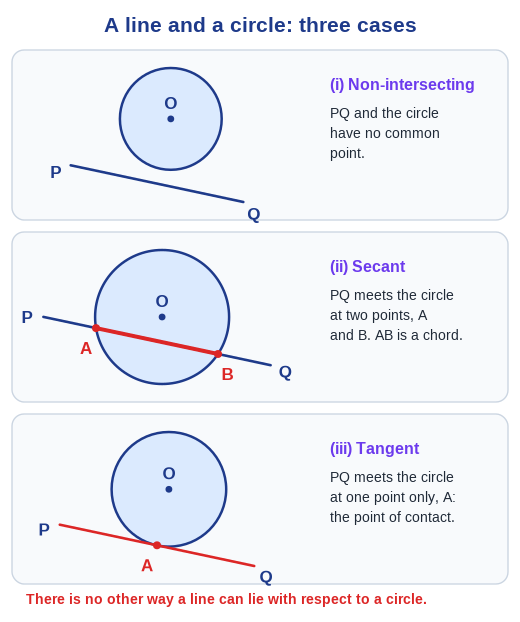
A tangent can be seen as a special secant. Turn a line about a point P of the circle: it usually meets the circle again somewhere else. As you turn it, that second point slides towards P, and in one position the two points become one. That position is the tangent at P. In the same way, lines parallel to a secant cut shorter and shorter chords as they move away, until the chord shrinks to a point on each side. So at most two tangents are parallel to a given secant. More on the tangent to a circle page.
Why is the tangent perpendicular to the radius?
Theorem 10.1: the tangent at any point of a circle is perpendicular to the radius through the point of contact.
The proof is short. Let XY touch the circle with centre O at P. Every other point Q of XY lies outside the circle (if Q were inside, XY would cut the circle twice and be a secant). So OQ is longer than the radius OP. Since this is true for every point of XY except P, OP is the shortest distance from O to the line, and the shortest segment from a point to a line is the perpendicular. So OP ⊥ XY.
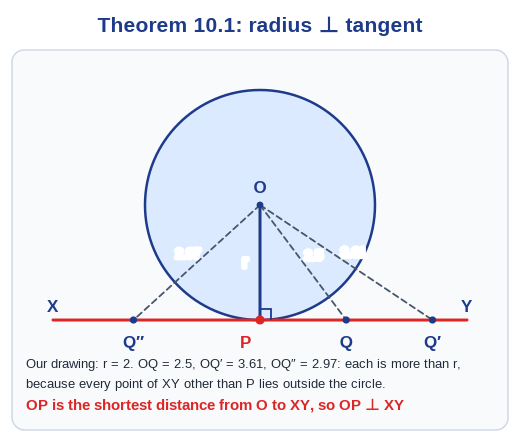
Two things follow. There is only one tangent at each point of a circle, because only one line through P is perpendicular to OP. And the line along the radius through the point of contact, called the normal, is perpendicular to the tangent.
How many tangents can be drawn from a point?
It depends on where the point is.
| Where P is | Tangents through P |
|---|---|
| Inside the circle | None: every line through P cuts the circle twice |
| On the circle | Exactly one |
| Outside the circle | Exactly two |
For a point P outside the circle, the segment from P to a point of contact T is called the length of the tangent from P.
Theorem 10.2: the lengths of the two tangents drawn from an external point to a circle are equal. If the tangents from P touch the circle at Q and R, join OP, OQ and OR. The angles at Q and R are right angles (Theorem 10.1), OQ = OR (radii) and OP is common, so △OQP ≅ △ORP by RHS, and PQ = PR. The same congruence shows that OP bisects the angle QPR.
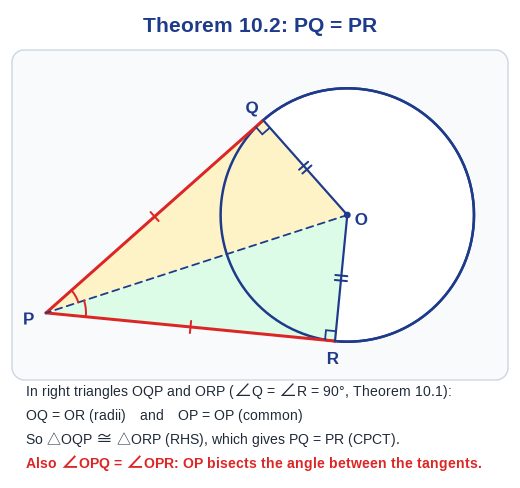
Read the full proofs and their uses on the tangents from an external point page.
How are the two theorems used?
Almost every question of the chapter starts by drawing the radius to a point of contact, which gives a right angle, and by marking equal tangents. A few results to remember:
- Lengths: in the right triangle made by the radius, the tangent and the line to the centre, tangent² = (distance to centre)² − radius². With a radius of 7 cm and a distance of 25 cm, the tangent is 24 cm.
- Angles: the angle between two tangents and the angle between the two radii to the points of contact add up to 180°.
- Polygons round a circle: each vertex sends out two equal tangents, so for a quadrilateral ABCD drawn round a circle, AB + CD = AD + BC.
Before we move on
The proofs use congruent triangles (RHS) and the fact that the perpendicular from the centre bisects a chord, both from Class 9, and similar triangles from Chapter 6. The current book has no section on constructing tangents. Every example and both exercises are solved in the NCERT solutions for Chapter 10.
Key terms
| Term | Meaning |
|---|---|
| Circle | All the points of a plane that are at the same distance (the radius) from a fixed point (the centre). |
| Non-intersecting line | A line that has no point in common with the circle. |
| Secant | A line that cuts the circle at two points. The part of it inside the circle is a chord. |
| Tangent | A line that meets the circle at exactly one point. The word comes from the Latin tangere, to touch. |
| Point of contact | The one common point of a tangent and the circle. The tangent is said to touch the circle there. |
| Normal | The line through the point of contact that contains the radius. It is perpendicular to the tangent. |
| Length of a tangent | The length of the segment from an outside point to the point of contact, such as PT in the figures. |
| Concentric circles | Circles with the same centre and different radii. |
| Circumscribe | A polygon circumscribes a circle when each of its sides touches the circle. The circle is then inside the polygon. |
| RHS congruence | Two right triangles are congruent if their hypotenuses and one more pair of sides are equal. It proves Theorem 10.2. |
Topics in this chapter
Practice
-
A line that meets a circle at exactly two points is called a:
Show answer
Answer: (b) secant
-
How many tangents can be drawn to a circle from a point inside it?
Show answer
Answer: (a) none
-
The angle between a tangent and the radius through the point of contact is:
Show answer
Answer: (c) 90°
-
From a point 13 cm from the centre of a circle of radius 5 cm, the length of the tangent is:
Show answer
Answer: (b) 12 cm
-
Two tangents from a point P make an angle of 60° with each other. The angle between the radii to the points of contact is:
Show answer
Answer: (c) 120°
Questions students ask
What are the main topics of Class 10 Maths Chapter 10?
Three short sections: the ways a line can meet a circle (10.1), the tangent to a circle with Theorem 10.1 (10.2), and the number of tangents from a point with Theorem 10.2 (10.3), followed by a three-point summary. The chapter is 10 pages long, pages 144 to 153.
How many exercises does Chapter 10 have?
Two. Exercise 10.1 has 4 questions on the basic ideas, and Exercise 10.2 has 13 questions: three MCQs, two lengths, one pair of sides and seven proofs. All of them, with the three examples, are worked out on the NCERT solutions page.
Which theorems of this chapter need to be learnt with proof?
Both. Theorem 10.1 (tangent perpendicular to the radius) and Theorem 10.2 (tangents from an external point are equal) are proved in the book, and most questions of Exercise 10.2 use one or both of them.
Is the construction of tangents in this chapter?
No. The 2026-27 book (rationalised) has no construction section in this chapter. Exercise 10.1 Question 4 only asks you to draw a tangent and a secant parallel to a given line.
Stuck on a question?
Take a photo and Lagnever AI explains it step by step. Try it for 7 days for ₹2.
Get it on Google Play Open in browser
For parents: after the trial, the plan renews monthly by UPI or card autopay. You can cancel anytime in the app.