
What is a tangent to a circle?
Answer in short
A tangent to a circle is a line that meets the circle at exactly one point, called the point of contact. A secant meets it at two points. Theorem 10.1 says the tangent at any point is perpendicular to the radius through the point of contact, so each point of a circle has exactly one tangent.
Stuck on a question? Take a photo and Lagnever AI explains it step by step. Try it for 7 days for ₹2. Get it on Google Play
How can a line lie with respect to a circle?
Draw a circle and a line in the same plane. Slide the line slowly across the circle and watch how many points they share.
- At first the line and the circle have no common point. It is a non-intersecting line.
- Then the line touches the circle at one point only. It is a tangent.
- Moving on, the line cuts the circle at two points, say A and B. It is a secant, and AB is a chord.
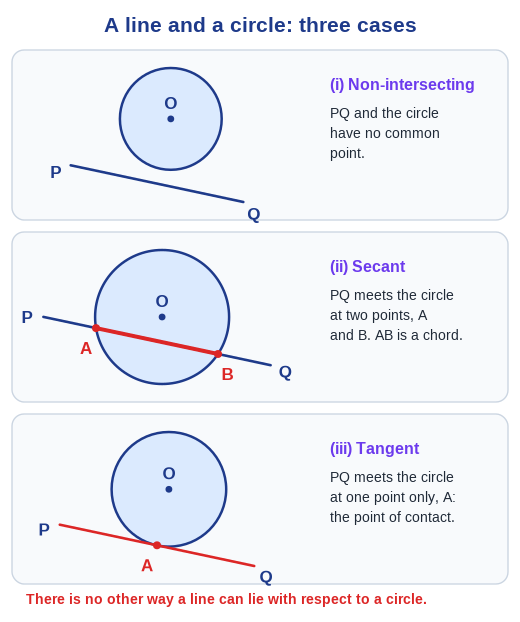
There is no fourth case: a straight line can meet a circle in at most two points. The one common point of a tangent and the circle is the point of contact, and we say the tangent touches the circle there. Real examples are easy to find. A wheel rolling on a road touches the road at one point at a time, and the road is like a tangent to the wheel. A rope coming off a pulley leaves it along a tangent.
How does a secant become a tangent?
The book shows this with two activities, which you can do with a circle drawn on paper and a ruler.
Turning a line. Fix a point P on the circle and turn a straight line about P. In most positions the line cuts the circle again at a second point. As you turn it towards one special position, the second point comes nearer and nearer to P, and in that position it meets P: the line now touches the circle at P alone. Turn further and a new second point appears on the other side. So there is exactly one tangent at P.
Sliding a line. Draw a secant and then lines parallel to it on both sides. Each line cuts a chord, and the chords get shorter as the lines move away from the secant. On each side, the chord finally shrinks to a single point: that line is a tangent. So there are exactly two tangents parallel to a given secant, one on each side, and no more.
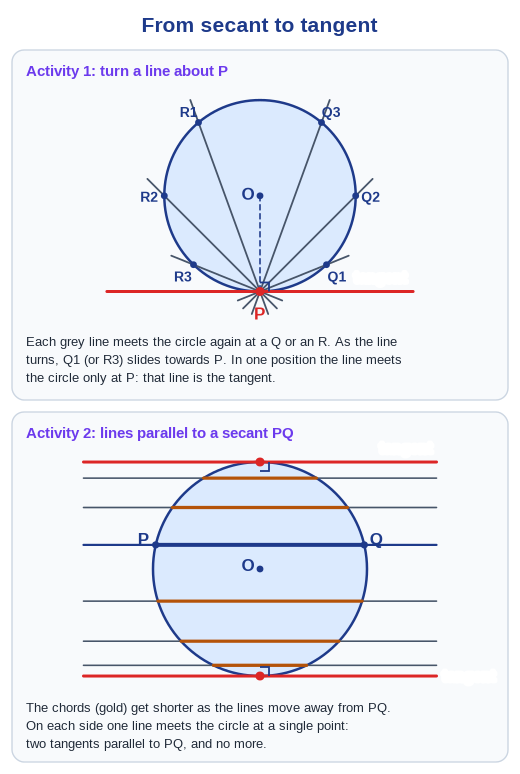
Both activities say the same thing: a tangent is a secant whose two end points of the chord have come together.
Theorem 10.1: why is the tangent perpendicular to the radius?
Statement: the tangent at any point of a circle is perpendicular to the radius through the point of contact.
Given: a circle with centre O, and a tangent XY touching it at P. To prove: OP ⊥ XY.
Proof:
- Take any point Q on XY other than P, and join OQ.
- Q lies outside the circle. If it were inside, the line XY would enter the circle and come out again, so it would be a secant, not a tangent.
- So OQ is longer than the radius: OQ > OP.
- This is true for every point of XY except P. So OP is the shortest of all the distances from O to the points of XY.
- The shortest segment from a point to a line is the perpendicular to the line. Therefore OP ⊥ XY.
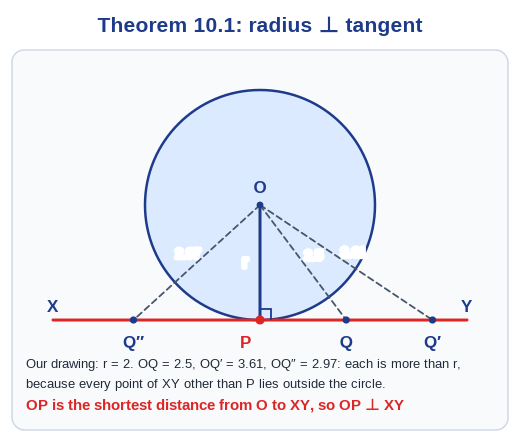
Two remarks follow from the theorem. First, there is one and only one tangent at any point of a circle, since only one line through P is perpendicular to OP. Second, the line containing the radius through the point of contact is called the normal to the circle at that point.
How is Theorem 10.1 used in sums?
Whenever a tangent appears, join the centre to the point of contact. You get a right angle there, and often a right triangle where the Pythagoras theorem works. In Exercise 10.1 Question 3, a tangent at P to a circle of radius 5 cm meets a line through the centre at Q with OQ = 12 cm. The angle at P is 90°, so PQ² = 12² − 5² = 119 and PQ = √119 cm.
The theorem also proves facts about lines. The tangents at the two ends of a diameter are both perpendicular to that diameter, so they are parallel to each other. And a line drawn perpendicular to a tangent at its point of contact must pass through the centre.
Read next: tangents from an external point, where Theorem 10.1 helps to prove that two tangents from one point are equal. All the questions are solved in the NCERT solutions, and the chapter notes give the full picture.
Practice
-
The number of tangents that can be drawn at one point of a circle is:
Show answer
Answer: (b) 1
-
A tangent PQ at P meets a line through the centre O at Q. If OP = 6 cm and OQ = 10 cm, PQ is:
Show answer
Answer: (b) 8 cm
-
Tangents at the two ends of a diameter of a circle are:
Show answer
Answer: (b) parallel
-
The tangent at P to a circle with centre O and radius 5 cm meets a point Q with OQ = 13 cm. Find PQ.
Show answer
Answer: By Theorem 10.1, ∠OPQ = 90°. So PQ² = OQ² − OP² = 169 − 25 = 144, and PQ = 12 cm.
-
Why can a point of a tangent other than the point of contact not lie inside the circle?
Show answer
Answer: If a point of the line were inside the circle, the line would pass into the circle and out again, cutting it at two points. It would then be a secant, not a tangent. So every other point of a tangent is outside the circle.
Questions students ask
What is the difference between a secant and a tangent?
A secant cuts a circle at two points, so part of it lies inside the circle as a chord. A tangent meets the circle at only one point and stays outside it everywhere else.
Where does the word tangent come from?
From the Latin word tangere, which means to touch. The book notes that the Danish mathematician Thomas Fineke introduced the word in 1583.
Why is OP the shortest distance from O to the tangent?
OP equals the radius, while every other point Q of the tangent lies outside the circle, so OQ is more than the radius. The shortest segment from a point to a line is the perpendicular, so OP is perpendicular to the tangent. The book points to Theorem A1.7 in its appendix for this fact.
What is a normal to a circle?
The line that contains the radius through the point of contact. By Theorem 10.1 it is perpendicular to the tangent at that point.
Stuck on a question?
Take a photo and Lagnever AI explains it step by step. Try it for 7 days for ₹2.
Get it on Google Play Open in browser
For parents: after the trial, the plan renews monthly by UPI or card autopay. You can cancel anytime in the app.