
How many tangents can be drawn from a point, and why are they equal?
Answer in short
No tangent passes through a point inside a circle, exactly one passes through a point on it, and exactly two pass through a point outside it. Theorem 10.2 says the two tangents from an external point are equal in length. The proof uses RHS congruence, and it also shows the centre lies on the angle bisector.
Stuck on a question? Take a photo and Lagnever AI explains it step by step. Try it for 7 days for ₹2. Get it on Google Play
How many tangents pass through a point?
Draw a circle and try to draw tangents through a point P, in three places.
- P inside the circle. Every line through P crosses the circle twice, because it has to leave the circle on both sides. No tangent passes through P.
- P on the circle. Exactly one tangent passes through P: the line perpendicular to the radius OP (Theorem 10.1).
- P outside the circle. Exactly two tangents can be drawn, touching the circle at two points, say T1 and T2.
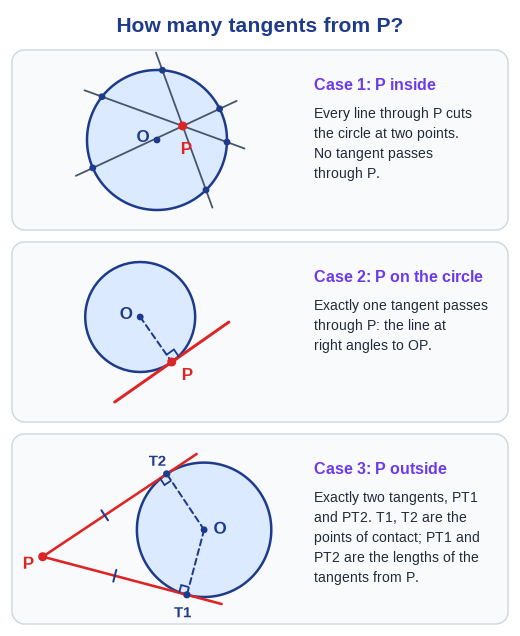
For the third case, the segment from P to a point of contact, PT1 or PT2, is called the length of the tangent from P to the circle. Measure PT1 and PT2 in your own drawing and they come out equal. The next theorem says this is always so.
Theorem 10.2: why are the two tangents equal?
Statement: the lengths of the tangents drawn from an external point to a circle are equal.
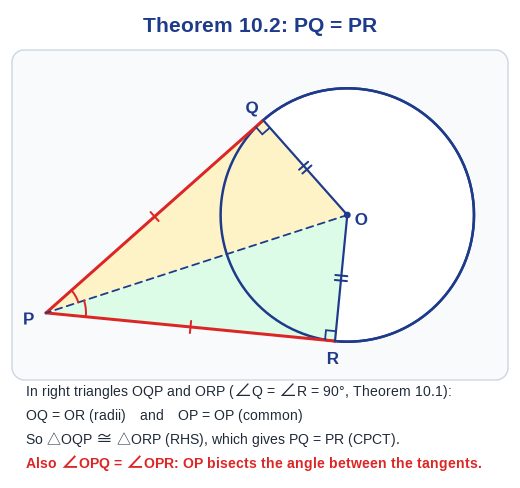
Given: a circle with centre O, a point P outside it, and tangents PQ and PR touching the circle at Q and R. To prove: PQ = PR.
Proof: join OP, OQ and OR.
- ∠OQP = ∠ORP = 90°, because each is the angle between a radius and the tangent at its point of contact (Theorem 10.1).
- In right triangles OQP and ORP: OQ = OR, as radii of the same circle, and the hypotenuse OP is common.
- So △OQP ≅ △ORP by the RHS rule.
- Corresponding parts of congruent triangles are equal, so PQ = PR.
Another proof. By the Pythagoras theorem, PQ² = OP² − OQ² and PR² = OP² − OR². The right sides are equal because OQ = OR, so PQ² = PR² and PQ = PR.
A bonus fact. The same congruence gives ∠OPQ = ∠OPR. So OP bisects the angle between the two tangents: the centre lies on the bisector of that angle.
What can be proved with Theorem 10.2?
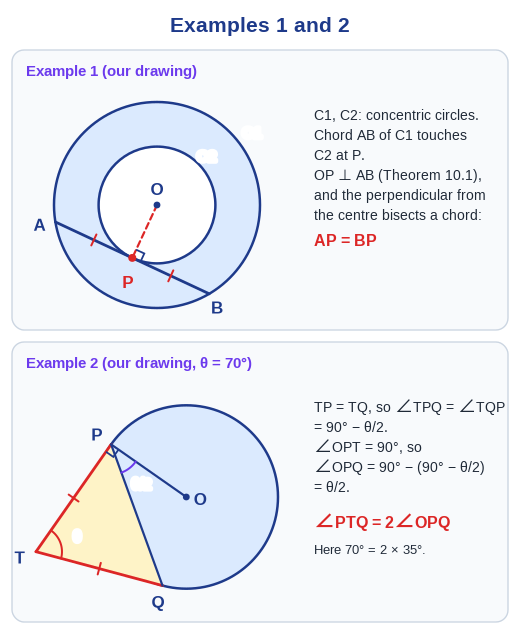
Concentric circles (Example 1). A chord AB of the larger of two concentric circles touches the smaller circle at P. Then OP ⊥ AB by Theorem 10.1, and the perpendicular from the centre to a chord bisects it, so AP = BP.
Angle between the tangents (Example 2). Tangents TP and TQ are drawn to a circle with centre O. Let ∠PTQ = θ. Since TP = TQ, the base angles of △TPQ are each 90° − θ/2. And ∠OPT = 90°, so ∠OPQ = 90° − (90° − θ/2) = θ/2. Hence ∠PTQ = 2∠OPQ.
Length of a tangent (Example 3). Tangents at the ends of a chord PQ of 8 cm in a circle of radius 5 cm meet at T. The line OT is perpendicular to PQ and bisects it, so PR = 4 cm and OR = 3 cm. The right triangles TRP and PRO are similar, giving TP/5 = 4/3, so TP = 20/3 cm.
Supplementary angles. In quadrilateral PQOR the angles at Q and R are right angles. The four angles add to 360°, so ∠QPR + ∠QOR = 180°.
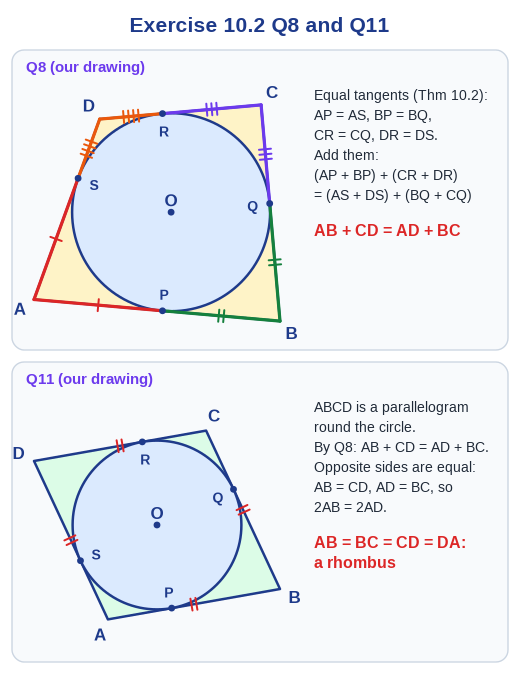
Polygons round a circle. When a quadrilateral ABCD is drawn round a circle, the two tangents from each vertex are equal. Adding them side by side gives AB + CD = AD + BC. A parallelogram drawn round a circle therefore has all four sides equal: it is a rhombus.
Read the first part on the tangent to a circle page. Every question of Exercises 10.1 and 10.2 is solved in the NCERT solutions, and the chapter notes give the full picture.
Practice
-
From a point P, 10 cm from the centre of a circle of radius 6 cm, the length of each tangent is:
Show answer
Answer: (b) 8 cm
-
Tangents PA and PB from P make ∠APB = 70°. Then ∠AOB is:
Show answer
Answer: (c) 110°
-
A quadrilateral ABCD circumscribes a circle, with AB = 5 cm, BC = 7 cm and CD = 6 cm. AD is:
Show answer
Answer: (a) 4 cm
-
Tangents TP and TQ are drawn from T to a circle with centre O. If ∠OPQ = 35°, find ∠PTQ.
Show answer
Answer: By Example 2 of the book, ∠PTQ = 2∠OPQ. So ∠PTQ = 2 × 35° = 70°. (Check: ∠TPQ = 90° − 35° = 55° = ∠TQP, and 180° − 110° = 70°.)
-
Two concentric circles have radii 25 cm and 7 cm. Find the length of the chord of the larger circle that touches the smaller one.
Show answer
Answer: The chord touches the small circle at P, so OP ⊥ chord and P is its midpoint. Half the chord is √(25² − 7²) = √576 = 24 cm, so the chord is 48 cm.
Questions students ask
Why can no tangent be drawn from a point inside a circle?
Any line through an inside point must leave the circle on both sides, so it cuts the circle at two points. Such a line is a secant, never a tangent.
Can Theorem 10.2 be proved without congruent triangles?
Yes. The book's remark uses the Pythagoras theorem: PQ² = OP² − OQ² and PR² = OP² − OR². Since OQ = OR, PQ² = PR², so PQ = PR.
What does 'the centre lies on the bisector' mean?
The congruent triangles OQP and ORP give ∠OPQ = ∠OPR. So the line from the external point to the centre cuts the angle between the two tangents into two equal halves.
What is a circle inscribed in a polygon?
When every side of a polygon touches a circle, the polygon circumscribes the circle (the circle is inscribed in it). Each vertex then sends two equal tangents to the circle, which is what Questions 8, 11, 12 and 13 of Exercise 10.2 use.
Stuck on a question?
Take a photo and Lagnever AI explains it step by step. Try it for 7 days for ₹2.
Get it on Google Play Open in browser
For parents: after the trial, the plan renews monthly by UPI or card autopay. You can cancel anytime in the app.