
What are the criteria for similarity of triangles?
Answer in short
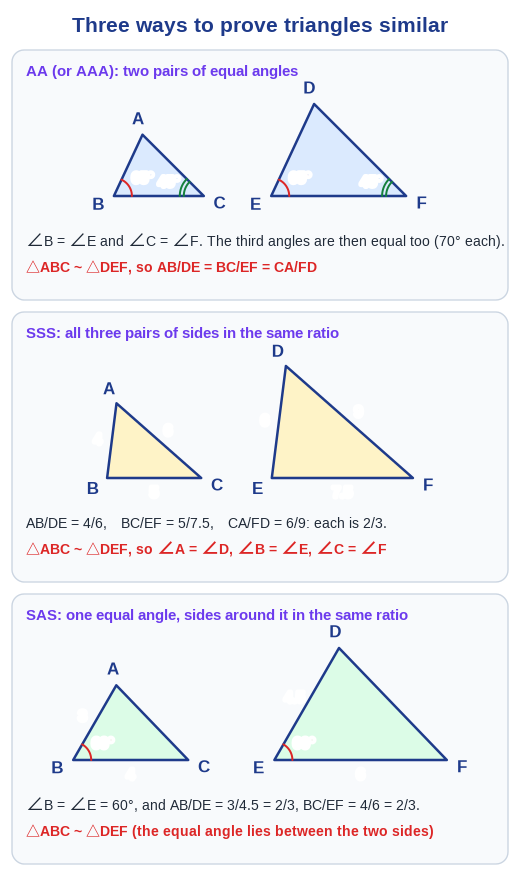
Two triangles are similar if their corresponding angles are equal and their corresponding sides are in the same ratio. Three criteria make checking shorter: AAA or AA (two pairs of equal angles), SSS (three pairs of sides in the same ratio) and SAS (one pair of equal angles with the sides including them in the same ratio).
Stuck on a question? Take a photo and Lagnever AI explains it step by step. Try it for 7 days for ₹2. Get it on Google Play
What does similarity of two triangles mean?
△ABC and △DEF are similar if
- ∠A = ∠D, ∠B = ∠E, ∠C = ∠F, and
- AB/DE = BC/EF = CA/FD.
We write △ABC ~ △DEF. The symbol ~ means “is similar to”. The letters are written in matching order, just as for congruence: A corresponds to D, B to E and C to F.
Checking all six facts each time is long. For congruence you had SSS, SAS, ASA and RHS. For similarity the chapter proves three criteria.
What is the AAA (or AA) criterion?
Theorem 6.3: if in two triangles the corresponding angles are equal, then their corresponding sides are in the same ratio, and so the two triangles are similar.
In the book’s Activity 4, two triangles are drawn on bases of 3 cm and 5 cm, each with base angles 60° and 40°. On measuring, every pair of corresponding sides gives the ratio 3/5 = 0.6.
Because the three angles of a triangle add up to 180°, two pairs of equal angles force the third pair to be equal. So the criterion is usually used as AA: if two angles of one triangle are equal to two angles of another triangle, the triangles are similar.
How are the criteria proved?
All three proofs use the same construction. Suppose △ABC is the smaller triangle. On DE cut off DP = AB, on DF cut off DQ = AC, and join PQ.
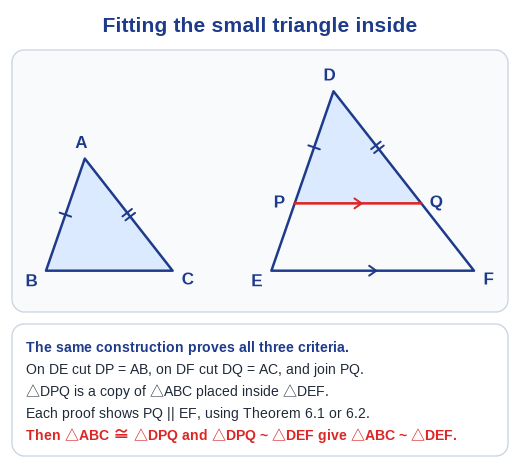
Proof of AAA. Given ∠A = ∠D, ∠B = ∠E, ∠C = ∠F.
- In △ABC and △DPQ: AB = DP, ∠A = ∠D, AC = DQ. So △ABC ≅ △DPQ (SAS).
- So ∠B = ∠P (CPCT). But ∠B = ∠E, so ∠P = ∠E. These are corresponding angles, so PQ ∥ EF.
- By Theorem 6.1, DP/PE = DQ/QF. Turning over and adding 1 gives DE/DP = DF/DQ, so DP/DE = DQ/DF, that is AB/DE = AC/DF.
- In the same way AB/DE = BC/EF. So AB/DE = BC/EF = AC/DF.
Proof of SSS (Theorem 6.4). Given AB/DE = BC/EF = CA/FD.
- DP/DE = DQ/DF (as DP = AB and DQ = AC). This gives DP/PE = DQ/QF, so PQ ∥ EF by Theorem 6.2.
- So ∠P = ∠E and ∠Q = ∠F (corresponding angles), and △DPQ ~ △DEF by AA. So DP/DE = PQ/EF.
- But DP/DE = AB/DE = BC/EF. So PQ/EF = BC/EF, and BC = PQ.
- So △ABC ≅ △DPQ (SSS). So ∠A = ∠D, ∠B = ∠P = ∠E and ∠C = ∠Q = ∠F.
Proof of SAS (Theorem 6.5). Given ∠A = ∠D and AB/DE = AC/DF.
- As in the SSS proof, DP/DE = DQ/DF gives PQ ∥ EF, so ∠P = ∠E and ∠Q = ∠F.
- △ABC ≅ △DPQ (SAS: AB = DP, ∠A = ∠D, AC = DQ), so ∠B = ∠P and ∠C = ∠Q.
- So ∠A = ∠D, ∠B = ∠E, ∠C = ∠F, and △ABC ~ △DEF by AAA.
Theorems 6.3 and 6.4 together show something special about triangles: equal angles bring proportional sides, and proportional sides bring equal angles. For other polygons this is not true. A square and a rectangle have equal angles without being similar.
How do you write the correspondence correctly?
Match the vertices through the equal angles or through the sides.
- By angles: if ∠A = ∠Q, ∠B = ∠R and ∠C = ∠P, write △ABC ~ △QRP.
- By sides: the vertex opposite the shortest side of one triangle matches the vertex opposite the shortest side of the other, and so on.
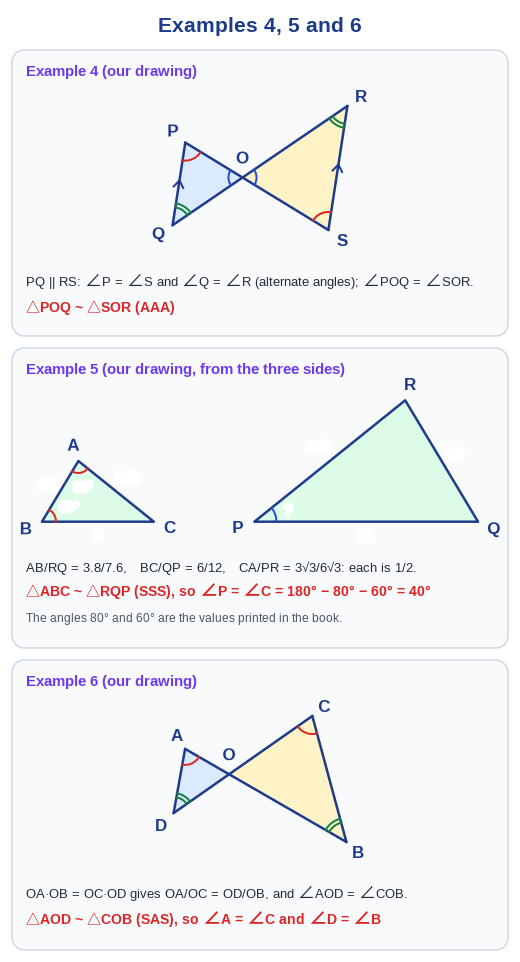
In Example 5 of the book, AB = 3.8, BC = 6, CA = 3√3 and RQ = 7.6, QP = 12, PR = 6√3. The ratios AB/RQ, BC/QP and CA/PR are all 1/2, so △ABC ~ △RQP by SSS. Then ∠P = ∠C = 180° − 80° − 60° = 40°.
How do the criteria solve problems?
Lines that cross between parallels (AA). If PQ ∥ RS and PS, QR cross at O, the alternate angles are equal and the angles at O are vertically opposite, so △POQ ~ △SOR (Example 4).
Products of lengths (SAS). OA · OB = OC · OD can be rewritten as OA/OC = OD/OB. With the vertically opposite angles at O, △AOD ~ △COB by SAS (Example 6).
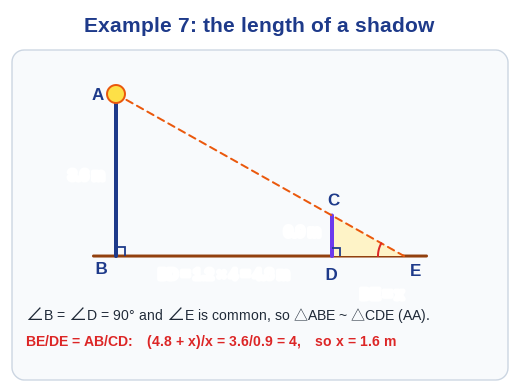
Heights and shadows (AA). A lamp-post and a girl both stand at 90° to the ground, and the ray of light makes the same angle E with the ground for both triangles. So the triangles are similar, and (4.8 + x)/x = 3.6/0.9 gives a shadow of x = 1.6 m (Example 7).
Read next: the Basic Proportionality Theorem, which every proof above depends on. All sixteen questions of Exercise 6.3 are solved in the NCERT solutions, and the chapter notes sum up the chapter.
Practice
-
One triangle has angles 50° and 60°. Another has angles 60° and 70°. The triangles are:
Show answer
Answer: (a) similar by AA
-
Triangles with sides 2 cm, 3 cm, 4 cm and 4 cm, 6 cm, 9 cm are:
Show answer
Answer: (c) not similar
-
△ABC ~ △DEF, AB = 6 cm, DE = 9 cm and AC = 8 cm. DF is:
Show answer
Answer: (d) 12 cm
-
A vertical pole 3 m high casts a shadow 2 m long. At the same time a building casts a shadow 16 m long. Find the height of the building.
Show answer
Answer: The sun's rays make the same angle with the ground for both, and both stand at 90° to the ground, so the two right triangles are similar (AA). Height/3 = 16/2 = 8, so the building is 24 m high.
-
In △ABC, AB = 3 cm, AC = 4.5 cm and ∠A = 40°. In △PQR, PQ = 4 cm, PR = 6 cm and ∠P = 40°. Are the triangles similar?
Show answer
Answer: AB/PQ = 3/4 = 0.75 and AC/PR = 4.5/6 = 0.75. The sides including ∠A and ∠P are in the same ratio, and ∠A = ∠P = 40°. So △ABC ~ △PQR by SAS.
Questions students ask
What is the difference between AAA and AA similarity?
They are the same criterion. AAA says that if all three pairs of corresponding angles are equal, the triangles are similar. But the angles of a triangle add up to 180°, so once two pairs are equal, the third pair must be equal too. That is why two pairs (AA) are enough.
Is there an ASA or AAS criterion for similarity?
It is not needed. Any test that gives two pairs of equal angles already proves similarity by AA, whatever is known about the sides.
Why does the order of letters matter in △ABC ~ △DEF?
The order records which vertex matches which. △ABC ~ △DEF says A matches D, B matches E and C matches F, so you can read the equal angles and the ratios of sides straight from it. For the same triangles, △ABC ~ △EDF would be a wrong statement, while △BAC ~ △EDF is correct.
Are all congruent triangles similar?
Yes. Congruent triangles have equal corresponding angles, and their corresponding sides are equal, so the sides are in the ratio 1. Similar triangles are congruent only when this ratio is 1.
Stuck on a question?
Take a photo and Lagnever AI explains it step by step. Try it for 7 days for ₹2.
Get it on Google Play Open in browser
For parents: after the trial, the plan renews monthly by UPI or card autopay. You can cancel anytime in the app.