
Class 10 Maths Chapter 6: Triangles Notes
This chapter in five lines
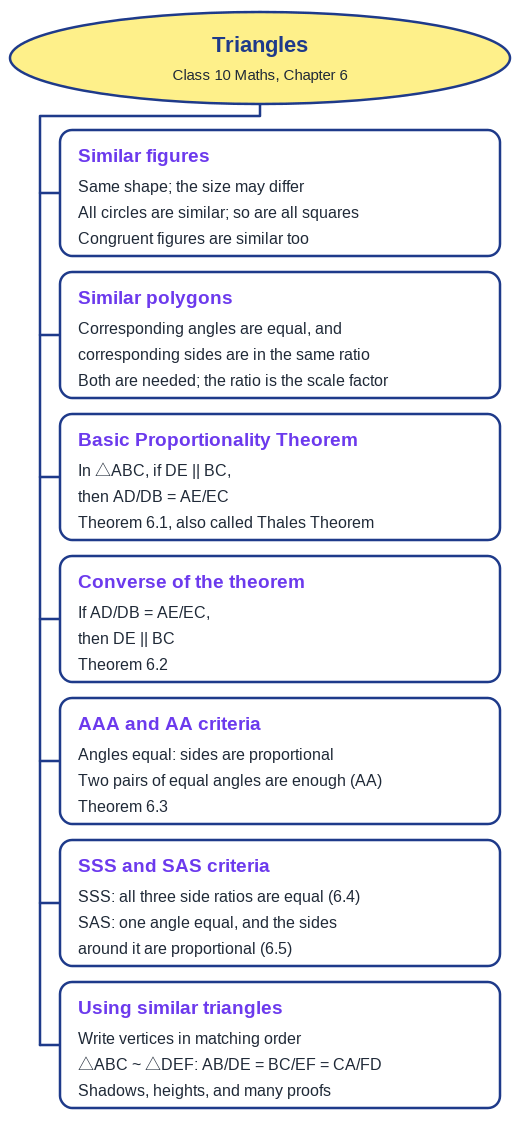
Two figures are similar when they have the same shape, even if their sizes differ. Two triangles are similar when their corresponding angles are equal and their corresponding sides are in the same ratio. The chapter proves the Basic Proportionality Theorem and its converse, and three quick tests for similar triangles: AA (or AAA), SSS and SAS.
What is this chapter about?
In Class 9 you studied congruent triangles: same shape and same size. This 26-page chapter is about figures that have the same shape but not always the same size. They are called similar figures. A photograph and its enlargement are similar, and so are a building and its plan. Similarity also lets us measure things we cannot reach. The height of a tower, for example, can be found from the length of its shadow.
What are similar figures?
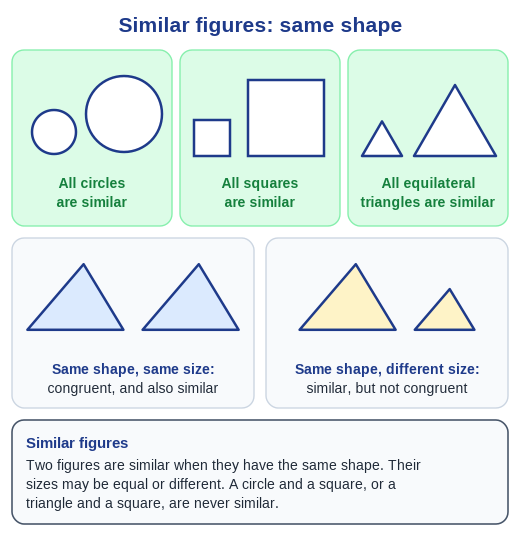
Two figures are similar if they have the same shape. Any two circles are similar, because every circle has the same shape; only the radius changes. In the same way, any two squares are similar and any two equilateral triangles are similar. Congruent figures are similar too, but similar figures need not be congruent. A circle and a square, or a triangle and a square, are never similar.
When are two polygons similar?
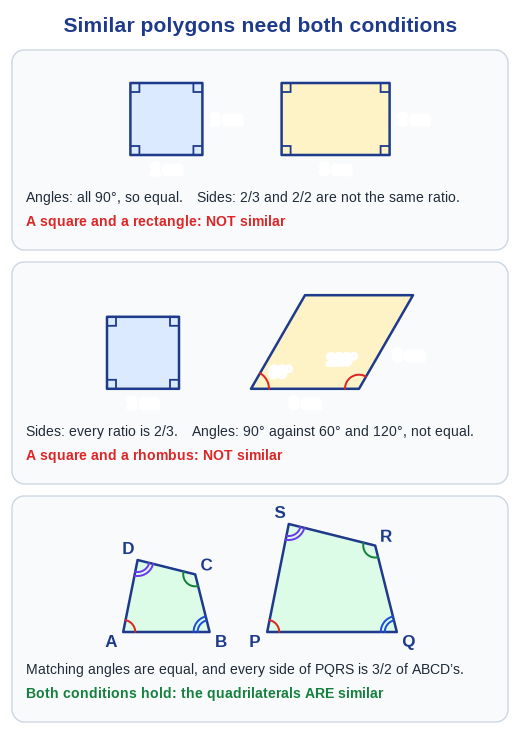
Looking is not enough, so the book gives a definition. Two polygons with the same number of sides are similar if
- their corresponding angles are equal, and
- their corresponding sides are in the same ratio (in proportion).
The common ratio of the sides is called the scale factor. The book’s activity with a lighted bulb shows the idea: a cardboard quadrilateral held parallel to a table throws a shadow that is an enlarged copy of itself.
One condition alone is not enough. A square and a rectangle have equal angles, but their sides are not in the same ratio. A square and a rhombus have sides in the same ratio, but their angles are not equal.
What is the Basic Proportionality Theorem?
A triangle is also a polygon, so the same two conditions define similar triangles. To study them, the chapter first proves a result credited to the Greek mathematician Thales (640–546 B.C.).
Theorem 6.1 (Basic Proportionality Theorem): if a line is drawn parallel to one side of a triangle, cutting the other two sides at distinct points, it divides those two sides in the same ratio. In △ABC, if DE ∥ BC, then AD/DB = AE/EC.
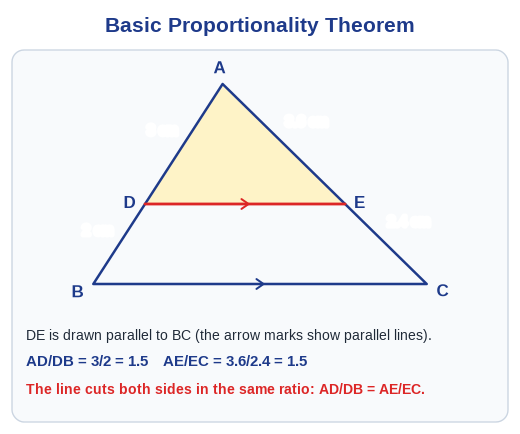
Theorem 6.2 (the converse): if a line divides two sides of a triangle in the same ratio, it is parallel to the third side. So AD/DB = AE/EC gives DE ∥ BC. The proofs and worked examples are on the Basic Proportionality Theorem page.
What are the criteria for similarity of triangles?
For polygons in general you must check both conditions. For triangles, less is enough. In △ABC and △DEF:
- AAA (or AA), Theorem 6.3: if the corresponding angles are equal, the triangles are similar. Two pairs of equal angles are enough, because the angle sum of a triangle fixes the third pair.
- SSS, Theorem 6.4: if AB/DE = BC/EF = CA/FD, the triangles are similar.
- SAS, Theorem 6.5: if one angle of a triangle equals one angle of the other, and the sides including these angles are in the same ratio, the triangles are similar.
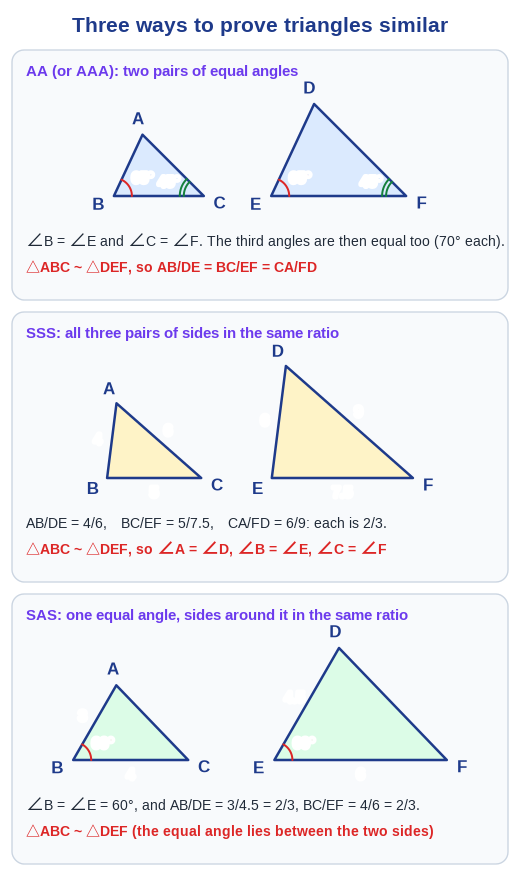
We write △ABC ~ △DEF, and the order of the letters matters: A matches D, B matches E and C matches F. From it you can read off ∠A = ∠D, ∠B = ∠E, ∠C = ∠F and AB/DE = BC/EF = CA/FD. Read more on the criteria for similarity page.
How is similarity used?
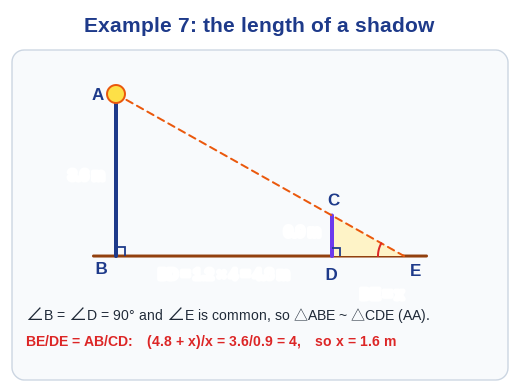
Many proofs in the exercises follow one plan: find two triangles, show they are similar by AA, SSS or SAS, then use the equal angles or the equal ratios. The same plan solves practical problems. In Example 7 of the book, a girl 90 cm tall walks away from a lamp-post 3.6 m high, and similar triangles give the length of her shadow.
A note at the end of the chapter adds one more test, for right triangles only: if the hypotenuse and one side of a right triangle are proportional to the hypotenuse and one side of another right triangle, the triangles are similar. The book calls it the RHS similarity criterion.
Before we move on
This chapter uses facts from earlier classes: congruence of triangles, the angles made by a transversal with parallel lines, and ratios and proportions. The current book has no section on areas of similar triangles or on the Pythagoras theorem in this chapter. Every example and all three exercises are answered in the NCERT solutions for Chapter 6.
Key terms
| Term | Meaning |
|---|---|
| Similar figures | Figures with the same shape; their sizes may be equal or different. All circles are similar, and so are all squares. |
| Congruent figures | Figures with the same shape and the same size. Congruent figures are always similar, but similar figures need not be congruent. |
| Similar polygons | Polygons with the same number of sides whose corresponding angles are equal and whose corresponding sides are in the same ratio. |
| Scale factor | The common ratio of the corresponding sides of two similar polygons. The book also calls it the Representative Fraction. |
| Corresponding parts | The angles and sides that match when one figure is laid over the other. In △ABC ~ △DEF, A matches D, B matches E and C matches F. |
| Equiangular triangles | Two triangles whose corresponding angles are equal. |
| Basic Proportionality Theorem | Theorem 6.1, also called the Thales Theorem: a line parallel to one side of a triangle divides the other two sides in the same ratio. |
| Converse of the Basic Proportionality Theorem | Theorem 6.2: a line that divides two sides of a triangle in the same ratio is parallel to the third side. |
| The symbol ~ | Read as 'is similar to'. △ABC ~ △DEF is written with the vertices in matching order. |
| AAA (or AA) criterion | Theorem 6.3: if the corresponding angles of two triangles are equal, the triangles are similar. Two pairs of equal angles are enough. |
| SSS criterion | Theorem 6.4: if the three pairs of corresponding sides are in the same ratio, the triangles are similar. |
| SAS criterion | Theorem 6.5: if one angle of a triangle equals one angle of another and the sides including these angles are in the same ratio, the triangles are similar. |
Topics in this chapter
Practice
-
In △ABC, DE ∥ BC with D on AB and E on AC. If AD = 2 cm, DB = 3 cm and AE = 4 cm, then EC is:
Show answer
Answer: (b) 6 cm
-
Which pair of figures is always similar?
Show answer
Answer: (c) Two squares
-
Triangles with sides 3 cm, 4 cm, 5 cm and 6 cm, 8 cm, 10 cm are similar by:
Show answer
Answer: (c) SSS
-
△ABC ~ △PQR, AB = 4 cm, PQ = 6 cm and BC = 5 cm. QR is:
Show answer
Answer: (a) 7.5 cm
-
D is on AB and E is on AC of △ABC, with AD/DB = AE/EC. Then:
Show answer
Answer: (b) DE ∥ BC
Questions students ask
What are the main topics of Class 10 Maths Chapter 6?
Similar figures and similar polygons; similarity of triangles; the Basic Proportionality Theorem (Theorem 6.1) and its converse (Theorem 6.2); and the criteria for similarity of triangles: AAA or AA (Theorem 6.3), SSS (Theorem 6.4) and SAS (Theorem 6.5).
Are areas of similar triangles and the Pythagoras theorem in the 2026-27 book?
No. The rationalised book (marked Reprint 2026-27) ends this chapter at the criteria for similarity. It has no section on areas of similar triangles or on the Pythagoras theorem, although the first paragraph of the chapter still mentions a proof of the Pythagoras theorem.
How many exercises does Chapter 6 have?
Three. Exercise 6.1 (3 questions) is on similar figures, Exercise 6.2 (10 questions) uses the Basic Proportionality Theorem and its converse, and Exercise 6.3 (16 questions) uses the similarity criteria. All of them, with the 8 examples, are worked out on the NCERT solutions page.
What is the difference between similar and congruent triangles?
Congruent triangles have the same shape and the same size, so their corresponding sides are equal. Similar triangles have the same shape only: their corresponding angles are equal and their corresponding sides are in the same ratio. Congruent triangles are similar with ratio 1.
Stuck on a question?
Take a photo and Lagnever AI explains it step by step. Try it for 7 days for ₹2.
Get it on Google Play Open in browser
For parents: after the trial, the plan renews monthly by UPI or card autopay. You can cancel anytime in the app.