
NCERT Solutions Class 10 Maths Chapter 6: Triangles
Answers to the questions inside Chapter 6, Triangles, all eight worked examples, and every question of Exercises 6.1, 6.2 and 6.3, from Mathematics, the Class 10 NCERT textbook. Page numbers follow the 2026-27 reprint (pages 73–98). The exercise questions are quoted from the book; the examples and in-chapter questions are restated in short and labelled by number and page. The book’s figures are not copied: every figure on this page is our own drawing, made from the data in the question with the same letters, and drawn to scale wherever lengths or angles are given. Every numerical answer was checked by calculation. Short notes: Chapter 6 notes.
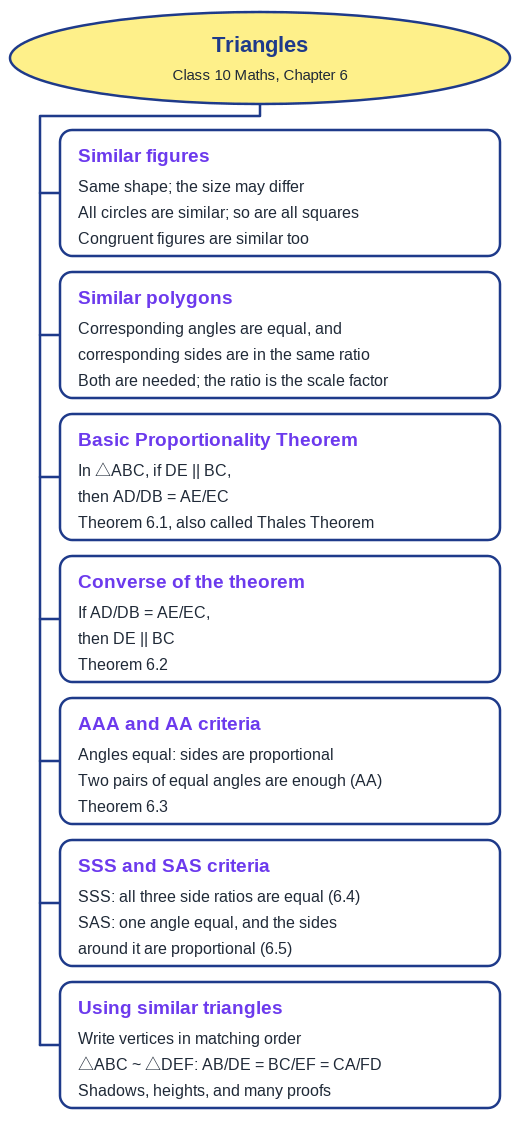
Questions inside the chapter: similar figures (pages 74–78)
Page 74: can a circle and a square be similar? A triangle and a square? Why? No. Similar figures must have the same shape. A circle has no corners and a square has four; a triangle has three sides and a square has four. Their shapes are different, so they cannot be similar.
Page 75: are two photographs of the same size, of the same person at 10 years and at 40 years, similar? No. They have the same size but not the same shape, because the face has changed. Similar figures need the same shape; the same size is not needed.
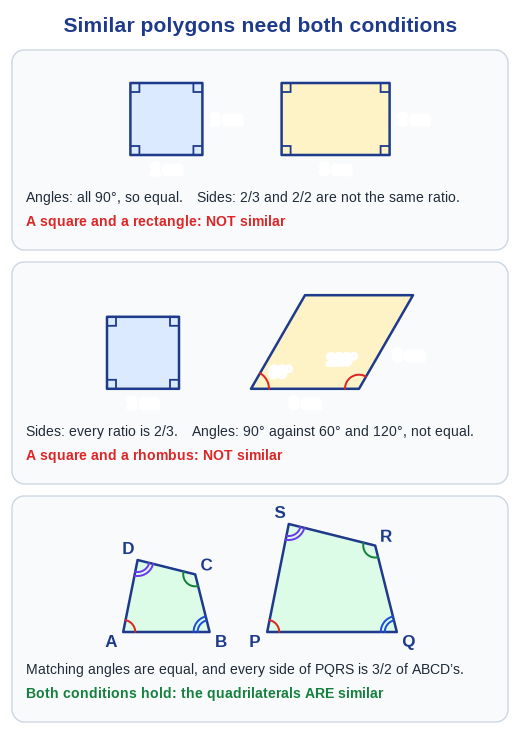
Pages 77–78: why are the square and the rectangle (Fig. 6.6), and the square and the rhombus (Fig. 6.7), not similar? In the first pair all angles are 90°, so corresponding angles are equal, but the sides are not in the same ratio. In the second pair all sides are in the same ratio, but the angles are not equal. Each pair meets only one of the two conditions, and both are needed.
Exercise 6.1 (page 78)
1. “Fill in the blanks using the correct word given in brackets : (i) All circles are ______. (congruent, similar) (ii) All squares are ______. (similar, congruent) (iii) All ______ triangles are similar. (isosceles, equilateral) (iv) Two polygons of the same number of sides are similar, if (a) their corresponding angles are ______ and (b) their corresponding sides are ______. (equal, proportional)”
(i) All circles have the same shape, but their radii can differ. So they are always similar, but not always congruent (congruent means same shape and same size).
(ii) Every angle of a square is 90°, and all four sides of a square are equal. So the sides of any two squares are in the same ratio, and the squares are similar.
(iii) Every angle of an equilateral triangle is 60°, and its sides are equal, so any two are similar. Two isosceles triangles can have different angles, so they need not be similar.
(iv) Both conditions are needed: equal angles and sides in the same ratio.
Answer: (i) similar (ii) similar (iii) equilateral (iv) (a) equal, (b) proportional
2. “Give two different examples of pair of (i) similar figures. (ii) non-similar figures.”
(i) Similar figures have the same shape (size may differ). Examples: two circles of radii 2 cm and 5 cm; two squares of sides 3 cm and 7 cm. (Two equilateral triangles of different sides would also do.)
(ii) Non-similar figures have different shapes. Examples: a circle and a square; a square of side 2 cm and a rectangle 3 cm by 2 cm. (A triangle and a parallelogram would also do.)
Answer: (i) two circles; two squares. (ii) a circle and a square; a square and a (non-square) rectangle.
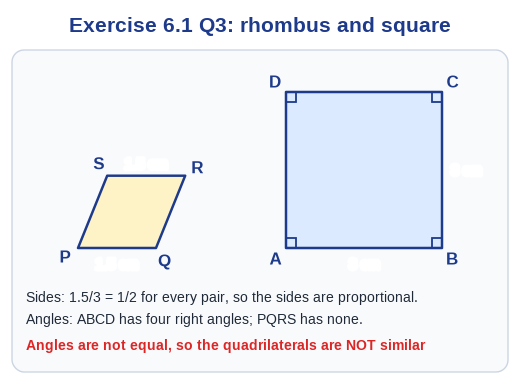
3. “State whether the following quadrilaterals are similar or not:” (Fig. 6.8 shows a quadrilateral PQRS with every side 1.5 cm and no right angle, and a quadrilateral ABCD with every side 3 cm and four right angles.)
Given: PQRS has all sides 1.5 cm and its angles are not 90°. ABCD has all sides 3 cm and all angles 90°.
To find: whether PQRS and ABCD are similar.
- PQRS is a rhombus and ABCD is a square.
- Sides: PQ/AB = QR/BC = RS/CD = SP/DA = 1.5/3 = 1/2. So the sides are proportional.
- Angles: each angle of ABCD is 90°, but the angles of PQRS are not 90°. So the corresponding angles are not equal.
- Two polygons are similar only if both conditions hold. Here the angle condition fails.
Answer: The quadrilaterals are not similar.
Questions inside the chapter: Theorems 6.1 and 6.2 (pages 79–82)
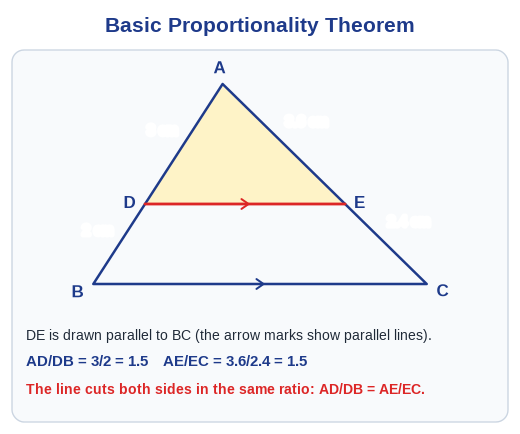
Page 79, Activity 2: five equal parts AP = PQ = QD = DR = RB are marked on arm AX, a line through B meets arm AY at C, and DE is drawn parallel to BC. What are AD/DB and AE/EC? AD is 3 parts and DB is 2 parts, so AD/DB = 3/2. On measuring, AE/EC also comes to 3/2. This is not a coincidence: it is Theorem 6.1.
Page 81, Activity 3: is the converse of Theorem 6.1 true? Five equal parts are marked on each arm of an angle, at B₁ to B and C₁ to C. Then AB₁/B₁B = AC₁/C₁C = 1/4, and B₁C₁ is seen to be parallel to BC. In the same way AB₂/B₂B = AC₂/C₂C = 2/3, AB₃/B₃B = AC₃/C₃C = 3/2 and AB₄/B₄B = AC₄/C₄C = 4/1, and each of B₂C₂, B₃C₃ and B₄C₄ is parallel to BC. So yes: a line that divides two sides in the same ratio is parallel to the third side (Theorem 6.2).
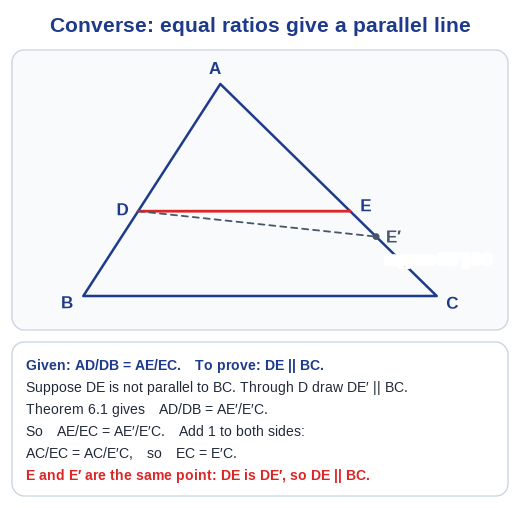
Page 82: the three “Why?” steps in the proof of Theorem 6.2. Here AD/DB = AE/EC, and DE′ is drawn parallel to BC.
- AD/DB = AE′/E′C. Why? By Theorem 6.1, because DE′ ∥ BC.
- AE/EC = AE′/E′C. Why? Both are equal to AD/DB.
- E and E′ coincide. Why? Adding 1 to both sides gives (AE + EC)/EC = (AE′ + E′C)/E′C, that is AC/EC = AC/E′C. So EC = E′C, and both points lie on AC at the same distance from C. So DE is the line DE′, which is parallel to BC.
Examples 1 to 3 (pages 82–84)
Example 1 (page 82): a line parallel to BC meets AB at D and AC at E. Prove that AD/AB = AE/AC.
- DE ∥ BC (given), so AD/DB = AE/EC (Theorem 6.1).
- Turning both fractions over: DB/AD = EC/AE.
- Adding 1 to both sides: (DB + AD)/AD = (EC + AE)/AE, that is AB/AD = AC/AE.
- Turning over again: AD/AB = AE/AC.
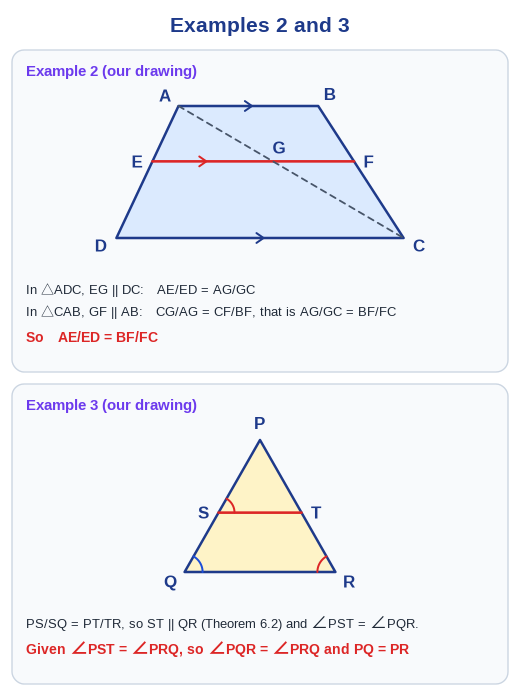
Example 2 (page 83): ABCD is a trapezium with AB ∥ DC. E on AD and F on BC are such that EF ∥ AB. Show that AE/ED = BF/FC.
Join AC, meeting EF at G.
- AB ∥ DC and EF ∥ AB (given), so EF ∥ DC (lines parallel to the same line are parallel).
- In △ADC, EG ∥ DC, so AE/ED = AG/GC (Theorem 6.1).
- In △CAB, GF ∥ AB, so CG/AG = CF/BF (Theorem 6.1), that is AG/GC = BF/FC.
- From steps 2 and 3, AE/ED = BF/FC.
Example 3 (page 83): PS/SQ = PT/TR and ∠PST = ∠PRQ. Prove that PQR is an isosceles triangle.
- PS/SQ = PT/TR (given), so ST ∥ QR (Theorem 6.2).
- So ∠PST = ∠PQR (corresponding angles).
- ∠PST = ∠PRQ (given). So ∠PQR = ∠PRQ.
- So PQ = PR (sides opposite equal angles). △PQR is isosceles.
Exercise 6.2 (pages 84–85)
In this exercise, Theorem 6.1 is the Basic Proportionality Theorem (BPT): a line drawn parallel to one side of a triangle divides the other two sides in the same ratio. Theorem 6.2 is its converse: a line that divides two sides of a triangle in the same ratio is parallel to the third side.
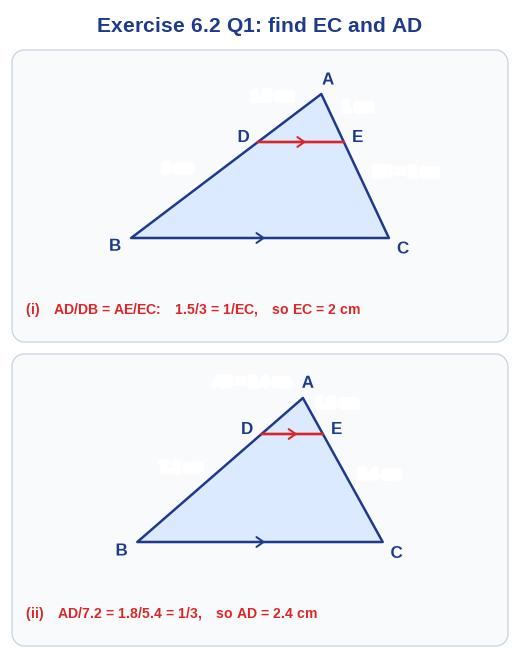
1. “In Fig. 6.17, (i) and (ii), DE ∥ BC. Find EC in (i) and AD in (ii).” (The figure gives, in (i), AD = 1.5 cm, DB = 3 cm and AE = 1 cm; in (ii), DB = 7.2 cm, AE = 1.8 cm and EC = 5.4 cm.)
Given: In △ABC, DE ∥ BC. (i) AD = 1.5 cm, DB = 3 cm, AE = 1 cm. (ii) DB = 7.2 cm, AE = 1.8 cm, EC = 5.4 cm.
To find: (i) EC (ii) AD.
- DE ∥ BC, so by Theorem 6.1, AD/DB = AE/EC.
- (i) 1.5/3 = 1/EC, so EC = 3 × 1 ÷ 1.5 = 2.
- (ii) AD/7.2 = 1.8/5.4 = 1/3, so AD = 7.2 ÷ 3 = 2.4.
Answer: (i) EC = 2 cm (ii) AD = 2.4 cm
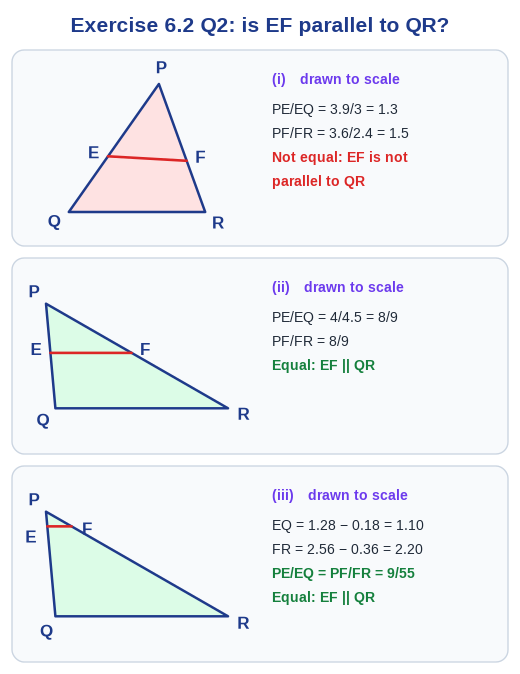
2. “E and F are points on the sides PQ and PR respectively of a △PQR. For each of the following cases, state whether EF ∥ QR : (i) PE = 3.9 cm, EQ = 3 cm, PF = 3.6 cm and FR = 2.4 cm (ii) PE = 4 cm, QE = 4.5 cm, PF = 8 cm and RF = 9 cm (iii) PQ = 1.28 cm, PR = 2.56 cm, PE = 0.18 cm and PF = 0.36 cm”
Given: E on PQ and F on PR, with the lengths in each case.
To find: whether EF ∥ QR.
Method: compare PE/EQ with PF/FR. If they are equal, EF ∥ QR (Theorem 6.2). If they are not equal, EF cannot be parallel to QR, because Theorem 6.1 would have made them equal.
(i) PE/EQ = 3.9/3 = 1.3 and PF/FR = 3.6/2.4 = 1.5. Not equal.
(ii) PE/EQ = 4/4.5 = 8/9 and PF/FR = 8/9. Equal.
(iii) First find the remaining parts: EQ = PQ − PE = 1.28 − 0.18 = 1.10 cm and FR = PR − PF = 2.56 − 0.36 = 2.20 cm. Then PE/EQ = 0.18/1.10 = 9/55 and PF/FR = 0.36/2.20 = 9/55. Equal.
Answer: (i) EF is not parallel to QR (ii) EF ∥ QR (iii) EF ∥ QR
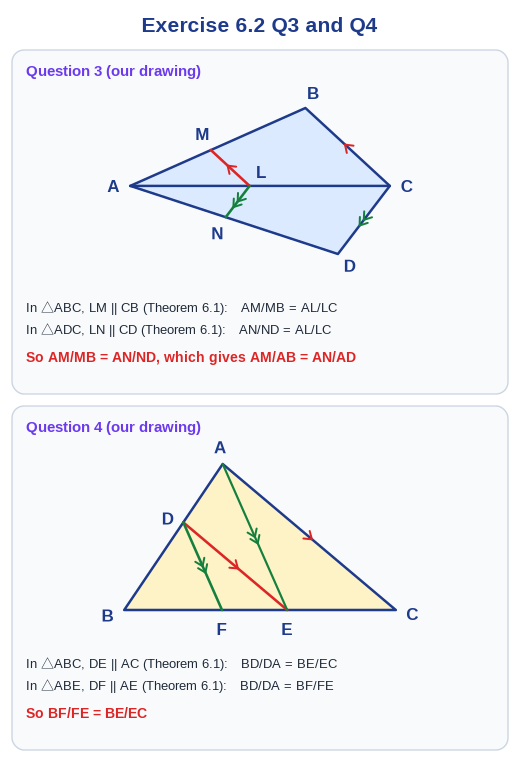
3. “In Fig. 6.18, if LM ∥ CB and LN ∥ CD, prove that AM/AB = AN/AD.” (In the figure, ABCD is a quadrilateral, L is a point on the diagonal AC, M is on AB and N is on AD.)
Given: In quadrilateral ABCD, L is on diagonal AC, M on AB and N on AD, with LM ∥ CB and LN ∥ CD.
To prove: AM/AB = AN/AD.
Proof:
- In △ABC, LM ∥ CB, so AM/MB = AL/LC (Theorem 6.1).
- In △ADC, LN ∥ CD, so AN/ND = AL/LC (Theorem 6.1).
- From steps 1 and 2, AM/MB = AN/ND.
- Turn both fractions upside down: MB/AM = ND/AN. Add 1 to both sides: (MB + AM)/AM = (ND + AN)/AN, that is AB/AM = AD/AN.
- Turn them upside down again: AM/AB = AN/AD.
Hence proved.
4. “In Fig. 6.19, DE ∥ AC and DF ∥ AE. Prove that BF/FE = BE/EC.” (In the figure, D is on side AB of △ABC, and F and E are on BC.)
Given: In △ABC, D is on AB and E, F are on BC, with DE ∥ AC and DF ∥ AE.
To prove: BF/FE = BE/EC.
Proof:
- In △ABC, DE ∥ AC, so BD/DA = BE/EC (Theorem 6.1).
- In △ABE, DF ∥ AE, so BD/DA = BF/FE (Theorem 6.1).
- Both ratios are equal to BD/DA, so BF/FE = BE/EC.
Hence proved.
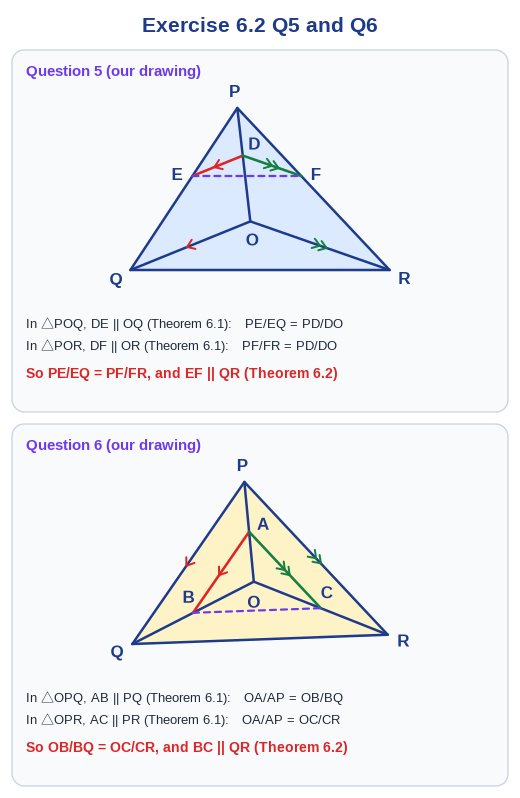
5. “In Fig. 6.20, DE ∥ OQ and DF ∥ OR. Show that EF ∥ QR.” (In the figure, O is a point inside △PQR, D is on PO, E is on PQ and F is on PR.)
Given: O is inside △PQR; D is on PO, E on PQ, F on PR; DE ∥ OQ and DF ∥ OR.
To prove: EF ∥ QR.
Proof:
- In △POQ, DE ∥ OQ, so PE/EQ = PD/DO (Theorem 6.1).
- In △POR, DF ∥ OR, so PF/FR = PD/DO (Theorem 6.1).
- So PE/EQ = PF/FR.
- In △PQR, the line EF divides PQ and PR in the same ratio. So EF ∥ QR (Theorem 6.2).
Hence proved.
6. “In Fig. 6.21, A, B and C are points on OP, OQ and OR respectively such that AB ∥ PQ and AC ∥ PR. Show that BC ∥ QR.” (In the figure, O is a point inside △PQR.)
Given: O is inside △PQR; A, B, C are on OP, OQ, OR; AB ∥ PQ and AC ∥ PR.
To prove: BC ∥ QR.
Proof:
- In △OPQ, AB ∥ PQ, so OA/AP = OB/BQ (Theorem 6.1).
- In △OPR, AC ∥ PR, so OA/AP = OC/CR (Theorem 6.1).
- So OB/BQ = OC/CR.
- In △OQR, the line BC divides OQ and OR in the same ratio. So BC ∥ QR (Theorem 6.2).
Hence proved.
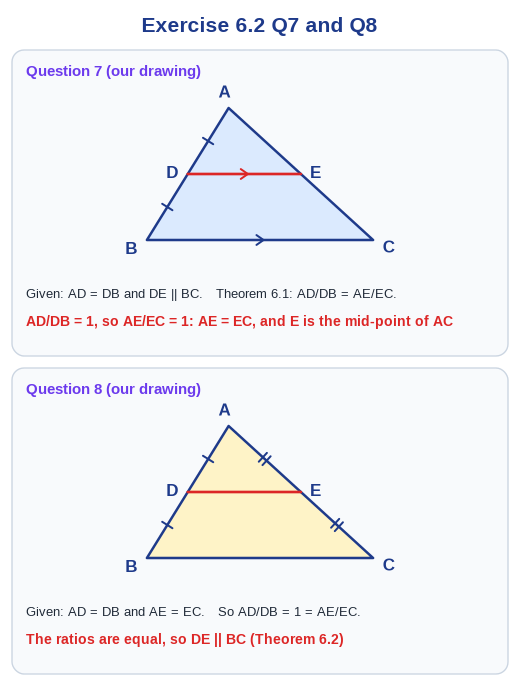
7. “Using Theorem 6.1, prove that a line drawn through the mid-point of one side of a triangle parallel to another side bisects the third side. (Recall that you have proved it in Class IX).”
Given: In △ABC, D is the mid-point of AB, and the line through D parallel to BC meets AC at E.
To prove: AE = EC (the line bisects AC, that is, cuts it into two equal parts).
Proof:
- DE ∥ BC, so AD/DB = AE/EC (Theorem 6.1).
- D is the mid-point of AB, so AD = DB and AD/DB = 1.
- So AE/EC = 1, that is AE = EC.
Hence proved.
8. “Using Theorem 6.2, prove that the line joining the mid-points of any two sides of a triangle is parallel to the third side. (Recall that you have done it in Class IX).”
Given: In △ABC, D and E are the mid-points of AB and AC.
To prove: DE ∥ BC.
Proof:
- AD = DB, so AD/DB = 1. AE = EC, so AE/EC = 1.
- So AD/DB = AE/EC.
- The line DE divides AB and AC in the same ratio, so DE ∥ BC (Theorem 6.2).
Hence proved.
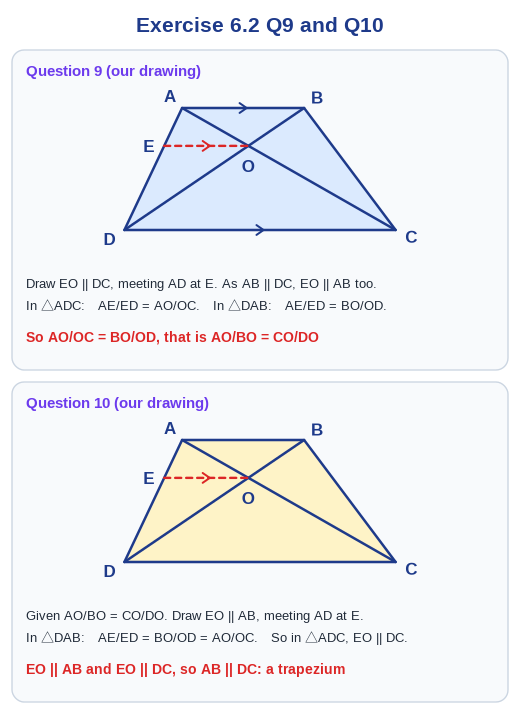
9. “ABCD is a trapezium in which AB ∥ DC and its diagonals intersect each other at the point O. Show that AO/BO = CO/DO.”
Given: ABCD is a trapezium with AB ∥ DC; diagonals AC and BD meet at O.
To prove: AO/BO = CO/DO.
Construction: through O, draw a line parallel to DC, meeting AD at E. (The book’s hint draws this line across to BC as well; one side is enough.)
Proof:
- EO ∥ DC (construction) and AB ∥ DC (given), so EO ∥ AB.
- In △ADC, EO ∥ DC, so AE/ED = AO/OC (Theorem 6.1).
- In △DAB, EO ∥ AB, so DE/EA = DO/OB (Theorem 6.1). Turning both upside down: AE/ED = BO/OD.
- From steps 2 and 3, AO/OC = BO/OD.
- Cross-multiply: AO × OD = BO × OC. Divide both sides by BO × OD: AO/BO = CO/DO.
Hence proved.
10. “The diagonals of a quadrilateral ABCD intersect each other at the point O such that AO/BO = CO/DO. Show that ABCD is a trapezium.”
Given: In quadrilateral ABCD, diagonals AC and BD meet at O, and AO/BO = CO/DO.
To prove: ABCD is a trapezium (one pair of opposite sides is parallel).
Construction: through O, draw a line parallel to AB, meeting AD at E.
Proof:
- AO/BO = CO/DO (given). Rearranging, AO/OC = BO/OD.
- In △DAB, EO ∥ AB (construction), so DE/EA = DO/OB (Theorem 6.1), that is AE/ED = BO/OD.
- From steps 1 and 2, AE/ED = AO/OC.
- In △ADC, the line EO divides AD and AC in the same ratio, so EO ∥ DC (Theorem 6.2).
- EO ∥ AB and EO ∥ DC, so AB ∥ DC.
- One pair of opposite sides of ABCD is parallel, so ABCD is a trapezium.
Hence proved.
Questions inside the chapter: the criteria (pages 85–91)
Page 87, Activity 4: triangles on bases BC = 3 cm and EF = 5 cm, each with base angles 60° and 40°. What are AB/DE and CA/FD? BC/EF = 3/5 = 0.6, and on measuring, AB/DE and CA/FD are also 0.6 (or very nearly, because of measuring errors). Equal angles give proportional sides.
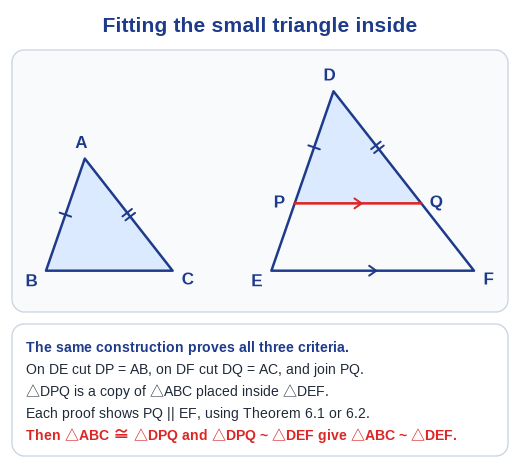
Page 87: the “Why?” and “How?” steps in the proof of Theorem 6.3 (AAA). Here ∠A = ∠D, ∠B = ∠E, ∠C = ∠F, and DP = AB, DQ = AC are cut off on DE and DF.
- △ABC ≅ △DPQ. Why? AB = DP, ∠A = ∠D and AC = DQ, so SAS.
- ∠B = ∠P = ∠E and PQ ∥ EF. How? ∠B = ∠P by CPCT, and ∠B = ∠E is given. ∠P and ∠E are corresponding angles for the lines PQ and EF, and they are equal, so PQ ∥ EF.
- DP/PE = DQ/QF. Why? Theorem 6.1 in △DEF.
- AB/DE = AC/DF. Why? Turn the fractions of step 3 over and add 1: DE/DP = DF/DQ. So DP/DE = DQ/DF, and DP = AB, DQ = AC.
Page 88, Activity 5: triangles with sides 3, 6, 8 cm and 4.5, 9, 12 cm. AB/DE = 3/4.5, BC/EF = 6/9 and CA/FD = 8/12, each equal to 2/3. On measuring, ∠A = ∠D, ∠B = ∠E and ∠C = ∠F.
Page 89: the “How?” and “Why?” steps in the proof of Theorem 6.4 (SSS). Here AB/DE = BC/EF = CA/FD, with DP = AB and DQ = AC.
- DP/PE = DQ/QF and PQ ∥ EF. How? DP/DE = DQ/DF (given ratios, with DP = AB, DQ = AC). Turn over and subtract 1: PE/DP = QF/DQ, so DP/PE = DQ/QF. Then PQ ∥ EF by Theorem 6.2.
- DP/DE = DQ/DF = PQ/EF, because ∠P = ∠E and ∠Q = ∠F make △DPQ ~ △DEF.
- DP/DE = BC/EF. Why? DP = AB, and AB/DE = BC/EF is given.
- BC = PQ. Why? From steps 2 and 3, PQ/EF = BC/EF.
- △ABC ≅ △DPQ. Why? AB = DP, AC = DQ and BC = PQ, so SSS.
- ∠A = ∠D, ∠B = ∠E, ∠C = ∠F. How? By CPCT, ∠A = ∠D, ∠B = ∠P and ∠C = ∠Q; and ∠P = ∠E, ∠Q = ∠F.
Page 90, Activity 6: AB = 2 cm, AC = 4 cm, ∠A = 50° and DE = 3 cm, DF = 6 cm, ∠D = 50°. AB/DE = 2/3 and AC/DF = 4/6 = 2/3, and the angles between these sides are equal. On measuring, ∠B = ∠E and ∠C = ∠F, so the triangles are similar by AAA.
Page 91: the “How?” and “Why?” steps in the proof of Theorem 6.5 (SAS). Here AB/DE = AC/DF and ∠A = ∠D.
- PQ ∥ EF and △ABC ≅ △DPQ. How? DP/DE = DQ/DF gives DP/PE = DQ/QF as before, so PQ ∥ EF (Theorem 6.2). And AB = DP, ∠A = ∠D, AC = DQ give the congruence by SAS.
- △ABC ~ △DEF. Why? ∠B = ∠P = ∠E and ∠C = ∠Q = ∠F (CPCT, then corresponding angles), and ∠A = ∠D. So the triangles are similar by AAA.
Examples 4 to 8 (pages 91–94)
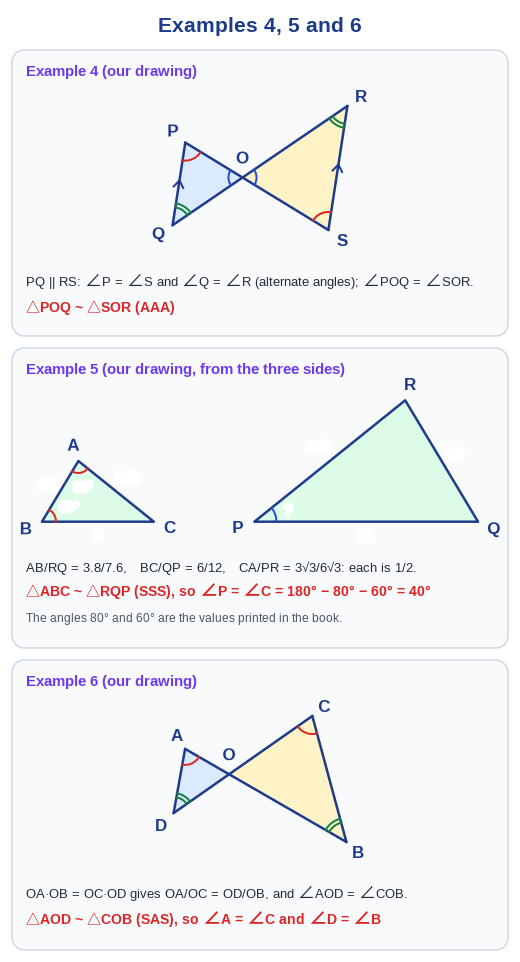
Example 4 (page 91): PQ ∥ RS, and PS and QR cross at O. Prove that △POQ ~ △SOR.
- PQ ∥ RS (given), so ∠P = ∠S and ∠Q = ∠R (alternate angles).
- ∠POQ = ∠SOR (vertically opposite angles).
- So △POQ ~ △SOR (AAA).
Example 5 (page 91): in △ABC, AB = 3.8, BC = 6, CA = 3√3, ∠A = 80° and ∠B = 60°; in △PQR, RQ = 7.6, QP = 12 and PR = 6√3. Find ∠P.
AB/RQ = 3.8/7.6 = 1/2, BC/QP = 6/12 = 1/2 and CA/PR = 3√3/6√3 = 1/2. So △ABC ~ △RQP (SSS), and ∠P = ∠C (corresponding angles). ∠C = 180° − 80° − 60° = 40°, so ∠P = 40°.
Example 6 (page 92): lines AB and CD cross at O, and OA · OB = OC · OD. Show that ∠A = ∠C and ∠B = ∠D.
- OA · OB = OC · OD (given), so OA/OC = OD/OB.
- ∠AOD = ∠COB (vertically opposite angles).
- So △AOD ~ △COB (SAS).
- So ∠A = ∠C and ∠D = ∠B (corresponding angles of similar triangles).
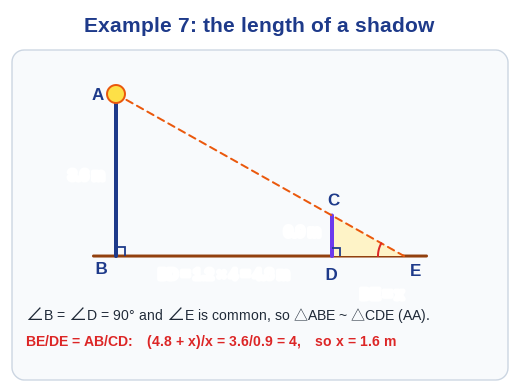
Example 7 (page 92): a girl 90 cm tall walks away from a lamp-post at 1.2 m/s. The lamp is 3.6 m above the ground. Find the length of her shadow after 4 seconds.
Let AB be the lamp-post, CD the girl after 4 seconds and DE her shadow, of length x metres. BD = 1.2 × 4 = 4.8 m, and CD = 90 cm = 0.9 m.
- In △ABE and △CDE: ∠B = ∠D = 90° (the post and the girl are vertical), and ∠E = ∠E (common).
- So △ABE ~ △CDE (AA).
- So BE/DE = AB/CD, that is (4.8 + x)/x = 3.6/0.9 = 4.
- 4.8 + x = 4x, so 3x = 4.8 and x = 1.6.
The shadow is 1.6 m long.
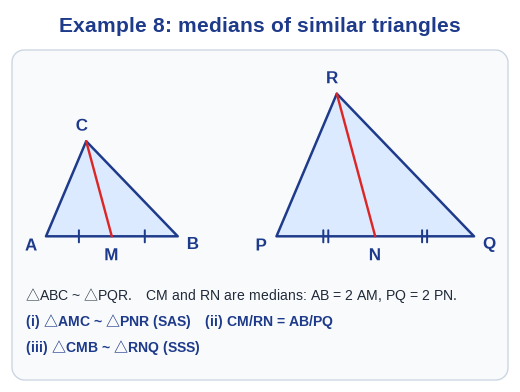
Example 8 (page 93): CM and RN are medians of △ABC and △PQR, and △ABC ~ △PQR. Prove (i) △AMC ~ △PNR, (ii) CM/RN = AB/PQ, (iii) △CMB ~ △RNQ.
△ABC ~ △PQR gives AB/PQ = BC/QR = CA/RP … (1), and ∠A = ∠P, ∠B = ∠Q, ∠C = ∠R … (2). Since CM and RN are medians, AB = 2AM = 2BM and PQ = 2PN = 2QN.
(i) From (1), 2AM/2PN = CA/RP, so AM/PN = CA/RP. Also ∠MAC = ∠NPR, from (2). So △AMC ~ △PNR (SAS).
(ii) From (i), CM/RN = CA/RP. And CA/RP = AB/PQ, from (1). So CM/RN = AB/PQ.
(iii) From (1) and (ii), CM/RN = BC/QR. Also CM/RN = AB/PQ = 2BM/2QN = BM/QN. So CM/RN = BC/QR = BM/QN, and △CMB ~ △RNQ (SSS).
Exercise 6.3 (pages 94–97)
The similarity criteria used below: AAA/AA (two pairs of equal angles are enough), SSS (all three pairs of sides in the same ratio) and SAS (two pairs of sides in the same ratio and the angles between them equal).
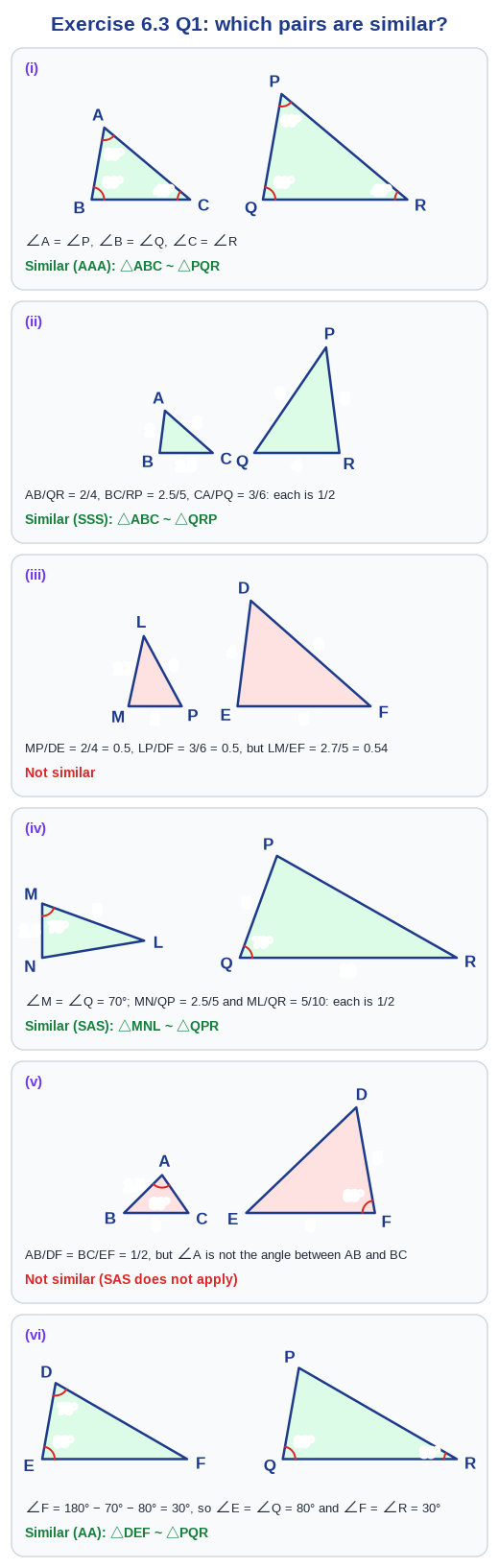
1. “State which pairs of triangles in Fig. 6.34 are similar. Write the similarity criterion used by you for answering the question and also write the pairs of similar triangles in the symbolic form :” (The six pairs, with the measurements printed in the figure, are listed below.)
(i) △ABC has ∠A = 60°, ∠B = 80°, ∠C = 40°; △PQR has ∠P = 60°, ∠Q = 80°, ∠R = 40°. All corresponding angles are equal. So the triangles are similar by AAA.
(ii) △ABC has AB = 2, BC = 2.5, CA = 3; △PQR has PQ = 6, QR = 4, PR = 5. Match shortest with shortest: AB/QR = 2/4 = 1/2, BC/RP = 2.5/5 = 1/2, CA/PQ = 3/6 = 1/2. All three ratios are equal, so they are similar by SSS.
(iii) △LMP has LM = 2.7, MP = 2, LP = 3; △DEF has DE = 4, EF = 5, DF = 6. MP/DE = 2/4 = 0.5 and LP/DF = 3/6 = 0.5, but LM/EF = 2.7/5 = 0.54. The ratios are not all equal, so they are not similar.
(iv) △MNL has MN = 2.5, ML = 5, ∠M = 70°; △PQR has PQ = 5, QR = 10, ∠Q = 70°. MN/QP = 2.5/5 = 1/2 and ML/QR = 5/10 = 1/2, and the angles between these sides, ∠M and ∠Q, are equal. So they are similar by SAS.
(v) △ABC has AB = 2.5, BC = 3, ∠A = 80°; △DEF has DF = 5, EF = 6, ∠F = 80°. AB/DF = BC/EF = 1/2, and ∠F lies between DF and EF. But ∠A does not lie between AB and BC; the angle between them is ∠B, which is not given. So SAS cannot be used. In fact, a triangle drawn with AB = 2.5, BC = 3 and ∠A = 80° has ∠B of about 45°, not 80°. So they are not similar.
(vi) △DEF has ∠D = 70°, ∠E = 80°, so ∠F = 180° − 70° − 80° = 30°. △PQR has ∠Q = 80°, ∠R = 30°, so ∠P = 70°. So ∠D = ∠P, ∠E = ∠Q, ∠F = ∠R, and they are similar by AA.
Answer: (i) AAA: △ABC ~ △PQR (ii) SSS: △ABC ~ △QRP (iii) not similar (iv) SAS: △MNL ~ △QPR (v) not similar (vi) AA: △DEF ~ △PQR
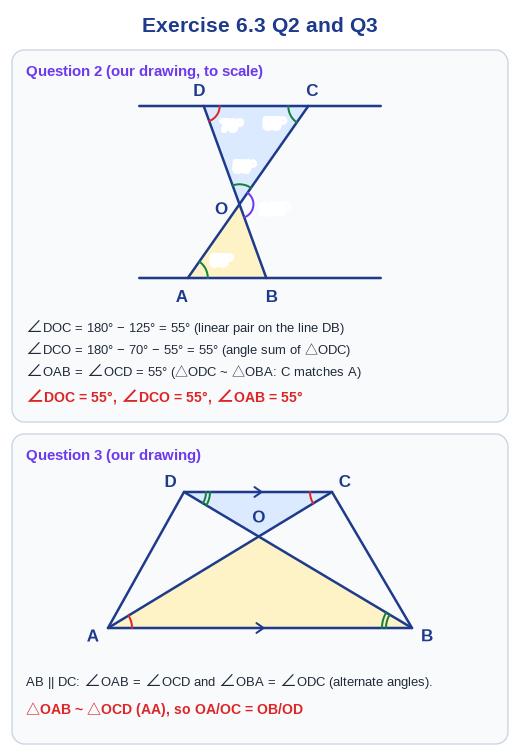
2. “In Fig. 6.35, △ODC ~ △OBA, ∠BOC = 125° and ∠CDO = 70°. Find ∠DOC, ∠DCO and ∠OAB.” (In the figure, the lines DB and CA cross at O.)
Given: △ODC ~ △OBA, ∠BOC = 125°, ∠CDO = 70°; DB and CA are straight lines meeting at O.
To find: ∠DOC, ∠DCO and ∠OAB.
- DOB is a straight line, so ∠DOC + ∠BOC = 180° (linear pair). ∠DOC = 180° − 125° = 55°.
- In △ODC, the angles add up to 180°. ∠DCO = 180° − ∠CDO − ∠DOC = 180° − 70° − 55° = 55°.
- △ODC ~ △OBA, so O matches O, D matches B and C matches A. So ∠OAB = ∠OCD = 55° (corresponding angles of similar triangles).
Answer: ∠DOC = 55°, ∠DCO = 55°, ∠OAB = 55°
3. “Diagonals AC and BD of a trapezium ABCD with AB ∥ DC intersect each other at the point O. Using a similarity criterion for two triangles, show that OA/OC = OB/OD.”
Given: ABCD is a trapezium with AB ∥ DC; diagonals AC and BD meet at O.
To prove: OA/OC = OB/OD.
Proof: In △OAB and △OCD:
- ∠OAB = ∠OCD (alternate angles, AB ∥ DC with transversal AC).
- ∠OBA = ∠ODC (alternate angles, AB ∥ DC with transversal BD).
- So △OAB ~ △OCD (AA criterion).
- Corresponding sides of similar triangles are in the same ratio, so OA/OC = OB/OD.
Hence proved.
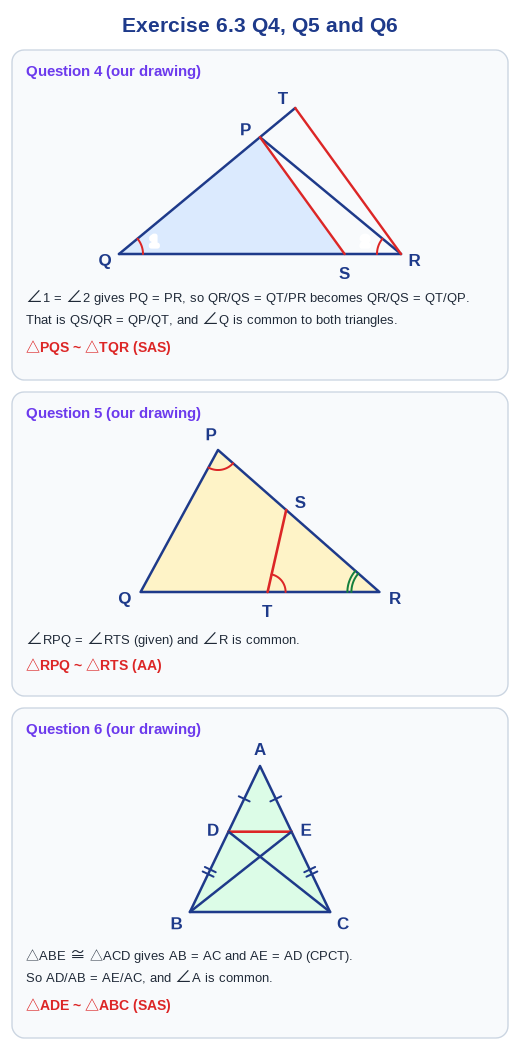
4. “In Fig. 6.36, QR/QS = QT/PR and ∠1 = ∠2. Show that △PQS ~ △TQR.” (In the figure, S is on QR, ∠1 = ∠PQR and ∠2 = ∠PRQ are the base angles of △PQR, and T is on QP produced.)
Given: QR/QS = QT/PR and ∠1 = ∠2, where ∠1 = ∠PQR and ∠2 = ∠PRQ.
To prove: △PQS ~ △TQR.
Proof:
- In △PQR, ∠1 = ∠2, so PR = PQ (sides opposite equal angles are equal).
- QR/QS = QT/PR (given). Put PR = PQ: QR/QS = QT/QP.
- Cross-multiply and rearrange: QP/QT = QS/QR.
- In △PQS and △TQR: QP/QT = QS/QR (step 3), and ∠PQS = ∠TQR (it is the same angle, ∠1).
- So △PQS ~ △TQR (SAS criterion).
Hence proved.
5. “S and T are points on sides PR and QR of △PQR such that ∠P = ∠RTS. Show that △RPQ ~ △RTS.”
Given: S on PR and T on QR of △PQR, with ∠P = ∠RTS.
To prove: △RPQ ~ △RTS.
Proof: In △RPQ and △RTS:
- ∠RPQ = ∠RTS (given).
- ∠PRQ = ∠TRS (common angle R).
- So △RPQ ~ △RTS (AA criterion).
Hence proved.
6. “In Fig. 6.37, if △ABE ≅ △ACD, show that △ADE ~ △ABC.” (In the figure, D is on AB and E is on AC.)
Given: D on AB, E on AC, and △ABE ≅ △ACD.
To prove: △ADE ~ △ABC.
Proof:
- △ABE ≅ △ACD, so AB = AC and AE = AD (CPCT: corresponding parts of congruent triangles are equal).
- So AD/AB = AE/AC (equal top lines over equal bottom lines).
- In △ADE and △ABC: AD/AB = AE/AC, and ∠DAE = ∠BAC (common angle A).
- So △ADE ~ △ABC (SAS criterion).
Hence proved.
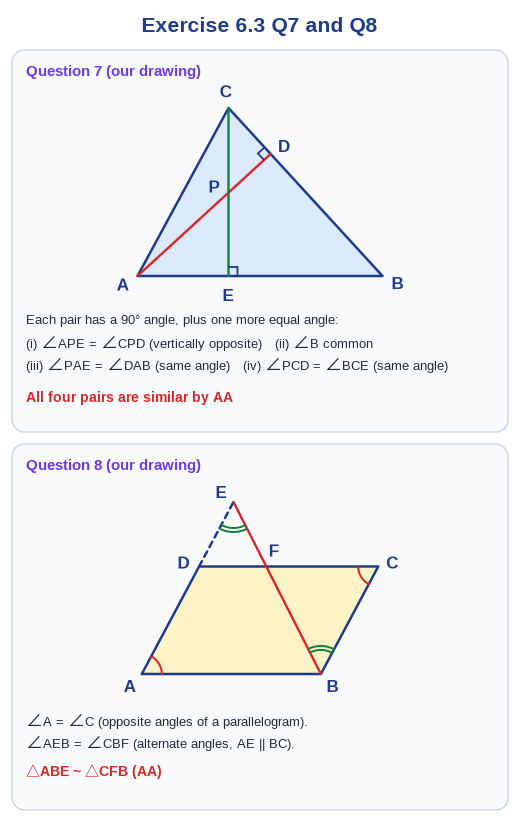
7. “In Fig. 6.38, altitudes AD and CE of △ABC intersect each other at the point P. Show that: (i) △AEP ~ △CDP (ii) △ABD ~ △CBE (iii) △AEP ~ △ADB (iv) △PDC ~ △BEC”
Given: In △ABC, AD ⊥ BC and CE ⊥ AB (altitudes), meeting at P. So the angles at D and at E are 90°.
To prove: the four similarities.
Proof:
(i) In △AEP and △CDP: ∠AEP = ∠CDP = 90°, and ∠APE = ∠CPD (vertically opposite angles). So △AEP ~ △CDP (AA).
(ii) In △ABD and △CBE: ∠ADB = ∠CEB = 90°, and ∠ABD = ∠CBE (common angle B). So △ABD ~ △CBE (AA).
(iii) In △AEP and △ADB: ∠AEP = ∠ADB = 90°, and ∠PAE = ∠BAD (the same angle at A). So △AEP ~ △ADB (AA).
(iv) In △PDC and △BEC: ∠PDC = ∠BEC = 90°, and ∠PCD = ∠BCE (the same angle at C). So △PDC ~ △BEC (AA).
Hence proved.
8. “E is a point on the side AD produced of a parallelogram ABCD and BE intersects CD at F. Show that △ABE ~ △CFB.”
Given: ABCD is a parallelogram; E is on AD produced; BE meets CD at F.
To prove: △ABE ~ △CFB.
Proof: In △ABE and △CFB:
- ∠BAE = ∠FCB (opposite angles of a parallelogram are equal, so ∠A = ∠C).
- AD ∥ BC, so AE ∥ BC. With BE as the transversal, ∠AEB = ∠CBF (alternate angles).
- So △ABE ~ △CFB (AA criterion).
Hence proved.
9. “In Fig. 6.39, ABC and AMP are two right triangles, right angled at B and M respectively. Prove that: (i) △ABC ~ △AMP (ii) CA/PA = BC/MP” (In the figure, M is on AC and P is on AB produced.)
Given: △ABC with ∠B = 90° and △AMP with ∠M = 90°; M is on AC and P on AB produced.
To prove: (i) △ABC ~ △AMP (ii) CA/PA = BC/MP.
Proof:
- In △ABC and △AMP: ∠ABC = ∠AMP = 90° (given), and ∠BAC = ∠MAP (common angle A).
- So △ABC ~ △AMP (AA criterion). This proves (i).
- In these similar triangles, A matches A, B matches M and C matches P.
- Corresponding sides are in the same ratio, so CA/PA = BC/MP. This proves (ii).
Hence proved.
10. “CD and GH are respectively the bisectors of ∠ACB and ∠EGF such that D and H lie on sides AB and FE of △ABC and △EFG respectively. If △ABC ~ △FEG, show that: (i) CD/GH = AC/FG (ii) △DCB ~ △HGE (iii) △DCA ~ △HGF”
Given: △ABC ~ △FEG; CD bisects ∠ACB (D on AB) and GH bisects ∠EGF (H on FE).
To prove: (i) CD/GH = AC/FG (ii) △DCB ~ △HGE (iii) △DCA ~ △HGF.
Proof:
- △ABC ~ △FEG, so ∠A = ∠F, ∠B = ∠E and ∠ACB = ∠FGE.
- CD and GH cut these equal angles into equal halves, so ∠ACD = ∠FGH and ∠DCB = ∠HGE.
- (iii) In △DCA and △HGF: ∠A = ∠F (step 1) and ∠ACD = ∠FGH (step 2). So △DCA ~ △HGF (AA).
- (i) From step 3, corresponding sides are in the same ratio: CD/GH = AC/FG.
- (ii) In △DCB and △HGE: ∠B = ∠E (step 1) and ∠DCB = ∠HGE (step 2). So △DCB ~ △HGE (AA).
Hence proved. (Part (iii) is done first because part (i) follows from it.)
11. “In Fig. 6.40, E is a point on side CB produced of an isosceles triangle ABC with AB = AC. If AD ⊥ BC and EF ⊥ AC, prove that △ABD ~ △ECF.” (In the figure, D is on BC and F is on AC.)
Given: △ABC with AB = AC; E on CB produced; AD ⊥ BC (D on BC); EF ⊥ AC (F on AC).
To prove: △ABD ~ △ECF.
Proof: In △ABD and △ECF:
- AB = AC, so ∠ABC = ∠ACB (angles opposite equal sides). That is, ∠ABD = ∠ECF.
- ∠ADB = ∠EFC = 90° (AD ⊥ BC and EF ⊥ AC).
- So △ABD ~ △ECF (AA criterion).
Hence proved.
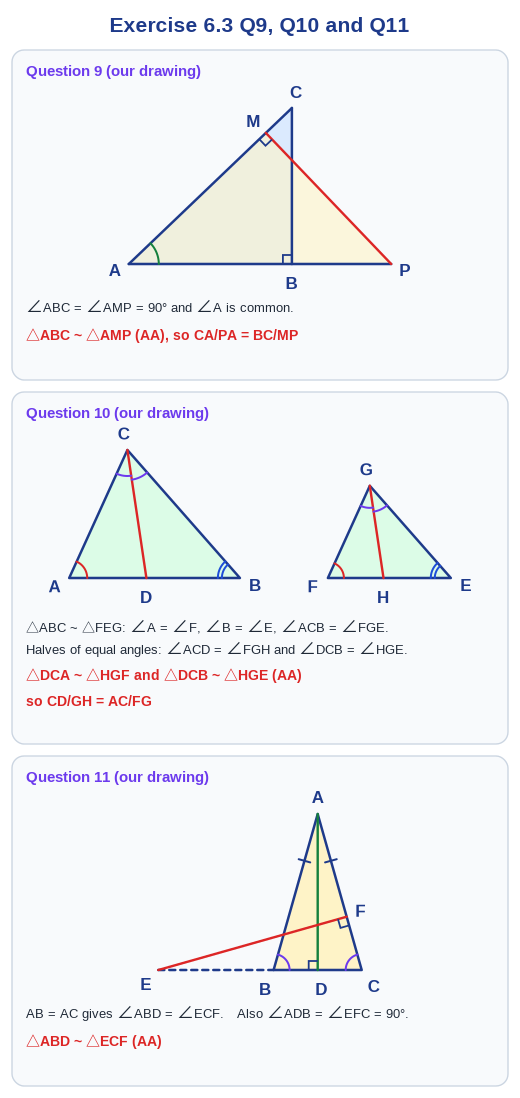
12. “Sides AB and BC and median AD of a triangle ABC are respectively proportional to sides PQ and QR and median PM of △PQR (see Fig. 6.41). Show that △ABC ~ △PQR.”
Given: AD and PM are medians (a median joins a vertex to the mid-point of the opposite side), and AB/PQ = BC/QR = AD/PM.
To prove: △ABC ~ △PQR.
Proof:
- D and M are mid-points, so BC = 2BD and QR = 2QM. So BC/QR = 2BD/2QM = BD/QM.
- So AB/PQ = BD/QM = AD/PM.
- So △ABD ~ △PQM (SSS criterion).
- So ∠ABD = ∠PQM (corresponding angles), that is ∠B = ∠Q.
- In △ABC and △PQR: AB/PQ = BC/QR (given) and ∠B = ∠Q (step 4). So △ABC ~ △PQR (SAS criterion).
Hence proved.
13. “D is a point on the side BC of a triangle ABC such that ∠ADC = ∠BAC. Show that CA² = CB.CD.”
Given: D is on BC of △ABC, and ∠ADC = ∠BAC.
To prove: CA² = CB · CD.
Proof: In △ADC and △BAC:
- ∠ADC = ∠BAC (given).
- ∠ACD = ∠BCA (common angle C).
- So △ADC ~ △BAC (AA criterion), with A matching B, D matching A and C matching C.
- Corresponding sides are in the same ratio: CA/CB = CD/CA.
- Cross-multiply: CA × CA = CB × CD, that is CA² = CB · CD.
Hence proved.
14. “Sides AB and AC and median AD of a triangle ABC are respectively proportional to sides PQ and PR and median PM of another triangle PQR. Show that △ABC ~ △PQR.”
Given: AD and PM are medians, and AB/PQ = AC/PR = AD/PM.
To prove: △ABC ~ △PQR.
Construction (as in the book’s hint): produce AD to E so that DE = AD, and produce PM to N so that MN = PM. Join EC and NR.
Proof:
- In △ABD and △ECD: BD = CD (AD is a median), AD = ED (construction), and ∠ADB = ∠EDC (vertically opposite angles). So △ABD ≅ △ECD (SAS congruence).
- So AB = EC and ∠BAD = ∠CED (CPCT).
- In the same way, △PQM ≅ △NRM, so PQ = NR and ∠QPM = ∠RNM.
- AE = 2AD and PN = 2PM, so AE/PN = AD/PM.
- Using steps 2, 3 and 4, the given ratios become EC/NR = AC/PR = AE/PN. So △ACE ~ △PRN (SSS criterion).
- So ∠CAE = ∠RPN and ∠CEA = ∠RNP (corresponding angles). That is, ∠CAD = ∠RPM, and by steps 2 and 3, ∠BAD = ∠QPM.
- Add: ∠BAD + ∠CAD = ∠QPM + ∠RPM, so ∠BAC = ∠QPR.
- In △ABC and △PQR: AB/PQ = AC/PR (given) and ∠A = ∠P (step 7). So △ABC ~ △PQR (SAS criterion).
Hence proved.
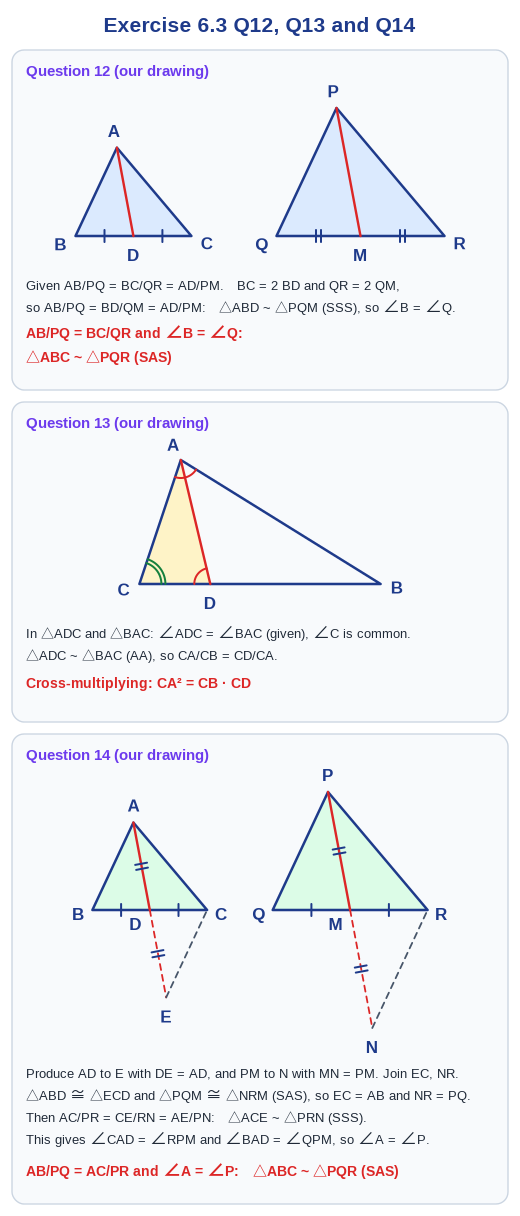
15. “A vertical pole of length 6 m casts a shadow 4 m long on the ground and at the same time a tower casts a shadow 28 m long. Find the height of the tower.”
Given: pole AB = 6 m with shadow BC = 4 m; tower PQ with shadow QR = 28 m, at the same time.
To find: the height of the tower, PQ = h m.
- ∠B = ∠Q = 90° (the pole and the tower are vertical).
- ∠C = ∠R (at the same time, the sun’s rays meet the ground at the same angle).
- So △ABC ~ △PQR (AA criterion).
- So PQ/AB = QR/BC, that is h/6 = 28/4 = 7.
- h = 6 × 7 = 42.
Answer: The tower is 42 m high.
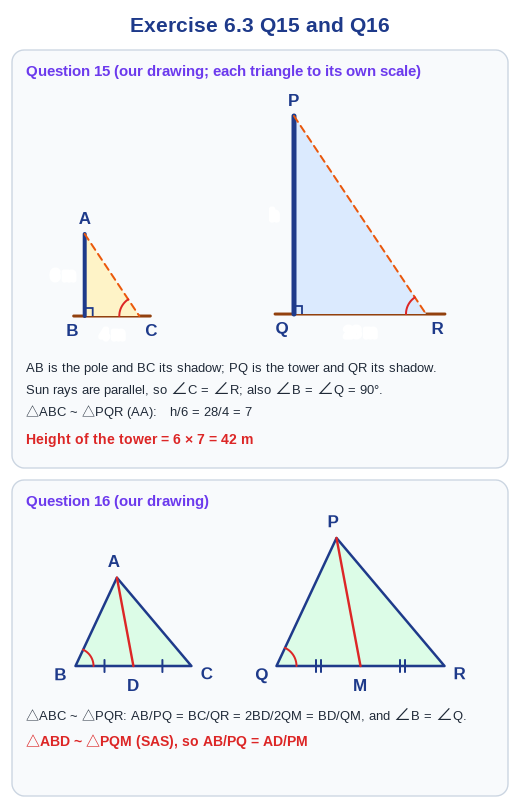
16. “If AD and PM are medians of triangles ABC and PQR, respectively where △ABC ~ △PQR, prove that AB/PQ = AD/PM.”
Given: △ABC ~ △PQR; AD and PM are medians.
To prove: AB/PQ = AD/PM.
Proof:
- △ABC ~ △PQR, so AB/PQ = BC/QR and ∠B = ∠Q.
- D and M are mid-points, so BC = 2BD and QR = 2QM. So BC/QR = BD/QM, and so AB/PQ = BD/QM.
- In △ABD and △PQM: AB/PQ = BD/QM and ∠B = ∠Q. So △ABD ~ △PQM (SAS criterion).
- Corresponding sides are in the same ratio, so AB/PQ = AD/PM.
Hence proved.
The note at the end of the chapter (page 98)
After the summary, a note for the reader states one more test, for right triangles only: if the hypotenuse and one side of a right triangle are proportional to the hypotenuse and one side of another right triangle, the two triangles are similar. The book calls this the RHS similarity criterion and says it shortens the proof of Example 2 of Chapter 8. It is stated there without proof.
More practice with reasons and steps: the Basic Proportionality Theorem and the criteria for similarity.
Practice
-
A triangle has sides 4 cm, 6 cm and 8 cm. A similar triangle has its shortest side 6 cm. Its longest side is:
Show answer
Answer: (c) 12 cm
-
In △ABC, DE ∥ BC with D on AB and E on AC. If AD = 1.2 cm, DB = 1.8 cm and AC = 5 cm, then AE is:
Show answer
Answer: (a) 2 cm
-
In △ABC and △DEF, ∠A = ∠D and AB/DE = AC/DF. The triangles are similar by:
Show answer
Answer: (c) SAS
-
A man 1.8 m tall stands 4 m from a lamp-post 5.4 m high. Find the length of his shadow.
Show answer
Answer: Let the shadow be x m. The post and the man are both vertical, and the ray of light makes the same angle with the ground, so the two right triangles are similar (AA). (4 + x)/x = 5.4/1.8 = 3, so 4 + x = 3x and x = 2. The shadow is 2 m long.
-
ABCD is a trapezium with AB ∥ DC and diagonals meeting at O. If AO = 4 cm, OC = 6 cm and BO = 3 cm, find OD.
Show answer
Answer: △OAB ~ △OCD by AA (alternate angles), so OA/OC = OB/OD. 4/6 = 3/OD gives OD = 18/4 = 4.5 cm.
Stuck on a question?
Take a photo and Lagnever AI explains it step by step. Try it for 7 days for ₹2.
Get it on Google Play Open in browser
For parents: after the trial, the plan renews monthly by UPI or card autopay. You can cancel anytime in the app.