
What is the Basic Proportionality Theorem?
Answer in short
The Basic Proportionality Theorem (Theorem 6.1, the Thales Theorem) says that a line drawn parallel to one side of a triangle, cutting the other two sides at distinct points, divides those sides in the same ratio. In △ABC, if DE ∥ BC, then AD/DB = AE/EC. Its converse is also true: equal ratios give a parallel line.
Stuck on a question? Take a photo and Lagnever AI explains it step by step. Try it for 7 days for ₹2. Get it on Google Play
What does the theorem say?
Take any triangle ABC. Mark a point D on AB and draw a line through D parallel to BC. Let it meet AC at E. The line cuts AB into two parts, AD and DB, and AC into two parts, AE and EC.
Theorem 6.1 (Basic Proportionality Theorem): if a line is drawn parallel to one side of a triangle to intersect the other two sides at distinct points, the other two sides are divided in the same ratio. That is,
AD/DB = AE/EC.
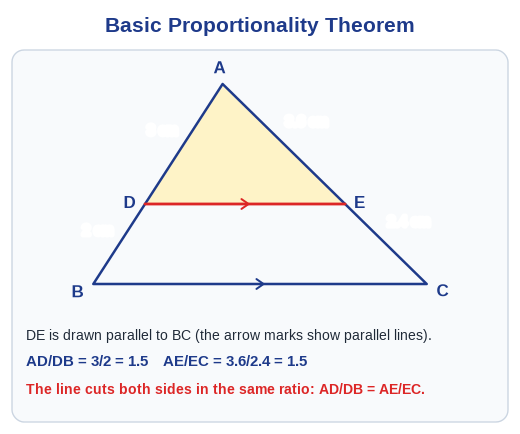
In our drawing, AD = 3 cm and DB = 2 cm, so AD/DB = 1.5. On the other side, AE = 3.6 cm and EC = 2.4 cm, and 3.6/2.4 is also 1.5. The book’s Activity 2 leads to the same idea: equal steps are marked along one arm of an angle, a parallel line is drawn, and both arms are found to be cut in the ratio 3 : 2.
How is the theorem proved?
The proof uses areas. Join BE and CD. Draw DM ⊥ AC and EN ⊥ AB.
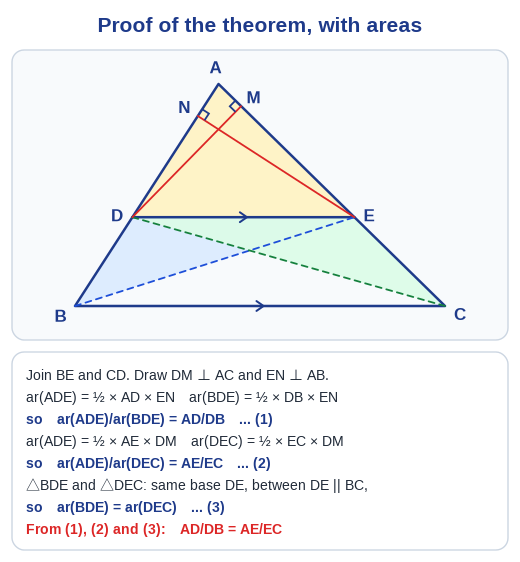
- △ADE and △BDE have bases AD and DB on the same line AB, and the same height EN. So ar(ADE) = ½ × AD × EN and ar(BDE) = ½ × DB × EN. Dividing, ar(ADE)/ar(BDE) = AD/DB.
- △ADE and △DEC have bases AE and EC on the same line AC, and the same height DM. So ar(ADE)/ar(DEC) = AE/EC.
- △BDE and △DEC stand on the same base DE and lie between the same parallels DE and BC. Triangles like these have equal areas, so ar(BDE) = ar(DEC).
- The left sides of steps 1 and 2 are now equal, so AD/DB = AE/EC.
What is the converse?
Theorem 6.2: if a line divides any two sides of a triangle in the same ratio, then the line is parallel to the third side.
The book’s Activity 3 suggests it: mark five equal parts on each arm of an angle, join matching points, and the joins come out parallel. The proof is by contradiction.
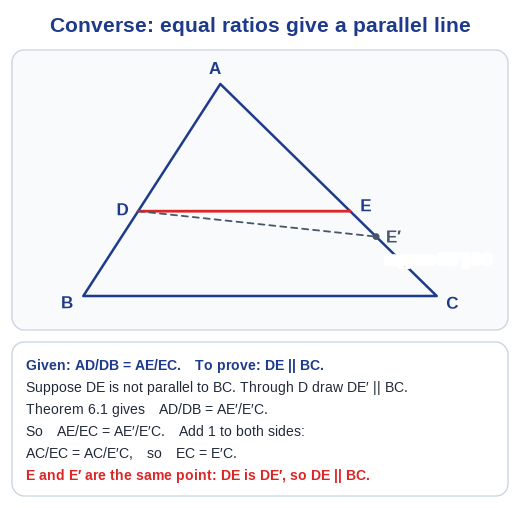
Suppose AD/DB = AE/EC but DE is not parallel to BC. Draw DE′ ∥ BC, with E′ on AC. By Theorem 6.1, AD/DB = AE′/E′C. So AE/EC = AE′/E′C. Add 1 to both sides: (AE + EC)/EC = (AE′ + E′C)/E′C, that is AC/EC = AC/E′C. So EC = E′C, which means E and E′ are the same point. So DE is the same line as DE′, and DE ∥ BC.
How do you use the two theorems?
To find a length. In △PQR, ST ∥ QR with S on PQ and T on PR. If PS = 4 cm, SQ = 6 cm and PT = 5 cm, then PS/SQ = PT/TR gives 4/6 = 5/TR, so TR = 30/4 = 7.5 cm.
To test for parallel lines. E is on PQ and F is on PR, with PE = 3.9 cm, EQ = 3 cm, PF = 3.6 cm and FR = 2.4 cm (Exercise 6.2, Question 2). Here PE/EQ = 1.3 but PF/FR = 1.5. The ratios differ, so EF is not parallel to QR. If EF were parallel to QR, Theorem 6.1 would make the ratios equal.
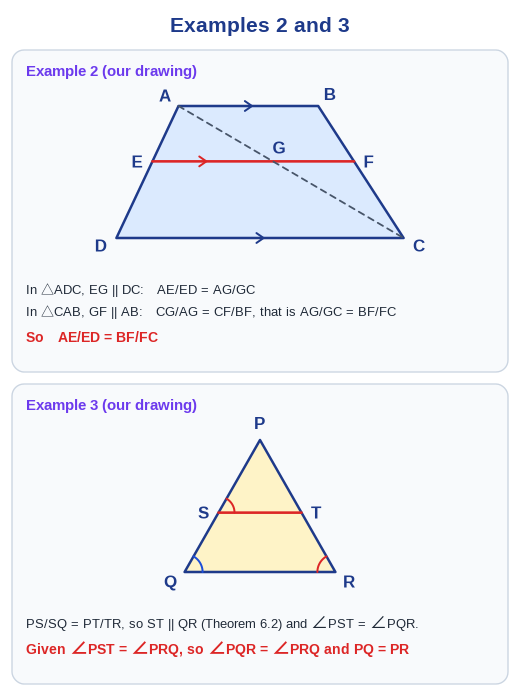
To prove a ratio in a bigger figure. Often one line is parallel to a side in two different triangles. In a trapezium ABCD with AB ∥ DC and EF ∥ AB (Example 2), the diagonal AC splits the figure into two triangles. Theorem 6.1 in each gives AE/ED = AG/GC and AG/GC = BF/FC, so AE/ED = BF/FC.
Which other forms of the ratio are useful?
From AD/DB = AE/EC you can get, by turning the fractions over and adding 1:
- DB/AD = EC/AE
- AB/AD = AC/AE, and so AD/AB = AE/AC
- AB/DB = AC/EC
Use the form that contains the lengths given in the question.
Read next: the criteria for similarity of triangles, whose proofs all use these two theorems. All ten questions of Exercise 6.2 are solved in the NCERT solutions, and the chapter notes give the full picture.
Practice
-
In △ABC, DE ∥ BC. If AD = 4 cm, DB = 6 cm and AE = 5 cm, then EC is:
Show answer
Answer: (b) 7.5 cm
-
E is on PQ and F is on PR of △PQR, with PE = 2 cm, EQ = 3 cm, PF = 3 cm and FR = 4.5 cm. Then:
Show answer
Answer: (a) EF ∥ QR
-
In △ABC, DE ∥ BC and AD/DB = 3/5. If AC = 4.8 cm, then AE is:
Show answer
Answer: (c) 1.8 cm
-
In △ABC, DE ∥ BC, AD = x, DB = x − 2, AE = x + 2 and EC = x − 1. Find x.
Show answer
Answer: AD/DB = AE/EC gives x/(x − 2) = (x + 2)/(x − 1). Cross-multiply: x(x − 1) = (x + 2)(x − 2), so x² − x = x² − 4 and x = 4. Check: AD/DB = 4/2 = 2 and AE/EC = 6/3 = 2.
-
ABCD is a trapezium with AB ∥ DC, and its diagonals meet at O. If AO = 3 cm, OC = 6 cm and BO = 2 cm, find OD.
Show answer
Answer: In a trapezium the diagonals divide each other in the same ratio: AO/OC = BO/OD (Exercise 6.2, Question 9). So 3/6 = 2/OD and OD = 4 cm.
Questions students ask
Why is the Basic Proportionality Theorem also called the Thales Theorem?
The book credits it to Thales, a Greek mathematician (640–546 B.C.). It is believed that he used this result to show that in two equiangular triangles the ratio of any two corresponding sides is always the same.
Is the converse of the Basic Proportionality Theorem true?
Yes. Theorem 6.2 says that if a line divides any two sides of a triangle in the same ratio, the line is parallel to the third side. It is used to prove that lines are parallel, for example in Questions 5, 6 and 8 of Exercise 6.2.
What does the mid-point theorem have to do with this theorem?
It is a special case. If D is the mid-point of AB and DE ∥ BC, then AD/DB = 1, so AE/EC = 1 and E is the mid-point of AC. And if D and E are both mid-points, the two ratios are both 1, so DE ∥ BC by the converse. These are Questions 7 and 8 of Exercise 6.2.
Can I write the theorem as AD/AB = AE/AC?
Yes. From AD/DB = AE/EC, turn both fractions over to get DB/AD = EC/AE, add 1 to both sides to get AB/AD = AC/AE, and turn them over again. Example 1 of the chapter proves exactly this form.
Stuck on a question?
Take a photo and Lagnever AI explains it step by step. Try it for 7 days for ₹2.
Get it on Google Play Open in browser
For parents: after the trial, the plan renews monthly by UPI or card autopay. You can cancel anytime in the app.