
Transversals: corresponding and alternate angles
Answer in short
A transversal is a line that crosses two lines, making eight angles with at most four different measures. If the two lines are parallel, corresponding angles are equal, alternate angles are equal, and interior angles on the same side add up to 180°. Turned around, equal corresponding angles prove that two lines are parallel.
Stuck on a question? Take a photo and Lagnever AI explains it step by step. Try it for 7 days for ₹2. Get it on Google Play
What is a transversal?
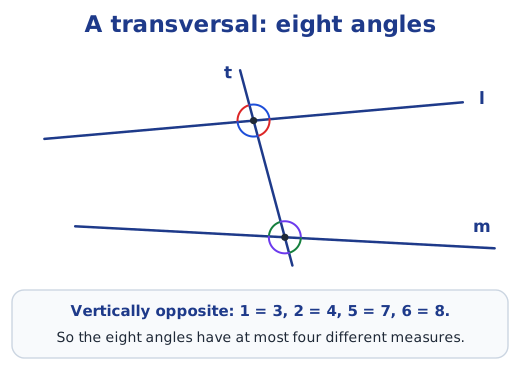
Sometimes it is hard to tell by eye whether two lines are parallel. Transversals settle it. A line t that crosses two lines l and m is a transversal, and it makes eight angles: ∠1 to ∠4 where it meets l, and ∠5 to ∠8 where it meets m. Can all eight be different? No. At each crossing the vertically opposite angles are equal, so ∠1 = ∠3, ∠2 = ∠4, ∠5 = ∠7 and ∠6 = ∠8: four equal pairs, and at most four different measures.
Corresponding angles
The transversal makes one set of angles with l and another with m. Angles in the same position in the two sets, such as ∠1 and ∠5, ∠2 and ∠6, ∠3 and ∠7, and ∠4 and ∠8, are corresponding angles.
Activity 3 asks for a pair of lines and a transversal that make only two different angles. Draw l and a transversal t meeting at X, and suppose the angle at X is 60°; its linear partner is then 120°. Mark a point Y on t and draw a line m through Y that also makes 60° with t, copying the angle with tracing paper or a protractor. Lines l and m come out parallel. So when the corresponding angles made by a transversal are equal, the lines are parallel.
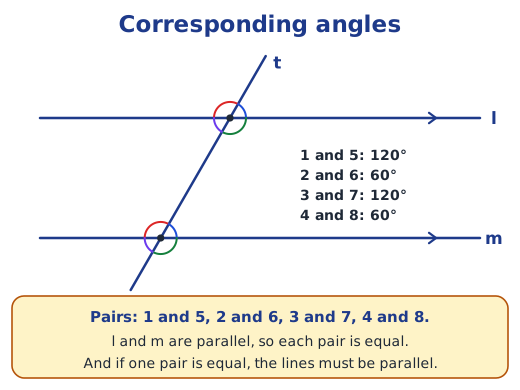
The other way round is also true. If a transversal crosses two parallel lines, trace one angle on tracing paper and slide it to the corresponding angle: it matches exactly. Corresponding angles made by a transversal across parallel lines are always equal. And if two lines are not parallel, as in Activity 5, no transversal can make a pair of corresponding angles equal.
Alternate angles
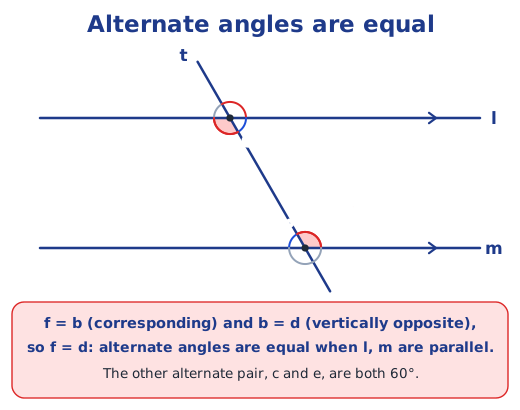
Now take parallel lines l and m and a transversal t, with angles a, b, c, d at l and e, f, g, h at m. ∠f and ∠d form a pair of alternate angles, and so do ∠e and ∠c: they lie between the lines on opposite sides of the transversal. If ∠f is 120°, what is ∠d? ∠b corresponds to ∠f, so ∠b = 120°, and ∠d is vertically opposite ∠b, so ∠d = 120°. The same steps work for any measure of ∠f, so alternate angles made by a transversal across parallel lines are always equal.
Interior angles on the same side
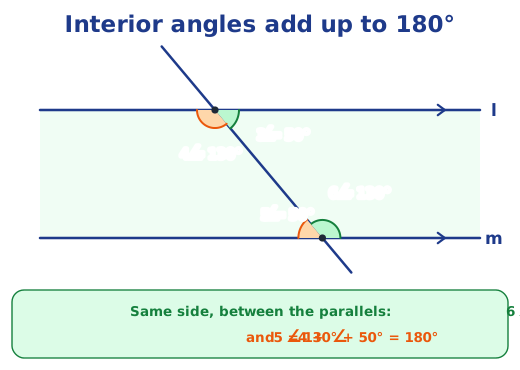
In Example 3, parallel lines are crossed by a transversal and ∠3 is 50°. Then ∠2 = 180° − 50° = 130°, a linear pair with ∠3, and ∠6 = ∠2 = 130° as corresponding angles. Angles such as ∠3 and ∠6, which lie between the lines on the same side of the transversal, are interior angles, and 50° + 130° = 180°. This always happens: ∠2 + ∠3 = 180° and ∠2 = ∠6, so ∠3 + ∠6 = 180°.
Using the angle facts
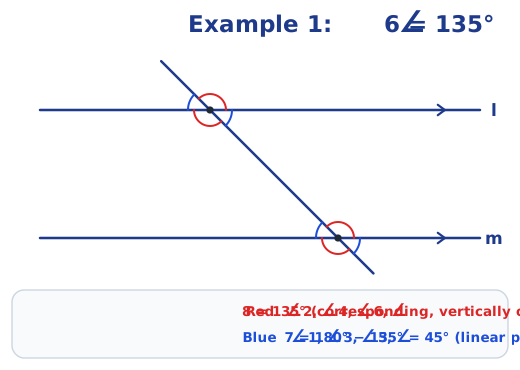
With one angle known, the rest follow. In Example 1, ∠6 is 135°: then ∠2, ∠4 and ∠8 are 135° too, through corresponding and vertically opposite angles, and the other four are 180° − 135° = 45°. In Example 2, ∠a is 120° and ∠f is 70°; then ∠b = 60°, but ∠b and ∠f are corresponding angles and are not equal, so the lines are not parallel.
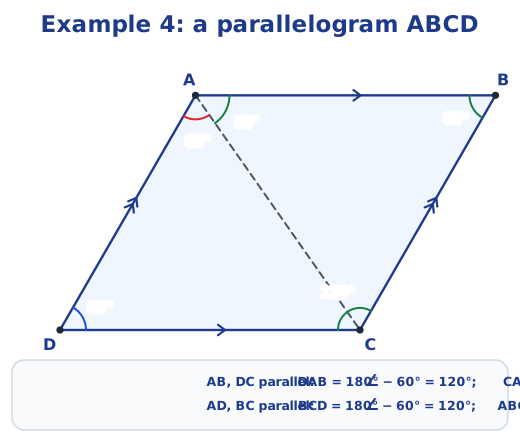
In Example 4, ABCD has AB parallel to CD and AD parallel to BC, with ∠DAC = 65° and ∠ADC = 60°. With AD as the transversal across AB and CD, the interior angles give ∠DAB = 180° − 60° = 120°, so ∠CAB = 120° − 65° = 55°. With CD as the transversal across AD and BC, ∠BCD = 180° − 60° = 120°, and in the same way ∠ABC = 60°.
Why it matters
Transversals give a reliable test for parallel lines, and they let one angle reveal many others. The angles at a single crossing are explained in linear pairs and vertically opposite angles, and drawing parallel lines in parallel and perpendicular lines. All six Figure it Out questions are solved in the NCERT solutions for Chapter 5; see all of the Chapter 5 notes.
Practice
-
Lines l and m are parallel and ∠6 = 135°. What is ∠5, which forms a linear pair with ∠6?
Show answer
Answer: (b) 45°
-
Alternate angles made by a transversal across parallel lines are…
Show answer
Answer: (a) always equal
-
A transversal crosses two lines, and a pair of corresponding angles measures 60° and 70°. The lines are…
Show answer
Answer: (b) not parallel
-
Lines l and m are parallel and ∠3 = 50°. Find ∠6, the interior angle on the same side.
Show answer
Answer: Interior angles on the same side add up to 180°, so ∠6 = 180° − 50° = 130°. As a check, ∠2 = 130° as a linear pair with ∠3, and ∠6 = ∠2 as corresponding angles.
-
Why are alternate angles equal when the lines are parallel?
Show answer
Answer: Take an angle ∠f at the second line. Its corresponding angle ∠b at the first line equals ∠f because the lines are parallel, and ∠b equals ∠d because they are vertically opposite. So ∠f = ∠d, and ∠f and ∠d are alternate angles.
Questions students ask
What is a transversal?
A transversal is a line that crosses two other lines. It forms four angles with each line, eight in all. Since each crossing has two pairs of equal vertically opposite angles, the eight angles have at most four different measures.
What are corresponding angles?
Corresponding angles are angles in the same position at the two crossings of a transversal, such as ∠1 and ∠5, or ∠2 and ∠6. If the two lines are parallel, corresponding angles are equal; and if a pair of corresponding angles is equal, the two lines are parallel.
What are interior angles on the same side?
They are the two angles between the pair of lines on the same side of the transversal, such as ∠3 and ∠6. When the lines are parallel they add up to 180°: for example, if ∠3 is 50°, ∠6 is 130°.
Stuck on a question?
Take a photo and Lagnever AI explains it step by step. Try it for 7 days for ₹2.
Get it on Google Play Open in browser
For parents: after the trial, the plan renews monthly by UPI or card autopay. You can cancel anytime in the app.