
NCERT Solutions Class 7 Maths Chapter 5: Parallel and Intersecting Lines
Answers to every question in Chapter 5, Parallel and Intersecting Lines, of Ganita Prakash, the Class 7 Maths textbook Part 1 (Reprint 2026-27): the questions in the text, Activities 1 to 6, the worked examples and all three Figure it Out sets. Page numbers follow the book (pages 107–126). For drawing tasks, the answers say what to draw and how to check it. Short notes: Chapter 5 notes.
Across the Line (pages 107–108)
Lines on folded paper. Some pairs of lines meet on the paper. Of the pairs that do not, some come closer towards one side and would meet if extended beyond the paper; others stay the same distance apart and would never meet.
How many angles do two intersecting lines form? Four.
Can two straight lines intersect at more than one point? No. Two straight lines can meet at only one point; after crossing, they move further apart.
Activity 1: patterns among the four angles. The angles opposite each other are equal, ∠a = ∠c and ∠b = ∠d, and neighbouring angles add up to 180°, for example ∠a + ∠b = 180° and ∠b + ∠c = 180°.
If ∠a is 120°, find ∠b, ∠c and ∠d. ∠a and ∠b form a straight angle, so ∠b = 180° − 120° = 60°. Then ∠c = 180° − 60° = 120° and ∠d = 180° − 120° = 60°.
Is this always true for any pair of intersecting lines? Yes. Since a straight angle is 180°, ∠a + ∠b = 180° and ∠a + ∠d = 180°, so ∠b = ∠d for any value of ∠a. Likewise ∠b + ∠a = ∠b + ∠c = 180°, so ∠a = ∠c. Vertically opposite angles are always equal.
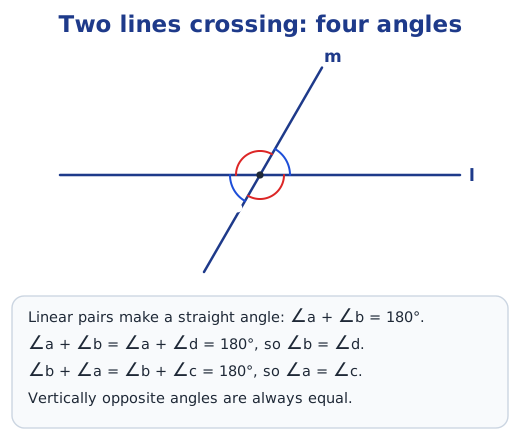
Figure it Out (page 108)
Fig. 5.3. Linear pairs: ∠a and ∠b, ∠b and ∠c, ∠c and ∠d, ∠d and ∠a. Pairs of vertically opposite angles: ∠b and ∠d, and ∠a and ∠c.
Why may measured linear pairs not add up to 180°? Because of measurement errors, such as not placing the protractor correctly, and because drawn lines have thickness, while the ideal line of geometry has none. Reasoning tells us the exact values; measurements only come close.
Perpendicular Lines (pages 108–109)
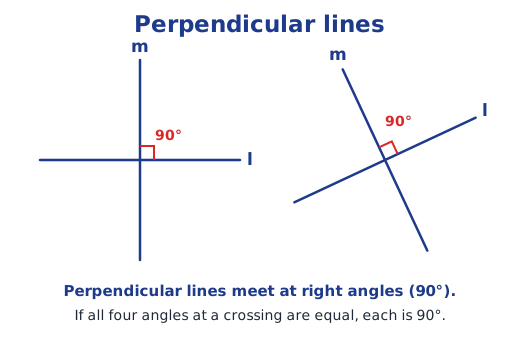
Can you draw intersecting lines with all four angles equal? Yes: the four angles add up to 360°, so each must be 90°. Such lines are perpendicular.
Between Lines (page 109)
Describing Fig. 5.5. Sample descriptions (measure the angles with a protractor):
- FG and FH meet at their common endpoint F, making an angle of 115.3°.
- Line segments AB and CD intersect at the point X, which is close to the midpoint of CD; the four angles at X form two pairs of equal vertically opposite angles, and neighbouring angles add up to 180°.
- Line segments IJ and LM intersect at the point Y, close to the middle of both segments; again opposite angles are equal and neighbouring angles add up to 180°.
- ST and UV do not meet, and neither do OP and QR.
Are ST and UV likely to meet if extended? They come slightly closer towards T and V, so if extended far enough on that side they would probably meet.
Are OP and QR likely to meet if extended? They stay about the same distance apart, so they are not likely to meet: they look parallel.
Parallel lines (page 110)
Parallel lines in the classroom: the opposite edges of the blackboard, a door or a desk top; the lines of a ruled notebook; the rows of tiles; the window bars.
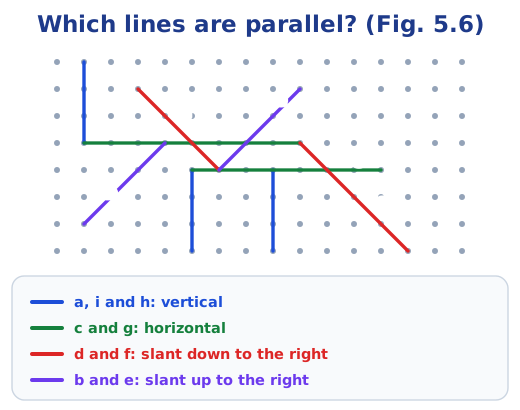
Fig. 5.6: which lines appear to be parallel? a, h and i; c and g; f and d; and b and e.
Activity 2: folding a square sheet (page 111)
- Opposite edges: parallel.
- Adjacent edges: perpendicular.
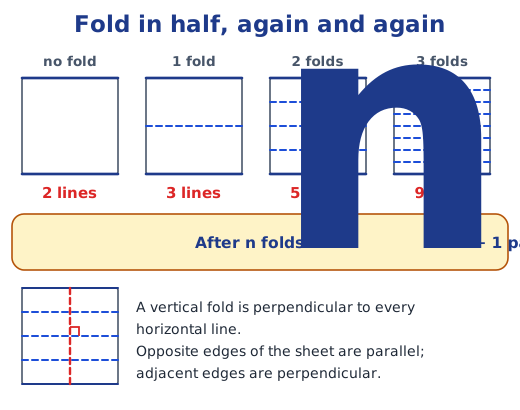
- After one horizontal fold, there are 3 parallel lines: the two edges and the crease. The new crease is perpendicular to the vertical sides.
- After one more fold, there are 5 parallel lines; after another, 9. The pattern: each fold doubles the strips, so n folds give 2ⁿ + 1 parallel lines, and the next fold gives 17. (Extra: NCERT’s answer key writes this as “2n + 1”, which does not fit 9 for 3 folds; it means 2ⁿ + 1.)
- A vertical fold is perpendicular to the horizontal lines.
- Yes: fold one of the corners that is not on the diagonal so that its tip touches the centre of the square, on the diagonal crease; the new crease is parallel to the diagonal.
Another folding activity (page 112)
Are a, b and c parallel to p, q and r respectively? Yes. a and p lie along the top and bottom edges, which are parallel. b and q lie along vertical creases, both perpendicular to those edges, so they are parallel. c and r are the folds that cut off the two opposite corners, both parallel to the same diagonal of the square, so they are parallel.
Figure it Out (pages 113–114)
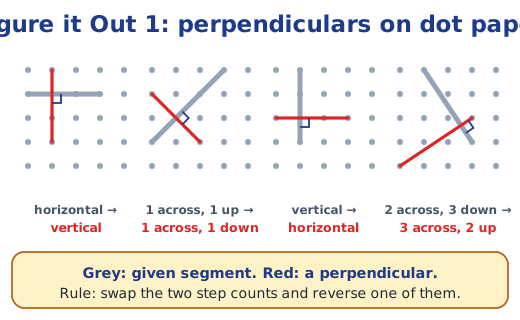
1. Perpendiculars on dot paper. For a horizontal segment, draw a vertical one; for a vertical segment, a horizontal one. For a segment that goes 1 across and 1 up, draw one going 1 across and 1 down. For the segment that goes 2 across and 3 down, draw one going 3 across and 2 up. The rule: swap the two step counts and reverse one of them.
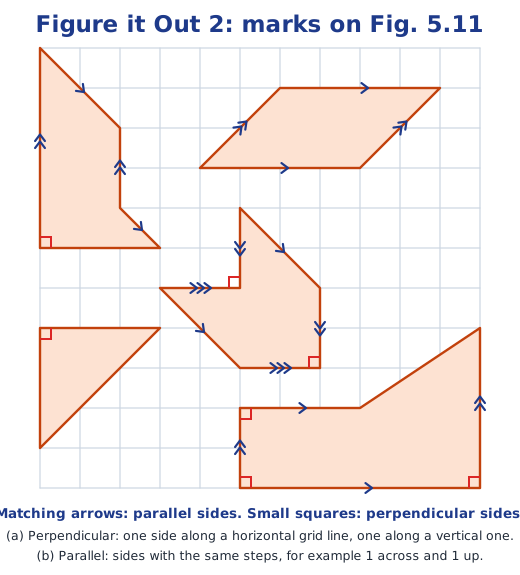
2. Marking Fig. 5.11. Sides with the same direction get matching arrows, and square marks go where a horizontal side meets a vertical one.
(a) Perpendicular sides were spotted where one side runs along a horizontal grid line and the other along a vertical grid line.
(b) Parallel sides were spotted as sides going in the same direction: both horizontal, both vertical, or slanting sides with the same steps, such as 1 square across for 1 square up.
3. Sets of parallel lines on dot paper. Draw segments that take the same steps from different dots, for example several horizontal segments, several vertical ones, and several going 1 across and 2 up.
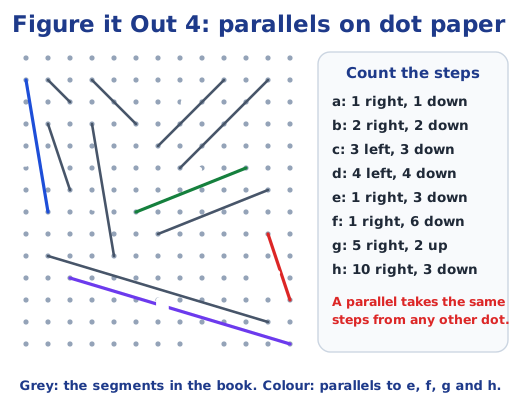
4. Parallels to the segments of Fig. 5.12.
(a) Yes, some were harder than others.
(b) The slanting ones that are not at 45°: e, f, g and h.
(c) Count the dot steps of the segment and repeat the same steps from another dot: e goes 1 right and 3 down, f 1 right and 6 down, g 5 right and 2 up, and h 10 right and 3 down.
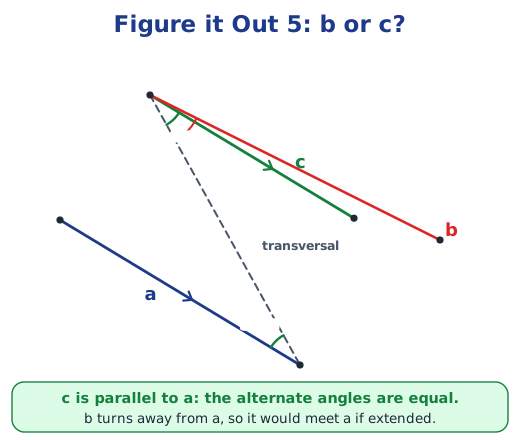
5. Fig. 5.13: is b or c parallel to a? Line c. The eye can be fooled here, so use a transversal: the line joining the top point to the lower end of a makes equal alternate angles with a and with c, so a and c are parallel. Line b turns away from a.
Transversals (page 115)
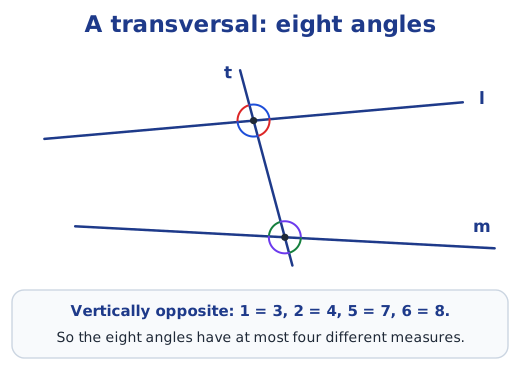
Can all eight angles be different? No. At each crossing, vertically opposite angles are equal: ∠1 = ∠3, ∠2 = ∠4, ∠5 = ∠7 and ∠6 = ∠8. So there are at most four different measures.
Can ∠6, ∠5, ∠4, ∠3 and ∠2 all be different? No, because ∠2 = ∠4, so at most four of these five can be different.
Activities 3, 4 and 5 (pages 115–117)
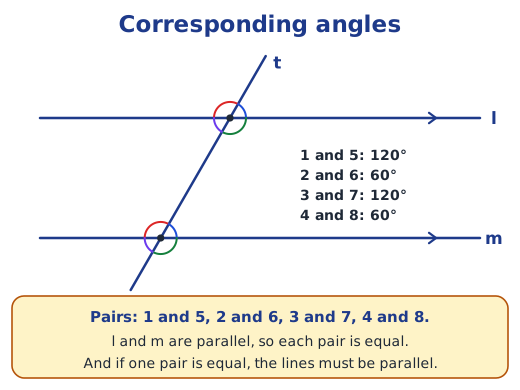
Activity 3. Following the steps, ∠a = 60° at X and ∠b = 60° at Y; only two different measures appear, 60° and 120°. What do you observe about l and m? They are parallel. Equal corresponding angles mean parallel lines.
Activity 4. The parallel lines in Fig. 5.19 are marked with matching arrows. The traced ∠a fits exactly over ∠b, and every pair of corresponding angles measures the same: corresponding angles made by a transversal across parallel lines are equal.
Activity 5. Yes, it is hard; in fact it cannot be done. Lines l and m in Fig. 5.20 are not parallel, and when two lines are not parallel, no transversal can make a pair of corresponding angles equal.
Drawing Parallel Lines (pages 118–119)
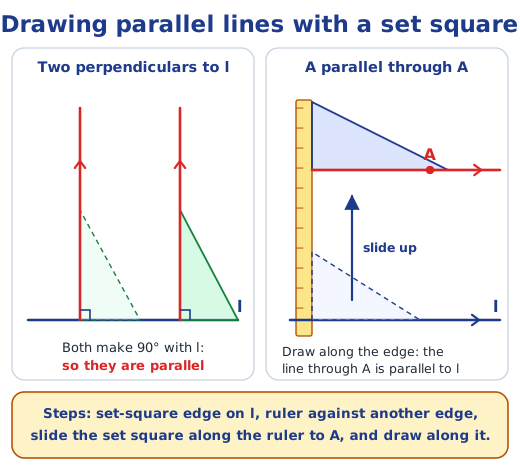
Are the two lines drawn with the set square parallel? Yes. Both make 90° with l; with l as a transversal, the corresponding angles are both 90°, so the lines are parallel.
Lines along the long side of the set square (Fig. 5.22). They are parallel too: both make the same angle with l, so the corresponding angles are equal. Check by tracing one angle onto the other, or by measuring both with a protractor.
Figure it Out: a parallel to l through A. Tools: a ruler, a set square and a pencil. Place one edge of the set square along l, hold the ruler firmly against another edge, move the set square along the ruler till the first edge passes through A, and draw along it. The new line is parallel to l.
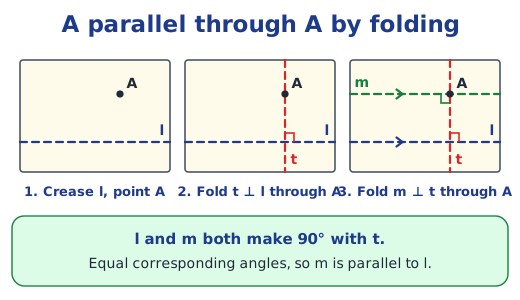
Why are l and m parallel in the paper folding (Fig. 5.24)? The crease t is perpendicular to l, and m is perpendicular to t. With t as a transversal, the corresponding angles at l and at m are both 90°, so l and m are parallel.
Alternate Angles and the examples (pages 120–122)
Activity 6: if ∠f is 120°, what is ∠d? 120°. ∠b corresponds to ∠f, so ∠b = 120°, and ∠d is vertically opposite ∠b, so ∠d = 120°. This works for any measure of ∠f, so alternate angles are always equal when the lines are parallel.
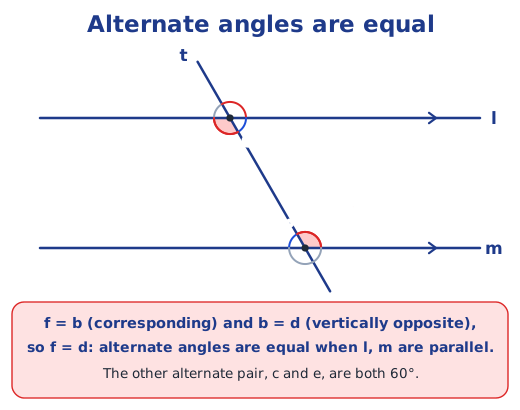
Example 1 (∠6 = 135°): ∠2, ∠4, ∠6 and ∠8 are 135°; ∠1, ∠3, ∠5 and ∠7 are 45°. Example 2 (∠a = 120°, ∠f = 70°): ∠b = 60°, which is not equal to its corresponding angle ∠f, so l and m are not parallel. Example 3 (∠3 = 50°): ∠6 = 130°. Example 4: ∠CAB = 55°, ∠ABC = 60° and ∠BCD = 120°.
Is there a relation between ∠3 and ∠6? Yes: they always add up to 180°. Proof: ∠2 + ∠3 = 180° because they form a linear pair, and ∠2 = ∠6 because they are corresponding angles, so ∠3 + ∠6 = 180°. Interior angles on the same side of a transversal across parallel lines add up to 180°.
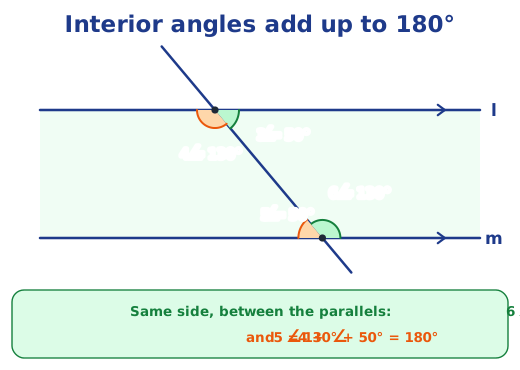
Figure it Out (pages 123–125)
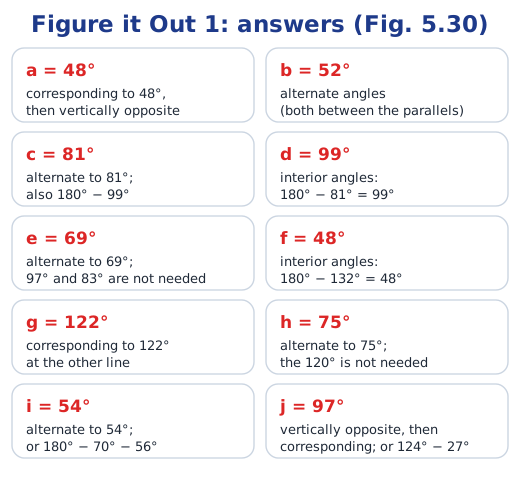
1. The angles in Fig. 5.30. a = 48°, b = 52°, c = 81°, d = 99°, e = 69°, f = 48°, g = 122°, h = 75°, i = 54°, j = 97°. The reasons are in the diagram.
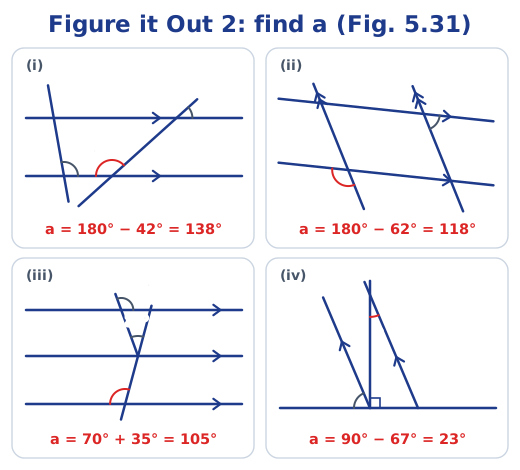
2. The angle a in Fig. 5.31.
(i) a = 180° − 42° = 138°; the 100° is not needed.
(ii) a = 180° − 62° = 118°.
(iii) The slanting line makes 180° − 110° = 70° with the parallels, and the next line turns a further 35°, so a = 70° + 35° = 105°.
(iv) The vertical line is perpendicular to the base, so it makes 90° − 67° = 23° with the slanting lines, and a = 23° as alternate angles.
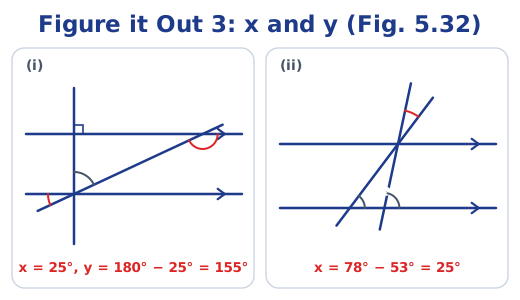
3. x and y in Fig. 5.32.
(i) The vertical line is perpendicular to the parallels, and the slanting line makes 65° with it, so the slanting line makes 90° − 65° = 25° with the parallels. x = 25° and y = 180° − 25° = 155°.
(ii) The two lines make 53° and 78° with the lower parallel, so they make the same angles with the upper one, where they meet; x = 78° − 53° = 25°.
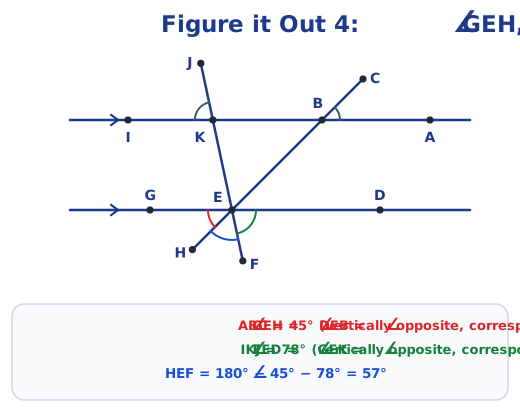
4. Fig. 5.33. ∠GEH = 45°: ∠DEB equals ∠ABC as corresponding angles, and ∠GEH is vertically opposite ∠DEB. ∠FED = 78°: ∠GEK equals ∠IKJ as corresponding angles, and ∠FED is vertically opposite ∠GEK. ∠HEF = 180° − 45° − 78° = 57°, since the three angles make a straight angle along GD.
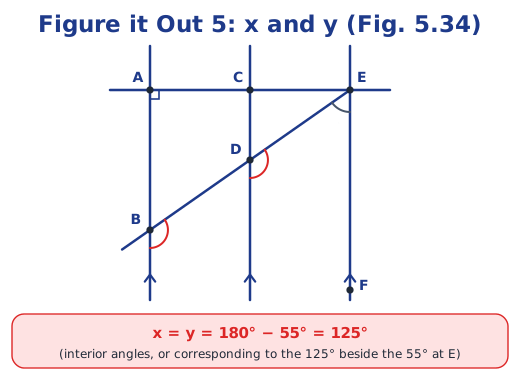
5. Fig. 5.34. ∠BEF = 55° is the angle between the slanting line BE and the vertical EF. AB, CD and EF are parallel, so at B and at D the slanting line makes 55° with the upward vertical (alternate angles), and the angles x and y below it are 180° − 55° = 125°. So x = y = 125°.
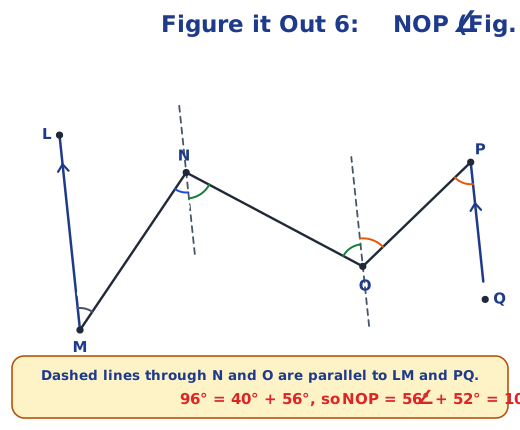
6. ∠NOP in Fig. 5.35. Draw lines through N and O parallel to LM and PQ. At N, the 96° splits into 40°, alternate to the 40° at M, and 96° − 40° = 56°. At O, the angle with ON is 56° (alternate to the 56° at N), and the angle with OP is 52° (alternate to the 52° at P). So ∠NOP = 56° + 52° = 108°.
Parallel Illusions (page 125)
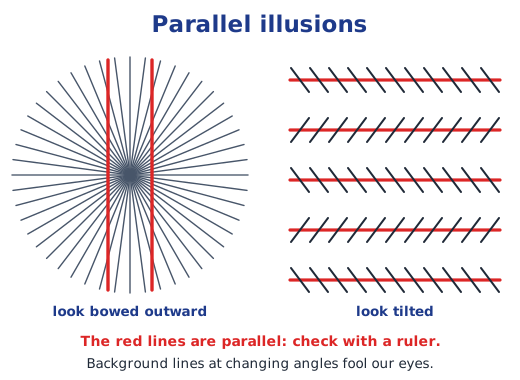
What causes these illusions? The parallel lines are crossed by background lines at angles that keep changing, a fan of lines in one picture and short slanting strokes in another. Our eyes misjudge the direction of a line near such crossings, so straight parallel lines look bowed or tilted. A ruler shows they are straight and parallel. (Extra: these are known as the Hering and Zöllner illusions.)
Short notes and more practice are on the topic pages: linear pairs and vertically opposite angles, parallel and perpendicular lines and transversals: corresponding and alternate angles.
Practice
-
Two parallel lines are crossed by a transversal, and one interior angle is 75°. What is the interior angle on the same side?
Show answer
Answer: (b) 105°
-
A transversal crosses two parallel lines and one of the eight angles is 40°. Which of these cannot be one of the eight angles?
Show answer
Answer: (c) 50°
-
How many parallel lines does a square sheet show after 3 horizontal folds, counting both edges?
Show answer
Answer: (c) 9
-
Two lines intersect and one angle is 90°. What are the other three angles, and what are the lines called?
Show answer
Answer: All three are 90°: the neighbours form linear pairs with it, 180° − 90° = 90°, and the opposite angle is vertically opposite, 90°. Lines that meet at right angles are perpendicular.
-
A transversal makes a pair of corresponding angles of 72° and 72° with lines p and q. What can you say about p and q?
Show answer
Answer: They are parallel, because equal corresponding angles show that two lines are parallel.
Stuck on a question?
Take a photo and Lagnever AI explains it step by step. Try it for 7 days for ₹2.
Get it on Google Play Open in browser
For parents: after the trial, the plan renews monthly by UPI or card autopay. You can cancel anytime in the app.