
Linear pairs and vertically opposite angles
Answer in short
When two lines intersect, they make four angles. Neighbouring angles, such as ∠a and ∠b, form a linear pair: together they make a straight angle, so they add up to 180°. Opposite angles, such as ∠b and ∠d, are vertically opposite angles and are always equal, because both make 180° with the same angle.
Stuck on a question? Take a photo and Lagnever AI explains it step by step. Try it for 7 days for ₹2. Get it on Google Play
When lines meet
Fold a square sheet of paper in different ways and draw along the creases with a pencil and a scale. Pick any two of the lines: do they meet on the paper? If not, would they meet if extended beyond it? All these lines lie on a plane surface, a flat surface like a table top, a page or the blackboard. When two lines on a plane meet at a point, we say they intersect. Two straight lines can intersect at only one point: after crossing, they keep moving apart.
Four angles at a crossing
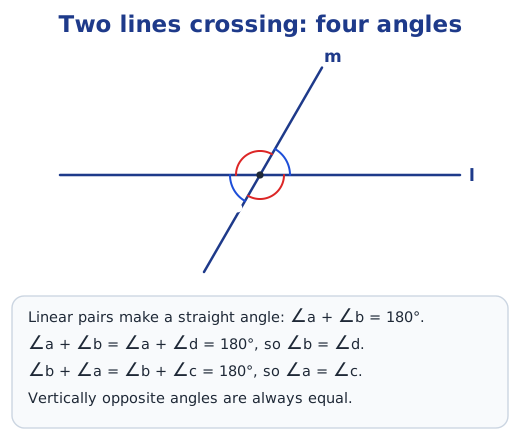
Where line l crosses line m, four angles are formed; call them ∠a, ∠b, ∠c and ∠d, going round the point. In Activity 1, draw several pairs of intersecting lines and measure the four angles with a protractor. A pattern appears: opposite angles come out equal, and neighbouring angles add up to 180°.
Can we predict the angles without measuring? Suppose ∠a is 120°. ∠a and ∠b together make a straight angle of 180°, so ∠b = 180° − 120° = 60°. Likewise ∠b and ∠c make a straight angle, so ∠c = 120°, and ∠c and ∠d make one, so ∠d = 60°. So ∠a and ∠c are both 120°, and ∠b and ∠d are both 60°.
Linear pairs
Neighbouring angles at a crossing, like ∠a and ∠b, are called a linear pair. Their outer arms lie along one straight line, so a linear pair always adds up to 180°. A crossing has four linear pairs: ∠a with ∠b, ∠b with ∠c, ∠c with ∠d, and ∠d with ∠a.
Vertically opposite angles, and a proof
Angles facing each other across the crossing, like ∠b and ∠d, are vertically opposite angles. Is it always true that they are equal, whatever the angles? Trying many values helps, but cannot cover every case. Reasoning can. Since a straight angle is 180°, ∠a + ∠b = 180° and ∠a + ∠d = 180°. Both are 180°, so ∠b and ∠d must be equal. Similarly, ∠b + ∠a = 180° and ∠b + ∠c = 180°, so ∠a = ∠c. So for any two intersecting lines, vertically opposite angles are equal. A justification like this, which works for every case without measuring, is called a proof.
When all four angles are equal
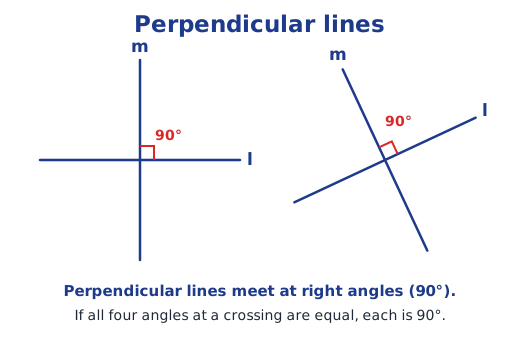
If the four angles at a crossing are all equal, each is a quarter of 360°, that is 90°. Such lines meet at right angles and are called perpendicular lines, shown with a small square at the corner.
Measurement and geometry
When you measure, a linear pair may come out as 179° or 181°, or two vertically opposite angles may differ by a little. There are two reasons: errors in using the protractor, and the thickness of the lines we draw. The ideal line of geometry has no thickness, but we cannot draw such a line. In geometry we reason about ideal lines and shapes, so we know that a straight angle split in two gives parts adding up to exactly 180°. Real measurements come very close to these predictions, which is why geometry is used so widely in physics, art, engineering and architecture.
Why it matters
Linear pairs and vertically opposite angles are the tools for every other angle fact in the chapter. Lines that never meet are explained in parallel and perpendicular lines, and the angles made by a line crossing two others in transversals: corresponding and alternate angles. Answers to every question are in the NCERT solutions for Chapter 5; see all of the Chapter 5 notes.
Practice
-
Two lines cross and ∠a = 120°. What is ∠c, vertically opposite to it?
Show answer
Answer: (b) 120°
-
Two lines cross and one angle is 35°. What are the other three angles, going round?
Show answer
Answer: (b) 145°, 35°, 145°
-
Can two straight lines intersect at more than one point?
Show answer
Answer: (b) No, at only one point
-
Prove that ∠a = ∠c when two lines intersect.
Show answer
Answer: ∠b and ∠a form a linear pair, so ∠b + ∠a = 180°. ∠b and ∠c also form a linear pair, so ∠b + ∠c = 180°. Both sums are 180°, so ∠b + ∠a = ∠b + ∠c, which gives ∠a = ∠c.
-
List the linear pairs and the vertically opposite pairs among ∠a, ∠b, ∠c and ∠d, going round the crossing.
Show answer
Answer: Linear pairs: ∠a and ∠b, ∠b and ∠c, ∠c and ∠d, ∠d and ∠a. Vertically opposite pairs: ∠a and ∠c, and ∠b and ∠d.
Questions students ask
What is a linear pair?
A linear pair is two neighbouring angles formed when two lines intersect, such as ∠a and ∠b. Their outer arms lie along one straight line, so together they make a straight angle and always add up to 180°. If one of them is 120°, the other is 60°.
What are vertically opposite angles?
They are the angles opposite each other at the point where two lines cross, such as ∠a and ∠c, or ∠b and ∠d. They are always equal: if ∠a is 120°, ∠c is also 120°, and if ∠b is 60°, so is ∠d.
Why don't measured angles always match the rule?
Because of measurement errors, such as placing a protractor slightly wrongly, and because drawn lines have thickness while the ideal line of geometry has none. Reasoning shows that a linear pair is exactly 180°; careful measurements come very close, which is why geometry is so useful in physics, art, engineering and architecture.
Stuck on a question?
Take a photo and Lagnever AI explains it step by step. Try it for 7 days for ₹2.
Get it on Google Play Open in browser
For parents: after the trial, the plan renews monthly by UPI or card autopay. You can cancel anytime in the app.