
Class 7 Maths Chapter 5: Parallel and Intersecting Lines Notes
This chapter in five lines
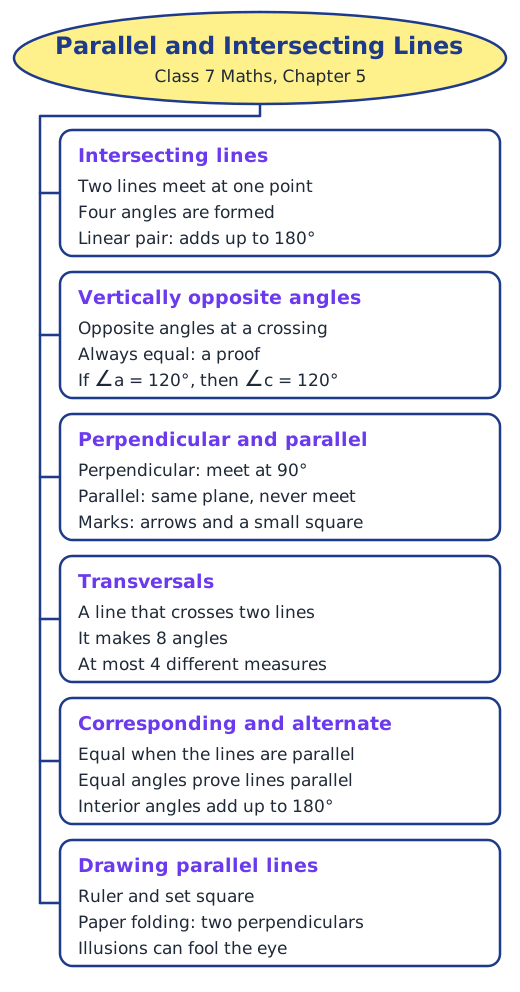
Parallel and Intersecting Lines studies lines on a flat surface. Two intersecting lines make four angles: neighbours form linear pairs adding up to 180°, and vertically opposite angles are equal. Perpendicular lines meet at 90°; parallel lines never meet. A transversal across parallel lines makes equal corresponding and alternate angles, and interior angles that add up to 180°.
What is this chapter about?
Fold a square sheet of paper in different ways and draw along the creases: you get many lines. Some pairs meet; others do not seem to meet even if you imagine them extended beyond the paper. This chapter studies how lines on a plane surface, such as a table top, a page or the blackboard, relate to each other: lines that meet, lines that meet at right angles, and lines that never meet.
Intersecting lines and their four angles
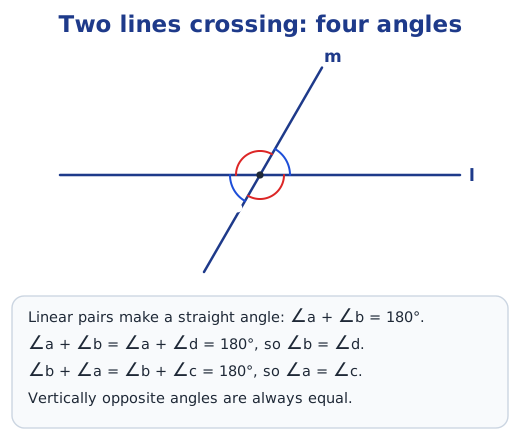
When two lines meet at a point on a plane, they intersect, and two straight lines can meet at only one point. They make four angles, a, b, c and d. If ∠a is 120°, then ∠b is 60°, because together they form a straight angle of 180°. In the same way ∠c is 120° and ∠d is 60°. Neighbouring angles such as ∠a and ∠b are a linear pair, and a linear pair always adds up to 180°. Opposite angles such as ∠b and ∠d are vertically opposite angles. Since ∠a + ∠b = 180° and ∠a + ∠d = 180°, ∠b must equal ∠d, whatever ∠a is; similarly ∠a = ∠c. Reasoning that shows something is always true, like this, is a proof. Read linear pairs and vertically opposite angles.
Measurement and geometry
When you measure a linear pair, you might get 179° or 181°, or two vertically opposite angles that differ slightly. Protractors can be placed slightly wrongly, and drawn lines have thickness, while the ideal line of geometry has none. Geometry works with ideal shapes and finds their properties by reasoning. Measurements still come very close to what reasoning predicts, which is why geometry is so useful in physics, art, engineering and architecture.
Perpendicular lines
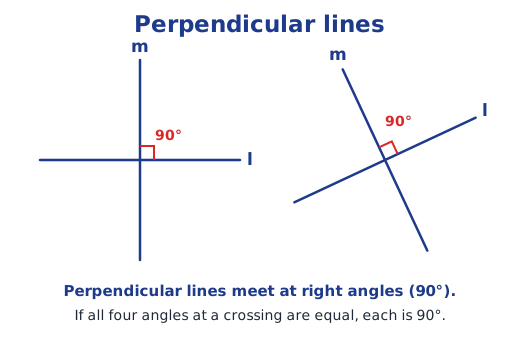
When the four angles at a crossing are all equal, each must be a right angle, 90°, since the four angles together make 360°. Lines that meet at right angles are perpendicular. They need not be horizontal and vertical: any two lines that meet at 90° are perpendicular.
Parallel lines
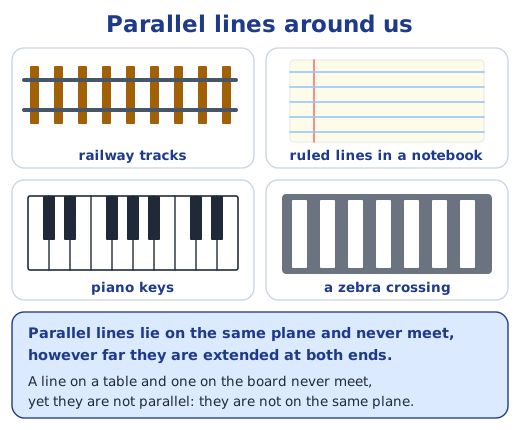
Some line segments look as if they would meet if extended, and others do not. Railway tracks, the ruled lines of a notebook and the stripes of a zebra crossing never seem to meet. Parallel lines are lines on one plane that never meet, no matter how far they are extended in either direction. Both conditions matter: lines drawn on a table and on the board may never meet, yet they lie on different planes, so they are not called parallel. Read parallel and perpendicular lines.
Paper folding and marks
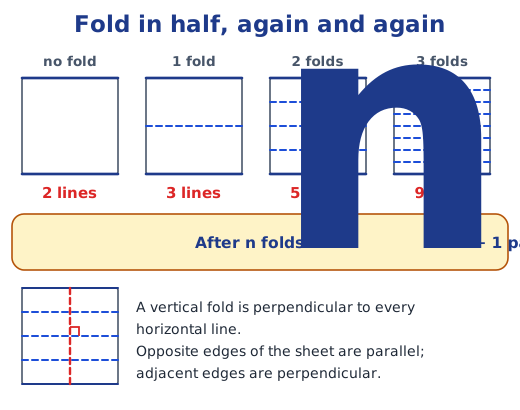
Take a square sheet. Its opposite edges are parallel and its adjacent edges are perpendicular. Fold it in half horizontally: the crease is a third line parallel to the top and bottom edges. Each new fold doubles the number of strips, so after n folds you have 2ⁿ + 1 parallel lines: 3, 5, 9 and so on. A vertical fold is perpendicular to all of them. In drawings, a set of parallel lines is marked with an arrow, a second set with two arrows, and a right angle with a small square.
Transversals and corresponding angles
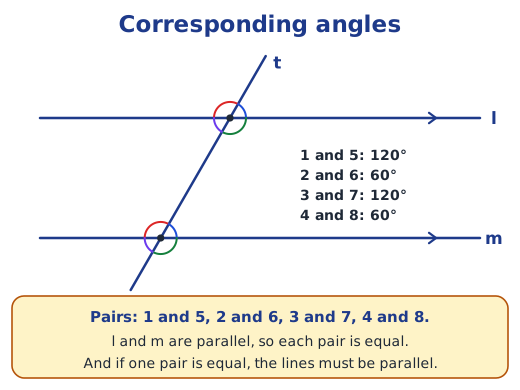
A line that crosses two lines is a transversal. It makes eight angles, four at each crossing, but each crossing has two pairs of equal vertically opposite angles, so there are at most four different measures. Angles in the same position at the two crossings, such as ∠1 and ∠5, are corresponding angles. When the two lines are parallel, corresponding angles are equal; and when a pair of corresponding angles is equal, the lines are parallel. If the lines are not parallel, corresponding angles can never be equal. Read transversals: corresponding and alternate angles.
Drawing parallel lines
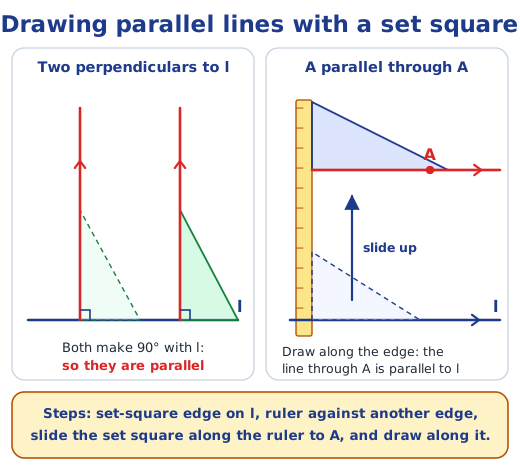
To draw parallel lines, slide a set square along a line l and draw two lines along its edge. Both make 90° with l, so the corresponding angles are equal and the lines are parallel. To draw a line parallel to l through a point A, put an edge of the set square on l, hold a ruler against another edge, move the set square along the ruler till its edge reaches A, and draw. With paper folding, fold a crease t perpendicular to l through A, then a crease m perpendicular to t through A: m is parallel to l.
Alternate and interior angles
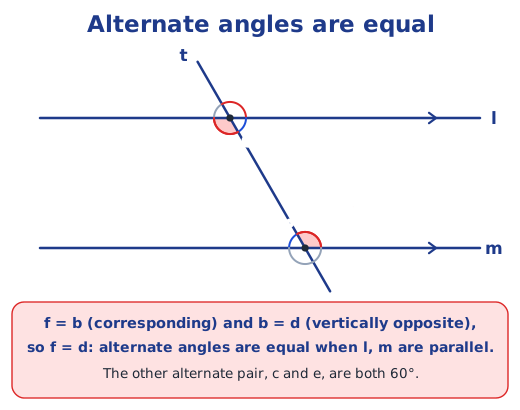
In a figure with parallel lines, ∠d is the alternate angle of ∠f: they lie between the lines, on opposite sides of the transversal. ∠f equals ∠b because they are corresponding angles, and ∠b equals ∠d because they are vertically opposite, so ∠f = ∠d: alternate angles are equal. Angles such as ∠3 and ∠6, between the lines on the same side of the transversal, are interior angles, and they add up to 180°. With these facts, one known angle gives all eight: if ∠6 is 135°, four angles are 135° and four are 45°.
Parallel illusions
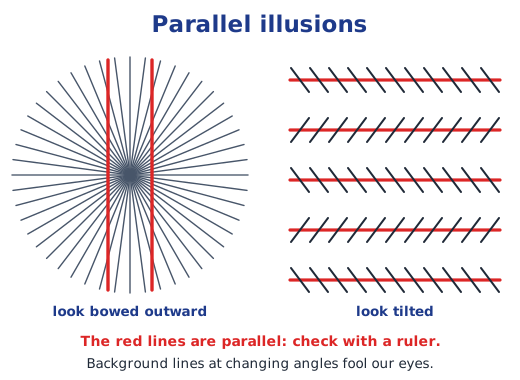
Some pictures hide parallel lines: lines drawn over a fan of lines look bowed, and lines crossed by short slanting strokes look tilted. A ruler shows they are straight and parallel; the background lines crossing them at changing angles fool our eyes.
Before we move on
Intersecting lines make linear pairs and equal vertically opposite angles; perpendicular lines meet at 90°; parallel lines never meet; and a transversal across parallel lines makes equal corresponding and alternate angles, with interior angles adding up to 180°. Answers to every question, activity and Figure it Out are in the NCERT solutions for Chapter 5.
Key terms
| Term | Meaning |
|---|---|
| Plane surface | A flat surface, such as a table top, a sheet of paper or the blackboard. The lines in this chapter lie on a plane surface. |
| Intersecting lines | Two lines that meet at a point. Two straight lines can intersect at only one point. |
| Linear pair | Two neighbouring angles formed by intersecting lines, such as ∠a and ∠b, that together make a straight angle; they always add up to 180°. |
| Vertically opposite angles | The angles opposite each other where two lines cross, such as ∠b and ∠d. They are always equal. |
| Proof | Reasoning that shows a statement is true in every case, without measuring; for example, the reasoning that vertically opposite angles are equal. |
| Perpendicular lines | Two lines that intersect at right angles (90°). A small square is drawn where they meet. |
| Parallel lines | Lines on the same plane that never meet, however far they are extended. They are marked with matching arrows. |
| Transversal | A line that crosses two other lines. It makes eight angles, four at each crossing. |
| Corresponding angles | Angles in the same position at the two crossings of a transversal, such as ∠1 and ∠5. They are equal when the lines are parallel. |
| Alternate angles | Angles between the two lines on opposite sides of the transversal, such as ∠d and ∠f. They are equal when the lines are parallel. |
| Interior angles on the same side | The two angles between the lines on one side of the transversal, such as ∠3 and ∠6. They add up to 180° when the lines are parallel. |
Topics in this chapter
Practice
-
Two lines intersect and one angle is 120°. What is the angle next to it?
Show answer
Answer: (b) 60°
-
Vertically opposite angles are always…
Show answer
Answer: (b) equal
-
How many angles does a transversal make with two lines?
Show answer
Answer: (c) 8
-
Lines l and m are parallel, and one angle of a corresponding pair is 70°. What is the other?
Show answer
Answer: (a) 70°
-
Interior angles on the same side of a transversal across parallel lines add up to…
Show answer
Answer: (b) 180°
-
When all four angles at a crossing are equal, each angle is…
Show answer
Answer: (c) 90°
Questions students ask
What are the main topics of Class 7 Maths Chapter 5?
Intersecting lines and the four angles they make; linear pairs and vertically opposite angles, with a proof; perpendicular and parallel lines; parallel and perpendicular lines in paper folding, with the arrow and square marks; transversals; corresponding angles, alternate angles and interior angles on the same side; drawing parallel lines with a set square and by folding; and parallel illusions.
Is Parallel and Intersecting Lines in the new NCERT Class 7 Maths book?
Yes. It is Chapter 5 of Ganita Prakash, the Class 7 Maths textbook Part 1 (Reprint 2026-27), on pages 107 to 126. It follows Expressions using Letter-Numbers and comes before Number Play.
Why are vertically opposite angles equal?
When two lines cross, ∠a and ∠b form a straight angle, so ∠a + ∠b = 180°, and ∠a and ∠d also form a straight angle, so ∠a + ∠d = 180°. Both sums are 180°, so ∠b = ∠d; in the same way ∠a = ∠c. The reasoning works for any pair of intersecting lines, so it is a proof.
How can you tell whether two lines are parallel?
Draw a transversal across them and compare a pair of corresponding angles. If they are equal, the lines are parallel; if they are not, the lines will meet somewhere. Equal alternate angles, or interior angles on the same side that add up to 180°, also show that the lines are parallel.
Stuck on a question?
Take a photo and Lagnever AI explains it step by step. Try it for 7 days for ₹2.
Get it on Google Play Open in browser
For parents: after the trial, the plan renews monthly by UPI or card autopay. You can cancel anytime in the app.