
Parallel and perpendicular lines
Answer in short
Perpendicular lines meet at right angles, 90°; if all four angles at a crossing are equal, each is 90°. Parallel lines lie on the same plane and never meet, however far extended. Parallel lines are marked with matching arrows and right angles with a small square, and parallels can be drawn with a set square or by folding.
Stuck on a question? Take a photo and Lagnever AI explains it step by step. Try it for 7 days for ₹2. Get it on Google Play
Perpendicular lines
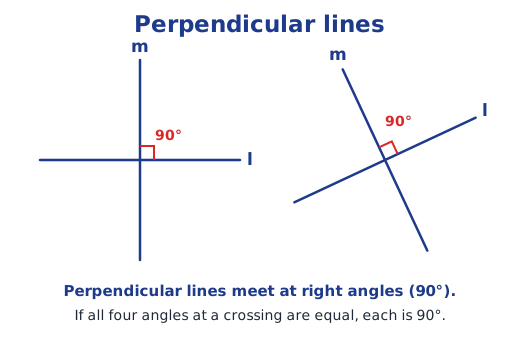
Can you draw two intersecting lines so that all four angles are equal? The four angles at a crossing add up to 360°, so if they are equal, each is 90°, a right angle. Lines that intersect at right angles are perpendicular to each other. A small square drawn in the corner shows the right angle. Perpendicular lines need not be horizontal and vertical; a pair turned at any slant is perpendicular as long as it meets at 90°.
Parallel lines
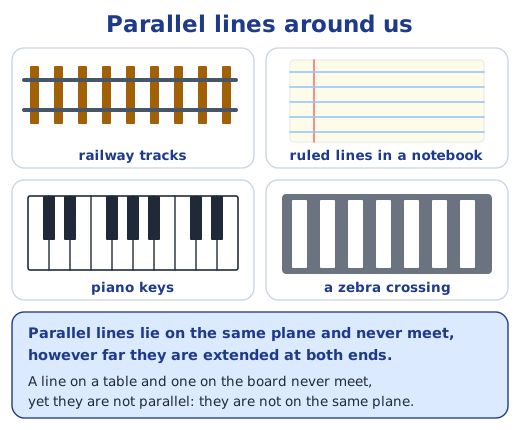
Look at line segments drawn in different directions. Some, if extended, would clearly meet; others, which keep the same distance apart, seem never to meet. Railway tracks, the ruled lines in a notebook, piano keys and the stripes of a zebra crossing are everyday examples. Parallel lines are lines on the same plane that do not meet, however far they are extended at both ends. Parallel lines are also common in artwork and shading.
The plane matters. Lines drawn on a table and on the board may never meet, yet they lie on different planes, so they are not parallel.
Which lines are parallel?
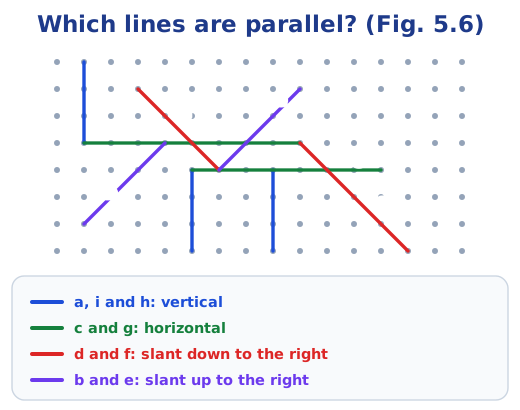
On dot paper, lines that take the same steps between dots are parallel. In Figure 5.6, the vertical lines a, h and i are parallel; the horizontal lines c and g are parallel; d and f, which slant down to the right, are parallel; and b and e, which slant up to the right, are parallel.
Parallel and perpendicular lines by folding
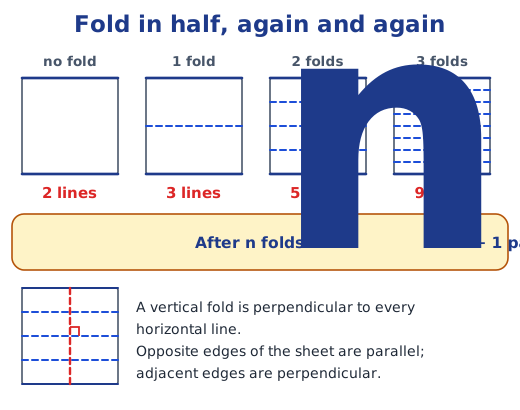
Take a square sheet of paper, such as a sheet of newspaper. Its opposite edges are parallel, and its adjacent edges are perpendicular: they meet at a point and form right angles. Fold it in half horizontally, and the crease is a new line parallel to the top and bottom edges and perpendicular to the vertical sides: 3 parallel lines. Fold the folded sheet again and there are 5; once more and there are 9. Each fold doubles the strips, so n folds give 2ⁿ + 1 parallel lines. A vertical fold is perpendicular to all the horizontal lines, and you can also fold a crease parallel to a diagonal.
Marks for parallel and perpendicular lines
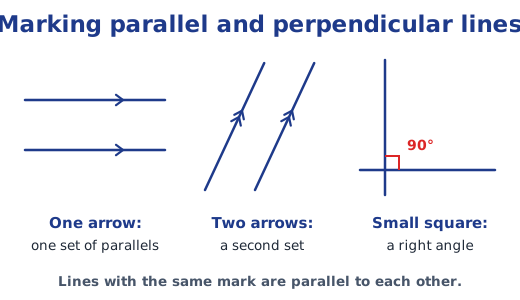
In drawings, a set of parallel lines is marked with an arrow mark (>) on each line. A second set of parallel lines gets two arrow marks, a third set three, and so on. A right angle between perpendicular lines is marked with a small square.
Drawing parallel lines
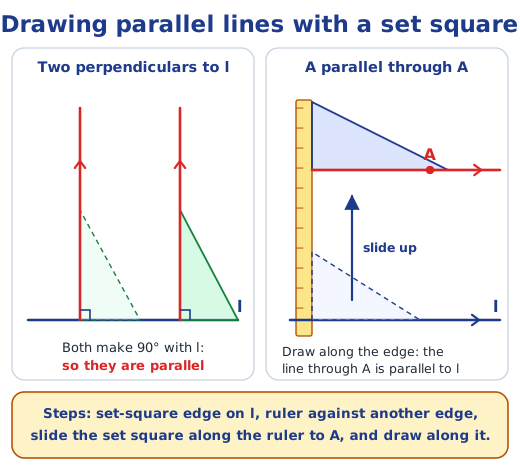
It is easy to draw parallels to horizontal or vertical lines on dot paper, but harder for slanting ones, and the eye can be fooled. A set square makes it exact. Draw a line l and move the set square along it, drawing two lines along its edge: both make 90° with l, so they are parallel. To draw a line parallel to l through a point A, place one edge of the set square on l, hold a ruler against another edge, move the set square along the ruler till the edge reaches A, and draw along it.
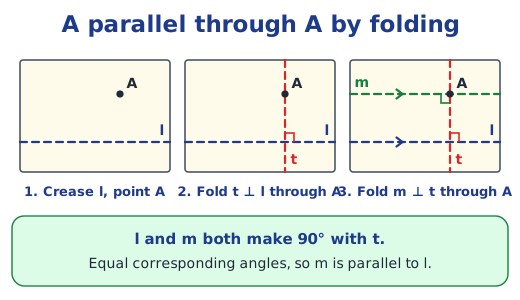
Paper folding works too. Fold a crease t perpendicular to the crease l so that it passes through A, then fold a crease m perpendicular to t through A. Lines l and m both make 90° with t, so m is parallel to l.
Why it matters
Parallel and perpendicular lines are everywhere, from roads and buildings to notebooks and tiles. Why equal angles mean that lines are parallel is explained in transversals: corresponding and alternate angles, and the angles of two crossing lines in linear pairs and vertically opposite angles. Answers to every question are in the NCERT solutions for Chapter 5; see all of the Chapter 5 notes.
Practice
-
Which pair of lines is perpendicular?
Show answer
Answer: (b) Two edges of a page that meet at a corner
-
A square sheet is folded in half twice, horizontally. Counting the edges, how many parallel lines are there?
Show answer
Answer: (c) 5
-
What does a small square at a crossing show?
Show answer
Answer: (b) The lines are perpendicular
-
How can you draw a line parallel to l through a point A with a ruler and a set square?
Show answer
Answer: Place one edge of the set square along l and hold the ruler firmly against another edge. Move the set square along the ruler till its first edge passes through A, then draw along that edge. The new line is parallel to l.
-
Why are two lines that are both perpendicular to a third line parallel to each other?
Show answer
Answer: Taking the third line as a transversal, both lines make 90° with it, so a pair of corresponding angles is equal, 90° each. Equal corresponding angles mean that the two lines are parallel.
Questions students ask
What are perpendicular lines?
Perpendicular lines are two lines that meet at right angles, 90°. When they cross, all four angles are equal, and since together they make 360°, each is 90°. The adjacent edges of a page or a table top are perpendicular, and a small square is drawn at the corner to show it.
What are parallel lines?
Parallel lines are lines on the same plane that never meet, however far they are extended at both ends, like railway tracks or the ruled lines of a notebook. Lines that never meet but lie on different planes, such as one on a table and one on the board, are not called parallel.
How do you get parallel lines by paper folding?
Fold a square sheet in half horizontally: the crease is parallel to the top and bottom edges, giving 3 parallel lines. Each further fold doubles the strips, so after n folds there are 2ⁿ + 1 parallel lines: 3, 5, 9 and so on. A vertical fold is perpendicular to all of them.
Stuck on a question?
Take a photo and Lagnever AI explains it step by step. Try it for 7 days for ₹2.
Get it on Google Play Open in browser
For parents: after the trial, the plan renews monthly by UPI or card autopay. You can cancel anytime in the app.