
Ratios and proportions: a : b and a : b :: c : d
Answer in short
A ratio a : b says that a units of one quantity go with b units of another. Its simplest form comes from dividing both terms by their HCF. Two ratios are in proportion (a : b :: c : d) when their simplest forms match, which is the same as ad = bc.
Stuck on a question? Take a photo and Lagnever AI explains it step by step. Try it for 7 days for ₹2. Get it on Google Play
What is a ratio?
A ratio compares two quantities by how many times one fits the other. We write it a : b and read it “a to b”. It tells us that a units of the first quantity go with b units of the second. A photo 6 cm wide and 4 cm tall has width to height 6 : 4. 6 and 4 are called its terms.
The order matters. Width to height is 6 : 4, but height to width is 4 : 6. When you write a ratio, say in words which quantity comes first.
How do you write a ratio in its simplest form?
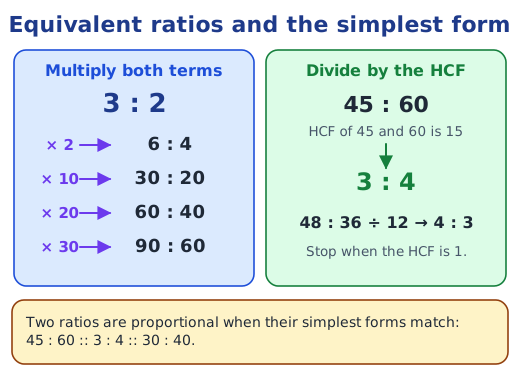
Divide both terms by their HCF. For 45 : 60 the HCF is 15, so the simplest form is 3 : 4. For 48 : 36 the HCF is 12, giving 4 : 3. Going the other way, multiplying both terms by the same number gives equivalent ratios: 3 : 2, 6 : 4, 30 : 20 and 60 : 40 all describe the same comparison.
This works like equivalent fractions. A ratio a : b behaves much like the fraction a/b when you scale both parts by the same number.
When are two ratios proportional?
Two ratios are proportional, or in proportion, when their simplest forms are the same. The sign for this is ::, as in a : b :: c : d. So 60 : 40 :: 90 : 60, because both are 3 : 2.
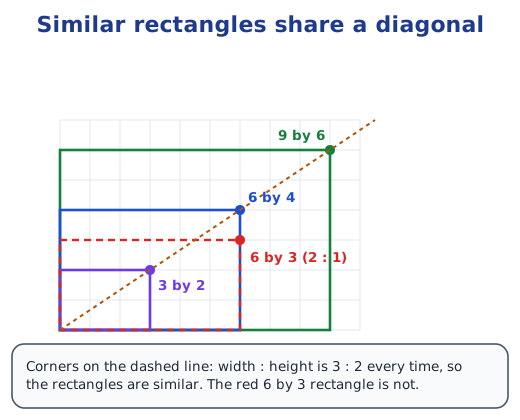
Shapes show this well. Rectangles whose width to height ratios are proportional are similar: they have the same shape in different sizes. If you draw them from one corner, their far corners fall on one straight line.
What is cross multiplication?
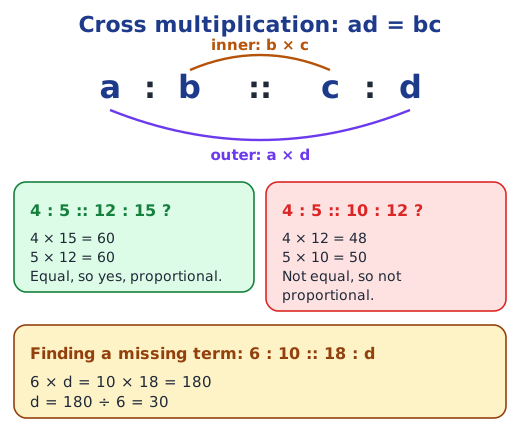
Suppose a : b :: c : d. Then c is some factor f times a, and d is the same f times b. So c ÷ a = d ÷ b, and multiplying both sides by ab gives ad = bc. The outer terms multiply to the same number as the inner terms.
This gives a quick test. Is 4 : 5 :: 12 : 15? 4 × 15 = 60 and 5 × 12 = 60, so yes. Is 4 : 5 :: 10 : 12? 48 is not 50, so no.
How do you find a missing term?
If three numbers of a proportion are known, cross multiplication gives the fourth: from a : b :: c : d, d = b × c ÷ a. For 6 : 10 :: 18 : d, d = 10 × 18 ÷ 6 = 30. You can also find the factor of change: 18 is 3 times 6, so d is 3 times 10.
The factor need not be a whole number. In 14 : 21 :: 6 : ?, the factor is 6 ÷ 14 = 3/7, and 21 × 3/7 = 9.
What is the Rule of Three?
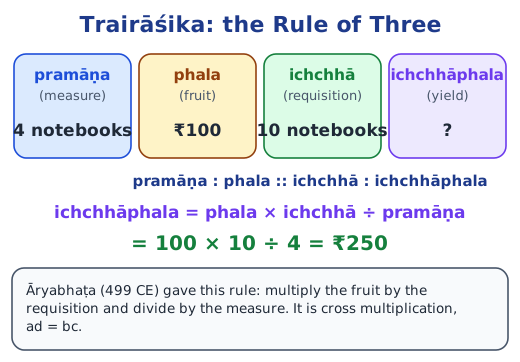
Indian mathematicians solved such problems long ago and called them Trairāśika, the Rule of Three. Āryabhaṭa (499 CE) named the three known numbers pramāṇa (the measure), phala (the fruit) and ichchhā (the requisition), and the answer ichchhāphala (the yield). In short, his rule is phala times ichchhā, divided by pramāṇa. That is exactly d = b × c ÷ a.
For example, if 4 notebooks cost ₹100, then 10 notebooks cost 100 × 10 ÷ 4 = ₹250. Before using the rule, make sure the matching quantities are in the same units.
Does adding the same number keep a ratio?
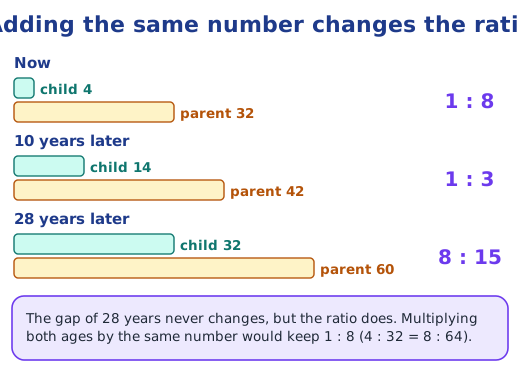
No. A child of 4 and a parent of 32 have ages in the ratio 1 : 8. Ten years later the ages are 14 and 42, which is 1 : 3. The gap stays 28 years, but the ratio changes. Only multiplying or dividing both terms by the same number keeps a ratio.
When can you not use the Rule of Three?
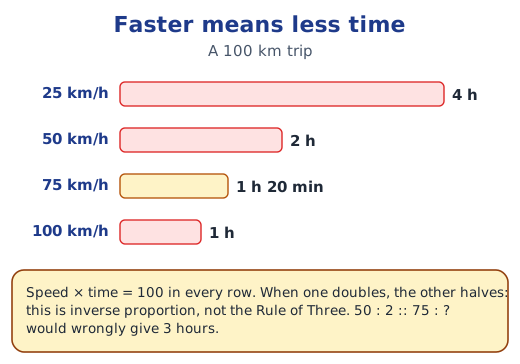
The rule works only when both quantities grow by the same factor. For a fixed trip, a faster speed means less time. A 100 km trip takes 2 hours at 50 km/h but 1 hour 20 minutes at 75 km/h. Writing 50 : 2 :: 75 : ? would give 3 hours, which is wrong. Here speed × time stays the same, which is inverse proportion, studied in Part 2.
Read next: the chapter notes, dividing in a given ratio, unit conversions, inverse proportion and the NCERT solutions.
Practice
-
The simplest form of 84 : 36 is:
Show answer
Answer: (b) 7 : 3
-
Which ratio is proportional to 5 : 8?
Show answer
Answer: (b) 15 : 24
-
If 3 : 7 :: x : 28, then x is:
Show answer
Answer: (a) 12
-
Are 18 : 27 and 30 : 45 proportional? Show two ways.
Show answer
Answer: Yes. Simplest forms: 18 : 27 ÷ 9 = 2 : 3 and 30 : 45 ÷ 15 = 2 : 3. Cross multiplication: 18 × 45 = 810 and 27 × 30 = 810.
-
5 pens cost ₹60. What do 8 pens cost?
Show answer
Answer: 5 : 60 :: 8 : ?, so ? = 60 × 8 ÷ 5 = ₹96. Or 1 pen costs 60 ÷ 5 = ₹12, and 8 pens cost ₹96.
Questions students ask
What is the difference between a ratio and a proportion?
A ratio compares two quantities, such as 3 : 2. A proportion says that two ratios are equal, such as 3 : 2 :: 6 : 4. A proportion is a statement about two ratios.
How do you find the simplest form of a ratio?
Find the HCF of the two terms and divide both by it. For 72 : 96 the HCF is 24, so the simplest form is 3 : 4. When the HCF of the terms is 1, nothing more can be cancelled.
What is cross multiplication in ratios?
If a : b :: c : d, then a × d = b × c. You can use it to check a proportion (4 : 5 :: 12 : 15 because 60 = 60) or to find a missing term (6 : 10 :: 18 : d gives d = 30).
Why does adding the same number change a ratio?
A ratio is about the factor between the terms, not the gap. Adding 10 years to ages 4 and 32 keeps the gap of 28 but turns 1 : 8 into 14 : 42, which is 1 : 3.
Stuck on a question?
Take a photo and Lagnever AI explains it step by step. Try it for 7 days for ₹2.
Get it on Google Play Open in browser
For parents: after the trial, the plan renews monthly by UPI or card autopay. You can cancel anytime in the app.