
NCERT Solutions Class 8 Maths Chapter 7: Proportional Reasoning-1
Answers to the questions inside the chapter, all four Figure it Out sets and the Binairo puzzle in Chapter 7, Proportional Reasoning-1, of Ganita Prakash, Grade 8 Part 1. Page numbers follow the book (pages 159–178). Every ratio and every answer here was checked by computing it again, and every proportion by cross multiplication. Where a question asks you to measure something or bring your own data, our numbers are only examples. Short notes: Chapter 7 notes.
Similar images (pages 159–161)
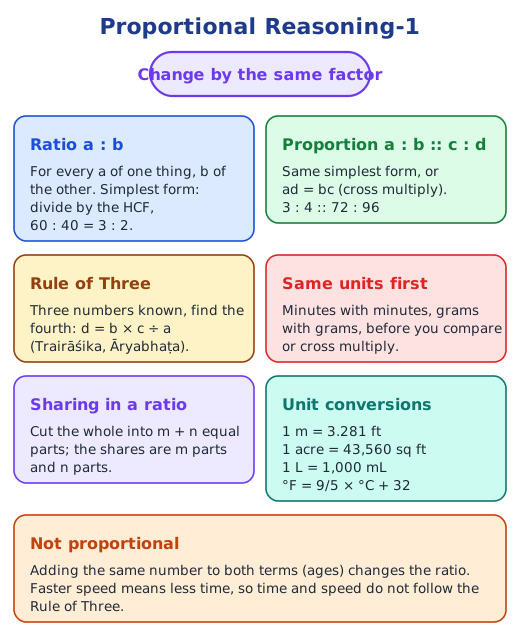
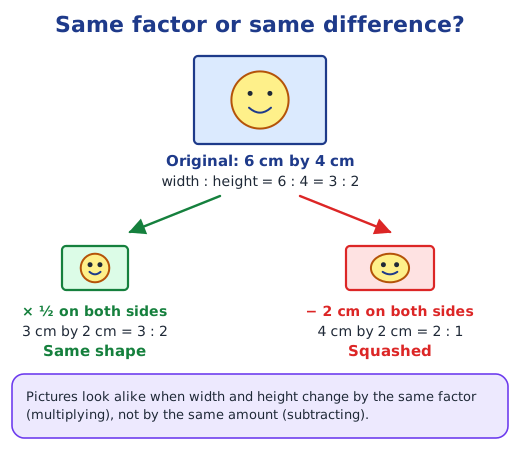
What makes A, C and D match, while B and E do not? In A, C and D the width and height change by the same factor. In B both lose the same amount, 20 mm, which is not the same factor, and E is a square. So B looks stretched and E squashed.
Image D against image A: what factor for the width, what factor for the height, and are they equal? Width: 90 ÷ 60 = 3/2. Height: 60 ÷ 40 = 3/2. Yes, both are multiplied by 3/2 (that is, 1.5), so D looks like A.
By what factor should 60 : 40 be multiplied to get 90 : 60? By 3/2: 60 × 3/2 = 90 and 40 × 3/2 = 60.
Simplest forms. HCF of 60 and 40 is 20, so A is 3 : 2. D, 90 : 60, divided by 30 is also 3 : 2. B, 40 : 20, is 2 : 1 and E, 60 : 60, is 1 : 1, so B and E do not match the 3 : 2 of A, C and D.
Your school and your blackboard (page 163)
Example 4: the teacher-to-student ratio. Count in your own school. Our example: a school with 12 teachers and 408 students has 12 : 408. The HCF is 12, so it is 1 : 34. The book’s school, 5 : 170, divided by 5 is also 1 : 34, so these two are proportional. A school with 15 teachers and 450 students has 1 : 30, which is not proportional to 1 : 34; it has more teachers for each student.
Example 5: the blackboard. Measure to the nearest cm. Our example: a board 240 cm wide and 120 cm tall has width to height 240 : 120 = 2 : 1. A rectangle 10 cm by 5 cm in the notebook keeps that ratio. Classmates may draw different sizes, such as 8 cm by 4 cm, but every rectangle in the ratio 2 : 1 has the same shape.
Missing terms (page 164)
Example 7: what factor turns 14 into 6? Can it be an integer? No. 6 is less than 14, so the factor must be a fraction: 14 × y = 6 gives y = 6/14 = 3/7. Then 21 × 3/7 = 9, and the ratio is 6 : 9.
Filter coffee (pages 164–165)
Why is 20 : 30 stronger than 15 : 35? Both make 50 mL, but 20 : 30 has more decoction and less milk. In simplest form, 20 : 30 = 2 : 3 and 15 : 35 = 3 : 7. For every 100 mL of milk, the stronger cup has about 67 mL of decoction, the regular about 43 mL.
Why is 10 : 40 lighter? 10 : 40 = 1 : 4 has less decoction for the same milk: 25 mL for every 100 mL of milk.
The table. Compare each mix with regular, 3 : 7 (about 43 mL of decoction for 100 mL of milk):
| Decoction : milk | Simplest form | Coffee |
|---|---|---|
| 300 : 600 | 1 : 2 (50 per 100) | Strong |
| 150 : 500 | 3 : 10 (30 per 100) | Light |
| 200 : 400 | 1 : 2 (50 per 100) | Strong |
| 24 : 56 | 3 : 7 (about 43 per 100) | Regular |
| 100 : 300 | 1 : 3 (about 33 per 100) | Light |
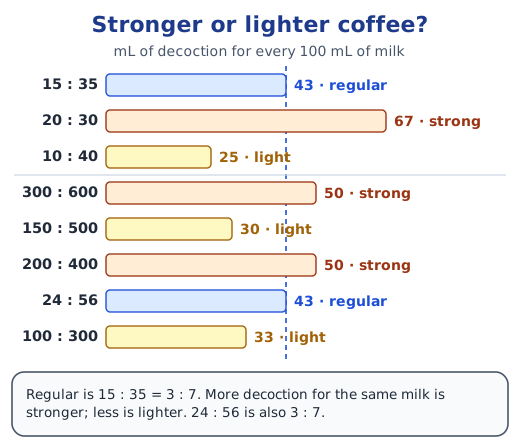
Figure it Out (pages 165–167)
1. True ones: (i), (iv) and (vi).
- (i) 4 : 7 :: 12 : 21: true. 4 × 21 = 84 = 7 × 12.
- (ii) 8 : 3 :: 24 : 6: false. 8 × 6 = 48 but 3 × 24 = 72 (24 : 6 is 4 : 1).
- (iii) 7 : 12 :: 12 : 7: false. 49 is not 144.
- (iv) 21 : 6 :: 35 : 10: true. Both are 7 : 2; 21 × 10 = 210 = 6 × 35.
- (v) 12 : 18 :: 28 : 12: false. 12 : 18 = 2 : 3 but 28 : 12 = 7 : 3.
- (vi) 24 : 8 :: 9 : 3: true. Both are 3 : 1; 24 × 3 = 72 = 8 × 9.
2. Multiply both terms of 4 : 9 by the same number: 8 : 18, 12 : 27 and 40 : 90. Any 4k : 9k works, even 2 : 4.5.
3. 18 : 24 = 3 : 4, so the second term is 4/3 of the first:
- 3 : 4
- 12 : 16
- 20 : 80/3 (that is, 26⅔)
- 27 : 36
Check 20 : 80/3 by cross multiplication: 18 × 80/3 = 480 = 24 × 20.
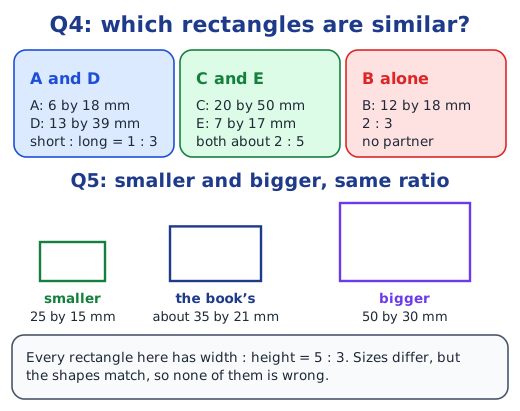
4. Measure the short and long side of each rectangle. Our measurements on the printed page, to the nearest mm:
- A, about 6 mm by 18 mm, and D, about 13 mm by 39 mm: both 1 : 3, so A and D are similar.
- C, about 20 mm by 50 mm, and E, about 7 mm by 17 mm: both about 2 : 5, so C and E are similar.
- B, about 12 mm by 18 mm, is 2 : 3 and is not similar to any other.
Turning a rectangle does not change its shape, so C, D and E can be compared with A and B even though they are drawn tilted. A printed copy may be a little bigger or smaller, but the ratios stay the same.
5. The rectangle is about 35 mm wide and 21 mm tall, so width to height is 5 : 3. A smaller one, 25 mm by 15 mm, and a bigger one, 50 mm by 30 mm, keep 5 : 3. Classmates may choose other sizes, such as 4 cm by 2.4 cm. They are not wrong as long as width to height is 5 : 3: the shapes match even if the sizes do not. A drawing that looks different has probably changed both sides by the same amount instead of the same factor, or measured to a different accuracy.
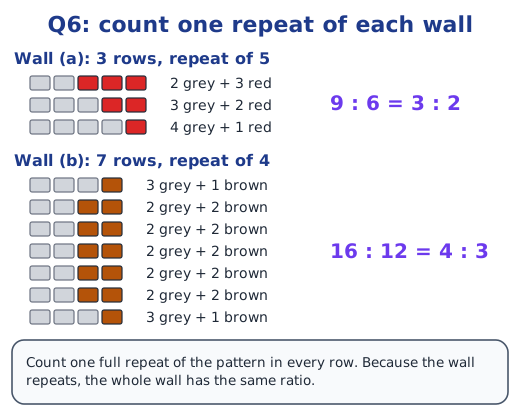
6. Count one full repeat of the pattern in every row.
- (a) Each of the 3 rows repeats every 5 bricks: 2 grey and 3 red, 3 grey and 2 red, 4 grey and 1 red. Grey : red = 9 : 6 = 3 : 2.
- (b) Each of the 7 rows repeats every 4 bricks: 3 grey and 1 brown in the top and bottom rows, 2 and 2 in the five rows between. Grey : brown = 16 : 12 = 4 : 3.
Since the pattern repeats all along the wall, the whole wall has the same ratio.
7. Measure a friend. Our example: head 20 cm, torso 60 cm, arm 60 cm, leg 80 cm. Then head : torso = 1 : 3, torso : arms = 1 : 1 and torso : legs = 3 : 4. Dividing every length by 10 gives a drawing with a 2 cm head, 6 cm torso, 6 cm arms and 8 cm legs. It looks realistic because every part is scaled by the same factor. A drawing with a 6 cm head on the same body would look like a cartoon, because the ratio head : torso would be 1 : 1 instead of 1 : 3.
The Rule of Three (pages 167–170)
Example 9: is 150 : 90 :: 4 : ? right? No. 150 is in minutes and 4 is in hours. Write 4 hours as 240 minutes: 150 : 90 :: 240 : ?.
Find the distance in 240 minutes in different ways. All give 144 km.
- Cross multiplication: ? = 90 × 240 ÷ 150 = 144.
- Unit rate: 90 ÷ 150 = 0.6 km each minute, and 0.6 × 240 = 144.
- Speed in km/h: 150 minutes is 2.5 hours, so the speed is 90 ÷ 2.5 = 36 km/h, and 36 × 4 = 144.
- Building up: 30 minutes is a fifth of 150, so 18 km; 240 minutes is 8 × 30, so 8 × 18 = 144.
Example 10: which tea is more expensive, and why? Compare the price of the same weight. 200 g is a fifth of 1 kg, so 1 kg of the Himachal tea costs 5 × ₹200 = ₹1,000, against ₹800 for the Meghalaya tea. The Himachal tea is more expensive, by ₹200 for each kg. Ideas to discuss in class, our own and not from the book: a small farmer makes and packs less tea, and selling in small packets usually costs more for each gram.
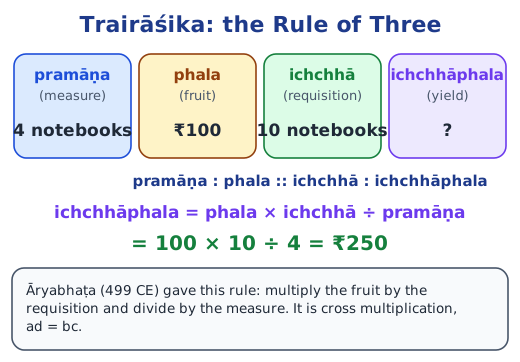
(The book dates Āryabhaṭa to 199 CE on page 168. Chapters 1 and 3 of the same book give 499 CE, the year of his Āryabhaṭīya, so we use 499 CE.)
Activity 1: a dish for 15 guests. Our example: poha for a family of 5 needs 2 cups of poha, 2 onions, 1 tablespoon of oil and half a teaspoon of salt. 15 guests is 3 times 5 people, so multiply everything by 3: 6 cups of poha, 6 onions, 3 tablespoons of oil and 1½ teaspoons of salt. If the family also eats, that is 20 people, a factor of 4. (Cooks often add salt and spices by taste rather than by exact ratio.)
Figure it Out (pages 170–171)
1. A year has about 52 weeks. 940,000,000 ÷ 52 ≈ 18,076,923 km, so the Earth travels about 18 million km (1.8 crore km) in a week. Using 365 days instead, 940,000,000 × 7 ÷ 365 ≈ 18,027,397 km, which is also about 18 million km.
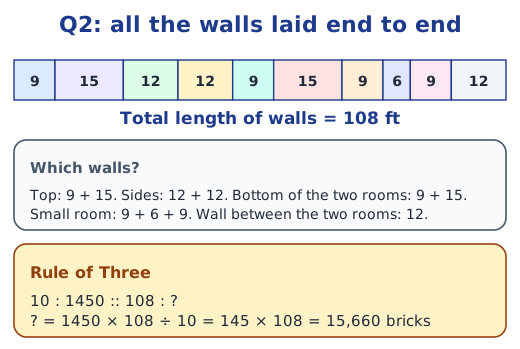
2. Add up all the walls in the plan: 9 + 15 along the top, 12 and 12 for the two sides, 9 and 15 along the bottom of the two big rooms, 9 + 6 + 9 round the small room, and 12 for the wall between the two big rooms. Total = 108 ft.
10 : 1450 :: 108 : ?, so ? = 1450 × 108 ÷ 10 = 145 × 108 = 15,660 bricks.
(This counts the 6 ft wall between the bigger room and the small room below it, which the plan draws. Without it the walls are 102 ft, and 102 × 145 = 14,790 bricks.)
When the Rule of Three does not work (pages 171–172)
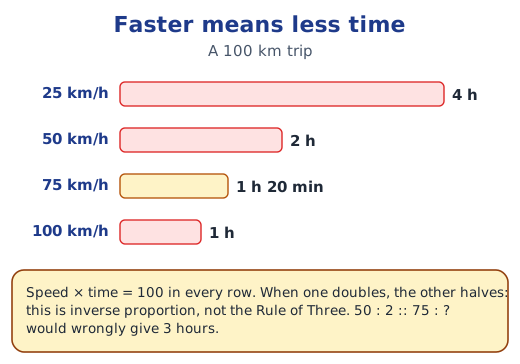
Puneeth’s father on the faster ride: time taken, and does the Rule of Three fit? Less. The distance is 50 × 2 = 100 km. At 75 km/h it takes 100 ÷ 75 = 4/3 hours = 1 hour 20 minutes. 50 : 2 :: 75 : ? would give 3 hours, more time at a faster speed, which cannot be right. When the speed goes up, the time goes down, so speed and time are not in proportion; their product, the distance, stays the same. This is inverse proportion.
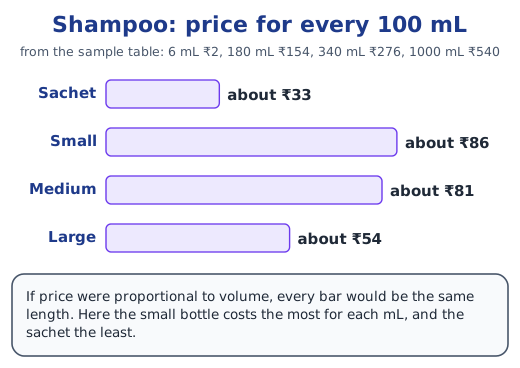
Activity 2: is the shampoo price proportional to the volume? Sachet to small bottle: volumes 6 : 180 = 1 : 30, prices 2 : 154 = 1 : 77. Not proportional. Price for every 100 mL in the sample table: sachet about ₹33, small about ₹86, medium about ₹81, large ₹54.
Why are the prices not proportional? The price covers more than the shampoo: the bottle or sachet, filling, transport and the shop’s costs, and companies set prices for each size separately. In this table the sachet is the cheapest for each mL and the small bottle the dearest. So never assume that one size is always the cheapest; work out the price for each mL.
Pros and cons of sizes. For customers, a sachet costs little at a time and suits a trip, but it makes a lot of packaging for little shampoo; a large bottle lasts long but needs more money at once. For the company, sachets reach people who buy small amounts, while large bottles use less packing material for each mL.
For a smaller ecological footprint, we would suggest larger or refillable bottles and fewer sachets, because the packaging for each mL of shampoo is much less. (Extra, our view: small multi-layer plastic sachets are hard to collect and recycle.)
Other products. Make the same table for rice, atta, oil or soap: write the price and the quantity of each pack, change to one unit (grams or mL), and work out the price of 1 kg or 1 L for each. If those prices match, the price is proportional to the quantity. Loose rice or atta weighed out from a sack is sold at a price per kg, so its price is proportional to the weight.
Sharing, but not equally (pages 172–175)
Activity 3. With 12 counters:
- Shared equally: 6 and 6, ratio 6 : 6 = 1 : 1.
- Your partner takes 5: you get 12 − 5 = 7, and the ratio is 5 : 7.
- In the ratio 3 : 1: each round uses 3 + 1 = 4 counters, and 12 ÷ 4 = 3 rounds, so your partner gets 9 and you get 3.
- 42 counters in the ratio 4 : 3: 4 + 3 = 7 groups of 42 ÷ 7 = 6, so your partner gets 24 and you get 18.
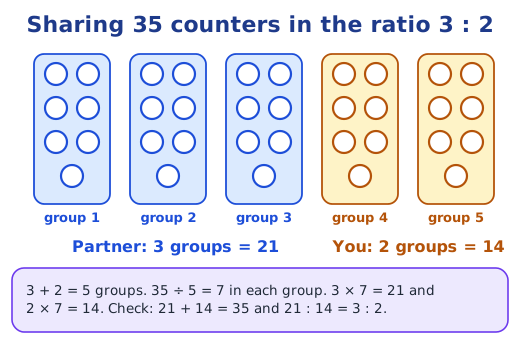
Figure it Out (page 175)
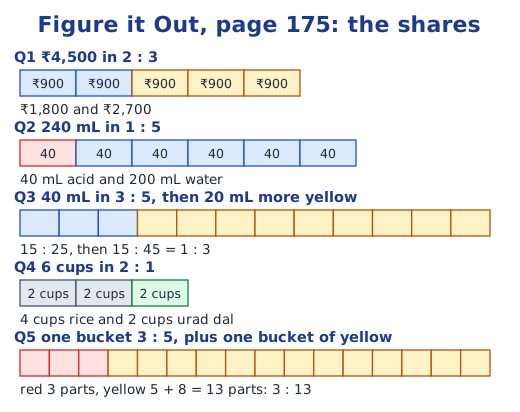
1. 2 + 3 = 5 parts of 4500 ÷ 5 = ₹900. Shares: ₹1,800 and ₹2,700. Check: 1800 + 2700 = 4500, and 1800 : 2700 = 2 : 3.
2. 1 + 5 = 6 parts of 240 ÷ 6 = 40 mL. Acid 40 mL, water 200 mL.
3. 3 + 5 = 8 parts of 40 ÷ 8 = 5 mL. Blue 15 mL and yellow 25 mL. After adding 20 mL of yellow: blue 15 mL, yellow 45 mL, so the new ratio is 15 : 45 = 1 : 3.
4. 2 + 1 = 3 parts of 6 ÷ 3 = 2 cups. Rice 4 cups, urad dal 2 cups.
5. Think of the bucket as 8 equal parts: 3 red and 5 yellow. Another bucket of yellow, the same size, adds 8 parts of yellow. Red : yellow = 3 : (5 + 8) = 3 : 13. (We take the second bucket to be the same size and full.)
Unit conversions (pages 175–177)
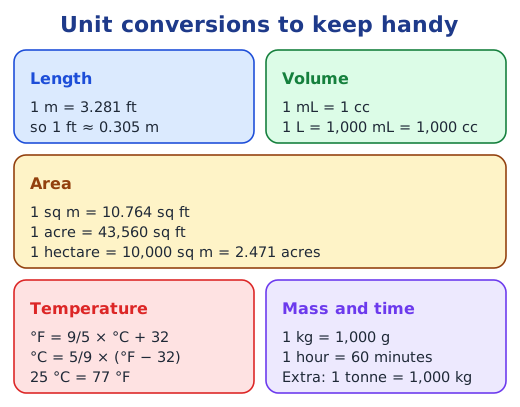
Check the example: 25 °C = 77 °F. 9/5 × 25 + 32 = 45 + 32 = 77. Going back, 5/9 × (77 − 32) = 5/9 × 45 = 25.
Figure it Out (pages 176–177)
1. 600 : 900. The HCF is 300, so orange juice : apple juice = 2 : 3.
2. Last year 3 full buses carried 162 people, so one bus holds 162 ÷ 3 = 54. This year 204 ÷ 54 ≈ 3.8, so 4 buses are needed. They have 4 × 54 = 216 seats, so not all are full: 3 buses are full and the fourth carries 204 − 162 = 42, with 12 seats empty. (The question says 204 students; if teachers travel too, add them. Up to 12 more people still fit in 4 buses.)
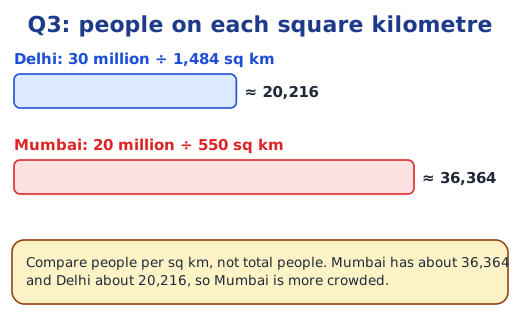
3. Compare people on each square kilometre.
- Delhi: 30,000,000 ÷ 1,484 ≈ 20,216 people per sq km.
- Mumbai: 20,000,000 ÷ 550 ≈ 36,364 people per sq km.
Mumbai is more crowded. It has fewer people in all, but far more on each square kilometre, because its area is much smaller.
4. Neck : rest of body = 4 : 6, so the neck is 4 out of every 10 parts of the height. The crane’s neck is 4 × 155 ÷ 10 = 62 cm. For your height h, neck = 4 × h ÷ 10 = 0.4 × h. Our example: for a height of 150 cm the neck would be 60 cm, leaving 90 cm below it.
5. Write the money and the saffron in the same order. 3/7 niska buys 2½ palas, so 1 niska buys 2½ ÷ 3/7 = 5/2 × 7/3 = 35/6 palas. For 9 niskas: 9 × 35/6 = 52½ palas of saffron. By cross multiplication: 3/7 : 5/2 :: 9 : ?, so ? = 5/2 × 9 ÷ 3/7 = 45/2 × 7/3 = 52.5.
6. The age gap is 5 − 1 = 4 years and never changes. In the ratio 1 : 2 the brother is twice as old as Harmain, so the gap equals her age. Harmain will be 4 (and her brother 8), 3 years from now. Check: 4 : 8 = 1 : 2.
7. Gold : water = 37 : 2 for equal volumes. With water 1 kg: 37 : 2 :: ? : 1, so ? = 37 ÷ 2 = 18.5 kg. One litre of gold has a mass of 18.5 kg.
8. The plot is 200 × 500 = 100,000 sq ft. 1 acre = 43,560 sq ft, so the plot is 100,000 ÷ 43,560 ≈ 2.30 acres. Manure: 43,560 : 10 :: 100,000 : ?, so ? = 10 × 100,000 ÷ 43,560 ≈ 22.96 tonnes, about 23 tonnes. (Extra: 1 tonne = 1,000 kg, so this is about 22,957 kg.)
9. 10 L = 10,000 mL = 20 mugs of 500 mL. 20 × 15 = 300 seconds = 5 minutes. As a proportion: 500 : 15 :: 10,000 : ?, so ? = 15 × 10,000 ÷ 500 = 300 s.
10. 1 acre = 43,560 sq ft. 43,560 : 15,00,000 :: 2,400 : ?, so ? = 15,00,000 × 2,400 ÷ 43,560 ≈ ₹82,645.
11. With oxen: 6 hours for each acre, so 20 acres take 20 × 6 = 120 hours. A tractor is 4 times faster, so it takes a quarter of the time: 120 ÷ 4 = 30 hours (1.5 hours an acre). The first part is a proportion: more acres, more hours. The second is not: the faster worker takes less time, so we divide by 4 instead of multiplying.
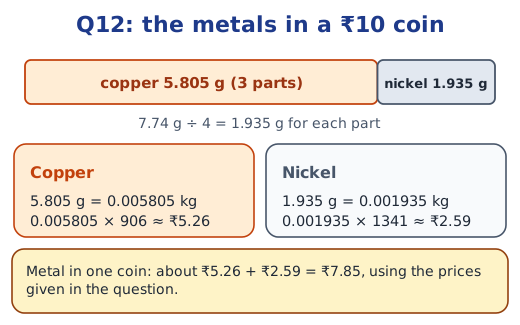
12. Copper : nickel = 3 : 1, so the 7.74 g coin has 4 parts of 7.74 ÷ 4 = 1.935 g.
- Copper: 3 × 1.935 = 5.805 g = 0.005805 kg. Cost: 0.005805 × 906 ≈ ₹5.26.
- Nickel: 1.935 g = 0.001935 kg. Cost: 0.001935 × 1,341 ≈ ₹2.59.
- Metal in one coin: about 5.26 + 2.59 = ₹7.85, at the prices given in the question.
Puzzle Time: Binairo (page 178)
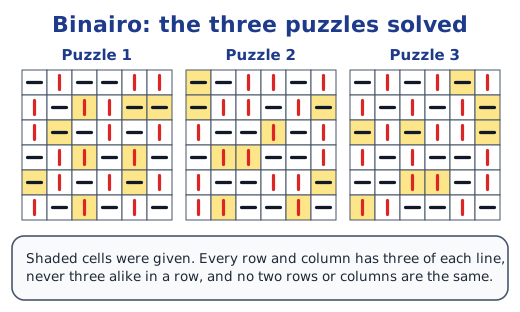
Each puzzle has exactly one solution; we checked every possible grid. Row by row, from the top, with H for a horizontal line and V for a vertical line:
- Puzzle 1: HVHHVV, VHVVHH, VHHVHV, HVVHVH, HVHVHV, VHVHVH.
- Puzzle 2: HHVVHV, HVVHVH, VHHVHV, HVVHHV, VHHVVH, VVHHVH.
- Puzzle 3: HVHVHV, VHVHVH, HVHVVH, VHVHHV, HHVVHV, VVHHVH.
How to start: wherever two equal lines sit side by side, the cells on both sides must hold the other line. Once a row or column has three of one kind, fill the rest with the other kind. If two rows could become the same, the last cells must make them different.
Practice
-
Which pair of ratios is proportional?
Show answer
Answer: (b) 6 : 9 and 10 : 15
-
12 L of paint covers 96 sq m of wall. How much wall does 5 L cover?
Show answer
Answer: (a) 40 sq m
-
₹2,400 is shared in the ratio 7 : 5. The smaller share is:
Show answer
Answer: (a) ₹1,000
-
Convert 30 °C to Fahrenheit.
Show answer
Answer: °F = 9/5 × 30 + 32 = 54 + 32 = 86 °F.
-
A farm is 2 hectares. About how many acres is it?
Show answer
Answer: 1 hectare = 2.471 acres, so 2 hectares = 2 × 2.471 = 4.942 acres, about 5 acres.
Stuck on a question?
Take a photo and Lagnever AI explains it step by step. Try it for 7 days for ₹2.
Get it on Google Play Open in browser
For parents: after the trial, the plan renews monthly by UPI or card autopay. You can cancel anytime in the app.