
Class 8 Maths Chapter 7: Proportional Reasoning-1 Notes
This chapter in five lines
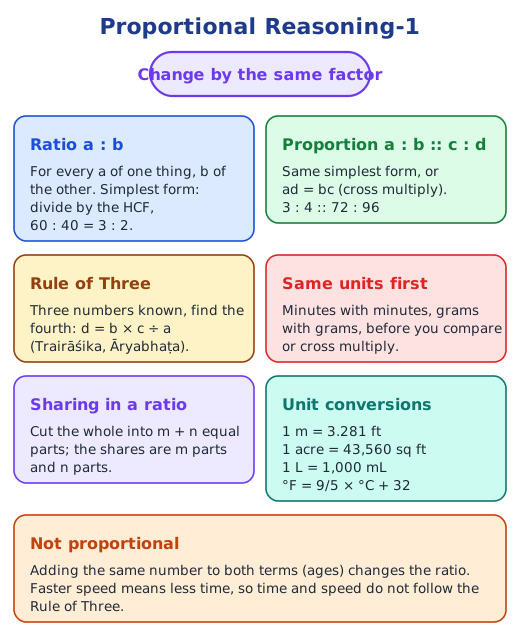
This chapter is about comparing quantities by multiplying, not subtracting. A ratio a : b says that for every a of one thing there are b of another. Two ratios are proportional when both terms are multiplied by the same number, which means ad = bc. The chapter uses this to find a missing quantity (the Rule of Three), to share a whole in a given ratio, and to convert between units.
What is this chapter about?
This is the seventh and last chapter of Ganita Prakash, Grade 8 Part 1. It asks a simple question: when two quantities change together, how should we compare the change? The chapter’s answer is to look at the factor of change, found by multiplying or dividing, and not at the difference. From that one idea come ratios, proportions, the Rule of Three, sharing in a ratio and unit conversions.
Same factor, same shape
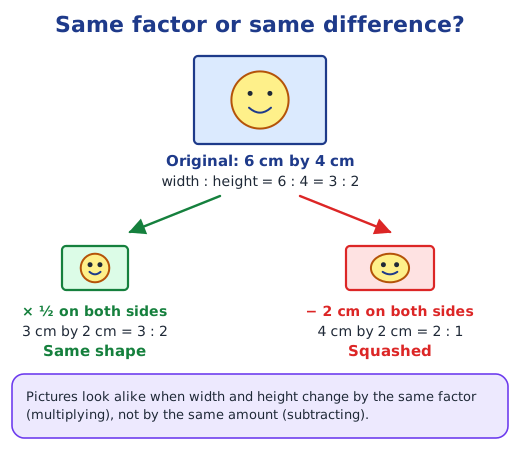
Resize a photo on a phone and it keeps its look only if the width and the height are both multiplied by the same number. Halve a 6 cm by 4 cm picture and you get 3 cm by 2 cm, the same shape. Cut 2 cm off each side instead and you get 4 cm by 2 cm, which looks squashed. When two quantities change by the same factor, we call the change proportional.
Ratios and their simplest form
A ratio a : b says that for every a units of one quantity there are b units of the other. The numbers a and b are the terms. To get the simplest form, divide both terms by their HCF: 60 : 40 ÷ 20 = 3 : 2. Two ratios are proportional when their simplest forms are the same, written with the sign ::, as in 60 : 40 :: 90 : 60. Read more in ratios and proportions.
Solving problems with proportions
To keep tea equally sweet, cups of tea and spoons of sugar must stay in the same ratio. If 4 cups need 6 spoons, then 12 cups need 18 spoons, because both terms are multiplied by 3. The chapter uses the same idea for lemonade, for the cement in two walls and for missing terms such as 14 : 21 :: 6 : 9.
A warning comes with it. Adding the same number to both terms does not keep a ratio. A child of 4 and a parent of 32 have ages in the ratio 1 : 8; ten years later the ages are 14 and 42, which is 1 : 3.
Cross multiplication and the Rule of Three
If a : b :: c : d, then ad = bc. This test is called cross multiplication, and it also finds the fourth term when three are known. If 8 kg of atta makes 200 rotis, then for 3 kg: 8 : 200 :: 3 : ?, so ? = 200 × 3 ÷ 8 = 75 rotis.
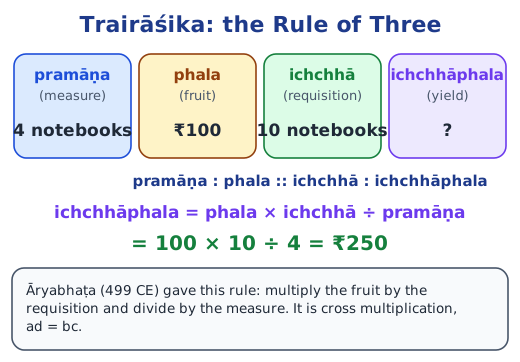
Indian mathematicians called this the Rule of Three (Trairāśika). Āryabhaṭa named the numbers pramāṇa (measure), phala (fruit) and ichchhā (requisition), and found the ichchhāphala (yield) by multiplying the fruit by the requisition and dividing by the measure.
Same units first, and when the rule does not apply
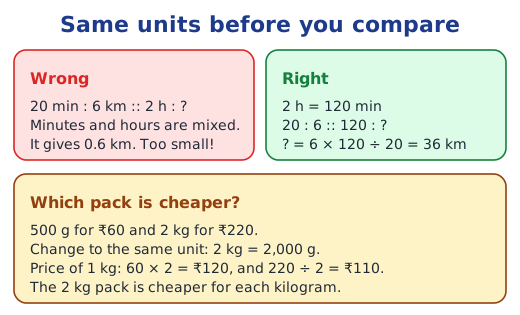
A cyclist who rides 6 km in 20 minutes rides 36 km in 2 hours, but only after 2 hours is written as 120 minutes. To compare a 500 g pack for ₹60 with a 2 kg pack for ₹220, change 2 kg to 2,000 g, or find the price of 1 kg for both: ₹120 against ₹110.
Not every problem is a proportion. A bus that takes 3 hours at 40 km/h takes less time, not more, at 60 km/h: 2 hours. Speed and time for the same trip move in opposite directions, so the Rule of Three does not fit. Market prices are another case: in the book’s sample table, shampoo prices do not grow in step with the volumes.
Sharing, but not equally
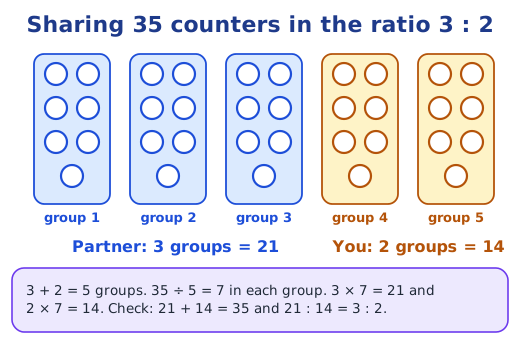
To share 35 counters in the ratio 3 : 2, make 3 + 2 = 5 equal groups of 7. One person takes 3 groups (21) and the other 2 groups (14). In general, x shared in the ratio m : n gives m × x ÷ (m + n) and n × x ÷ (m + n). The chapter uses this to share a profit in the ratio of two investments, and to find how much cement turns a mixture of one ratio into another. Read dividing in a given ratio.
Unit conversions
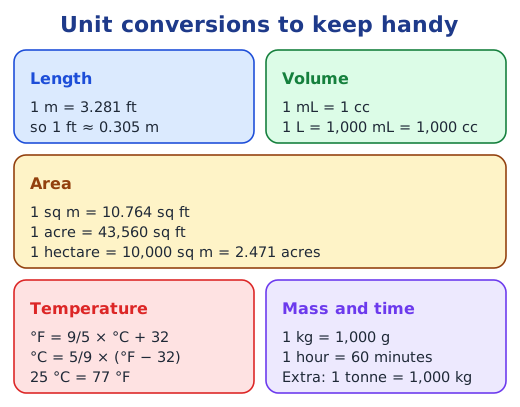
Proportion problems often need a change of units. The chapter lists the ones used most: 1 m = 3.281 ft, 1 sq m = 10.764 sq ft, 1 acre = 43,560 sq ft, 1 hectare = 10,000 sq m = 2.471 acres, 1 mL = 1 cc and 1 L = 1,000 mL. Temperature is different: °F = 9/5 × °C + 32, so 25 °C is 77 °F. Read unit conversions.
Puzzle Time: Binairo
Binairo, also called Takuzu, fills a grid with horizontal and vertical lines. Each row and column has as many of one as of the other, no three alike sit side by side, and no two rows or columns are the same. The chapter gives three 6 by 6 puzzles; each has exactly one solution.
Before we move on
This chapter uses equivalent fractions from Class 6 and dividing fractions from Class 7. Ratios come back in Part 2, Chapter 3: Proportional Reasoning-2, with maps, pie charts, ratios of more than two terms and inverse proportion. Answers to every question in this chapter, all four Figure it Out sets and the puzzle are in the NCERT solutions for Chapter 7.
Key terms
| Term | Meaning |
|---|---|
| Ratio | a : b means that a units of one quantity go with b units of the other, such as 3 : 2 for width to height. |
| Terms of a ratio | The two numbers in a ratio. 3 : 5 has the terms 3 and 5. |
| Simplest form | A ratio whose terms have no common factor except 1. Divide both terms by their HCF: 60 : 40 becomes 3 : 2. |
| Equivalent ratios | Ratios with the same simplest form, made by multiplying or dividing both terms by the same number, such as 3 : 2, 6 : 4 and 90 : 60. |
| Proportion | Two ratios that are equal in their simplest forms. We write a : b :: c : d and say the ratios are proportional. |
| Factor of change | The number both terms are multiplied by to get from one ratio to a proportional one. From 6 : 10 to 18 : 30 the factor is 3. |
| Cross multiplication | If a : b :: c : d, then a × d = b × c. It tests a proportion and finds a missing term. |
| Rule of Three (Trairāśika) | Three numbers of a proportion are known and the fourth is found: d = b × c ÷ a. |
| Pramāṇa, phala, ichchhā, ichchhāphala | Āryabhaṭa’s names for the four numbers of a Rule of Three problem: the measure, the fruit, the requisition and the yield. |
| Dividing in a ratio | Sharing a whole x in the ratio m : n: the shares are m × x ÷ (m + n) and n × x ÷ (m + n). |
| Unit conversion | Changing a measurement into another unit, such as 1 m = 3.281 ft or 1 L = 1,000 mL, so that the quantities being compared use the same unit. |
| Acre and hectare | Units of land area. 1 acre = 43,560 sq ft, and 1 hectare = 10,000 sq m, about 2.471 acres. |
Topics in this chapter
Practice
-
The simplest form of 45 : 75 is:
Show answer
Answer: (b) 3 : 5
-
Which statement of proportion is true?
Show answer
Answer: (b) 3 : 4 :: 12 : 16
-
In 4 : 9 :: 20 : x, the value of x is:
Show answer
Answer: (c) 45
-
₹900 is shared in the ratio 4 : 5. The larger share is:
Show answer
Answer: (c) ₹500
-
A ratio of 2 hours to 30 minutes, in its simplest form, is:
Show answer
Answer: (c) 4 : 1
Questions students ask
What are the main topics of Class 8 Maths Chapter 7?
Ratios and their simplest form, proportional ratios (a : b :: c : d), cross multiplication and the Rule of Three, problems where units must match, sharing a quantity in a given ratio, and conversions of length, area, volume and temperature.
Is Proportional Reasoning-1 in the new NCERT Class 8 Maths book?
Yes. It is Chapter 7, the last chapter of Ganita Prakash, Grade 8 Part 1, on pages 159 to 178 of the book marked Reprint 2026-27. It ends with the Binairo puzzle. Proportional Reasoning-2 is Chapter 3 of Part 2.
How do you check whether two ratios are proportional?
Reduce both to their simplest form and compare, or cross multiply. 3 : 4 and 72 : 96 are proportional because 72 : 96 ÷ 24 is 3 : 4, and also because 3 × 96 = 288 = 4 × 72.
What is the Rule of Three?
It finds the fourth number of a proportion when three are known. Indian mathematicians such as Āryabhaṭa called it Trairāśika: multiply the fruit (phala) by the requisition (ichchhā) and divide by the measure (pramāṇa).
Stuck on a question?
Take a photo and Lagnever AI explains it step by step. Try it for 7 days for ₹2.
Get it on Google Play Open in browser
For parents: after the trial, the plan renews monthly by UPI or card autopay. You can cancel anytime in the app.