
What are equivalent fractions?
Answer in short
Equivalent fractions are fractions that stand for the same share or length, like 1/2, 2/4, 3/6 and 4/8. You get one by multiplying or dividing the numerator and the denominator by the same number. A fraction is in lowest terms when its numerator and denominator have no common factor except 1.
Stuck on a question? Take a photo and Lagnever AI explains it step by step. Try it for 7 days for ₹2. Get it on Google Play
What does a fraction wall show?
Take paper strips of the same length. Fold one into halves, one into quarters and one into eighths, and lay them one below the other. The edge of 1/2 lines up exactly with the edge of 2/4 and with 4/8. They are the same length, so
1/2 = 2/4 = 4/8
Fractions like these, which stand for the same length or share but use different fractional units, are called equivalent fractions. Keep adding strips for thirds, fifths, sixths and so on, and you get a fraction wall.
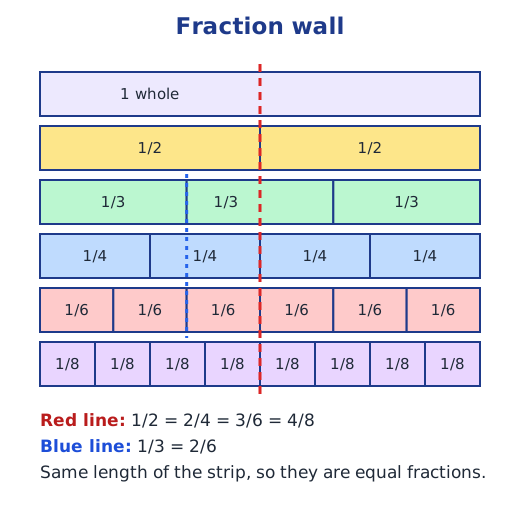
From the wall: 1/3 = 2/6, 2/3 = 4/6, and 3 pieces of 1/6 make 1/2.
Equal shares give equivalent fractions
Share 1 roti between 2 children, 2 rotis among 4 children, or 3 rotis among 6 children. In each case every child gets the same amount, so 1/2 = 2/4 = 3/6.
In the same way, 2 cakes shared among 5 children and 4 cakes shared among 10 children give the same share: 2/5 = 4/10. And 2 rotis among 3 children, 4 among 6 and 6 among 9 give 2/3 = 4/6 = 6/9.
Sharing can also be written as facts. When 3 rotis are shared by 4 children:
- division fact: 3 ÷ 4 = 3/4;
- addition fact: 3 = 3/4 + 3/4 + 3/4 + 3/4;
- multiplication fact: 3 = 4 × 3/4.
How do you make an equivalent fraction?
Look at 2/3 = 4/6 = 6/9. The numerator and the denominator were both multiplied by the same number:
2/3 = (2 × 2)/(3 × 2) = 4/6, and 2/3 = (2 × 3)/(3 × 3) = 6/9.
Why does this work? Multiplying the denominator by 2 cuts every part into 2 smaller parts. There are now twice as many parts, each half the size, so we need twice as many of them: the numerator doubles too. The share itself does not change.
Giving two fractions the same fractional unit
To compare 3/4 and 7/10, we want both in the same fractional unit. List equivalent fractions:
- 3/4 = 6/8 = 9/12 = 12/16 = 15/20 = … = 30/40
- 7/10 = 14/20 = 21/30 = 28/40
Both lists reach the denominator 20, so 3/4 = 15/20 and 7/10 = 14/20. The product of the denominators (4 × 10 = 40) always works as a common denominator, but a smaller common multiple, here 20, keeps the numbers small. You will use this in comparing fractions.
What is a fraction in lowest terms?
A fraction is in lowest terms (or in its simplest form) when its numerator and denominator have no common factor except 1.
Is 16/20 in lowest terms? No: 4 is a common factor of 16 and 20. Divide both by 4: 16/20 = 4/5. Now 4 and 5 have no common factor except 1, so 4/5 is the simplest form of 16/20.
You can also go in steps. For 36/60:
- Both are even: 36/60 = 18/30.
- Both are even again: 18/30 = 9/15.
- Both are multiples of 3: 9/15 = 3/5.
Or notice at once that 36 = 3 × 12 and 60 = 5 × 12, so 36/60 = 3/5. Either way gives the same answer, because dividing by the highest common factor (here 12) gets there in one step.
Practice
-
Which fraction is equivalent to 3/5?
Show answer
Answer: (b) 6/10
-
24/36 in lowest terms is:
Show answer
Answer: (c) 2/3 The HCF of 24 and 36 is 12, and 24 ÷ 12 = 2, 36 ÷ 12 = 3.
-
How many pieces of 1/8 make 3/4?
Show answer
Answer: (c) 6 3/4 = (3 × 2)/(4 × 2) = 6/8.
-
Write three fractions equivalent to 3/7.
Show answer
Answer: 6/14, 9/21 and 12/28: multiply the numerator and the denominator by 2, 3 and 4.
-
4 cakes are shared equally by 6 children, and 6 cakes by 9 children. Does every child get the same share?
Show answer
Answer: Yes. 4/6 and 6/9 are both equal to 2/3 in lowest terms, so every child gets 2/3 of a cake.
Questions students ask
What are equivalent fractions?
Fractions that show the same share or the same length, like 1/2, 2/4 and 3/6. On a fraction wall they end at the same point.
How do you find an equivalent fraction?
Multiply or divide the numerator and the denominator by the same number (not zero). For example, 3/4 = (3 × 5)/(4 × 5) = 15/20.
What does lowest terms mean?
A fraction is in lowest terms, or in its simplest form, when its numerator and denominator have no common factor except 1, like 4/5. Divide both by their highest common factor to get there.
Why do equivalent fractions matter?
They let us rewrite fractions with the same fractional unit, which we need to compare, add and subtract fractions.
Stuck on a question?
Take a photo and Lagnever AI explains it step by step. Try it for 7 days for ₹2.
Get it on Google Play Open in browser
For parents: after the trial, the plan renews monthly by UPI or card autopay. You can cancel anytime in the app.