
Class 6 Maths Chapter 7: Fractions Notes
This chapter in five lines
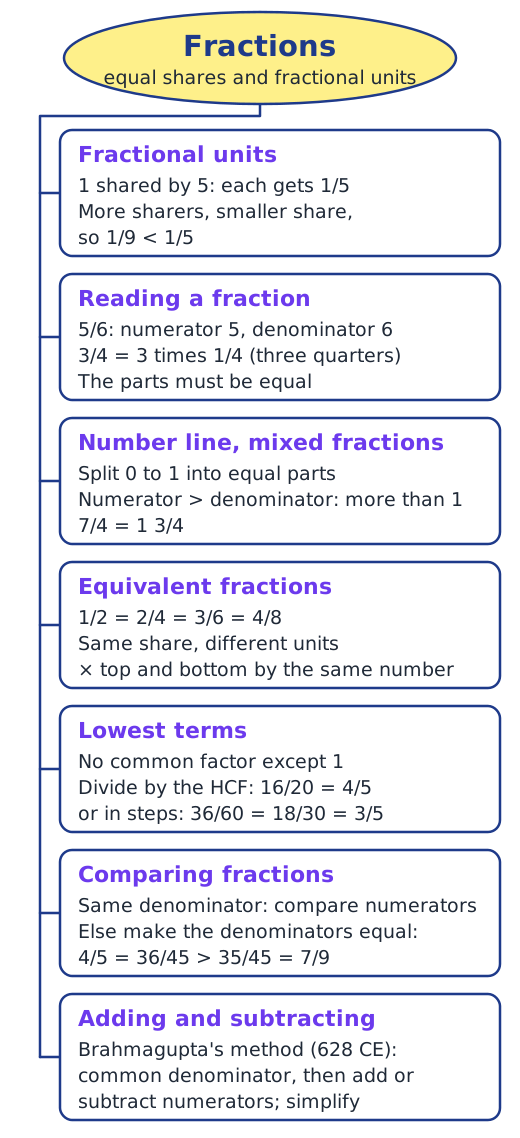
A fraction tells us how much each share is when a whole is divided into equal parts. Each equal part is a fractional unit, like 1/4, and 3/4 means 3 times 1/4. Fractions greater than 1 can be written as mixed fractions, like 7/4 = 1 3/4. Equivalent fractions such as 1/2 = 2/4 show the same share. To compare, add or subtract fractions, first give them the same denominator (Brahmagupta's method).
What is a fraction?
When some whole number of things is shared equally, a fraction tells us how much each share is. One roti shared equally by 2 children gives each child 1/2 roti; shared by 4 children, each child gets 1/4 roti. The second share is smaller, because more children share the same roti, so 1/2 > 1/4.
What are fractional units?
When one whole is divided into equal parts, each part is a fractional unit (or unit fraction): 1/2, 1/3, 1/4, … , 1/10, … , 1/100. The more parts we make, the smaller each part is, so 1/9 < 1/5 and 1/200 < 1/100. Pieces of the same fractional unit can have different shapes and still be the same size, as long as they are equal shares of the same whole. Learn more in what is a fraction.
How do we read and measure fractions?
We measure a quantity by counting fractional units. Fold a paper strip in half twice and you get 4 equal parts: 3 of them make 3/4, which means 3 times 1/4. In a fraction such as 5/6, the top number 5 is the numerator and the bottom number 6 is the denominator.
Fractions on the number line and mixed fractions
Divide the length from 0 to 1 into equal parts, and every fraction gets its own point on the number line. When the numerator is bigger than the denominator, the fraction is more than 1 and can be written as a mixed fraction: a whole part and a fractional part less than 1. For example, 7/2 = 3 1/2 and 8/3 = 2 2/3. Going back, 3 3/4 = 15/4.
What are equivalent fractions?
Fractions that stand for the same share are equivalent fractions. A fraction wall shows that 1/2 = 2/4 = 3/6 = 4/8. Sharing gives the same result: 2 cakes among 5 children and 4 cakes among 10 children both give 2/5 = 4/10. Multiplying or dividing the numerator and denominator by the same number gives an equivalent fraction. A fraction is in lowest terms when its numerator and denominator have no common factor except 1, so 16/20 in lowest terms is 4/5. See equivalent fractions.
How do we compare fractions?
With the same denominator, compare the numerators: 5/8 > 3/8. With the same numerator, the smaller denominator gives the bigger fraction: 4/7 > 4/8. Otherwise, first rewrite both fractions with the same denominator: 4/5 = 36/45 and 7/9 = 35/45, so 4/5 > 7/9. See comparing fractions.
How do we add and subtract fractions?
With the same denominator, add or subtract the numerators: 2/5 + 1/5 = 3/5 and 6/7 − 4/7 = 2/7. With different denominators, first find equivalent fractions with a common denominator: 1/4 + 1/3 = 3/12 + 4/12 = 7/12, and 3/4 − 2/3 = 9/12 − 8/12 = 1/12. This is Brahmagupta’s method (628 CE). See adding and subtracting fractions.
A pinch of history
In ancient India a fraction was called bhinna, ‘broken’, and also bhaga or ansha, ‘part’. The way the whole world writes fractions today began in India: the Bakshali manuscript, from about 300 CE, writes a half as 1 above 2. The line between the two numbers was added later by the Moroccan mathematician Al-Hassar in the 12th century. Brahmagupta’s rules for working with fractions reached Europe through the Arabs and are the rules we still use.
Key terms
| Term | Meaning |
|---|---|
| Fraction | A number that tells how much each share is when a whole is divided equally, like 3/4. |
| Fractional unit (unit fraction) | One of the equal parts made when one whole is divided equally, like 1/2, 1/3 or 1/10. |
| Numerator | The top number of a fraction. In 5/6 it is 5: how many fractional units there are. |
| Denominator | The bottom number of a fraction. In 5/6 it is 6: how many equal parts make one whole. |
| Mixed fraction (mixed number) | A whole number and a fraction less than 1 together, like 2 2/3 for 8/3. |
| Equivalent fractions | Fractions that stand for the same share or length, like 1/2, 2/4 and 3/6. |
| Lowest terms (simplest form) | A fraction whose numerator and denominator have no common factor except 1, like 4/5. |
| Common denominator | The same denominator given to two or more fractions, so that they use the same fractional unit. |
| Fraction wall | Strips of the same length cut into halves, thirds, quarters and so on, used to see equal lengths. |
| Brahmagupta's method | The way to add or subtract fractions: make the denominators the same, then add or subtract the numerators. Described by Brahmagupta in 628 CE. |
| Bhinna | The Sanskrit word for a fraction, meaning ‘broken’. Fractions were also called bhaga or ansha, ‘part’. |
Topics in this chapter
Practice
-
Which is greater, 1/5 or 1/9?
Show answer
Answer: (b) 1/5, because the whole is shared among fewer parts
-
In the fraction 7/12, the denominator is:
Show answer
Answer: (b) 12
-
11/4 written as a mixed fraction is:
Show answer
Answer: (a) 2 3/4 11/4 = 8/4 + 3/4 = 2 + 3/4.
-
Which fraction is equivalent to 2/3?
Show answer
Answer: (c) 6/9 Multiply the numerator and the denominator by 3: (2 × 3)/(3 × 3) = 6/9.
-
1/4 + 1/3 equals:
Show answer
Answer: (b) 7/12 1/4 = 3/12 and 1/3 = 4/12, so the sum is 7/12.
Questions students ask
What are the main topics of Class 6 Maths Chapter 7?
Fractional units and equal shares, fractions as parts of a whole, measuring with fractional units, fractions on the number line, mixed fractions, equivalent fractions and lowest terms, comparing fractions, adding and subtracting fractions with Brahmagupta's method, and a short history of fractions.
Is Fractions in the new Ganita Prakash book?
Yes. Fractions is Chapter 7 of Ganita Prakash, the Class 6 Maths textbook used in the 2026-27 session.
What is Brahmagupta's method?
It is the method we still use to add and subtract fractions: give the fractions the same denominator, add or subtract the numerators, and write the answer in lowest terms. Brahmagupta described it in general in 628 CE.
Stuck on a question?
Take a photo and Lagnever AI explains it step by step. Try it for 7 days for ₹2.
Get it on Google Play Open in browser
For parents: after the trial, the plan renews monthly by UPI or card autopay. You can cancel anytime in the app.