
How do you add and subtract fractions?
Answer in short
To add or subtract fractions with the same denominator, add or subtract the numerators and keep the denominator: 2/5 + 1/5 = 3/5. With different denominators, first rewrite them with a common denominator: 1/4 + 1/3 = 3/12 + 4/12 = 7/12. Simplify at the end. This is Brahmagupta's method.
Stuck on a question? Take a photo and Lagnever AI explains it step by step. Try it for 7 days for ₹2. Get it on Google Play
Adding fractions with the same denominator
Meena ate 1/2 of a chikki and her brother ate 1/4 of it. How much did they eat together? Cut the chikki into halves, and cut the remaining half into two quarters. Meena’s half is 2 quarters, and her brother ate 1 quarter, so together they ate 1/4 + 1/4 + 1/4 = 3/4 of the chikki. The 1/4 that is left is what remains.
When the fractions already have the same fractional unit, adding is just counting units:
- 2/5 + 1/5 = 3/5 (2 fifths and 1 fifth make 3 fifths).
- 4/7 + 6/7 = 10/7 = 7/7 + 3/7 = 1 3/7.
On a number line, start at 4/7 and take 6 more hops of 1/7. You land on 10/7, which is 3/7 past 1.
Adding fractions with different denominators
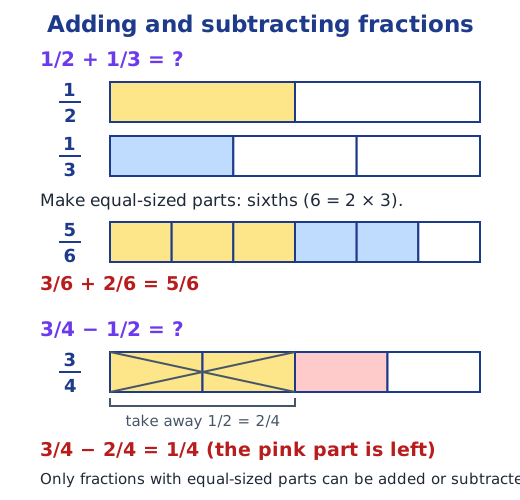
1/4 and 1/3 are parts of different sizes, so we cannot just count them. First turn them into parts of the same size. Both 4 and 3 divide 12:
- 1/4 = (1 × 3)/(4 × 3) = 3/12
- 1/3 = (1 × 4)/(3 × 4) = 4/12
Now 1/4 + 1/3 = 3/12 + 4/12 = 7/12.
Brahmagupta’s method
This method of adding any number of fractions was first described in general by Brahmagupta in 628 CE:
- Find equivalent fractions with a common fractional unit, using a common multiple of the denominators (their product, or the smallest common multiple).
- Add the numerators and keep the same denominator.
- Write the answer in lowest terms if needed.
Example: 2/3 + 1/5. The smallest common multiple of 3 and 5 is 15, so 2/3 = 10/15 and 1/5 = 3/15. The sum is 13/15.
Example: 1/6 + 1/3. The smallest common multiple of 6 and 3 is 6, so 1/3 = 2/6 and the sum is 1/6 + 2/6 = 3/6. In lowest terms, dividing by 3, that is 1/2.
Subtracting fractions
Brahmagupta’s method works for subtraction too. With the same denominator, subtract the numerators: 6/7 − 4/7 = 2/7 (take away 4 of the 6 sevenths).
With different denominators, first make them the same. For 3/4 − 2/3, use 12:
- 3/4 = (3 × 3)/(4 × 3) = 9/12 (multiply by 3, because 4 × 3 = 12)
- 2/3 = (2 × 4)/(3 × 4) = 8/12 (multiply by 4, because 3 × 4 = 12)
So 3/4 − 2/3 = 9/12 − 8/12 = 1/12. Then simplify if you can.
Word problems
- Ravi walks 3/5 km to the bus stop and then 1/4 km from the bus to school. He walks 3/5 + 1/4 = 12/20 + 5/20 = 17/20 km in all.
- A bottle holds 7/8 litre of oil, and 1/2 litre is used. 7/8 − 1/2 = 7/8 − 4/8 = 3/8 litre is left.
Check that you are adding when parts are put together, and subtracting when a part is taken away or when you find a difference.
A pinch of history
The way we write fractions today began in India. The Bakshali manuscript, from about 300 CE, writes a half as 1 above 2. Brahmagupta wrote down the rules for adding and subtracting fractions, and they reached Europe through the Arabs many centuries later. Ancient Egyptians wrote most fractions as sums of different unit fractions, such as 19/24 = 1/2 + 1/6 + 1/8. Can you find three different unit fractions that add up to 1? There is only one way: 1/2 + 1/3 + 1/6 = 1. Before adding, it helps to know how to compare fractions.
Practice
-
3/8 + 2/8 equals:
Show answer
Answer: (b) 5/8
-
1/2 − 1/5 equals:
Show answer
Answer: (b) 3/10 1/2 = 5/10 and 1/5 = 2/10, so 5/10 − 2/10 = 3/10.
-
A jug has 5/6 litre of water and 2/3 litre more is poured in. How much water is in it now?
Show answer
Answer: (b) 1 1/2 litres 5/6 + 2/3 = 5/6 + 4/6 = 9/6 = 3/2 = 1 1/2.
-
Find 2/5 + 1/4.
Show answer
Answer: 20 is a common multiple of 5 and 4: 2/5 = 8/20 and 1/4 = 5/20, so the sum is 13/20.
-
A ribbon is 3/4 m long. 1/3 m is cut off. How much is left?
Show answer
Answer: 3/4 − 1/3 = 9/12 − 4/12 = 5/12 m.
Questions students ask
How do you add fractions with different denominators?
Rewrite them as equivalent fractions with a common denominator, add the numerators, keep the denominator, and simplify. For example, 2/3 + 1/5 = 10/15 + 3/15 = 13/15.
Why can't we add the denominators?
The denominator tells the size of the parts. 1/4 and 1/3 are parts of different sizes, so we first cut both into parts of the same size, twelfths, and then count the parts.
What is Brahmagupta's method?
Brahmagupta, an Indian mathematician, described in 628 CE how to add and subtract any fractions: bring them to a common denominator, then add or subtract the numerators. We still use this method.
How do you subtract a fraction from a whole number?
Write the whole number as a fraction with the same denominator. For example, 1 − 3/4 = 4/4 − 3/4 = 1/4.
Stuck on a question?
Take a photo and Lagnever AI explains it step by step. Try it for 7 days for ₹2.
Get it on Google Play Open in browser
For parents: after the trial, the plan renews monthly by UPI or card autopay. You can cancel anytime in the app.