
How do you compare fractions?
Answer in short
To compare two fractions, give them the same denominator and then compare the numerators. With the same denominator, the bigger numerator wins: 5/8 > 3/8. With the same numerator, the smaller denominator wins: 4/7 > 4/8. Otherwise rewrite them: 4/5 = 36/45 and 7/9 = 35/45, so 4/5 > 7/9.
Stuck on a question? Take a photo and Lagnever AI explains it step by step. Try it for 7 days for ₹2. Get it on Google Play
When the denominators are the same
5/8 means 5 parts of 1/8, and 3/8 means 3 parts of 1/8. Both use the same fractional unit, so the one with more units is bigger: 5/8 > 3/8. With the same denominator, just compare the numerators.
When the numerators are the same
Which is bigger, 1/5 or 1/9? Think of sharing one roti. Shared among 5 children, each piece is bigger than when it is shared among 9 children, so 1/9 < 1/5. The same idea works for any numerator. If 4 chikkis are shared among 7 children, each gets 4/7; shared among 8 children, each gets 4/8. More children, smaller share, so 4/7 > 4/8. And because 4/8 = 1/2, we also know that 4/7 > 1/2.
So with the same numerator, the fraction with the smaller denominator is bigger.
When both are different
Who gets more chikki: a child in a group where 1 chikki is shared between 2 children, or a child in a group where 5 chikkis are shared among 8? We must compare 1/2 and 5/8. Since 1/2 = 4/8, and 4/8 < 5/8, each child in the second group gets more.
Most of the time neither number matches, so we change both fractions to the same fractional unit first. Compare 3/4 and 2/3: both 4 and 3 divide 12, so 3/4 = 9/12 and 2/3 = 8/12.
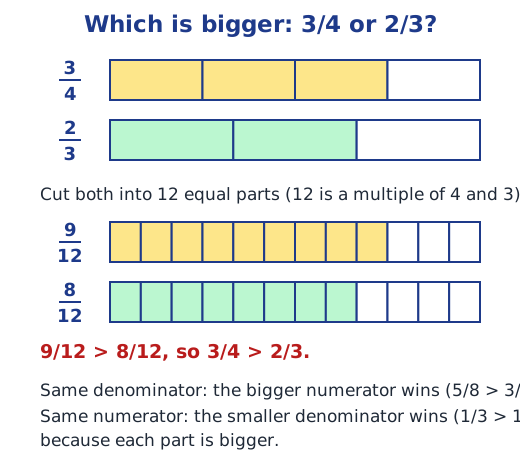
9 twelfths are more than 8 twelfths, so 3/4 > 2/3.
Two steps to compare any fractions
- Step 1: rewrite the fractions as equivalent fractions with the same denominator. A common multiple of the denominators works.
- Step 2: compare the numerators, that is, count the fractional units.
Example 1: 4/5 or 7/9? 45 is a common multiple of 5 and 9. 4/5 = (4 × 9)/(5 × 9) = 36/45 and 7/9 = (7 × 5)/(9 × 5) = 35/45. So 4/5 > 7/9.
Example 2: 7/9 or 17/21? 63 is a common multiple of 9 and 21. 7/9 = (7 × 7)/(9 × 7) = 49/63 and 17/21 = (17 × 3)/(21 × 3) = 51/63. So 7/9 < 17/21.
Putting fractions in order
To arrange 1/2, 5/6 and 2/3 in ascending order, use the common denominator 6: 1/2 = 3/6, 5/6 = 5/6 and 2/3 = 4/6. So the order is 1/2 < 2/3 < 5/6. For descending order, simply reverse it: 5/6 > 2/3 > 1/2.
Fractions greater than 1
The same steps work for fractions greater than 1. Compare 8/3 and 5/2: with the denominator 6, 8/3 = 16/6 and 5/2 = 15/6, so 8/3 > 5/2. With mixed fractions you can compare the whole parts first: 8/3 = 2 2/3 and 5/2 = 2 1/2 have the same whole part, so compare 2/3 and 1/2, and 2/3 is bigger.
Comparing is also the first step before adding and subtracting fractions, which uses the same common-denominator idea.
Practice
-
Which is greater: 5/6 or 7/9?
Show answer
Answer: (a) 5/6 With the denominator 18: 5/6 = 15/18 and 7/9 = 14/18.
-
Which group gives each child more juice: 3 glasses for 5 children, or 3 glasses for 4 children?
Show answer
Answer: (b) 3 glasses for 4 children 3/4 > 3/5: the same juice is shared among fewer children.
-
Which list is in ascending order?
Show answer
Answer: (b) 2/5, 1/2, 3/4 With the denominator 20: 2/5 = 8/20, 1/2 = 10/20 and 3/4 = 15/20.
-
Compare 5/12 and 3/8.
Show answer
Answer: 24 is a common multiple of 12 and 8: 5/12 = 10/24 and 3/8 = 9/24. So 5/12 > 3/8.
-
Arrange 2/3, 5/9 and 7/12 in descending order.
Show answer
Answer: With the denominator 36: 2/3 = 24/36, 5/9 = 20/36 and 7/12 = 21/36. So 2/3 > 7/12 > 5/9.
Questions students ask
How do you compare fractions with different denominators?
Find a common multiple of the denominators, write both fractions with it as the denominator, and compare the numerators. For example, 3/4 = 15/20 and 7/10 = 14/20, so 3/4 > 7/10.
Which is bigger, 1/5 or 1/9?
1/5. When one whole is shared among 5, each part is bigger than when it is shared among 9.
Which common denominator should I use?
The product of the denominators always works. The smallest common multiple keeps the numbers small, for example 20 instead of 40 for 3/4 and 7/10.
How do you put fractions in ascending order?
Write all of them with one common denominator, then arrange them by their numerators from the smallest to the biggest. For descending order, go from the biggest to the smallest.
Stuck on a question?
Take a photo and Lagnever AI explains it step by step. Try it for 7 days for ₹2.
Get it on Google Play Open in browser
For parents: after the trial, the plan renews monthly by UPI or card autopay. You can cancel anytime in the app.