
What is a fraction?
Answer in short
A fraction tells how much each share is when a whole is divided into equal parts. Each equal part is a fractional unit: 1 roti shared by 4 children gives each child 1/4 roti. 3/4 means 3 times 1/4. The top number is the numerator and the bottom number is the denominator.
Stuck on a question? Take a photo and Lagnever AI explains it step by step. Try it for 7 days for ₹2. Get it on Google Play
Fractions as equal shares
Share one roti equally between 2 children and each gets 1/2 (one half) roti. Share the same roti among 4 children and each gets 1/4 (one quarter). The second share is smaller, because more children are sharing the same roti, so 1/2 > 1/4.
So a fraction answers a simple question: when a whole is shared equally, how much is each share?
Fractional units
When one whole is divided into equal parts, each part is called a fractional unit, or a unit fraction: 1/2, 1/3, 1/4, 1/5, … , 1/10, … , 1/100.
Which is bigger, 1/5 or 1/9? Many students say 1/9, because 9 is bigger than 5. Think of shares instead. One roti shared by 5 children gives a bigger piece than one roti shared by 9 children. So 1/9 < 1/5, and in the same way 1/200 < 1/100.
Parts of a whole
A whole chikki can be broken into equal pieces in many ways. Cut it into 6 equal pieces in two different ways and the pieces may have different shapes, but each one is still 1/6 of the chikki, because each is one of 6 equal parts. What matters is that the parts are equal, not that they look the same.
Measuring with fractional units
Take a paper strip and call its length 1 unit. Fold it in half: each part is 1/2. Fold it in half again: there are 4 equal parts, each 1/4. One more fold gives 8 parts of 1/8.
Now we can measure using these units. Three parts of 1/4 make 3/4:
3/4 = 1/4 + 1/4 + 1/4 = 3 times 1/4
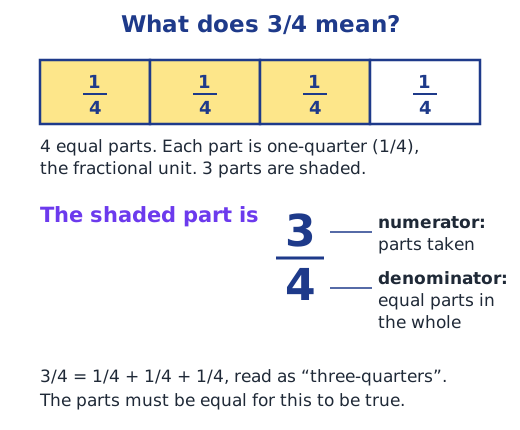
We usually read 3/4 as “three quarters” or “three upon four”. Reading it as “3 times 1/4” is very useful, because it shows the fractional unit (1/4) and how many of them there are (3). In a fraction such as 5/6, the top number 5 is the numerator and the bottom number 6 is the denominator.
Fractions on the number line
The distance from 0 to 1 on a number line is 1 unit. Divide it into 4 equal parts and each part is 1/4. Three hops of 1/4 from 0 land on 3/4. Divide it into 5 equal parts instead, and the marks are 1/5, 2/5, 3/5, 4/5.
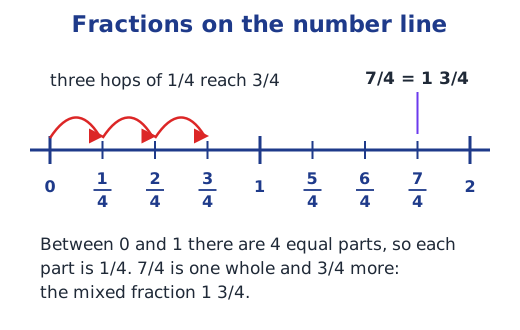
Every fraction has its own point on the number line. How many fractions lie between 0 and 1? Endlessly many: between any two of them you can always fit another.
Fractions greater than 1: mixed fractions
Look at 1/2, 3/4 and 2/5: the numerator is smaller than the denominator, and each fraction is less than 1. In 3/2, 5/2 and 7/4 the numerator is bigger, and each is more than 1.
To see how many wholes such a fraction holds, group its fractional units into wholes:
- 7/2 = 2/2 + 2/2 + 2/2 + 1/2 = 3 + 1/2, written 3 1/2.
- 8/3 = 3/3 + 3/3 + 2/3 = 2 + 2/3, written 2 2/3 and read “two and two thirds”.
A mixed fraction (or mixed number) has a whole part and a fractional part less than 1. To go back, count the fractional units: 3 3/4 = 4/4 + 4/4 + 4/4 + 3/4 = 15/4. When the numerator is a multiple of the denominator, there is no fractional part at all: 8/4 = 2, a whole number.
Words for fractions in our languages
Fractions have been named in India since ancient times. The Rig Veda calls 3/4 tri-pada, much like “teen paav” in everyday Hindi and “mukkaal” in Tamil. Hindi also has words such as paav (1/4), aadha (1/2), sava (1 1/4), dedh (1 1/2) and dhai (2 1/2). Ask at home which words your family uses. Next, see how different fractions can stand for the same share in equivalent fractions.
Practice
-
1 kg of rice is packed equally into 5 packets. Each packet holds:
Show answer
Answer: (b) 1/5 kg
-
What is the fractional unit in 5/8?
Show answer
Answer: (c) 1/8
-
9/4 written as a mixed fraction is:
Show answer
Answer: (a) 2 1/4 9/4 = 8/4 + 1/4 = 2 + 1/4.
-
Write 2 3/5 as a fraction.
Show answer
Answer: 2 = 10/5, so 2 3/5 = 10/5 + 3/5 = 13/5.
-
Two rotis are shared equally by 3 children. How much does each child get?
Show answer
Answer: 2 ÷ 3 = 2/3 roti. Cut each roti into 3 equal parts; each child gets 2 parts of 1/3.
Questions students ask
What is a fractional unit?
When one whole is divided into equal parts, each part is a fractional unit, such as 1/2, 1/5 or 1/10. It is also called a unit fraction, because its numerator is 1.
What is the difference between the numerator and the denominator?
The denominator, the bottom number, tells into how many equal parts the whole is divided. The numerator, the top number, tells how many of those parts we have.
How many fractions are there between 0 and 1?
Endlessly many. Between any two fractions you can always find another one, for example halfway between them, so they never run out.
What is a mixed fraction?
A whole number and a fraction less than 1 written together, like 2 1/4. It is another way to write a fraction greater than 1: 2 1/4 = 9/4.
Stuck on a question?
Take a photo and Lagnever AI explains it step by step. Try it for 7 days for ₹2.
Get it on Google Play Open in browser
For parents: after the trial, the plan renews monthly by UPI or card autopay. You can cancel anytime in the app.