
Class 8 Maths Part 2 Chapter 3: Proportional Reasoning-2 Notes
This chapter in five lines
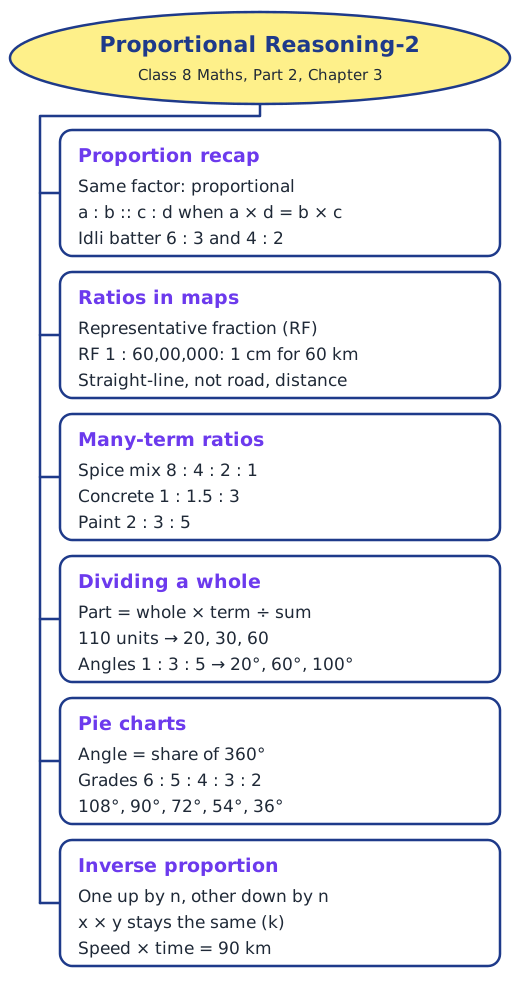
Proportional Reasoning-2 extends ratios. A map’s representative fraction, such as 1 : 60,00,000, turns map distances into real ones. Ratios can have many terms, like a spice mix of 8 : 4 : 2 : 1, and a whole can be divided in such a ratio. Pie charts share 360° in proportion to data, and inverse proportion links quantities whose product stays fixed, such as speed and time.
What is this chapter about?
Ratios turn up in the kitchen, on maps, on building sites and in survey results. This chapter picks up where Proportional Reasoning-1 stopped. It reads the scale on a map, works with ratios of three, four or more quantities, splits a whole in a given ratio, draws pie charts, and meets a new kind of proportion, inverse proportion, in which one quantity shrinks as the other grows.
Proportion: a quick recap
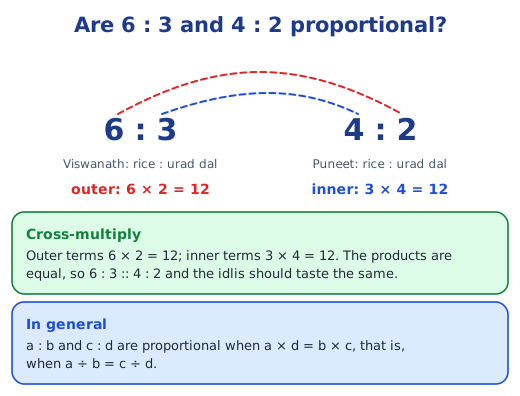
Two quantities are in a proportional relationship when they change by the same factor. Idli batter can use 2 cups of rice to 1 cup of urad dal. Viswanath uses 6 cups to 3, and Puneet 4 cups to 2. Are 6 : 3 and 4 : 2 proportional? Cross-multiply: 6 × 2 = 12 and 3 × 4 = 12. The products match, so the ratios are proportional, and if everything else is in proportion too, the idlis should taste alike. In general a : b :: c : d when a × d = b × c.
Ratios in maps
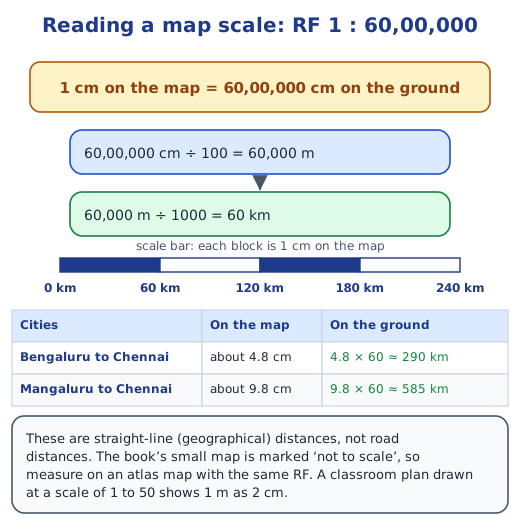
Most maps carry a ratio such as 1 : 60,00,000 in a corner. This representative fraction (RF) compares a distance on the map with the real distance on the ground: 1 cm on the map stands for 60,00,000 cm, which is 60 km. Measure two cities with a ruler and multiply: about 4.8 cm between Bengaluru and Chennai means about 290 km. This is the straight-line, geographical distance; the road is longer. A classroom plan drawn at 1 : 50 shows each metre as 2 cm.
Ratios with more than two terms
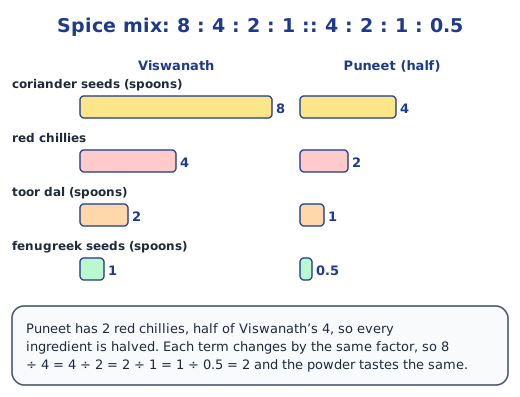
Viswanath grinds a spice powder from coriander seeds (8 spoons), red chillies (4), toor dal (2 spoons) and fenugreek seeds (1 spoon): the ratio 8 : 4 : 2 : 1. Puneet has only 2 chillies, half as many, so he halves everything: 4 : 2 : 1 : 0.5. The two are proportional, written 8 : 4 : 2 : 1 :: 4 : 2 : 1 : 0.5, and in general a : b : c : d :: p : q : r : s when a ÷ p = b ÷ q = c ÷ r = d ÷ s. Paint mixed red : blue : white = 2 : 3 : 5 with 10 litres of white needs 4 litres of red and 6 of blue. Read ratios with more than two terms.
Dividing a whole in a given ratio
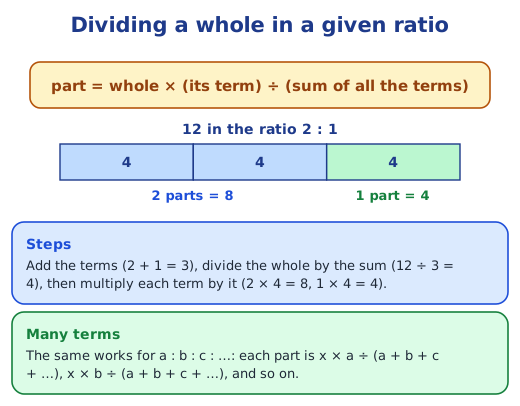
To split 12 in the ratio 2 : 1, add the terms (3), divide (12 ÷ 3 = 4) and multiply: 8 and 4. The same works with more terms: each part of x in the ratio a : b : c is x × a ÷ (a + b + c), and so on. Concrete for pillars and roofs is cement : sand : gravel = 1 : 1.5 : 3, so 110 units need 20 units of cement, 30 of sand and 60 of gravel. If a triangle’s angles are in the ratio 1 : 3 : 5, they measure 20°, 60° and 100°.
Pie charts
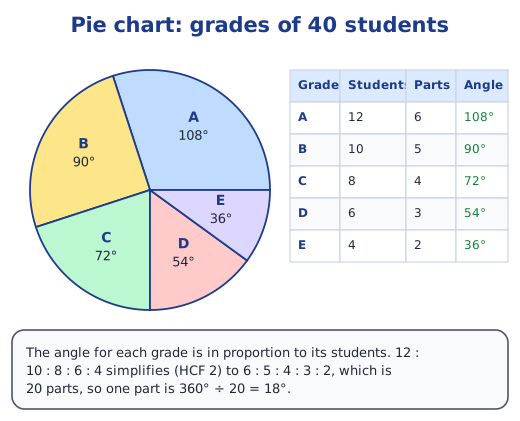
A pie chart shows how a whole is shared out. Each slice’s angle is proportional to its share, and the whole circle is 360°. For 40 students with grades A to E scored by 12, 10, 8, 6 and 4 students, the ratio simplifies to 6 : 5 : 4 : 3 : 2, which is 20 parts of 18°. The slices are 108°, 90°, 72°, 54° and 36°. Draw a radius, measure the first angle with a protractor, then each next angle from the last line drawn, and colour and label the slices. Read pie charts.
Inverse proportion
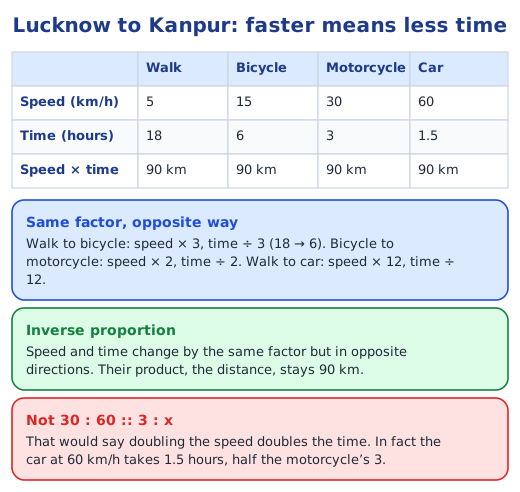
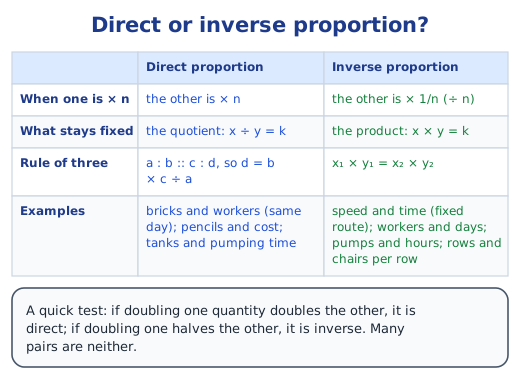
Going from Lucknow to Kanpur takes 18 hours on foot at 5 km/h, 6 hours by bicycle at 15 km/h, 3 hours by motorcycle at 30 km/h and 1.5 hours by car at 60 km/h. When the speed is multiplied by 3, the time is divided by 3. The two change by the same factor but in opposite directions: that is inverse proportion. Their product stays fixed, here 90 km, the distance: x × y = k, so x₁ × y₁ = x₂ × y₂. Fewer workers need more days, more pumps fill a tank faster, and more students make the food run out sooner. Read inverse proportion.
Working together
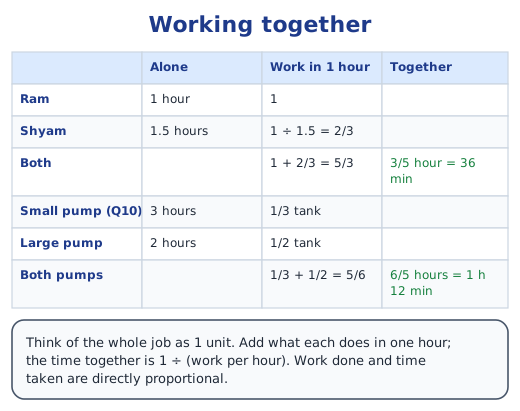
Ram cuts a heap of vegetables in 1 hour and Shyam in 1.5 hours. In one hour Ram does the whole job and Shyam two-thirds of it, so together they do 5/3 of the job each hour. The work done and the time taken are in direct proportion, so one whole job takes 3/5 of an hour, which is 36 minutes.
In a nutshell
A ratio of many terms means every quantity scales by the same factor; dividing a whole uses each term’s share of the sum; a pie chart gives each share of 360°; and in inverse proportion the product, not the quotient, stays the same. Answers to every question are in the NCERT solutions for Part 2 Chapter 3.
Key terms
| Term | Meaning |
|---|---|
| Proportional relationship | A link between quantities that all change by the same factor, so their ratio stays the same. |
| Cross-multiplication | The test for a : b :: c : d: the ratios are proportional when a × d = b × c. |
| Representative fraction (RF) | The ratio of a distance on a map to the matching distance on the ground, written as 1 : a large number. |
| Geographical distance | The straight-line distance between two places on the ground, which is usually shorter than the road distance. |
| Ratio with more than two terms | A ratio such as a : b : c : d, meaning a units of the first quantity for every b of the second, c of the third and d of the fourth. |
| Dividing in a ratio | Splitting a whole x so that each part is x × (its term) ÷ (sum of all the terms). |
| Pie chart | A circle cut into slices whose angles are proportional to the parts of a whole; all the angles add up to 360°. |
| Direct proportion | Two quantities that change by the same factor in the same direction, so their quotient stays the same. |
| Inverse proportion | Two quantities where multiplying one by n divides the other by n, so their product stays the same: x × y = k. |
| Constant of proportionality (k) | The fixed value of the quotient (direct) or of the product (inverse) of two proportional quantities. |
Topics in this chapter
Practice
-
On a map with RF 1 : 60,00,000, 3 cm stands for:
Show answer
Answer: (c) 180 km
-
Which ratio is proportional to 8 : 4 : 2 : 1?
Show answer
Answer: (b) 4 : 2 : 1 : 0.5
-
50 mL of purple paint in the ratio 2 : 3 : 5 needs how much white paint?
Show answer
Answer: (c) 25 mL
-
In a pie chart, a group that is 25% of the total gets an angle of:
Show answer
Answer: (c) 90°
-
If 20 workers lay a road in 4 days, 10 workers take:
Show answer
Answer: (c) 8 days
-
Which pair is in inverse proportion?
Show answer
Answer: (b) Speed and time for a fixed route
Questions students ask
What are the main topics of Class 8 Maths Part 2 Chapter 3?
A recap of proportion and cross-multiplication; ratios in maps and the representative fraction; ratios with more than two terms; dividing a whole in a given ratio; drawing and reading pie charts; and inverse proportion, including work, speed and time problems and working together.
Is Proportional Reasoning-2 in the new NCERT Class 8 Maths book?
Yes. It is Chapter 3 of Ganita Prakash, Grade 8 Part 2, on pages 55 to 69. It builds on Proportional Reasoning-1, the chapter in Part 1 that introduced ratios and proportional relationships.
What is the difference between direct and inverse proportion?
In direct proportion both quantities go up or down by the same factor, and their quotient stays the same, like the number of pencils and their cost. In inverse proportion one goes up by a factor while the other goes down by the same factor, and their product stays the same, like speed and travel time on a fixed route.
How do you find the angles of a pie chart?
Find what fraction of the total each group is and multiply it by 360°. For 40 students with 12, 10, 8, 6 and 4 in grades A to E, the ratio 6 : 5 : 4 : 3 : 2 has 20 parts of 18° each, giving 108°, 90°, 72°, 54° and 36°.
Stuck on a question?
Take a photo and Lagnever AI explains it step by step. Try it for 7 days for ₹2.
Get it on Google Play Open in browser
For parents: after the trial, the plan renews monthly by UPI or card autopay. You can cancel anytime in the app.