
NCERT Solutions Class 8 Maths Part 2 Chapter 3: Proportional Reasoning-2
Answers to every question in Chapter 3, Proportional Reasoning-2, of Ganita Prakash, Grade 8 Part 2: the questions in the text, the Math Talk prompts and all four Figure it Out sets. Page numbers follow the book (pages 55–69). Short notes: Part 2 Chapter 3 notes.
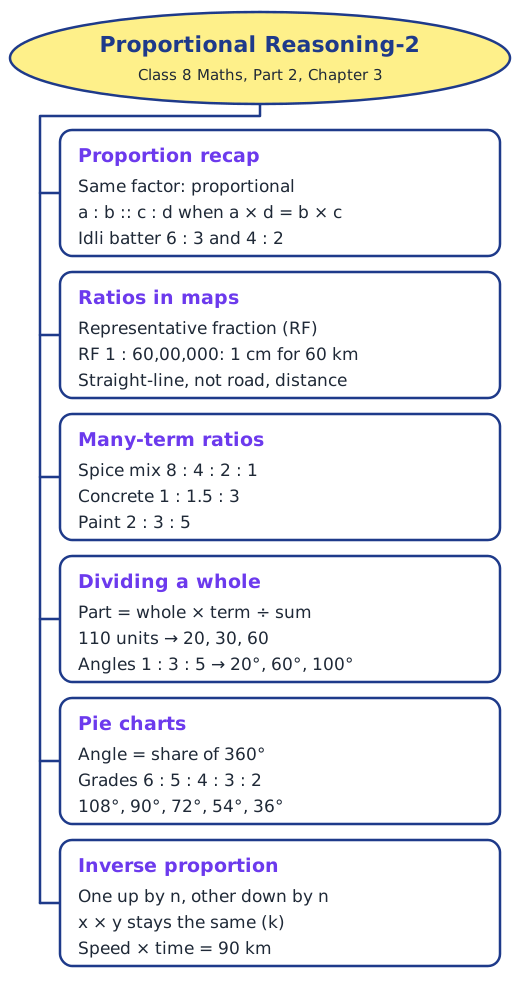
Proportion recap (page 55)
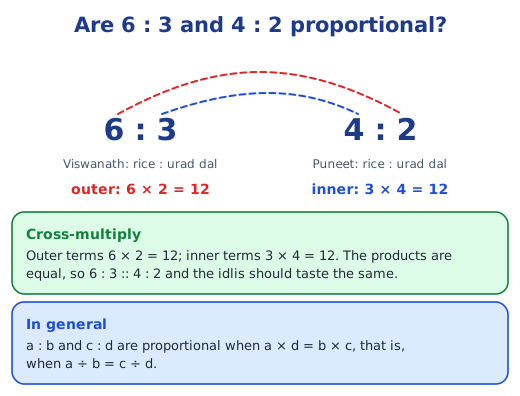
Would Viswanath’s and Puneet’s idlis taste the same? Very likely, yes. Cross-multiplying 6 : 3 and 4 : 2 gives 6 × 2 = 12 and 3 × 4 = 12, so the ratios of rice to urad dal are proportional; the idlis should taste the same if the other ingredients are in proportion too.
Ratios in maps (pages 56–57)
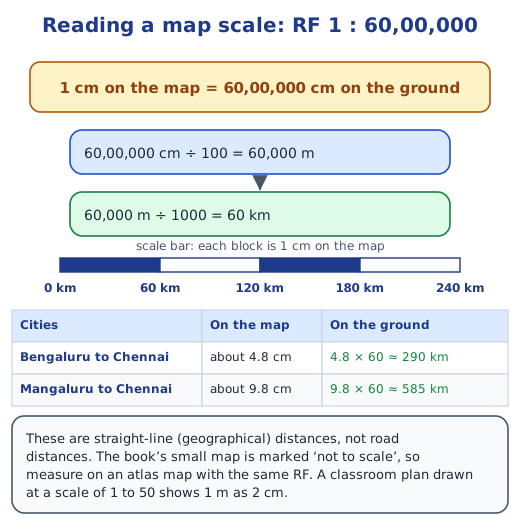
Meaning of RF 1 : 60,00,000. Every 1 cm measured on the map stands for 60,00,000 cm on the ground, in a straight line.
Convert 60,00,000 cm to kilometres. 60,00,000 cm ÷ 100 = 60,000 m, and 60,000 m ÷ 1000 = 60 km. So 1 cm on the map is 60 km.
Distances from Bengaluru to Chennai and from Mangaluru to Chennai. Measure each gap with a ruler and multiply the centimetres by 60 km. On a true 1 : 60,00,000 map, Bengaluru to Chennai is about 4.8 cm, so about 290 km, and Mangaluru to Chennai about 9.8 cm, so about 585 km. These are geographical (straight-line) distances; road distances are longer. The small map in the book is marked ‘not to scale’, so a ruler on the printed page may give a different figure; use an atlas map and its own RF.
Do maps with different scales give the same distances? Approximately, yes. A map with a larger RF number shows the cities closer together, but multiplying by its larger ground distance per centimetre gives about the same answer; small differences come from measuring errors and thick city dots.
Map making activity. At 1 : 50, 1 cm on paper is 50 cm in the room, so a classroom 8 m by 6 m becomes a rectangle 16 cm by 12 cm, and a desk 1 m long is drawn 2 cm long.
Ratios with more than two terms (pages 57–58)
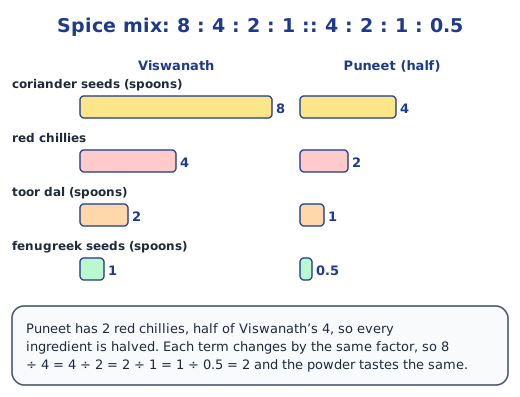
Puneet’s ingredients. He has 2 chillies, half of Viswanath’s 4, so he halves everything: 4 spoons of coriander seeds, one spoon of toor dal and 0.5 spoon of fenugreek seeds.
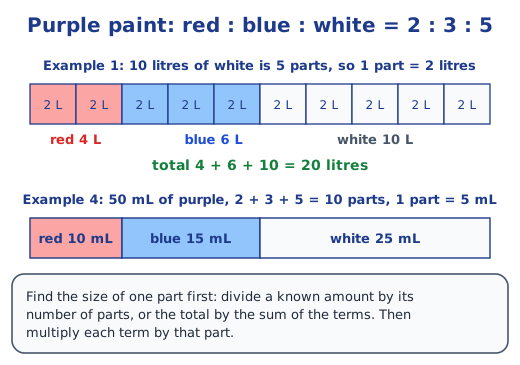
Example 1: total volume of purple paint. 4 + 6 + 10 = 20 litres.
Dividing a whole in a ratio (pages 58–60)
The worked examples give 20, 30 and 60 units for 110 units of concrete, 10, 15 and 25 mL for 50 mL of purple paint, and angles of 20°, 60° and 100° for a triangle in the ratio 1 : 3 : 5.
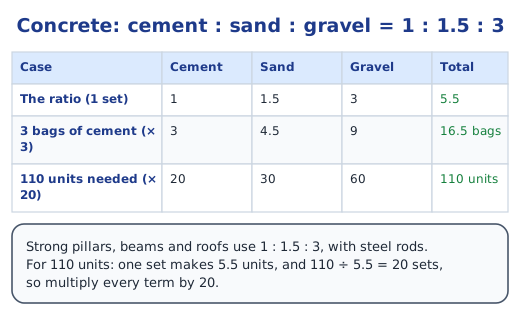
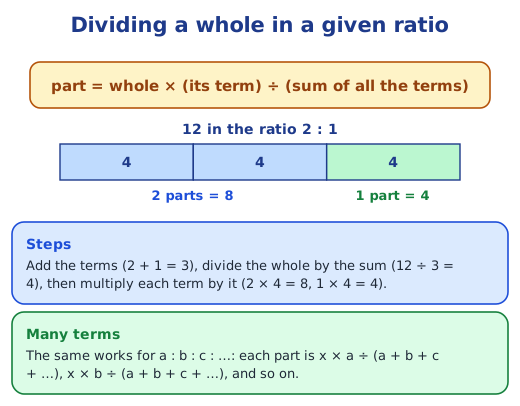
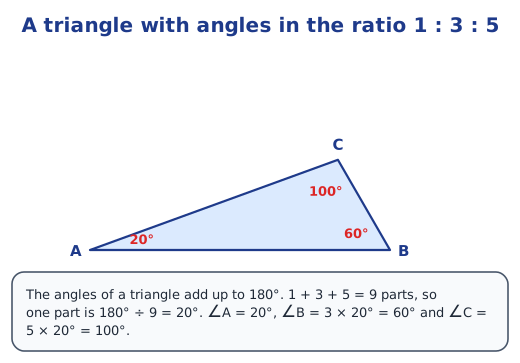
Figure it Out (page 60)
1. 3 + 4 + 3 + 5 = 15 parts, and one part is 150 ÷ 15 = 10 minutes. Warm-up and cool-down: 30 minutes; batting: 40 minutes; bowling: 30 minutes; fielding: 50 minutes.
2. Odiya books are 3 parts, so one part is 288 ÷ 3 = 96 books. Hindi books: 2 × 96 = 192. English books: 96.
3. 4 + 3 + 2 + 1 = 10 parts, so one part is 10 coins: forty ₹10 coins (₹400), thirty ₹5 coins (₹150), twenty ₹2 coins (₹40) and ten ₹1 coins (₹10). Total: ₹600.
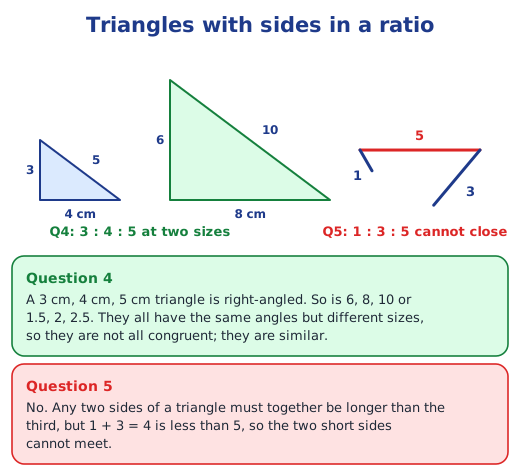
4. Take one part as 1 cm and draw sides of 3 cm, 4 cm and 5 cm: the angle between the 3 cm and 4 cm sides comes out as a right angle. No, the triangles are not all congruent. Sides of 6, 8 and 10 cm, or 1.5, 2 and 2.5 cm, are also in the ratio 3 : 4 : 5; all these triangles have the same angles and shape but different sizes, so they are similar, not congruent.
5. No. In a triangle, any two sides must together be longer than the third. Here the two shorter sides add up to 1 + 3 = 4 parts, less than 5, so they cannot meet to close the triangle.
Pie charts (pages 60–63)
Can 12 : 10 : 8 : 6 : 4 be reduced? Yes. The HCF of the terms is 2, so it becomes 6 : 5 : 4 : 3 : 2, giving angles of 108°, 90°, 72°, 54° and 36°.
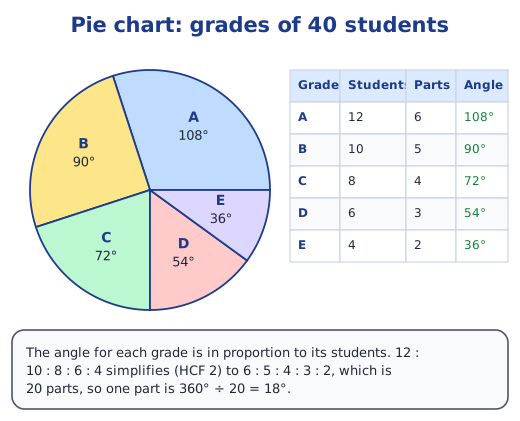
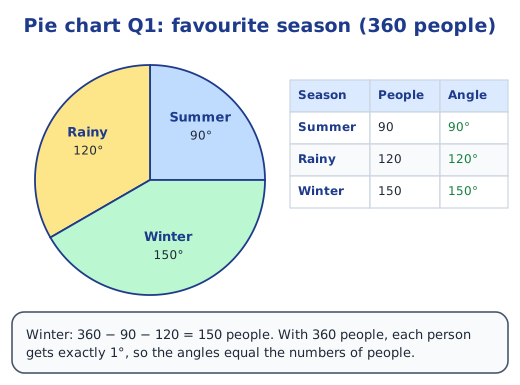
Figure it Out, 1. Winter: 360 − 90 − 120 = 150 people. With 360 people, each person is 1°, so the slices are summer 90°, rainy 120° and winter 150°.
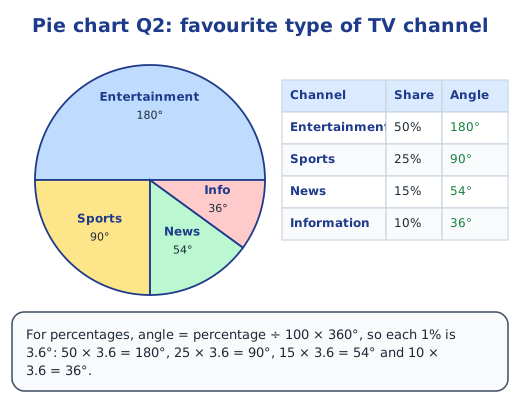
2. Each 1% is 3.6°: entertainment 50% → 180°, sports 25% → 90°, news 15% → 54°, information 10% → 36°.
3. Collect one choice per student, then use angle = (students for that subject ÷ class size) × 360°. For example, in a class of 36 with Language 6, Arts Education 3, Vocational Education 3, Social Science 5, Physical Education 7, Maths 7 and Science 5, each student is 10°, so the slices are 60°, 30°, 30°, 50°, 70°, 70° and 50°.
Inverse proportions (pages 63–65)
Example 2: can it be written 30 : 60 :: 3 : x? Will the time increase or decrease? No. That statement would make the faster car take longer (x = 6 hours). As the speed increases, the travel time decreases.
Check the other modes of transport. Motorcycle to car: speed × 2, time ÷ 2 (3 → 1.5). Bicycle to motorcycle: speed × 2, time ÷ 2 (6 → 3). Walking to car: speed × 12, time ÷ 12 (18 → 1.5). Every time, the speed and the time change by the same factor in opposite directions, and speed × time = 90 km.
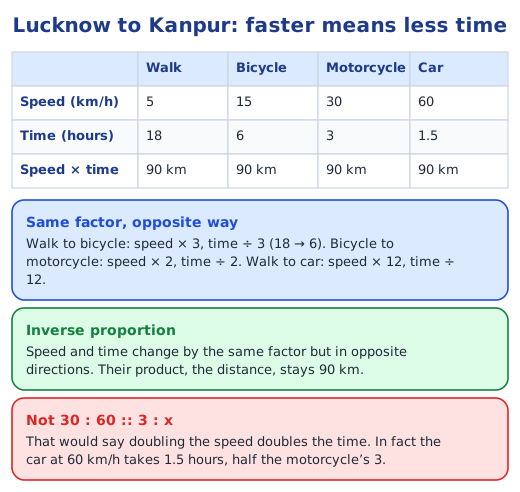
What is 1.5 ÷ 18? 0.0833…, the same as 5 ÷ 60.
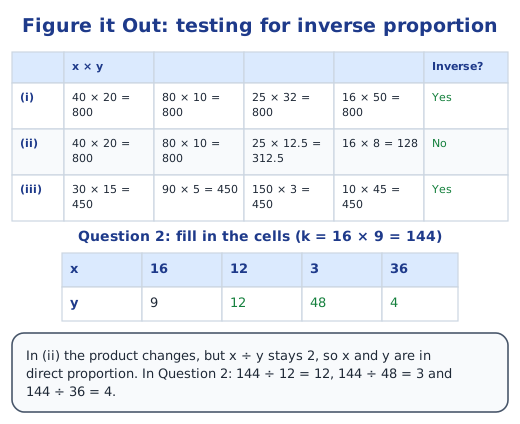
Figure it Out (page 65), 1. (i) Every product is 800, so yes. (ii) The products are 800, 800, 312.5 and 128, so no; here x ÷ y is always 2, which is direct proportion. (iii) Every product is 450, so yes.
2. k = 16 × 9 = 144. For x = 12, y = 144 ÷ 12 = 12; for y = 48, x = 144 ÷ 48 = 3; for x = 36, y = 144 ÷ 36 = 4.
Example 6: are the work and the time taken directly or inversely proportional? Directly: twice the work takes twice the time. So 5/3 : 1 :: 1 : x, and x = 3/5 hour, which is 36 minutes.
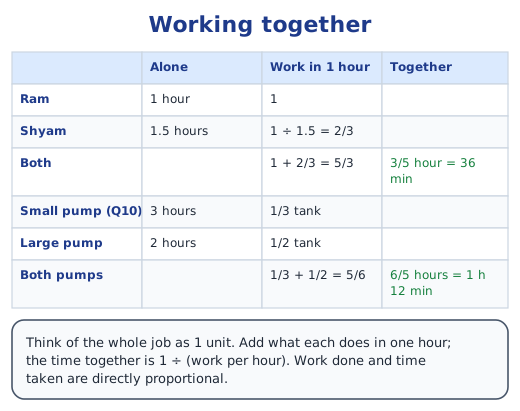
Figure it Out (pages 67–68)
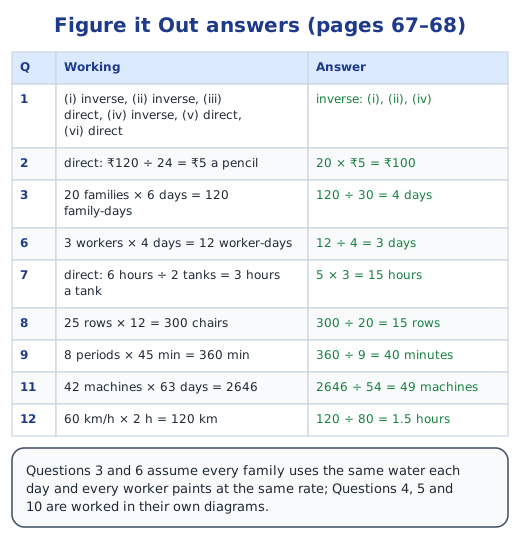
1. Inverse proportion: (i) taps and the time to fill a tank, (ii) painters and the days to paint a wall, and (iv) a cyclist’s speed and the time for a fixed route. Pairs (iii), (v) and (vi) are in direct proportion.
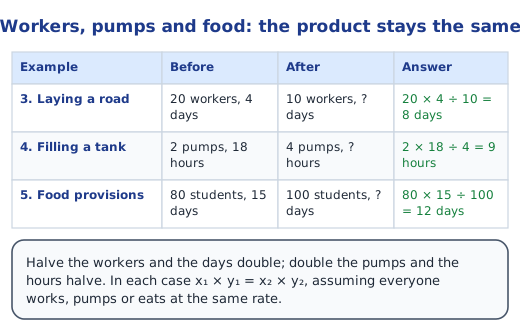
2. One pencil costs ₹120 ÷ 24 = ₹5, so 20 pencils cost ₹100.
3. 20 families for 6 days is 120 family-days of water. With 30 families it lasts 120 ÷ 30 = 4 days. Assumptions: every family uses the same amount of water each day, use does not change, and the tank is not refilled.
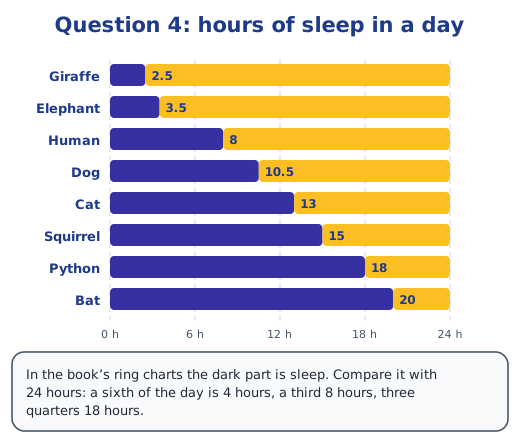
4. From the ring charts, where the dark part is sleep: giraffe 2.5 hours, elephant 3.5, human 8, dog 10.5, cat 13, squirrel 15, python 18 and bat 20.
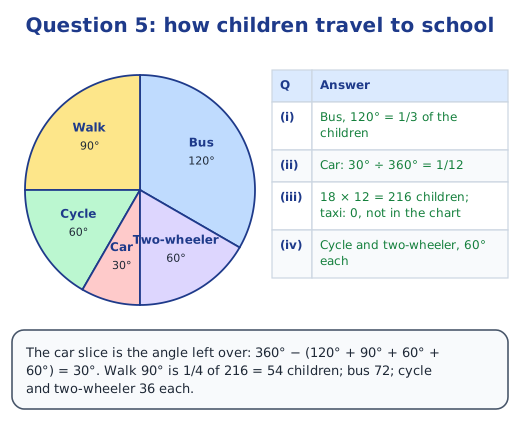
5. The slices are bus 120°, walk 90°, cycle 60°, two-wheeler 60°, and car the remaining 30°. (i) Bus. (ii) 30° ÷ 360° = 1/12. (iii) 18 × 12 = 216 children took part. Taxi is not a slice in the chart, so no children use taxis. (iv) Cycle and two-wheeler, 60° each (36 children each).
6. 3 workers × 4 days = 12 worker-days, so 4 workers take 12 ÷ 4 = 3 days. Assumptions: all workers paint at the same rate and do not slow each other down.
7. This is direct proportion: 6 hours for 2 tanks is 3 hours a tank, so 5 tanks take 15 hours.
8. 25 × 12 = 300 chairs, so 300 ÷ 20 = 15 rows.
9. 8 × 45 = 360 minutes a day, so each of 9 periods is 360 ÷ 9 = 40 minutes.
10. In an hour the small pump fills 1/3 of the tank and the large one 1/2. Together they fill 1/3 + 1/2 = 5/6 of the tank an hour, so the tank takes 6/5 hours, which is 1 hour 12 minutes.
11. 42 × 63 = 2646 machine-days, so 2646 ÷ 54 = 49 machines are needed.
12. Distance = 60 × 2 = 120 km, so at 80 km/h it takes 120 ÷ 80 = 1.5 hours.
Practice
-
100 coins of ₹10, ₹5, ₹2 and ₹1 are in the ratio 4 : 3 : 2 : 1. The total money is:
Show answer
Answer: (c) ₹600
-
x and y are in inverse proportion with x = 16 when y = 9. If y = 48, x is:
Show answer
Answer: (a) 3
-
A small pump fills a tank in 3 hours and a large one in 2 hours. Together they take:
Show answer
Answer: (b) 1 hour 12 minutes
-
A school has 8 periods of 45 minutes. With 9 periods in the same day, how long is each?
Show answer
Answer: The school day is 8 × 45 = 360 minutes. Periods and their length are in inverse proportion, so each of 9 periods is 360 ÷ 9 = 40 minutes.
-
Can a triangle have sides in the ratio 1 : 3 : 5?
Show answer
Answer: No. Any two sides of a triangle must together be longer than the third side, but 1 + 3 = 4, which is less than 5, so the two shorter sides can never meet.
Stuck on a question?
Take a photo and Lagnever AI explains it step by step. Try it for 7 days for ₹2.
Get it on Google Play Open in browser
For parents: after the trial, the plan renews monthly by UPI or card autopay. You can cancel anytime in the app.