
Inverse proportion: when one goes up, the other comes down
Answer in short
Two quantities are in inverse proportion when multiplying one by a factor n divides the other by n, so their product stays the same: x × y = k. Speed and time on a fixed route are an example: 5 km/h takes 18 hours, 15 km/h takes 6 hours, and speed × time is always 90 km.
Stuck on a question? Take a photo and Lagnever AI explains it step by step. Try it for 7 days for ₹2. Get it on Google Play
The rule of three, again
In direct proportion, a : b :: c : d and the fourth value is d = b × c ÷ a. If 5 workers move 4500 bricks in a day, then 18000 bricks need 18000 × 5 ÷ 4500 = 20 workers: four times the bricks, four times the workers. Both quantities grow together.
A different pattern
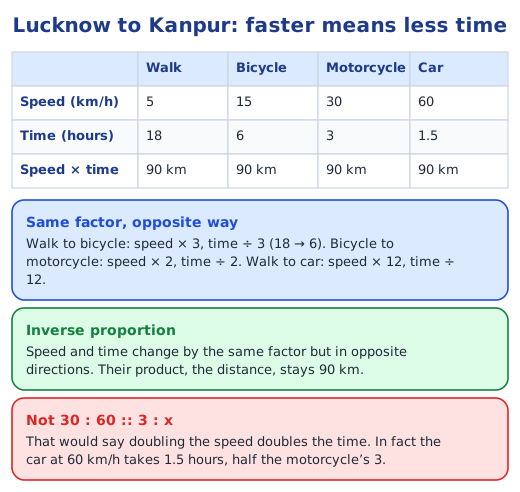
Puneeth’s father rides from Lucknow to Kanpur on a motorcycle at 30 km/h and takes 3 hours. How long would a car at 60 km/h take? Writing 30 : 60 :: 3 : x would say the faster car takes longer, which cannot be right. Look at the whole table:
| Walk | Bicycle | Motorcycle | Car | |
|---|---|---|---|---|
| Speed (km/h) | 5 | 15 | 30 | 60 |
| Time (hours) | 18 | 6 | 3 | 1.5 |
The bicycle is 3 times as fast as walking, and the trip takes a third of the time: 18 ÷ 3 = 6. The car is twice as fast as the motorcycle, and takes half the time. The two quantities change by the same factor, but in opposite directions. Such quantities are in inverse proportion.
The product stays the same
Multiply speed by time for each column: 5 × 18, 15 × 6, 30 × 3 and 60 × 1.5 are all 90. That 90 km is the distance from Lucknow to Kanpur, and it does not change. In general, x and y are in inverse proportion when x × y = k for a constant k. So for any two pairs of values, x₁ × y₁ = x₂ × y₂, which can also be written x₁ ÷ x₂ = y₂ ÷ y₁. For walking and the car: 5 ÷ 60 = 0.0833…, and 1.5 ÷ 18 = 0.0833… too.
Put another way: multiply one quantity by n and the other is multiplied by 1/n.
Testing a table
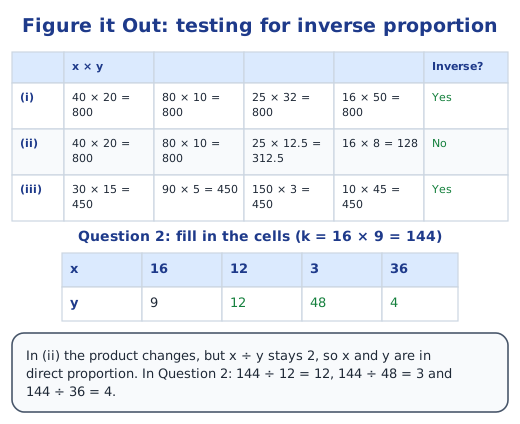
To test a table, multiply each pair. In x = 40, 80, 25, 16 with y = 20, 10, 32, 50, every product is 800, so x and y are in inverse proportion. Change the y values to 20, 10, 12.5 and 8 and the products are 800, 800, 312.5 and 128, so that table is not; there x ÷ y is always 2, which makes it direct proportion. To fill a table, find k from a complete pair: with x = 16 and y = 9, k = 144, so x = 12 gives y = 12, x = 36 gives y = 4, and y = 48 needs x = 3.
Solving problems
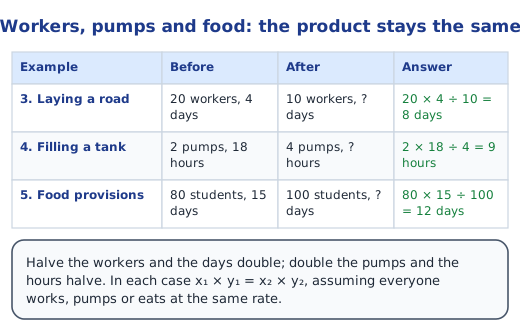
The same idea, x₁ × y₁ = x₂ × y₂, solves many problems:
- Road laying: 20 workers take 4 days, so 10 workers take 20 × 4 ÷ 10 = 8 days.
- Filling a tank: 2 pumps take 18 hours, so 4 pumps take 2 × 18 ÷ 4 = 9 hours.
- Food stocks: food for 80 students for 15 days lasts 100 students 80 × 15 ÷ 100 = 12 days.
- Rows of chairs: 25 rows of 12 is 300 chairs, so rows of 20 make 15 rows.
Each answer quietly assumes that everyone works, pumps or eats at the same steady rate. If a new worker is slower, or one family uses more water, the simple answer is only an estimate.
Direct or inverse?
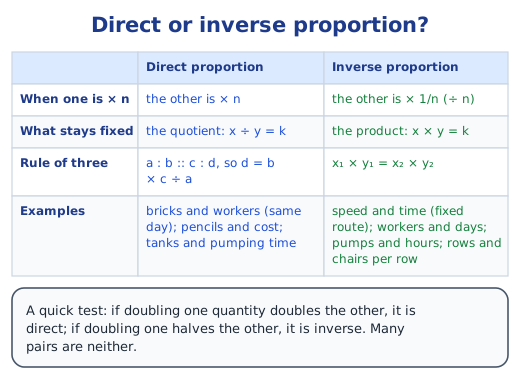
Before solving, ask which way the quantities move. More taps or more painters mean less time: inverse. More petrol means more distance, more cloth means a bigger bill, more pages mean more reading time: direct. Speed and time on a fixed route: inverse.
Keep going with pie charts and ratios with more than two terms, or see the chapter notes and the NCERT solutions.
Practice
-
x and y are in inverse proportion and x = 16 when y = 9. When x = 36, y is:
Show answer
Answer: (a) 4
-
Which pair is in inverse proportion?
Show answer
Answer: (b) Painters hired and days to paint a wall
-
A school has food for 80 students for 15 days. With 100 students it lasts:
Show answer
Answer: (b) 12 days
-
A car takes 2 hours at 60 km/h. How long at 80 km/h?
Show answer
Answer: Speed × time is the fixed distance: 60 × 2 = 120 km. At 80 km/h the time is 120 ÷ 80 = 1.5 hours.
-
42 machines make some toys in 63 days. How many machines would do it in 54 days?
Show answer
Answer: Machines × days stays the same: 42 × 63 = 2646. So 2646 ÷ 54 = 49 machines are needed.
Questions students ask
What is inverse proportion in simple words?
It is a link between two quantities in which one grows exactly as fast as the other shrinks. If you double the number of pumps filling a tank, the time is halved; if you halve the number of workers, the days double. Their product does not change.
How do you check whether two quantities are in inverse proportion?
Multiply each pair of values. If the product is the same every time, they are in inverse proportion. For x = 40, 80, 25, 16 and y = 20, 10, 32, 50 every product is 800, so they are; if the product changes, they are not.
How is inverse proportion different from direct proportion?
In direct proportion both quantities change by the same factor in the same direction, so their quotient stays fixed, like pencils and their cost. In inverse proportion they change by the same factor in opposite directions, so their product stays fixed, like speed and time.
Stuck on a question?
Take a photo and Lagnever AI explains it step by step. Try it for 7 days for ₹2.
Get it on Google Play Open in browser
For parents: after the trial, the plan renews monthly by UPI or card autopay. You can cancel anytime in the app.