
How do you divide a quantity in a given ratio?
Answer in short
To divide x in the ratio m : n, cut it into m + n equal parts of x ÷ (m + n) each. The first share is m of these parts and the second is n of them. The two shares always add up to x and stay in the ratio m : n.
Stuck on a question? Take a photo and Lagnever AI explains it step by step. Try it for 7 days for ₹2. Get it on Google Play
What does sharing in a ratio mean?
Sharing equally is easy: 12 sweets between two friends is 6 each, a ratio of 1 : 1. But often a whole must be shared unequally. Two partners may share a profit in the ratio of the money they put in. A recipe may need rice and dal in the ratio 3 : 1. Dividing in a ratio means finding the two shares so that they add up to the whole and are in the given ratio.
How do you share counters in a ratio, one round at a time?
Say 20 counters are to be shared in the ratio 3 : 1. In each round, one person takes 3 counters and the other takes 1, so each round uses 4 counters. After 5 rounds the counters run out. The first person has 15 and the second has 5. Check: 15 + 5 = 20, and 15 : 5 = 3 : 1.
This works, but it is slow for big numbers. Notice that the number of rounds is just 20 ÷ 4 = 5.
What is the quick way?
Make equal groups. For 35 counters in the ratio 3 : 2, one person must get 3 groups and the other 2 groups, so there are 3 + 2 = 5 groups. Each group has 35 ÷ 5 = 7 counters. The shares are 3 × 7 = 21 and 2 × 7 = 14.
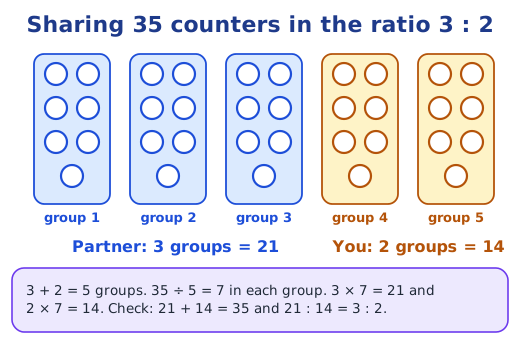
What is the rule for dividing x in the ratio m : n?
Cut x into m + n equal parts. Each part is x ÷ (m + n).
- First share = m × x ÷ (m + n)
- Second share = n × x ÷ (m + n)
For ₹1,200 in the ratio 3 : 5 there are 8 parts of ₹150, so the shares are ₹450 and ₹750. A bar model makes this easy to see and to check.
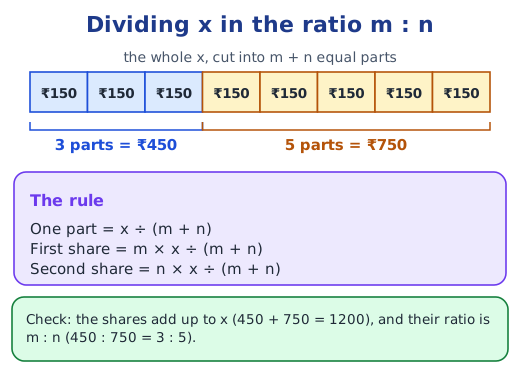
Always check two things: the shares add up to the whole (450 + 750 = 1,200), and they are in the given ratio (450 : 750 = 3 : 5 after dividing by 150).
How do you share a profit in the ratio of investments?
First write the investments as a ratio in its simplest form. If one partner puts in ₹40,000 and another ₹60,000, the ratio is 40,000 : 60,000 = 2 : 3. A profit of ₹5,000 then has 5 parts of ₹1,000: ₹2,000 for the first partner and ₹3,000 for the second. Whoever puts in more gets more, in the same proportion.
How do you change the ratio of a mixture?
Some questions add more of one thing to a mixture. The trick is to see which part stays the same.
Take 30 kg of a sand-cement mix made 4 : 1. It has 4 × 30 ÷ 5 = 24 kg of sand and 6 kg of cement. To make the ratio 3 : 1, the sand stays at 24 kg, so the cement must be 24 ÷ 3 = 8 kg. That means adding 8 − 6 = 2 kg of cement.
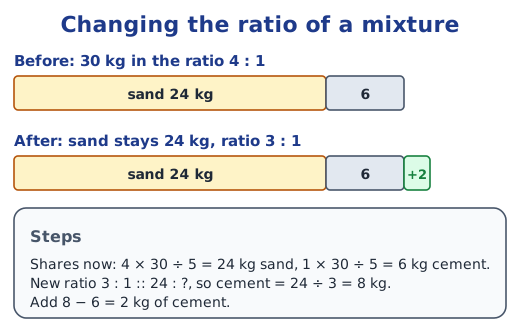
The same thinking answers paint questions. A 40 mL green that is half blue and half yellow (1 : 1) has 20 mL of each. Add 20 mL of yellow and you have 20 mL of blue and 40 mL of yellow, so the ratio becomes 1 : 2, a lighter green.
Where do we use this?
In the kitchen, a recipe in the ratio 2 : 1 can be scaled to any amount. On a building site, sand and cement are mixed in a fixed ratio. In a lab, an acid is mixed with water in a fixed ratio. When friends share a prize in the ratio of the work each did, the same rule decides the shares.
Read next: the chapter notes, ratios and proportions, unit conversions, ratios with more than two terms and the NCERT solutions.
Practice
-
₹720 shared in the ratio 5 : 3 gives:
Show answer
Answer: (a) ₹450 and ₹270
-
A 60 mL mix of syrup and water is 1 : 4. How much syrup is in it?
Show answer
Answer: (b) 12 mL
-
36 students are in the ratio of girls to boys 5 : 4. How many boys are there?
Show answer
Answer: (b) 16
-
Divide 84 marbles between Asha and Ravi in the ratio 4 : 3.
Show answer
Answer: 4 + 3 = 7 parts. 84 ÷ 7 = 12 in each part. Asha gets 4 × 12 = 48 and Ravi gets 3 × 12 = 36. Check: 48 + 36 = 84 and 48 : 36 = 4 : 3.
-
A 20 L mix of milk and water is 3 : 1. How much milk must be added to make it 4 : 1?
Show answer
Answer: Now: milk 15 L, water 5 L. Water stays 5 L, so for 4 : 1 the milk must be 4 × 5 = 20 L. Add 20 − 15 = 5 L of milk.
Questions students ask
What is the formula to divide a number in a given ratio?
To divide x in the ratio m : n, the first part is m × x ÷ (m + n) and the second is n × x ÷ (m + n). For ₹1,200 in 3 : 5, the parts are 3 × 1200 ÷ 8 = ₹450 and 5 × 1200 ÷ 8 = ₹750.
Why do we add the terms of the ratio?
The ratio m : n says that for every m going to one side, n go to the other. So every round of sharing uses m + n items. Counting how many rounds fit into x gives the size of one part, x ÷ (m + n).
How do you share a profit in the ratio of investments?
Write the investments as a ratio and simplify it, then divide the profit in that ratio. If two partners put in ₹40,000 and ₹60,000, the ratio is 2 : 3, so a profit of ₹5,000 is shared as ₹2,000 and ₹3,000.
Can a quantity be divided in a ratio of three numbers?
Yes. The same idea works: add all the terms to get the number of parts. Class 8 Part 2, Chapter 3 does this with ratios of three or more terms.
Stuck on a question?
Take a photo and Lagnever AI explains it step by step. Try it for 7 days for ₹2.
Get it on Google Play Open in browser
For parents: after the trial, the plan renews monthly by UPI or card autopay. You can cancel anytime in the app.