
Unit conversions: why the units must match
Answer in short
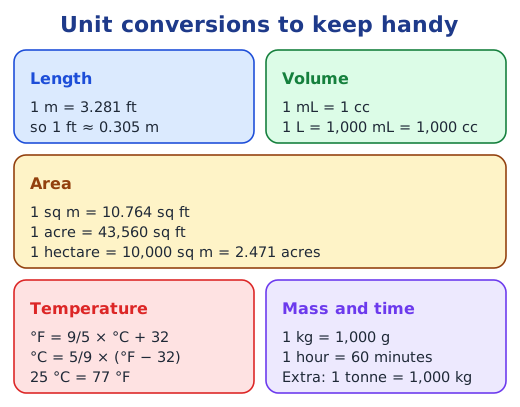
Before comparing two quantities or using the Rule of Three, write them in the same unit. Useful conversions: 1 m = 3.281 ft, 1 acre = 43,560 sq ft, 1 hectare = 2.471 acres, 1 L = 1,000 mL = 1,000 cc, and °F = 9/5 × °C + 32.
Stuck on a question? Take a photo and Lagnever AI explains it step by step. Try it for 7 days for ₹2. Get it on Google Play
Why must the units match?
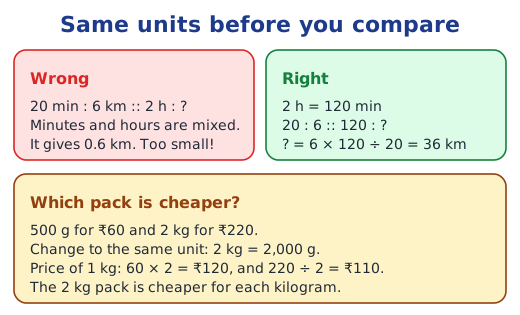
A ratio compares like with like. If the first ratio uses minutes, the second must use minutes too. Suppose a cyclist rides 6 km in 20 minutes and you want the distance in 2 hours. Writing 20 : 6 :: 2 : ? mixes minutes and hours and gives 0.6 km, which is clearly wrong. Change 2 hours to 120 minutes first: 20 : 6 :: 120 : ?, so ? = 6 × 120 ÷ 20 = 36 km.
Prices work the same way. Is a 500 g pack for ₹60 cheaper than a 2 kg pack for ₹220? Change 2 kg to 2,000 g, or find the price of 1 kg for both: ₹120 against ₹110. The bigger pack is cheaper for each kilogram.
Which conversions does the chapter list?
The chapter gives a short table for reference. It covers length (metres and feet), area (square metres, square feet, acres and hectares), volume (millilitres, cubic centimetres and litres) and temperature (Celsius and Fahrenheit). Problems on land, water tanks, buckets and weather use them.
How do you convert using a proportion?
A conversion is a proportion in which one ratio is the conversion itself. For metres and feet, 1 : 3.281 :: 5 : ?, so 5 m = 5 × 3.281 = 16.405 ft. Going the other way, 100 ft = 100 ÷ 3.281, about 30.48 m. When you are unsure whether to multiply or divide, ask which unit is smaller: there are more feet than metres in the same length.
Why is 1 square metre about 10.764 square feet?
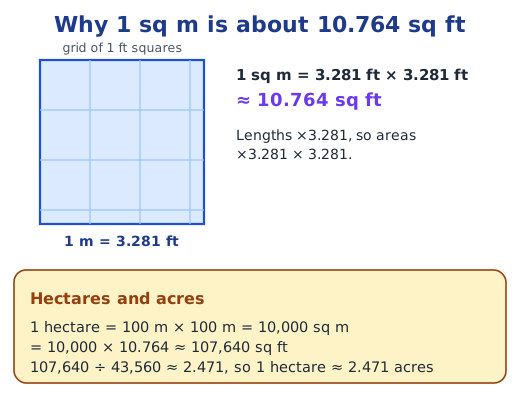
A square metre is a square 1 m on each side. Each side is 3.281 ft, so its area is 3.281 × 3.281 square feet. That is about 10.765; the chapter gives 10.764, because 3.281 is itself rounded. The lesson is that when lengths are multiplied by a factor, areas are multiplied by the square of that factor.
How do acres and hectares compare?
Farmland is often measured in acres or hectares. One acre is 43,560 sq ft. One hectare is a square 100 m by 100 m, so it is 10,000 sq m. Since 10,000 × 10.764 = 107,640 sq ft, a hectare is about 107,640 ÷ 43,560 = 2.471 acres.
To find the area of a plot in acres, find it in square feet and divide by 43,560. A plot 120 ft by 363 ft is 43,560 sq ft, exactly 1 acre. A plot 60 ft by 90 ft is 5,400 sq ft, about 0.12 acre.
What about litres and cubic centimetres?
One millilitre is the same as one cubic centimetre (cc), and 1 litre = 1,000 mL = 1,000 cc. A 2 litre bottle holds 2,000 mL, enough to fill eight glasses of 250 mL. When a question gives a mug in mL and a bucket in litres, change the litres to mL first.
How do Celsius and Fahrenheit convert?
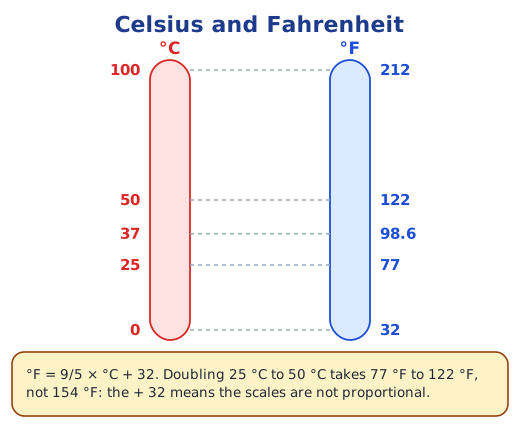
Temperature is the odd one out. 0 °C is 32 °F, so the two scales do not start at the same zero. The formulas are
°F = 9/5 × °C + 32 and °C = 5/9 × (°F − 32).
For 25 °C: 9/5 × 25 = 45, and 45 + 32 = 77 °F. For 100 °C: 180 + 32 = 212 °F. Because of the + 32, the scales are not proportional. Doubling 25 °C to 50 °C takes 77 °F to 122 °F, not to 154 °F. The two scales show the same number only at −40.
This is like adding the same number to both terms of a ratio: once a fixed amount is added, the relationship is no longer proportional.
Read next: the chapter notes, ratios and proportions, dividing in a given ratio, units of area and the NCERT solutions.
Practice
-
How many cc are there in 1.5 litres?
Show answer
Answer: (c) 1,500 cc
-
A plot is 120 ft by 363 ft. Its area in acres is:
Show answer
Answer: (b) 1 acre
-
40 °C in Fahrenheit is:
Show answer
Answer: (b) 104 °F
-
A rope is 15 m long. How long is it in feet?
Show answer
Answer: 1 m = 3.281 ft, so 15 m = 15 × 3.281 = 49.215 ft, about 49.2 ft.
-
Convert 212 °F to Celsius.
Show answer
Answer: °C = 5/9 × (212 − 32) = 5/9 × 180 = 100 °C.
Questions students ask
How many square feet are there in 1 acre?
1 acre = 43,560 square feet. So a plot of 200 ft by 500 ft, which is 100,000 sq ft, is 100,000 ÷ 43,560, about 2.3 acres.
How many acres are there in 1 hectare?
1 hectare = 10,000 square metres, which is about 2.471 acres. So 4 hectares are about 4 × 2.471 = 9.884 acres.
Is 1 mL the same as 1 cc?
Yes. 1 millilitre equals 1 cubic centimetre, the volume of a cube 1 cm on each side. So 1 litre = 1,000 mL = 1,000 cc.
What is the formula to convert Celsius to Fahrenheit?
°F = 9/5 × °C + 32. For 25 °C: 9/5 × 25 = 45, and 45 + 32 = 77 °F. To go back, °C = 5/9 × (°F − 32).
Stuck on a question?
Take a photo and Lagnever AI explains it step by step. Try it for 7 days for ₹2.
Get it on Google Play Open in browser
For parents: after the trial, the plan renews monthly by UPI or card autopay. You can cancel anytime in the app.