
Rectangles, paths and units of area
Answer in short
A rectangle holds length × width unit squares, and its perimeter cannot tell us its area: shapes with longer boundaries can cover less. The area of a path is the outer area minus the inner area. To change units of area, use the length factor twice, so 1 in² = 6.4516 cm² and 1 ft² = 144 in².
Stuck on a question? Take a photo and Lagnever AI explains it step by step. Try it for 7 days for ₹2. Get it on Google Play
How is the area of a rectangle measured?
We measure an area by finding how many unit squares cover it. A unit square might be 1 cm by 1 cm (1 cm²), or 1 m by 1 m (1 m²). A rectangle 7 cm long and 4 cm wide holds 4 rows of 7 squares, so its area is 7 × 4 = 28 cm². In general,
Area of a rectangle = length × width.
The answer can include parts of unit squares too: a rectangle 2.5 cm by 2 cm covers 5 cm². A diagonal cuts a rectangle into two identical triangles, so each triangle has half the area.
Does a bigger perimeter mean a bigger area?
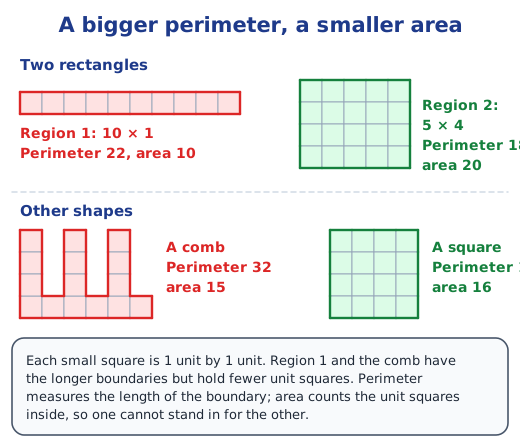
No. Perimeter is the length of the boundary, and area counts the squares inside, so one cannot stand in for the other. A strip 10 cm long and 1 cm wide has perimeter 22 cm but area only 10 cm², while a 5 cm × 4 cm card has a shorter perimeter, 18 cm, and twice the area, 20 cm². Shapes with many inlets show it even more clearly: a comb made of 15 unit squares has perimeter 32 units, while a 4 × 4 square has perimeter 16 and area 16.
How do you find the area of a path around a park?
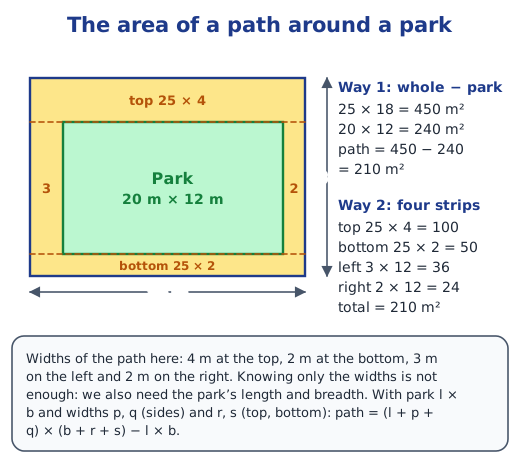
Suppose a park is 20 m by 12 m and a path runs around it, 4 m wide at the top, 2 m at the bottom, 3 m on the left and 2 m on the right. The outer rectangle is then (20 + 3 + 2) m = 25 m long and (12 + 4 + 2) m = 18 m wide. There are two ways to find the area of the path.
- Whole minus park: 25 × 18 − 20 × 12 = 450 − 240 = 210 m².
- Strips: top 25 × 4 = 100, bottom 25 × 2 = 50, left 3 × 12 = 36 and right 2 × 12 = 24, which add up to 210 m².
Notice that the widths alone are not enough: we also need the size of the park. And if the outer rectangle shifts while the park stays inside it, the path’s area does not change, because it is still the same outer area minus the same park.
What about two paths that cross?
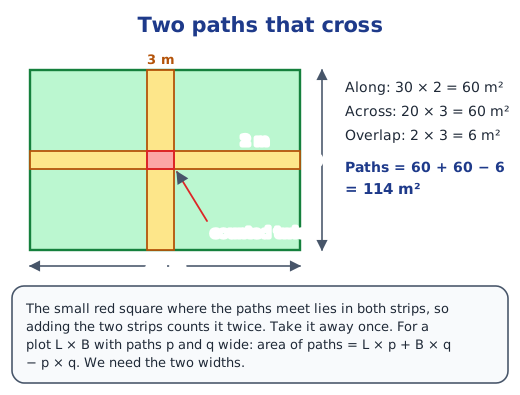
Take a plot 30 m by 20 m with a path 2 m wide along its length and another 3 m wide across it. The first path covers 30 × 2 = 60 m² and the second 20 × 3 = 60 m². But the small 2 m by 3 m square where they meet belongs to both strips, so adding them counts it twice. Subtract it once: 60 + 60 − 6 = 114 m². For a plot L by B with paths p and q wide, the paths cover L × p + B × q − p × q.
How do you change units of area?
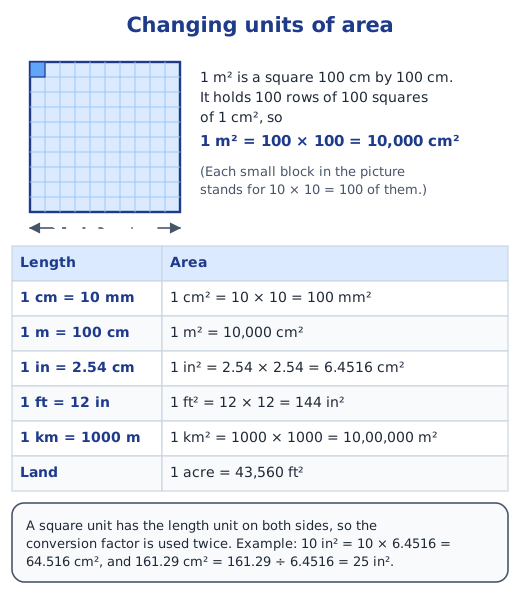
A square unit has the length unit on both sides, so a conversion factor for length is used twice for area.
- 1 m = 100 cm, so 1 m² = 100 × 100 = 10,000 cm².
- 1 in = 2.54 cm, so 1 in² = 2.54 × 2.54 = 6.4516 cm². Then 10 in² = 64.516 cm², and 161.29 cm² = 161.29 ÷ 6.4516 = 25 in².
- 1 ft = 12 in, so 1 ft² = 12 × 12 = 144 in².
- 1 km = 1000 m, so 1 km² = 10,00,000 m².
Which units are used in real life?
An A4 sheet measures 21 cm by 29.7 cm, so it covers 623.7 cm². Tables and chairs are often measured in inches or feet, and rooms and houses in ft² or m². Land is measured in acres, where 1 acre = 43,560 ft², and towns and cities in km². Many parts of India also use local units for land, such as bigha, gaj, katha, dhur, cent and ankanam. Extra: a gaj usually means a square yard, about 0.84 m², and a cent is one hundredth of an acre, 435.6 ft²; the size of a bigha changes from region to region, so ask what it means where you live.
To estimate a large area, such as your school ground, pace out its length and width, change the paces into metres and multiply. Comparing it with the area of your town, both in the same unit, tells you how many school grounds would fit into the town.
Read next: area of triangles, area of quadrilaterals, the chapter notes and NCERT solutions.
Practice
-
Which rectangle has the larger area: 9 cm × 2 cm or 6 cm × 4 cm?
Show answer
Answer: (b) 6 cm × 4 cm
-
1 ft² is equal to:
Show answer
Answer: (c) 144 in²
-
A 10 m × 8 m garden has a 1 m wide path all round it, outside. The area of the path is:
Show answer
Answer: (b) 40 m²
-
A plot is 40 m by 25 m. A path 2 m wide runs along its length and another 2 m wide runs across it. Find the area of the paths.
Show answer
Answer: 40 × 2 + 25 × 2 − 2 × 2 = 80 + 50 − 4 = 126 m². The 2 m × 2 m square where they cross is counted only once.
-
Convert 50 in² into cm².
Show answer
Answer: 1 in² = 2.54 × 2.54 = 6.4516 cm², so 50 in² = 50 × 6.4516 = 322.58 cm².
Questions students ask
If two shapes have the same perimeter, do they have the same area?
No. A 6 cm × 1 cm rectangle and a 4 cm × 3 cm rectangle both have perimeter 14 cm, but their areas are 6 cm² and 12 cm². Perimeter measures the boundary, area the surface inside.
How do you find the area of a path around a rectangular park?
Find the area of the outer rectangle, including the path, and subtract the area of the park. You can also cut the path into rectangular strips and add their areas.
How many square centimetres are there in a square inch?
1 in = 2.54 cm, so 1 in² = 2.54 cm × 2.54 cm = 6.4516 cm².
Stuck on a question?
Take a photo and Lagnever AI explains it step by step. Try it for 7 days for ₹2.
Get it on Google Play Open in browser
For parents: after the trial, the plan renews monthly by UPI or card autopay. You can cancel anytime in the app.